
You've written the opening chapters, reorganized them twice, and still can't tell whether you're making progress or just moving paragraphs around. The manuscript feels finished on Monday, broken on Tuesday, and impossible to judge by Friday. That uncertainty isn't a sign that you lack talent. It usually means you're treating a book as a writing task instead of a long production project with decisions, stages, and stopping rules.
A manuscript becomes publishable through deliberate layers. You need a defined reader, a workable structure, a complete draft, focused revision, outside feedback, and production-ready files. The fastest way forward isn't endless polishing. It's knowing what each stage must accomplish, what evidence tells you it's complete, and when to stop touching it.
What a Book Manuscript Actually Is in 2026
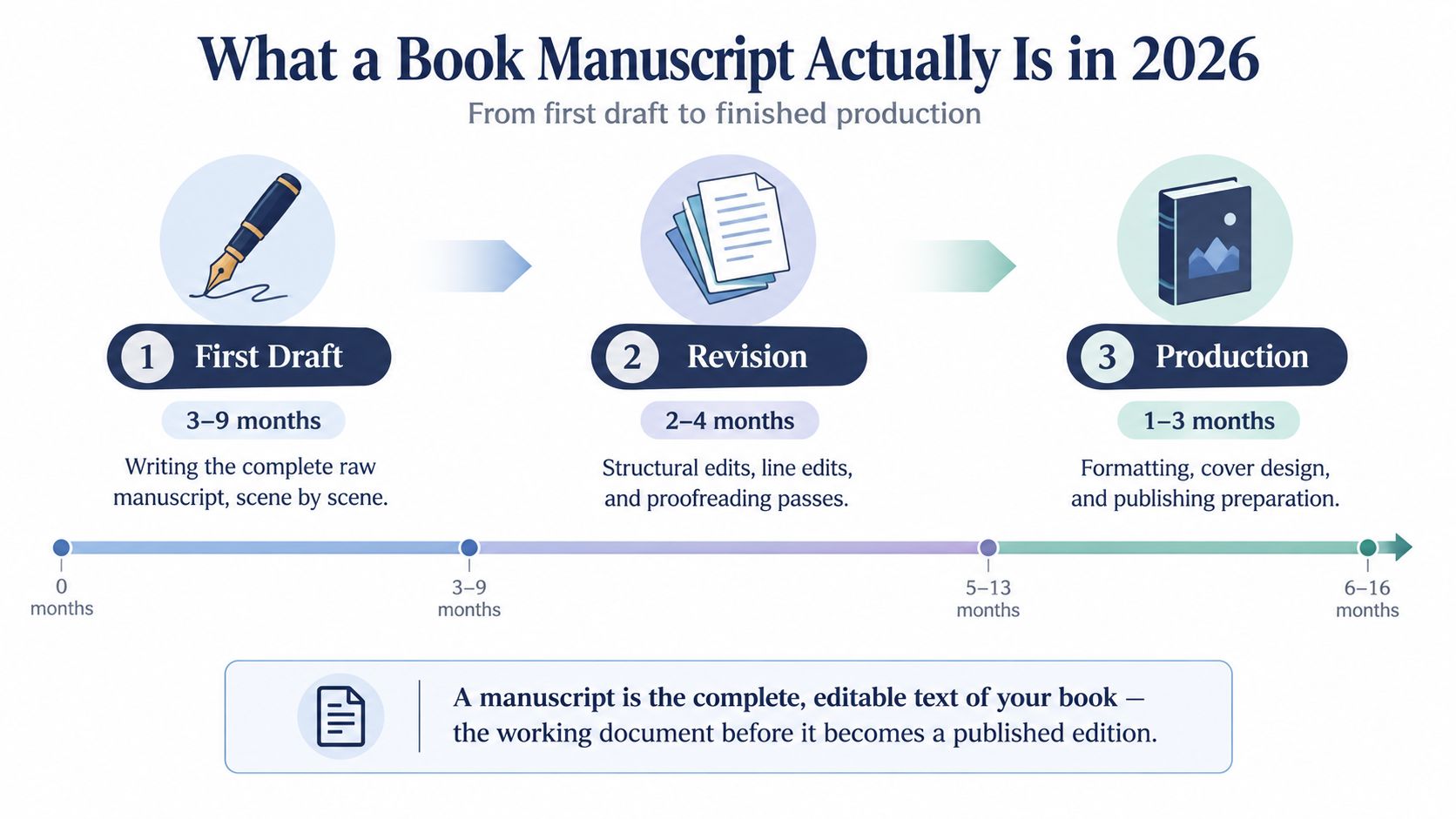
A manuscript isn't the same thing as a published book. It's the complete, editable working document that carries your book from an idea to a submission, editorial review, or production handoff. Depending on your route, it may include the main text, front matter, back matter, formatting instructions, and the information needed to identify and position the book.
Professional publishing treats manuscript development as a staged process, not a single burst of inspiration. A widely used publishing timeline places the completed draft well before launch, followed by beta-reader feedback and developmental editing, then copyediting, formatting, and final cover and interior decisions. The timeline is measured across a year-scale production schedule, not a few hurried weeks. This publishing timeline shows why a manuscript must be ready before the production team needs it.
Your publishing route changes the handoff
A traditional publisher generally wants a polished proposal or query package, and many authors need literary-agent representation before an editor sees the full project. The publisher then controls most production decisions, including the final format, cover, distribution plan, and publication schedule.
A small press may offer more flexibility, but it still needs a manuscript that can survive editorial scrutiny and production. Self-publishing gives you control over format, pricing, distribution, metadata, and design. That control also makes you responsible for decisions a traditional publisher would normally make.
Decide these items before drafting seriously:
- Book category: Know whether you're writing commercial fiction, literary fiction, memoir, narrative nonfiction, or practical nonfiction.
- Target reader: Describe the person who needs this book, not an imaginary audience of everyone.
- Working length: Choose a realistic length for the category and publisher or platform you're targeting.
- Publication route: Decide whether you're preparing for an agent, a small press, or an independent release.
A vague audience produces vague chapters. A confused format creates expensive rewrites. Treat the first planning decisions as production requirements, not administrative chores.
Practical rule: Don't draft a book you haven't defined well enough to describe in one sentence.
Planning Your Manuscript Before You Write a Single Chapter
Three months into drafting, an author discovers that the premise supports a strong opening but not a complete book. The chapters repeat one idea, the research sits in scattered files, and every revision requires rebuilding the plan. Prevent that failure before you write prose. Treat the manuscript as a year-scale production project, with a clear stop point for planning before drafting begins.
Start by compressing the book into one sentence. For fiction, name the protagonist, central conflict, and direction of the resolution. For nonfiction, state the reader's problem, your method, and the result you promise. If the premise becomes vague when shortened, fix the concept now. A weak premise becomes a weak book when expanded.
Next, create a chapter-level outline that fits the project. A novel may use a three-act progression, a memoir may follow a chronological or thematic arc, and a practical book may move from problem to method to application. Give every chapter a purpose statement answering What changes here, and why should the reader continue? Guidance on how to write an outline for a book can help turn a broad concept into a usable plan. Research-heavy projects can also borrow the sequence and chapter-purpose principles in structuring a dissertation.
Build a working book file
Before drafting, create one physical binder or digital folder for the entire project. Keep the outline, synopsis, character or subject notes, research, permissions, terminology, and style decisions together. Scrivener, Google Docs, Microsoft Word, or a plain folder will work. Choose the tool that lets you find a note without breaking a writing session.
Include:
- A working title and subtitle
- A one-sentence premise
- A chapter list with purpose statements
- Comparable titles and category notes
- A reader profile
- Character or subject profiles
- Research and source notes
- A style sheet for names, terms, spelling, and continuity
Set a word-count expectation as a planning limit, not a promise. Shape it around the category and publishing route. Fiction needs a plot arc, turning points, and character progression. Nonfiction needs a defined reader problem, a usable framework, and chapters that apply it. Memoir needs a narrative through-line, selected life material, and thematic resolution.
Stop planning when the premise is specific, every chapter has a distinct job, the core materials are findable, and the projected shape matches the book you intend to produce. Do not draft until those conditions hold. A good outline costs hours. Rebuilding an aimless manuscript costs months.
Drafting on a Schedule That Gets You to The End
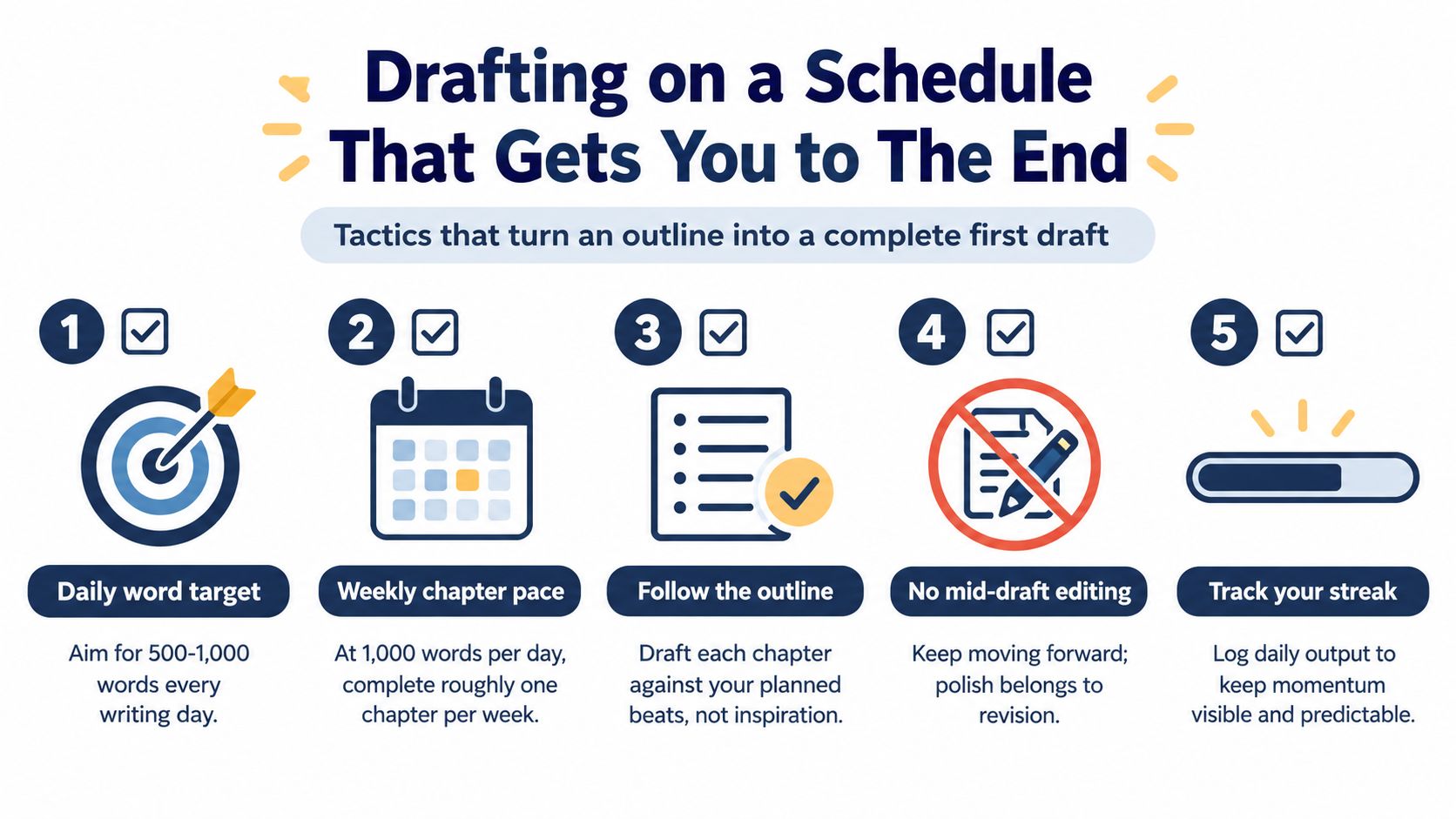
By the third week, an appealing writing plan often collapses under missed sessions, research questions, and chapters that refuse to cooperate. Prevent that outcome by deciding in advance when you write, where the manuscript lives, what counts as progress, and which questions can wait. Motivation may open the file. A repeatable schedule gets the book finished.
Treat the manuscript as a year-scale production project, with a clear stop point for each stage. Set a writing-day target that fits your life. Many plans use 500 to 1,000 words on a writing day, but sustainability matters more than ambition. Record the total in a spreadsheet or writing app, and judge raw prose later. Drafting time is for generating pages, not polishing sentences.
At the start of each session, read the current chapter's purpose statement and write toward its promised change. Finish the chapter when its dramatic, informational, or emotional work is done. A short chapter with a clean ending serves the book better than padded pages built to meet an arbitrary target.
Keep the draft advancing
Use a zero-edit rule for the first pass. Stop reopening the opening every morning. Mark uncertain research with “[CHECK]” and continue unless the missing fact blocks the scene or argument. If it does block progress, record the exact question, research it during a scheduled research session, then return to the draft.
Control the ratio of scene to summary. Fiction and memoir need enough fully rendered scenes to create immediacy, while summary can carry the reader across time and context. Nonfiction needs examples and explanation, yet repeated exposition makes pages feel flat. Give readers moments to experience and arguments that develop. A manuscript that only reports events or information will feel thin.
Use checkpoints tied to the project's production calendar:
- Early checkpoint: Confirm that the premise still governs the chapters.
- Quarter checkpoint: Review pace, character consistency, and alignment with the working plan.
- Middle checkpoint: Test whether pressure, stakes, or reader value have increased.
- Late checkpoint: List unresolved threads before drafting the final chapters.
- Completion checkpoint: Confirm that every planned chapter exists in usable form.
Set a stop point at completion when the ending exists, every chapter is present, and the unresolved questions are listed for revision. That is the handoff from drafting to diagnosis. Do not start line editing before then. The first draft must reveal the whole book, including its weak sections, before revision can address them.
Use this short video as a practical reminder that consistency matters more than waiting for ideal writing conditions.
Diagnosing the Manuscript Problems That Block Publication
Editors don't reject a manuscript because it contains a few imperfect sentences. They reject projects whose central problems remain after a serious read. The most useful diagnostic question is not “Is this prose beautiful?” It's “Does every part earn its place?”
Research on manuscript quality repeatedly identifies structural weakness, incoherence, unclear purpose, jargon, unsupported claims, and conclusions that exceed the evidence. Those problems appear in book manuscripts too, even when the subject isn't academic. This review of common manuscript errors is valuable because it turns vague editorial discomfort into identifiable failures.
| Failure Mode | Draft Symptom | Where It Shows Up |
|---|---|---|
| Sagging middle | Events or ideas repeat without increasing pressure | The central chapters |
| Viewpoint drift | The narrative enters another mind without a clear break | Scene transitions |
| Throat-clearing opening | The book explains its premise before delivering it | Opening pages |
| Backstory overload | History replaces present action or argument | Early chapters |
| Performing dialogue | Characters speak to inform the reader rather than reveal themselves | Conversations |
| Pacing collapse | Scenes linger without movement, or summary skips meaningful moments | Across the manuscript |
Run a cold middle read
Read the middle portion of the manuscript as if you didn't write it. Don't consult your outline. Mark every place where your attention drops, where the same point is restated, where a character's goal becomes unclear, or where the chapter could be removed without damaging the book.
Then classify each mark. A scene may need cutting, relocation, compression, or a stronger consequence. A nonfiction section may need a sharper example, a clearer claim, or a limitation that keeps the argument honest. Don't line-edit these pages yet. Diagnosis comes before treatment.
The common failure is protecting material because it was difficult to write. Difficulty doesn't create value. A chapter earns its place by changing the reader's understanding, advancing the plot, deepening character, or creating necessary momentum.
Running the Revision Layers With a Stop Point
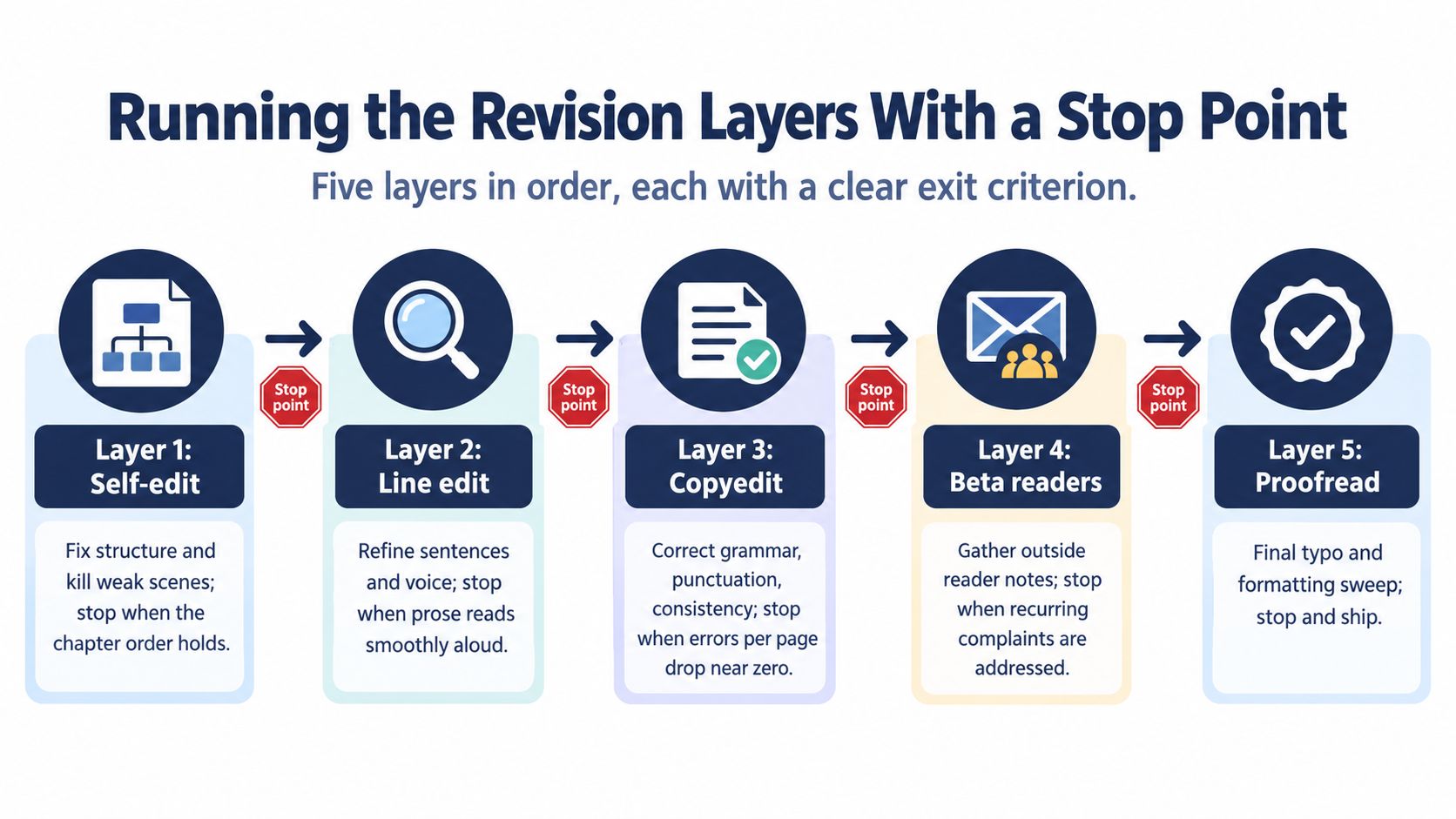
Revision becomes endless when every pass tries to solve every problem. Separate the work into layers and refuse to move forward until the current layer has done its job. Then stop. The order matters because polished sentences can't rescue a broken structure.
Layer one self-edit
Read for architecture. Create a reverse outline if the draft drifted away from the original plan. List what happens in every chapter, then ask whether each chapter creates a clear cause-and-effect chain. Cut or redesign scenes where the protagonist's goal, understanding, or situation doesn't change.
Stop point: The chapter list reads as a coherent progression, and you can explain why each chapter belongs.
Layer two outside readers
Recruit beta readers who resemble the intended audience. Give them focused questions instead of asking whether they “liked it.” Ask where they became confused, bored, emotionally disconnected, or eager to continue.
Stop point: Recurring concerns are visible and you've addressed the patterns, not merely collected opinions.
Layer three developmental editing
A developmental editor should work on plot, structure, argument, audience, pacing, and scope. Ask for an editorial letter or action plan that distinguishes essential changes from preferences. If the feedback produces an unmanageable cloud of possibilities, the brief wasn't specific enough.
Stop point: You have a prioritized revision list and can describe the new shape of the book.
Layer four line editing
Only now should you refine voice, rhythm, transitions, repetition, diction, and paragraph-level clarity. Read pages aloud. Your ear will catch clumsy phrasing that your eyes skip over. The distinction between line editing and copy editing matters because sentence craft and mechanical correctness aren't the same task.
Stop point: The prose sounds intentional when read aloud, and the sentences no longer distract from the story or argument.
Layer five proofreading
Proofreading happens after layout, not before. Check the actual interior file for typographical errors, inconsistent headings, page problems, missing text, captions, and contents-page mismatches.
Stop point: The laid-out edition has received its final controlled read. Further changes require a documented reason, not nervousness.
The expensive mistake is line-editing material you'll later restructure. Fix the foundation first, then improve the house.
Preparing the Manuscript for Production and Distribution
Production begins when the manuscript stops changing at random. Create a handoff folder with the editable manuscript, approved supporting documents, and a separate set of files prepared for publication. An agent or editor needs a readable submission document. A printer, retailer, or digital platform needs files built to its technical specifications.
Clean the source document before exporting anything. Apply consistent paragraph styles to chapter titles, body text, quotations, and captions. Remove accidental double spaces, stray tabs, and manual formatting that will break during conversion. Check the front matter in the correct order for the project, including the title page, copyright page, dedication, and epigraph where relevant. Keep the editable file intact, then export copies for each production route.
Build the book's production record
Metadata is part of the product. Prepare the title, subtitle, description, author bio, categories, keywords, and subject classification before uploading the book. The description should tell an unfamiliar reader what the book offers and why it suits them. A vague personal statement will not do that work.
Record ownership and permissions while the details are easy to verify. Decide whose name will hold the ISBN, retain copyright-registration records, and document permission for quoted, reproduced, or adapted material. If a publisher is involved, get a written division of responsibilities between you and the production team.
Choose files according to the publishing route:
- Agent submission: Follow the requested manuscript format exactly.
- Publisher handoff: Send the editable source file, supporting documents, and a concise list of unresolved questions.
- Print distribution: Prepare the interior and cover to the selected printer's specifications, including trim, margins, and file type.
- Digital distribution: Test the ebook on multiple screen sizes. Check navigation, links, images, and front matter after conversion.
- Aggregator or direct upload: Confirm the required metadata, ISBN, territorial, and rights fields before submission.
A narrative summary can also borrow techniques from other publishing documents. These film treatment format tips can help you present narrative movement clearly to a professional audience without confusing a treatment with a manuscript.
Use these manuscript formatting guidelines as a reference, then follow the exact requirements of the receiving agent, publisher, printer, or retailer. Formatting is a technical handoff. A clean file reduces questions, conversion errors, and avoidable production delays.
Knowing When Your Manuscript Is Ready to Ship
You're ready to ship when the manuscript meets its purpose, not when you've eliminated every doubt. A book can always be made different. That doesn't mean it can always be made better.
Use category expectations as a guide rather than chasing a universal word count. A commercial novel, memoir, practical nonfiction book, and collection of memoir essays have different assumptions about scope and structure. Your target length should support the reader's experience and the publishing route, not give you an excuse to add material.
| Book Type | Target Word Count | Ship Criteria |
|---|---|---|
| Fiction | Appropriate for its category | Complete plot, stable viewpoint, resolved central arc |
| Memoir | Appropriate for its narrative scope | Clear through-line, selective life material, meaningful resolution |
| Prescriptive nonfiction | Appropriate for the reader's problem | Coherent method, useful examples, claims supported |
| Memoir-essay collection | Appropriate for the collection's design | Strong individual pieces and a deliberate whole |
Use a final readiness test
Ship when you can answer yes to these questions:
- Have you incorporated useful beta feedback or consciously declined it?
- Does every chapter perform a necessary structural job?
- Can you state the manuscript's through-line in one sentence?
- Does the file meet the submission or production specification?
- Can you identify who needs this book without hedging?
- Have you read the manuscript aloud from beginning to end?
The publishing process has long involved submission, review, revision, production, and release. University publishing guidance describes book production as a process that can span 6 to 18 months, while another university press describes a typical 1 to 2 year path from proposal to publication. This overview of the publication process makes the important point clear: a manuscript is part of a larger sequence, not the final consumer product.
Recent manuscript guidance also identifies a persistent gap. Writers receive plenty of advice to outline, draft, revise, and proofread, but much less help defining when revision should end. Set the stop point yourself. Once the structure works, the feedback is resolved, the prose is clean, and the file is compliant, send it to readers or publishing professionals. You'll learn more from a real response than from another month of rearranging sentences.
If your manuscript needs a structured path from draft to publication, BarkerBooks offers editorial support, proofreading, formatting, cover design, ISBN and copyright assistance, and worldwide distribution preparation. Visit the site to review the available publishing support and choose the help that matches the stage your book has reached.