
So, you have an idea for a nonfiction book. That's fantastic. But before you dive into writing chapter one, let's talk about what really separates the books that succeed from those that gather dust. It all comes down to the foundation.
Getting this initial stage right isn't just a suggestion; it's the most critical part of the entire process. Think of it like building a house. You wouldn't start putting up walls without first pouring a solid concrete foundation. Skipping this work is a recipe for disaster, no matter how brilliant your writing is.
Start with a Problem, Not Just an Idea
The best nonfiction books don't just share information—they solve a real, tangible problem for a specific group of people. Your first job is to connect something you're genuinely passionate about with a problem that keeps your ideal reader up at night. That passion is the fuel you'll need to get through the long haul of writing.
Once you have that topic, get laser-focused on who you're writing for. "Everyone" is not an audience. Trying to write for everyone means you'll end up connecting with no one.
Instead, build a crystal-clear picture of your ideal reader:
- What's their biggest frustration or pain point? Are they new managers struggling with team dynamics, entrepreneurs trying to navigate their first product launch, or parents looking for healthier meal ideas?
- What kind of transformation are they actually looking for? They aren't just buying a book; they're buying a better outcome.
- Where are they already searching for answers? Knowing this—whether it's blogs, podcasts, or online courses—helps you understand the competitive landscape and how to position your book.
Make Sure People Will Actually Buy It
An idea is just an idea until you can prove there's a market for it. This is where a little bit of smart research saves you a mountain of heartache later. You need to validate that people are not only interested in your topic but are also willing to pay for a solution. The process is pretty straightforward: you move from your initial concept, to defining your audience, to confirming there's a real market waiting for your book.
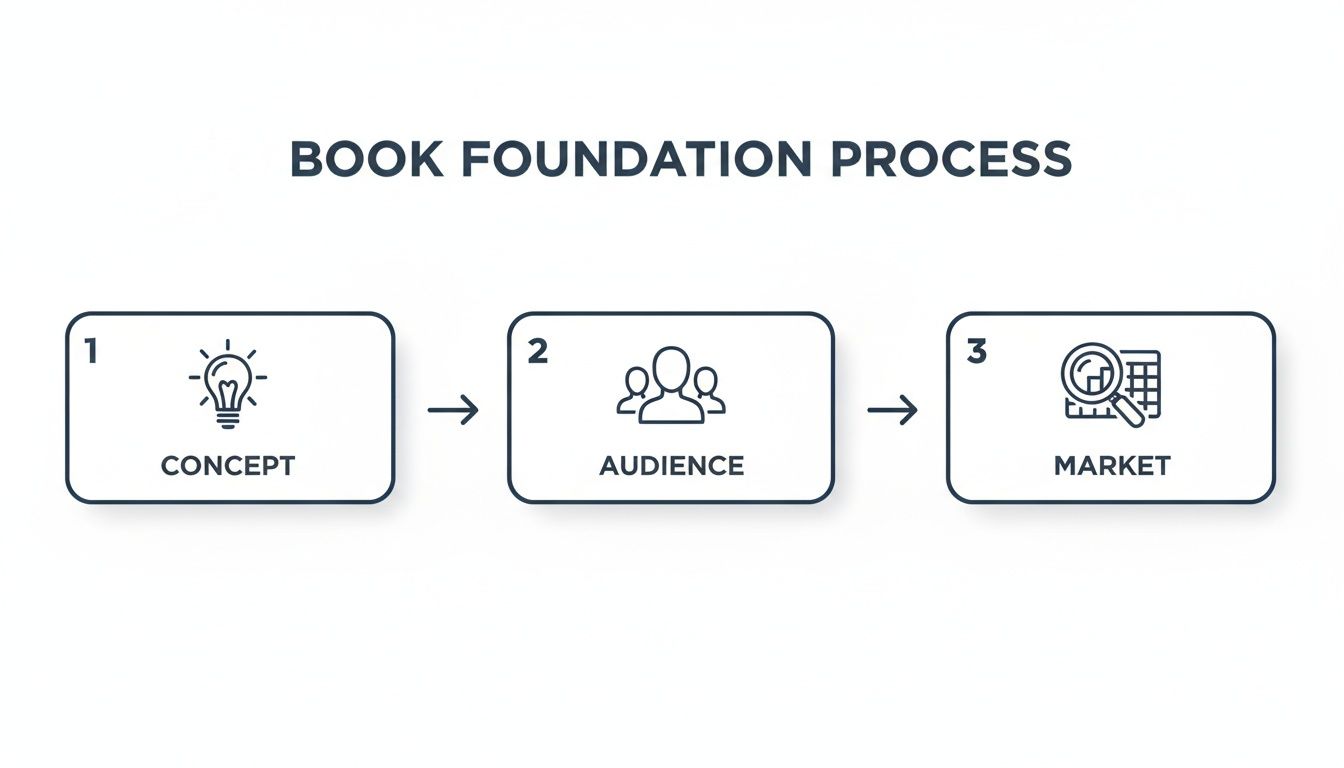
This simple flow is your reality check. A great book idea must hit the sweet spot where your expertise, a clear audience need, and proven market demand all overlap. Part of what makes an author's work stand out is their unique perspective. This is why finding your writing voice and building a powerful brand is so crucial—it's what will make readers connect with you specifically.
And don't worry, the demand is there. The global non-fiction book market is huge, valued at over $15.78 billion in 2025 and growing. Readers are actively looking for expert advice, especially in booming areas like personal finance, mental health, and career development.
To help you nail this down, here’s a quick summary of the core elements you need to have in place before you start writing.
Core Elements of a Winning Book Concept
| Pillar | Key Question to Answer | Why It Matters |
|---|---|---|
| Concept | What specific problem does my book solve? | A problem-solving book has a built-in purpose and is easier to market. |
| Audience | Who is the one specific person I am writing this for? | A defined audience allows for targeted language, marketing, and a stronger connection. |
| Market | Are people already spending money to solve this problem? | It confirms your idea is commercially viable before you invest months of work. |
Getting clear answers to these questions gives you a solid, validated concept that's built to succeed.
Define Your Book's Unique Promise
Finally, you need to figure out what makes your book different from everything else out there. What's your unique hook, your "secret sauce"? This becomes the core promise you make to your reader.
Your book's unique selling proposition is the clear, compelling reason a reader should choose your book over all others. It's the answer to the question: "Why this book, from this author, right now?"
For example, there are thousands of books on productivity. But maybe your angle is a productivity system designed specifically for freelance artists, not corporate VPs. That specific focus immediately makes your book stand out to that niche audience.
With these foundational pieces locked in, you're not just hoping for success—you're building a roadmap for it. If you're looking for more guidance on the writing journey, check out our other guides on https://barkerbooks.com/learning-how-to-write-books/.
Creating a Structure That Engages Readers
Think of your book's outline as its architectural blueprint. Without a solid structure, even the most brilliant ideas can devolve into a confusing mess that loses the reader and leaves you, the writer, completely stuck. It’s the framework that turns a pile of research and a head full of thoughts into a cohesive, compelling journey.
Every nonfiction book makes a promise to its reader. Your outline is how you ensure you deliver on that promise, chapter by chapter, guiding them logically from their starting point to the solution you're offering. This is about more than just listing chapter titles; it’s about crafting a narrative that keeps people hooked and turning the page.

Choosing Your Outlining Method
There is no single "right" way to build your book's structure. Honestly, the best method is whichever one clicks with how your brain organizes information. Many authors give up on outlining because they feel boxed in by a simple, linear list. Don't let that be you.
Instead, experiment with a few different approaches to see what feels natural:
Mind Mapping: This is a fantastic visual technique. You start with your book’s big idea in the center and branch out with your main themes or chapters. From there, you add smaller branches for sub-points, stories, and data. It’s a great way to see connections you might otherwise miss.
The Snowflake Method: Originally developed for fiction, this method works wonders for nonfiction too. Start with a single sentence that sums up your book’s core argument. Expand that into a paragraph, then a full page. Then, break down each sentence of that page into its own paragraph—these eventually become the skeletons of your chapters.
The Post-it Note Method: I love this one for its flexibility. Write every idea, story, statistic, and key point on individual sticky notes. Then, you can physically arrange and rearrange them on a wall or a big table, literally building your book's flow. It's a tactile way to spot gaps and shuffle sections around until the structure just feels right.
If you want to go deeper on these, our detailed guide on how to write a book outline covers even more techniques. Finding the right method is half the battle.
From Chapter Titles to Reader Promises
Once you’ve settled on a high-level structure, it’s time to drill down. A truly effective outline details what each chapter will accomplish, ensuring every part of your book has a clear purpose and delivers real value. If you don't do this, it's incredibly easy to get lost in the weeds when you actually start writing.
A bare-bones outline like this just won't cut it:
- Chapter 1: Intro
- Chapter 2: The Problem
- Chapter 3: The Solution
That’s not a roadmap; it’s a vague destination. A functional outline is far more robust.
For every single chapter, you need to define three core components. This simple practice will transform your list of topics into a powerful writing guide.
- The Core Promise: In one clear sentence, what is the single most important thing the reader will learn or be able to do after finishing this chapter? This becomes your North Star.
- Key Supporting Points: List the 3-5 main ideas, arguments, or steps you’ll use to fulfill the chapter's promise. Think of these as the future subheadings within that chapter.
- Supporting Evidence and Stories: Under each key point, jot down the specific anecdotes, case studies, research, or expert quotes you'll use to make your argument. This is how you make abstract concepts concrete and memorable.
An outline is more than a table of contents; it's a commitment to your reader. By defining each chapter's promise, you ensure your book isn't just a collection of information, but a guided transformation.
Yes, this detailed planning takes some effort upfront, but the payoff is huge. It slashes writer's block, prevents you from rambling, and ensures your final manuscript is focused, logical, and deeply valuable. It's the secret to writing a nonfiction book that people don't just start, but actually finish.
Turning Research and Ideas into a First Draft
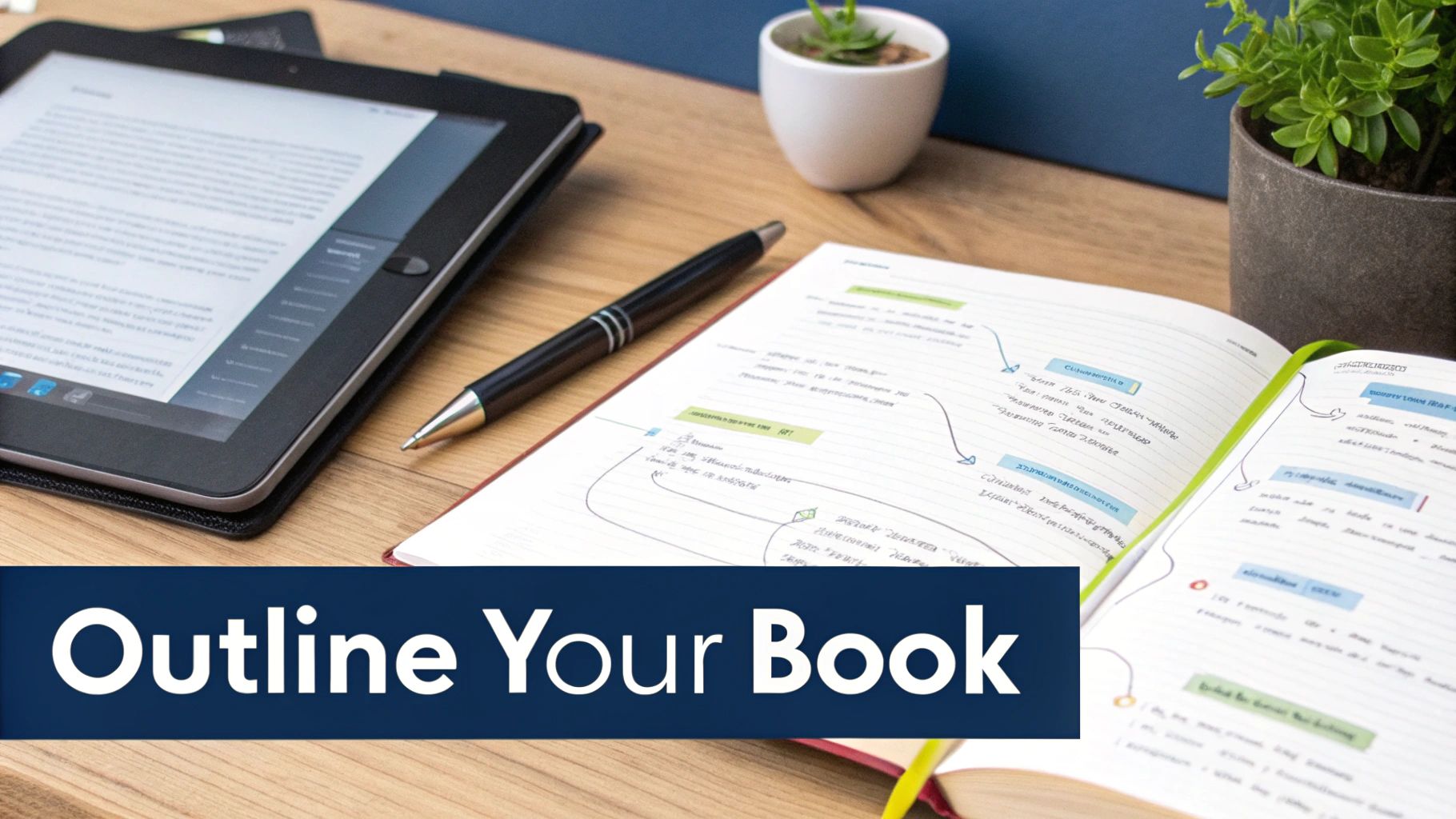
Alright, you've got your outline—the architectural blueprint for your book. Now it’s time to get your hands dirty and start laying the bricks. This is where all that planning pays off as you begin the real work of building your manuscript, moving from organized ideas to actual prose.
Don't aim for perfection here. The first draft is all about getting the words down and building momentum. Think of it as a marathon, not a sprint. It’s a phase that demands a smart approach to research and, more importantly, a disciplined writing routine.
Gathering Your Evidence and Stories
Before you can write a single chapter, you need the raw materials. Your outline probably highlighted a few gaps—places where you need a compelling statistic, an expert quote, or a real-world story to make your point land.
This is where smart research comes in. It's not about becoming the world's leading expert on everything, but about efficiently finding the right information to support your arguments. For a nonfiction book, credibility is everything.
- Primary Sources: This is your original material. Think interviews you conduct, surveys you run, or even your own personal experiences. This is the stuff nobody else has.
- Secondary Sources: Dive into academic journals, respected industry reports, and books from established authors in your field. Google Scholar is a fantastic resource for finding peer-reviewed studies.
- Tertiary Sources: Use articles and blog posts for a general overview, but always do the legwork to trace their claims back to the original source.
As you collect these gems, keep them organized. A tool like Notion or Evernote works wonders, but even a simple spreadsheet will do. The key is to tag each piece of information with the chapter it belongs to. This little trick keeps you from tumbling down endless research rabbit holes. To see how this fits into the bigger picture, check out our guide on the complete book writing process.
Building a Consistent Writing Habit
Let's be honest: the single biggest hurdle to finishing a first draft is consistency. If you wait for inspiration to strike, you'll be waiting a long time. The writers who actually finish books treat it like a job—they show up, even on days they don't feel like it.
Your mission is to build a habit. That's it. Forget writing a masterpiece in one go. Just find a time and place to write and stick to it. Even 30 minutes a day adds up to a surprising amount of progress over a few months.
The secret to writing a nonfiction book is not found in grand, sweeping gestures of creativity, but in the quiet, daily discipline of putting words on the page, one sentence at a time.
This isn’t about just having more willpower. It's about taking ownership. Stop saying you don't have the time or energy. You're the only one who can write this book, so commit to the small, daily actions that will make it happen.
Strategies to Keep the Words Flowing
Even with the best habits, the well runs dry sometimes. That’s perfectly normal. The trick is to have a few go-to strategies to get things moving again, so you never lose momentum for long. Thinking "I have to write a book" is paralyzing. Thinking "I just need to write this one small story" is doable.
Here are a few techniques that actually work:
- Write in Vignettes: Don't try to tackle an entire chapter. Instead, just write one small piece—a single story, an explanation of one core concept, or a specific case study. You can stitch these self-contained "vignettes" together later, like a quilt.
- Start with the Easiest Chapter: There’s no rule that says you have to write your book in order. Jump ahead to the chapter you’re most excited about or the one you already know inside and out. An early win builds confidence that can carry you through the tougher sections.
- Embrace the "Ugly" First Draft: This is a big one. Give yourself explicit permission to write badly. The only goal of a first draft is to exist. You will fix the awkward sentences, the repetitive phrases, and the clunky transitions later. Don't let perfectionism kill your progress.
- Talk it Out: Feeling stuck? Grab your phone, open a voice memo app, and just talk through the point you're trying to make as if you were explaining it to a friend. When you transcribe it, you’ll often find the natural, authentic language you were looking for.
Writing a nonfiction book is a major project, but it’s absolutely achievable when you break it down. By pairing focused research with a solid writing routine and a few tricks to overcome roadblocks, you’ll turn that detailed outline into a complete first draft. It will be messy, it will be imperfect, but it will be done. And that draft is the clay from which you’ll sculpt your final, polished book.
Refining Your Manuscript Through Editing
Finishing that first draft is a huge milestone. Pop the champagne, take a breath—you’ve earned it. But the manuscript you have now isn't the finished book. It’s the raw clay, and the real magic of turning it into a polished, impactful book happens in the editing room.
A lot of authors see editing as a chore, the painful part after the creative fun of writing. I think it’s better to see it for what it really is: the phase where you elevate your work. This is where you sharpen your arguments, clarify your message, and make sure the book truly delivers on its promise to the reader.
The key is to not get overwhelmed. You do that by tackling it in layers.
The Three Layers of Editing
You can't fix everything at once. Trying to spot a typo while you're also wondering if a chapter is in the right place is a recipe for a headache. Professional editors work in stages, and you should too. It’s the only way to focus on the right problems at the right time.
Think of it like building a house. You don't paint the walls before the drywall is up, and you definitely don't put up drywall before the frame is secure. Same logic here.
Developmental Edit (The Big Picture): This is all about the structure. Is your core argument strong and clear from start to finish? Does the chapter order flow logically? Are there glaring holes in your content or spots where the reader might get lost?
Line Edit (The Sentence Level): With the structure solid, you can zoom in. Now you’re looking at the prose itself—the style, the flow, the voice. Are your sentences clunky or do they sing? Is your tone consistent? Do your paragraphs transition smoothly, guiding the reader along?
Copyedit (The Final Polish): This is the last line of defense. You're on the hunt for all the technical gremlins: typos, grammatical slip-ups, punctuation errors, and weird formatting quirks. It’s the final sweep that makes the manuscript clean and professional.
Your First Pass: The Self-Edit
Before you hand your work over to anyone else, you need to do a thorough self-edit. This is non-negotiable. It’s your chance to fix the obvious stuff and tighten up the manuscript, which makes the feedback you get from others a thousand times more valuable.
First, step away from it. Put the manuscript in a drawer for at least a week, maybe even two. You need to come back to it with fresh eyes to see its flaws. When you’re ready, print it out. Reading on paper feels different; it slows you down and helps you catch things you’d normally skim right over on a screen.
My number one tip? Read it aloud. Seriously. This is the single best way to catch awkward phrasing and clunky sentences. If it sounds weird when you say it, it's going to feel just as off to your reader.
Your goal during the self-edit isn't perfection. It’s to make the manuscript as strong as you possibly can on your own, setting the stage for others to help you take it to the next level.
Bringing in Outside Eyes
After you’ve done all you can, it’s time for reinforcements. No writer, no matter how experienced, can be truly objective about their own work. You’re just too close to it.
Beta Readers: These are people you trust who fit the profile of your ideal reader. Their job isn’t to find typos (though they might). Their job is to give you a real reader’s reaction. Did the book solve their problem? Was anything confusing? Did they get bored? Give them a few specific questions to guide their feedback so you get more than just, "I liked it!"
A Professional Editor: Beta readers are fantastic, but they aren't a substitute for a pro. Hiring a skilled editor is often the best investment you can make in your book. They bring an expert, impartial eye that will spot issues with structure, style, and grammar that everyone else (including you) missed. A professional edit tells your future readers that you respect their time and are serious about delivering a quality book.
This whole process—from the big-picture review down to the final polish—is what separates a simple draft from a book that truly connects with an audience.
From Manuscript to Marketplace: Navigating Your Path to Publication
You did it. You finished your manuscript—a massive accomplishment worthy of a serious celebration. But the journey from a polished draft to a book in a reader's hands is a whole new adventure. This is where you put on your publisher hat and get down to the business of turning your hard work into a real, marketable book.
This final stage is less about creative inspiration and more about smart, strategic moves. You’ll be tackling the technical stuff, making key design decisions, and choosing the publishing path that makes the most sense for you and your goals.

Taking Care of the Backend Essentials
Before your book can appear on Amazon or a bookstore shelf, there are a couple of non-negotiable administrative tasks to check off. Think of these as your book's official birth certificate and passport—they protect your work and get it ready for the global marketplace.
- Secure an ISBN: An International Standard Book Number is the unique 13-digit ID for your book. You'll need a different one for every format you release (paperback, ebook, hardcover, etc.). It’s absolutely essential for tracking and distribution.
- Register Your Copyright: Technically, your work is copyrighted the moment you write it. But formally registering it with the U.S. Copyright Office creates a public record of your ownership, giving you much stronger legal footing if you ever need to defend it.
Getting these fundamentals right legitimizes your book and sets it up for commercial success.
The Make-or-Break Power of Professional Design
Let’s be honest: people do judge a book by its cover. In a sea of options, a killer cover design is your single most important piece of marketing. It's that first glance that convinces someone to click "buy" instead of scrolling on by.
But what's inside counts just as much. The interior layout—the formatting, fonts, and chapter headings—shapes the entire reading experience. A clean, professional interior feels inviting and authoritative. A sloppy one just screams amateur, pulling readers out of your content no matter how brilliant it is.
Your book's design isn't just an expense; it's a direct investment in its success. A professional look tells readers that the content inside is valuable and worth their time.
Hiring a professional designer for both your cover and interior is one of the smartest moves you can make. It transforms your manuscript from a Word document into a polished product that can stand tall next to any bestseller.
Choosing Your Publishing Route
Years ago, there was pretty much one path to getting published. Today, you have options. The two main routes offer very different experiences, and the best one for you comes down to what you value most: control, speed, or prestige.
This table breaks down the key differences to help you decide which path aligns with your goals.
Publishing Path Comparison Traditional vs. Supported Self-Publishing
| Factor | Traditional Publishing | Supported Self-Publishing (with BarkerBooks) |
|---|---|---|
| Creative Control | Limited. The publisher has final say on the title, cover, and content. | 100% control. You approve every detail, from the cover to the final edits. |
| Timeline | Slow. Often 18-24 months (or longer) from signing a contract to launch day. | Fast. You can go from final manuscript to published book in just a few months. |
| Upfront Cost | None. The publisher covers all production costs. | Requires an upfront investment to pay for professional services like editing and design. |
| Royalties | Low. Typically 5-15% of the net receipts. | High. You keep a much larger percentage of each sale, often 70-100%. |
| Distribution | Extensive, with potential for placement in physical bookstores. | Broad global distribution to online retailers (Amazon, B&N, etc.) and print-on-demand. |
| Ownership | You license the rights to your book to the publisher for a set term. | You retain 100% ownership and all rights to your intellectual property. |
Choosing a publishing path is a personal decision based on your priorities. Traditional publishing offers prestige but requires sacrificing control and time. Supported self-publishing gives you complete ownership and a faster timeline but requires an initial investment.
The financial upside of self-publishing can be huge, especially for authors who approach it like a business. A 2025 survey of indie authors found that while 44% earned under $100 a month, 20% were pulling in $500–$5,000, and an elite 8% were making over $10,000 per month.
Your Book Launch Starts Now
Hitting "publish" isn't the finish line—it's the starting gun. The most successful nonfiction authors I know start marketing long before their book is even finished. To make a real impact, you need to build an online presence that actually works and connect with readers directly.
Your author platform—your website, email list, and social media—is your home base for building a community. Start sharing your expertise, offering valuable content, and engaging with people interested in your topic today. That way, when launch day arrives, you’ll have a crowd of eager fans ready to buy your book and spread the word.
Common Questions About Writing Nonfiction
As you get deeper into the process of writing your nonfiction book, you're bound to have questions pop up. It's only natural. Let's tackle some of the most common ones I hear from authors so you can move forward with confidence.
How Long Should a Nonfiction Book Be?
There’s no single magic number, but most nonfiction books—especially in genres like business or self-help—land in a sweet spot between 50,000 and 75,000 words. That's usually enough room to explore your topic in-depth without making your reader feel like they're slogging through a textbook.
Instead of getting hung up on a target word count from the start, focus on covering your topic thoroughly. Your outline is your best friend here. If you flesh out each chapter to deliver on its promise, you'll find the book naturally settles into the right length. Later on, a good editor can tell you if a chapter feels a bit thin or if you need to do some trimming.
Biggest Mistakes First-Time Authors Make
I see so many first-time authors run into the same few obstacles. Knowing what they are ahead of time is half the battle.
By far the biggest misstep is failing to lock down a specific reader and the exact problem you’re solving for them. When you try to write for "everyone," your message gets watered down and ends up connecting with no one. It’s too general to make a real impact.
Another classic mistake is rushing past the outlining stage. Jumping straight into writing without a detailed map almost always leads to a jumbled manuscript and a frustrating case of writer’s block. Finally, don't underestimate the power of professional editing and cover design. A cheap-looking cover or a book riddled with typos can kill even a brilliant idea before anyone gives it a chance.
The success of a nonfiction book often hinges on its quality and market positioning. A standout book can thrive even in a competitive environment, but it must be exceptional to cut through the noise.
For example, a look at the international book market shows things are tough for nonfiction right now. The category only saw growth in 6 out of 18 territories, while fiction grew in 16. Despite this, revenue did increase in eight countries, but it was usually because of a few blockbuster hits that bucked the trend. You can dig into more of the data with these 2025 book publishing statistics.
Do I Need a Literary Agent?
You really only need an agent if your goal is to land a deal with one of the big traditional publishing houses. If you go the supported self-publishing route, you'll work directly with a publishing partner, so there's no need for an agent at all.
This path has become the go-to for countless entrepreneurs and experts. It gives you way more creative control, much higher royalty rates, and gets your book out into the world a whole lot faster. It’s a way to share what you know without having to get past the gatekeepers of traditional publishing.
Ready to turn your manuscript into a professionally published book that can compete on a global stage? The expert team at BarkerBooks is here to guide you every step of the way, from editing and design to worldwide distribution. Let's bring your vision to life at https://barkerbooks.com.