
Your book blurb is the ultimate sales pitch. It’s that short, punchy block of text—usually around 150-200 words—that has one job: to turn a casual browser into an eager buyer. This isn't a summary of your plot. Think of it as an advertisement for the experience of reading your story, designed to hook a reader and not let them go.
Why Your Blurb Is Your Most Important Sales Pitch
We often hear that a book cover is the most important sales tool. While the cover earns that first glance, the blurb is what truly closes the deal. It's your one shot to make a promise to the reader—a promise of heart-pounding suspense, swoon-worthy romance, or a journey that will change how they see the world.
Imagine a reader in a bookstore or scrolling through Amazon. You have maybe ten seconds of their attention. In that tiny sliver of time, your blurb has to slice through the noise, grab them by the collar, and forge an immediate emotional connection. It's a specific craft, a kind of psychological copywriting that sparks curiosity and creates a powerful need to know what happens next.
The Blurb as Your Silent Salesperson
In the ridiculously crowded world of books, your blurb is your tireless, 24/7 salesperson. It's constantly working to convince readers to take a chance on you. And it works—compelling blurbs are a huge driver of impulse buys. In fact, some studies show that as many as 67% of impulse bookstore purchases happen because a blurb promised an irresistible story.
More than that, the blurb is the first real taste of your voice. If it’s clunky, confusing, or dull, potential readers will assume your book is too. But if it’s sharp, intriguing, and crackles with energy? They’ll feel confident that the story inside is worth their time and money.
A book blurb is an elevator pitch for your story. You have about 150 words to convince a complete stranger to invest hours of their life in a world you created from scratch. Make every word count.
Moving Beyond a Simple Summary
One of the most common traps authors fall into is writing a plot summary instead of a blurb. The goal isn't to explain what happens; it's to make the reader feel the stakes. You're trying to create a sense of tension, a burning question that can only be answered by turning the page.
Learning this skill pays dividends far beyond your back cover. The art of crafting a powerful hook and presenting a clear, emotional promise is central to all marketing. A killer blurb is one of the most powerful tools in your book marketing strategies. To see how this principle applies more broadly, you can learn more about how to create engaging content that gets results.
By mastering this, you’re not just writing a book description. You’re building the engine that will drive your book's sales and help it find its audience. You're building the bridge between your finished manuscript and your next devoted reader. Let's get started.
The Anatomy of a Blurb That Captivates
A great book blurb isn't just one solid block of text. It's more like a finely tuned machine, with four key parts working together to hook a reader and not let them go. Each component has a specific job, guiding a potential buyer from casual browsing to clicking "Add to Cart."
Forget about summarizing your plot. Your real task is to isolate the most magnetic parts of your story and reassemble them into a killer piece of sales copy.
Let's break down this anatomy piece by piece.
The Irresistible Hook
Your first sentence has one job and one job only: to stop a reader mid-scroll. You have seconds to cut through the digital noise, so this opening has to be sharp, intriguing, and memorable.
A weak hook describes a situation. A strong one poses a puzzle, makes a shocking claim, or asks a question that demands an answer. It instantly creates a gap in the reader's knowledge they feel a burning need to fill. In fact, some marketing analyses suggest a powerful opening can increase reader engagement by as much as 42%.
Here are a few ways I’ve seen this work brilliantly:
- The Provocative Question: Kick things off with a "What if…" that turns the reader's world on its head. For instance: "What if the only person who could save the world was the one destined to destroy it?"
- The Shocking Statement: Hit them with a fact about your character or world that’s impossible to ignore. Like this: "On his fortieth birthday, John discovered his wife had been replaced by a perfect replica."
- The Character's Dilemma: Throw the reader right into your protagonist’s most difficult choice. For example: "To save her son, she had to betray her country."
Your hook is the doorway to your story. If it’s locked, cluttered, or boring, no one will bother trying to see what’s inside. Make it an open invitation to a world of intrigue.
Nailing that opening line is a true art form. For a much deeper dive, check out our guide on how to write a hook that grabs readers.
The Protagonist and Their Problem
Okay, you’ve got their attention. Now it’s time to introduce the heart of the story: your protagonist. Readers connect with people, not just plot points. The goal here is to create an immediate bond by showing us a relatable person facing an earth-shattering problem.
This isn't the place for a full character bio or a detailed physical description. Just give us their core identity and the inciting incident that just blew up their life. Who are they, and what just happened to turn their world upside down?
Take this fantasy example: Elara was just a village healer, content with her herbs and remedies. But when a cursed shadow falls over the land, she discovers the quiet magic in her blood is the only thing standing against an ancient evil.
See how that works? We immediately know who Elara is (a healer), her normal life (content), and the massive problem she's now facing (a world-threatening curse only she can fight). It’s just enough to make us care, without getting bogged down in details.
The Conflict and Escalating Stakes
This is where you crank up the tension. We know our hero and their problem. Now we need to understand the conflict and—most importantly—what's at stake if they fail. The stakes are the engine of your blurb; they’re the reason a reader becomes emotionally invested.
Vague threats like "he must fight for his life" just fall flat. You have to be specific. What terrible thing will happen to the character, their family, their city, or their world if they don't succeed?
Think of it this way:
- Identify the Obstacle: Who or what is in the way? A ruthless corporation? A vengeful god? Their own self-doubt?
- Define the Goal: What do they have to do? Find a lost artifact? Expose a conspiracy?
- Clarify the Stakes: What’s the specific, awful consequence of failure? The end of civilization? The loss of their soul?
Here’s a thriller example: Hunted by a shadowy agency, he must decode the secrets his mentor died to protect. If he fails, it won't just be his life on the line—it will unleash a weapon that could erase a city from the map.
The obstacle is the "shadowy agency," the goal is to "decode the secrets," and the stakes are brutally clear: an entire city wiped out. Suddenly, the conflict feels real, immediate, and massive.
The Final Cliffhanger
Never, ever resolve the tension at the end of your blurb. Your final sentence should leave the reader hanging, desperate to find out what happens next. This is the last nudge that turns a curious browser into a buyer.
End with a twist, a final impossible choice, or a haunting question that sticks in the reader's mind. You want to create a sense of incompleteness that can only be satisfied by reading the book. It's the literary equivalent of that dramatic final chord in a movie trailer that leaves you breathless.
A sci-fi example: But as she gets closer to the truth, she uncovers a conspiracy far more terrifying than she ever imagined… one that suggests the greatest threat to humanity isn't from the stars, but from within.
This ending flips the entire premise on its head and leaves the reader questioning everything. They need answers, and that's exactly the feeling you want to create. For more on this, a good guide on writing effective marketing copy can really sharpen these skills.
Master these four elements—Hook, Protagonist/Problem, Conflict/Stakes, and Cliffhanger—and you'll have a blurb that works hard for you every single time.
Genre-Specific Formulas and Real-World Examples
Knowing the anatomy of a blurb is one thing, but making it sing for your specific genre is where the real magic happens. Readers have expectations. Someone grabbing a thriller wants a racing pulse; a romance reader is looking for that delicious emotional ache. A one-size-fits-all blurb just won’t work.
The good news? You don’t have to reinvent the wheel. There are proven formulas for every major genre. Think of them less as restrictive rules and more as reliable recipes you can season with your own unique ingredients.
Let's break down a few of the most popular genres and see what makes a blurb feel like it was written just for that ideal reader.
Crafting the Perfect Thriller Blurb
For a thriller, your blurb absolutely must feel like a ticking clock. Every single sentence should dial up the pressure, hitting on speed, danger, and impossibly high stakes. The formula is beautifully simple: introduce a vulnerable hero, drop them in front of an overwhelming threat, and add a deadline that feels suffocating.
Here's what that looks like in action.
Before (The Generic Summary):
Agent Mark Corrigan is a CIA operative who has to stop a dangerous terrorist group. They have a new weapon and plan to use it soon. He travels across Europe to find them, but he faces many challenges along the way. He must succeed to save countless lives.
This tells us the plot, sure, but it has zero tension. It's a summary, not a hook. Now, let’s inject some adrenaline using the thriller formula.
After (The High-Stakes Pitch):
Mark Corrigan was the CIA’s ghost, a man who never left a trace. But when a single encrypted message is the only warning of a coming attack, he’s forced into the light. A ghost can’t stop a shadow war.
A rogue cell, armed with a biological agent that leaves no survivors, has vanished. Their target: a global summit where the world’s leaders are gathering in 72 hours. As the clock ticks down, Corrigan finds himself hunted by the very allies he once trusted, with only a disgraced journalist as his guide.
He’s cut off, outmanned, and running out of time. To stop the unthinkable, he’ll have to become the monster everyone fears he is. But in a world of lies, the truth might be the most dangerous weapon of all.
See the difference? This version grabs you. It establishes the hero's core skill ("ghost"), introduces a terrifyingly specific threat ("biological agent"), and slams down a hard, urgent deadline ("72 hours"). The stakes feel both personal and global, creating that perfect cocktail of dread and excitement.
Writing a Romance Blurb That Sells
Romance readers are here for one thing: the emotional journey. Your blurb has to sell the central relationship by highlighting the initial spark, the core conflict keeping them apart, and the promise of that heart-fluttering "will they or won't they" tension.
Let’s take a bland romance blurb and give it some chemistry.
Before (The Simple Setup):
Chloe, a small-town baker, meets Liam, a big-city developer who wants to buy her family’s bakery. They don’t get along at first because he represents everything she’s against. Over time, they start to fall for each other and have to figure out their differences.
Again, it summarizes the plot, but it doesn't make us feel a thing. Let's rebuild it to promise an emotional rollercoaster.
After (The Emotional Promise):
Chloe lives her life by one rule: never trust a man in a suit. Especially not one with a wrecking ball aimed at her grandmother’s century-old bakery. Liam is everything she despises—arrogant, charming, and determined to pave over her hometown for his latest glass-and-steel monstrosity.
She’s ready for a fight. What she isn’t ready for is the man behind the infuriating smirk. A man who sees the cracks in her tough exterior and challenges her to want more than a life covered in flour.
Giving in to the sparks between them feels like a betrayal of everything she holds dear. But Liam is hiding a secret of his own, and when it comes to light, it could either build a bridge between their two worlds… or burn them both to the ground.
Now that sizzles. It sets up a classic "enemies-to-lovers" trope, clearly defines the internal and external conflicts, and ends on a cliffhanger that promises some serious emotional stakes. We can already feel the chemistry and the obstacles, and that's exactly what a romance reader is looking for.
Forging an Unforgettable Fantasy Blurb
Fantasy blurbs have a tough job. You have to introduce a unique world, establish the protagonist's special place in it, and hint at the epic, world-altering stakes—all without overwhelming the reader. The trick is to ground the extraordinary with a relatable human problem.
Let’s look at a fantasy example.
Before (The Vague Quest):
In the world of Atheria, a young orphan named Kaelen discovers he has magic. An ancient evil is returning, and he is the only one who can stop it. He must go on a dangerous journey to find a lost artifact to save the kingdom.
This is a collection of fantasy clichés that could describe a hundred different books. It's completely forgettable.
After (The Epic Hook):
The gods are dead. In Atheria, their magic is now a poison, twisting the land and its people into monstrous husks. Kaelen is a nobody, an orphan scraping by in the city’s underbelly, marked only by the strange, silver scar on his hand.
But when the scar erupts with a power that hasn’t been seen in a thousand years, he becomes the most wanted man in the kingdom. Hunted by the ruthless Inquisitors who cleanse the world of rogue magic, Kaelen finds an unlikely ally in a grizzled, disgraced knight with a death wish.
The whispers say his power is a key—the only thing that can relight the sacred fires and heal the world. But the same whispers warn that wielding such magic comes at a terrible cost. To save his world, Kaelen might have to sacrifice his very soul.
This version is so much stronger. It opens with a killer world concept ("magic is a poison"), gives the hero a specific and intriguing feature ("silver scar"), and raises the personal stakes to an unbearable level ("sacrifice his very soul"). It sells not just a quest, but a truly unique and perilous journey.
Common Blurb Mistakes That Sabotage Sales
A phenomenal story can get completely lost in the crowd if its blurb doesn't do the heavy lifting. Writing a killer book description is a very specific skill, and it's all too easy to fall into a few common traps that can unfortunately send readers clicking away.
Honestly, a lot of authors think a blurb is just a short summary of their book. It's not. Its only job is to sell the experience of reading your story, not to explain every little detail. Let's walk through some of the biggest mistakes I see writers make so you can steer clear of them.
Giving Away the Whole Story
This is, without a doubt, the cardinal sin of blurb writing. Your goal is to spark curiosity, not hand over a detailed itinerary of your plot. If you give away the midpoint twist, the final showdown, and how it all wraps up, you've left zero reason for anyone to actually buy the book.
Think of your blurb like a movie trailer. It should set the scene, introduce the central problem, and hint at what’s at stake. But it must cut to black before the big reveals. You want to leave your reader asking, "What happens next?" not feeling like they've already seen the whole movie.
Relying on Tired Old Clichés
You've seen them a million times. "A world unlike any other." "Nothing is as it seems." "She must face her demons." These phrases are so overused they've become completely invisible to readers. They signal a generic story, even if yours is anything but.
Be specific instead. Don't just tell us the world is unique; give us one weird, compelling detail that proves it. Don't say the protagonist has inner demons; show us the gut-wrenching choice they're forced to make.
Key Takeaway: A blurb filled with clichés suggests a story that's equally unoriginal. Your book is unique—use language that is, too. Vivid, specific details are what will make your blurb pop.
Here’s a quick look at how you can use genre conventions to your advantage and sidestep that generic feel.
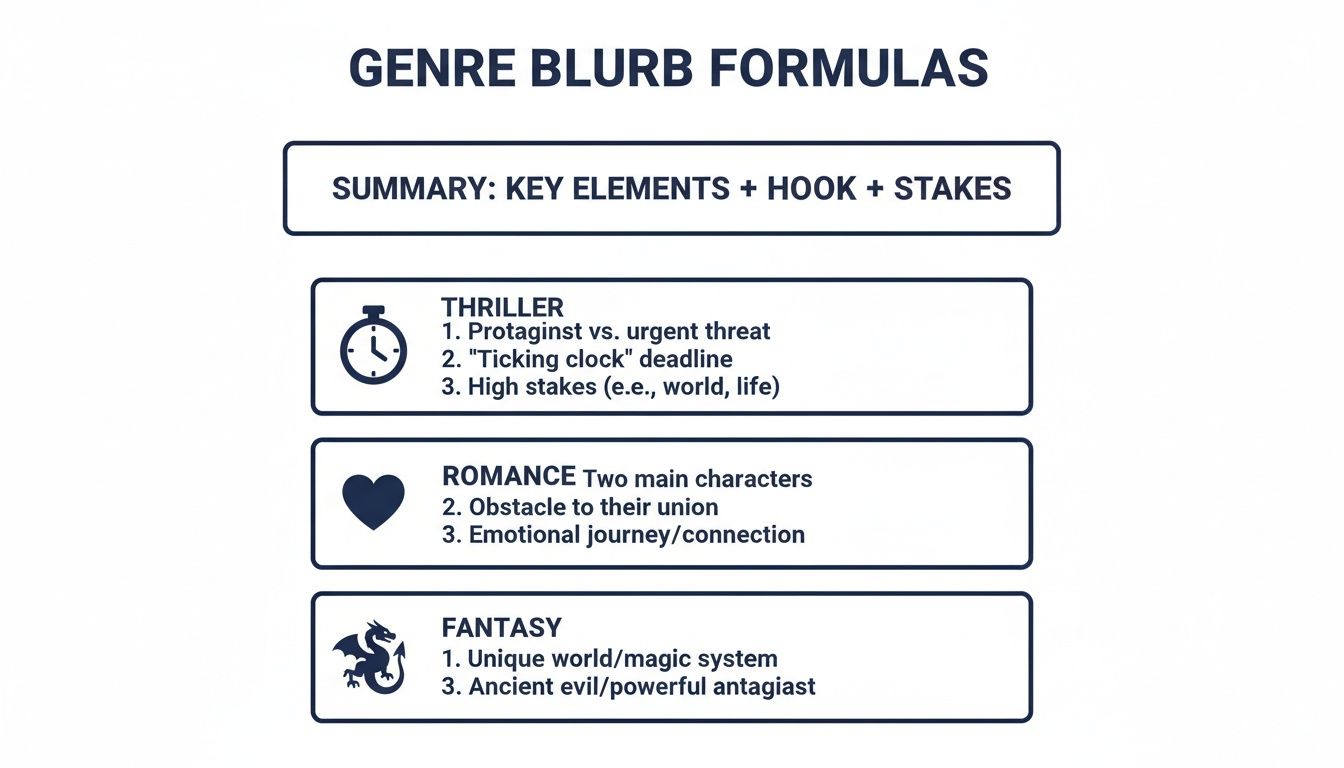
Every genre has its hooks—a ticking clock in a thriller, an impossible obstacle in a romance—and leaning into those can help you build a much stronger pitch.
Info-Dumping the Backstory
I get it. You spent months, maybe years, crafting an intricate world with a rich history or a character with a deeply complex past. It's natural to want to show it off. But the blurb is absolutely not the place for it.
Dumping a ton of exposition—whether it’s the 1,000-year history of your magic system or the full rundown of your hero's childhood trauma—will bring your blurb to a screeching halt. It's boring, and it's overwhelming.
Stick to the bare essentials. What does the reader need to know right now to grasp the immediate conflict? Everything else is gravy, and it belongs inside the book. Your only job here is to convince them to open it.
Polishing, Testing, and Optimizing Your Blurb for Maximum Impact
Alright, you’ve wrestled that first draft of your blurb onto the page. That's a huge step, but the real work starts now. Think of that draft as a lump of clay; it's time to sculpt it into a sharp, powerful sales tool that does the heavy lifting for you.
Your blurb isn't set in stone. It’s a living piece of marketing copy that you can—and absolutely should—refine until it sings. We're moving beyond "good enough" and aiming for a description that actively turns casual browsers into dedicated readers.
Fine-Tuning: From Draft to Dynamite
Before you show your blurb to anyone, it’s time to get ruthless with your own editing. This isn't just about catching typos; it's about making every single word fight for its spot. Your mission is to trim the fat and amplify the punch.
Here’s what I look for when I’m editing a blurb:
- Kill Passive Voice: Hunt down weak, passive verbs like "was," "is," or "were." They kill the energy. Instead of saying, "The city was destroyed by the cataclysm," try "The cataclysm shattered the city." Feel the difference?
- Cut Every Wasted Word: Do you really need that adverb? Can you find a stronger verb instead of using an adjective? Is your hero "very scared," or is he simply "terrified"? Be brutal. Brevity is your best friend.
- Match the Vibe: Read your blurb out loud. Does it sound like your book? A thriller blurb needs to feel tense and breathless. A romance blurb should crackle with chemistry. The rhythm and tone have to match the reader's expectations for your genre.
Your blurb isn't a summary; it's an advertisement for the emotional experience of reading your book. Edit for feeling, not just for facts.
Once you’ve done your own pass, it’s time to see if it actually works on real people.
Putting Your Blurb to the Test
You don't need a fancy marketing budget to figure out what resonates with readers. The trick is to gather some real-world feedback before you hit "publish."
One of the easiest ways to do this is with a simple poll on your social media channels. Jump on Facebook, run a poll in your Instagram Stories, or post on X.
Here’s a quick example:
"Help me pick a hook for my new book! Which one grabs you more?
A) In a city that runs on stolen memories, a detective must find a killer who leaves no trace.
B) He was the city's best detective until he woke up with a stranger's memories and a body at his feet."
This kind of direct feedback is gold. You'll quickly see which hook has more pulling power, letting you zero in on what your audience actually wants.
How to Format Your Blurb for Online Stores
Your blurb won’t just be on your book cover; it’ll be on Amazon, Apple Books, and Barnes & Noble. A giant wall of text is an instant turn-off for online shoppers, especially on a phone. You need to use formatting to your advantage.
- Make It Scannable: Use bold and italics to make key phrases pop. Emphasize the hook, the core conflict, or a killer question at the end. On most platforms, you can use simple HTML tags like
<b>and<i>to do this. - Embrace White Space: Keep your paragraphs short—1 to 3 sentences, max. This breaks up the text, makes it easier to read, and feels far less intimidating to a potential buyer who's just scrolling by.
This isn’t just about looking pretty. It's about conversion. Time and again, we see that authors who A/B test their blurbs and optimize their formatting see a real impact on sales. In competitive genres, a well-formatted blurb on Amazon can lead to a 15-20% higher conversion rate. That's a lot of readers you don't want to miss. To dive deeper into these trends, you can explore more data on the global book market.
Ready to give your own blurb a final, professional-grade polish? It’s time to run it through one last review to make sure it’s ready for prime time.
Your Blurb Editing and Optimization Checklist
This checklist is your final quality control step. Go through it point by point to ensure your blurb is not only well-written but also strategically positioned to sell.
| Check Point | Action Item | Why It Matters |
|---|---|---|
| Hook Power | Read the first sentence aloud. Does it grab you? | You have about three seconds to capture a reader's attention. If the hook is weak, they're gone. |
| Clarity & Intrigue | Is the core conflict clear without giving away the plot? | Readers need to understand what the book is about, but they buy based on what they don't know. |
| Protagonist Connection | Have you introduced the protagonist and their core desire or problem? | Readers connect with characters. Give them someone to root for (or against) from the start. |
| Genre Tone | Does the language and rhythm match your genre's conventions? | A horror blurb should feel unsettling; a rom-com should feel witty. Mismatched tone confuses readers. |
| Word Choice | Have you replaced passive verbs and weak adjectives with powerful ones? | Strong, active language creates energy and excitement, making the story feel more immediate. |
| Readability | Are paragraphs short (1-3 sentences)? Is there plenty of white space? | A dense block of text is intimidating on a screen. Short paragraphs are easy to scan and digest. |
| Strategic Formatting | Have you used bold or italics to emphasize key phrases? | Formatting guides the reader's eye to the most compelling parts of your blurb. |
| Call to Action | Does your blurb end with a compelling question or cliffhanger? | This final line is what pushes the reader to click "Buy Now" or "Look Inside." |
| Proofread | Have you checked for typos, grammar mistakes, or awkward phrasing? | Errors make your work look unprofessional and can pull a reader right out of the moment. |
By the time you've worked through this checklist, you can be confident that your blurb is a lean, mean, book-selling machine, ready to do its job across every online retailer.
Your Top Book Blurb Questions, Answered
Even after you’ve got a handle on the basic formula, a few tricky questions always pop up. I get these all the time from authors deep in the trenches of writing their sales copy. Getting these details right can be the difference between a reader clicking "buy" or scrolling on by.
So, let's tackle some of the most common sticking points I see.
Should I Use First or Third Person?
The point of view you choose for your blurb is all about the tone you want to set. Most books stick with the industry standard: a third-person perspective ("He was a detective on the edge…"). It feels classic, almost cinematic, and gives you a bit of distance to describe your hero and their world objectively.
But don't overlook the power of a first-person blurb ("They call me a detective, but I'm just a man haunted by the ghosts of my last case…"). This can forge an instant, intimate connection, pulling the reader right into the protagonist's head. It's a fantastic choice for genres that thrive on a strong, distinctive voice, like gritty thrillers, urban fantasy, and a lot of contemporary romance.
What’s Different About Non-Fiction Blurbs?
When you’re writing a blurb for a non-fiction book, you have to make a fundamental mental shift. You're not selling a story; you're selling a solution. The reader is your protagonist, and their problem is the conflict you’re about to resolve.
Your blurb needs to do three things, fast:
- Pinpoint the reader's pain: What problem are they desperately trying to solve?
- Position your book as the answer: How does your method or expertise fix that problem?
- Promise a transformation: What specific, tangible results will they get from reading it?
A novel's blurb is built on mystery and intrigue. A non-fiction blurb is all about making a clear, compelling promise.
Your blurb for a non-fiction book isn't a plot summary; it's a value proposition. It answers one question for the reader: "What's in it for me?" This approach is a core difference from learning how to write a book synopsis, which focuses on detailing the narrative.
How Often Should I Update My Blurb?
Think of your blurb as a living piece of marketing copy, not a one-and-done task. It should adapt and evolve as your book finds its audience and gains momentum.
A few key moments to consider a refresh are:
- After you win an award or land a killer endorsement from a big name.
- When you're launching the next book in the series to create continuity.
- If you spot a consistent theme in your reader reviews that you hadn't emphasized before.
Giving your blurb a check-up now and then ensures it's always pulling its weight and hooking new readers.
Ready to move from writing a blurb to building a bestseller? The team at BarkerBooks offers comprehensive editing, cover design, and marketing services to give your book the professional edge it deserves. Start your publishing journey with us today.