
You've finished the manuscript, approved the cover, and perhaps already published the ebook. Then a listener asks the question that turns a finished book into a new project: “Is it available as an audiobook?” The answer depends on far more than placing a microphone in front of the author. You need to adapt the manuscript for listening, choose the right voice, produce clean files, pass platform checks, and decide who controls the audiobook rights after release.
The commercial opportunity is substantial. The Audio Publishers Association reported more than 750,000 active audiobook titles in 2025, a 43% increase from 2024, while U.S. audiobook sales reached $2.43 billion in 2025, up 9% from 2024. Those figures make the format attractive, but they don't make production simple. The practical question is how to turn a book into an audiobook without sacrificing performance, technical quality, rights flexibility, or long-term revenue.
Understanding the Audiobook Production Pipeline
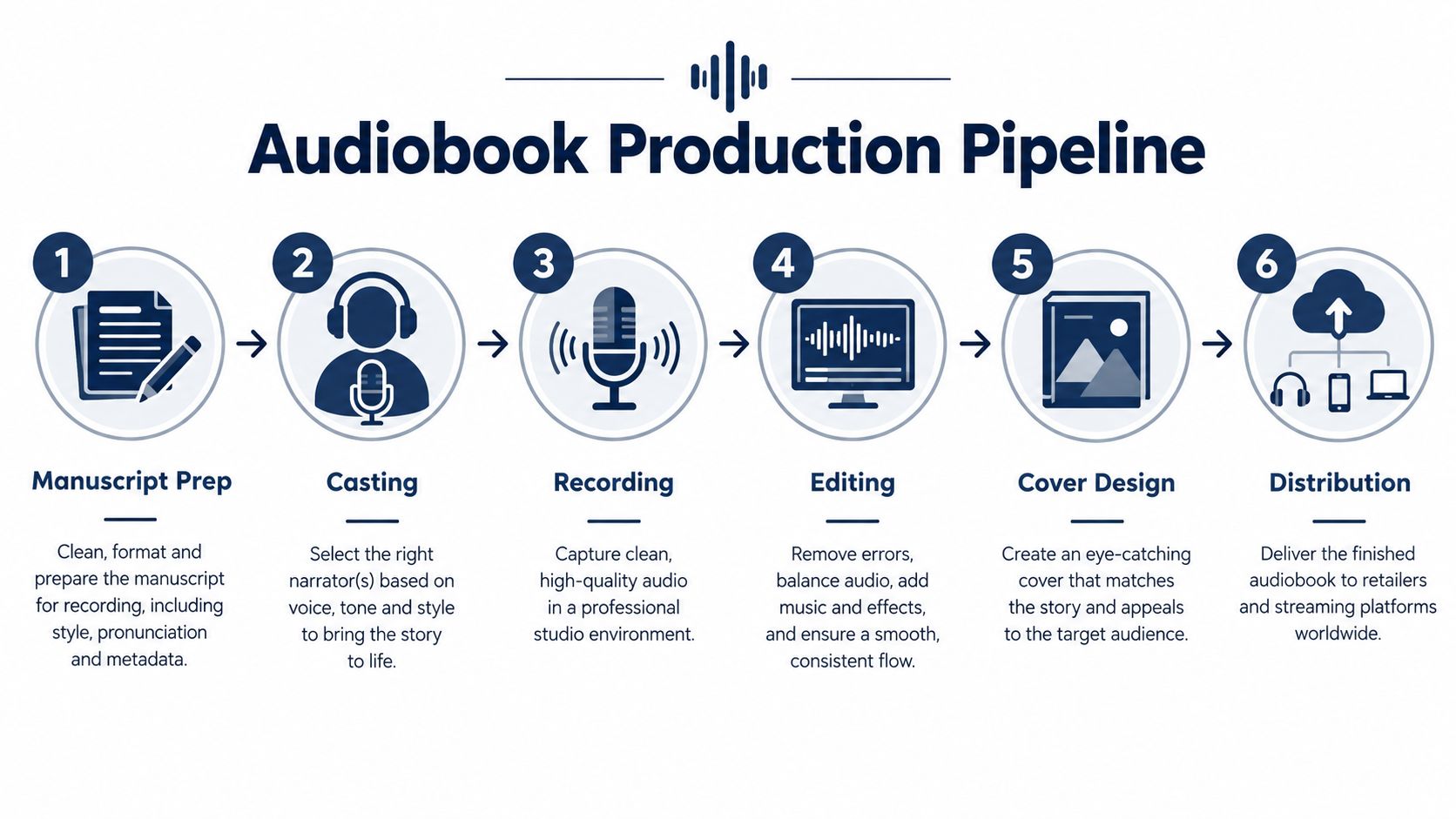
Audiobook production is a managed publishing project, not a file conversion. The work usually passes through six stages, manuscript preparation, narrator casting, recording, post-production, quality control, and distribution. Each stage affects the next one. A weak pronunciation guide creates recording problems, rushed editing creates quality-control problems, and an unclear rights decision can limit the value of a finished production.
A typical 10-hour audiobook takes about 8 to 12 weeks end to end, with approximately 30 to 50 hours of studio recording and another 30 to 50 hours for editing and mastering, according to this audiobook production process guide. ACX-style quality control can add 2 to 4 weeks, while distribution may go live 1 to 3 business days after approval. The production timeline therefore reflects labor, review, revisions, and platform processing, not just the length of the finished audio.
Treat the manuscript as a performance script
Print readers can see headings, footnotes, tables, illustrations, page references, and typographic emphasis. Listeners can't. Before recording, the production team must decide what should be spoken, what should be rewritten, and what belongs in a companion document instead. Fiction may need pronunciation notes and character guidance. Nonfiction may need spoken transitions where the printed page relied on layout.
The pipeline also benefits from an early decision about format. An unabridged edition preserves the complete book, while an abridged edition requires editorial judgment about what listeners can lose without damaging the argument or story. Authors considering the format can review the differences between abridged and unabridged audiobooks before committing to a recording schedule.
Practical rule: Approve the audio plan before hiring a narrator. Changing the script, narration style, or rights strategy after recording has started creates avoidable rework.
The final stage is distribution, but release isn't the end of the business decision. Your audiobook may be offered exclusively through one retailer, distributed across multiple outlets, or uploaded through a direct or aggregator route. That choice affects audience access, rights flexibility, revenue structure, and the amount of operational work you retain.
Preparing Your Manuscript for Audio Conversion
A finished print manuscript isn't automatically ready for narration. The narrator needs a clean, stable script that contains the words to be spoken and enough supporting information to avoid uncertainty. If the underlying book still needs substantive editing, resolve those changes before recording. Text changes after narration usually mean locating, re-recording, editing, and rechecking the affected passages.
Start by creating an audio master from the approved manuscript. Remove page numbers, running heads, captions, hyperlinks, footnotes, visual callouts, and references to material the listener can't see. Don't leave sentences such as “as shown in the table below” in the recording. Rewrite them into spoken language or move the supporting material into a clearly identified companion resource.
Build a pronunciation and style sheet
Read the manuscript aloud, or have someone else read it to you. The places where a reader hesitates often reveal the places where a narrator will need help. Record unusual names, invented terms, technical vocabulary, foreign phrases, regional pronunciations, and words whose meaning changes with emphasis.
A useful style sheet can include:
- Pronunciation notes: Write the preferred pronunciation in plain language, and include an audio reference when a word is especially difficult.
- Character guidance: Describe each important voice by attitude, energy, age range, or regional quality without forcing an exaggerated performance.
- Pacing markers: Flag passages that need a deliberate pause, a change in intensity, or a clear transition.
- Consistency rules: Record how recurring names, places, brands, and technical terms should sound throughout the book.
Don't over-direct every sentence. Experienced narrators need room to interpret the text, and excessive markup can make the script harder to use. Give them the information that prevents ambiguity, then discuss tone, pacing, and character treatment before recording.
Confirm the listening experience before full recording
Ask for an early sample before the narrator records the entire manuscript. ACX recommends a 15-minute checkpoint review to catch pronunciation, pacing, tone, and character-voice issues while corrections are still manageable, as described in its audiobook recording guidance. Use that checkpoint to assess whether the voice fits the book, not merely whether the audio sounds clean.
A short review should answer practical questions. Does the narrator sound natural in exposition? Can listeners distinguish dialogue without cartoonish voices? Do pauses clarify the argument, or interrupt it? If the answer is no, fix the direction before full production begins.
Choosing Between DIY Narration and Professional Talent
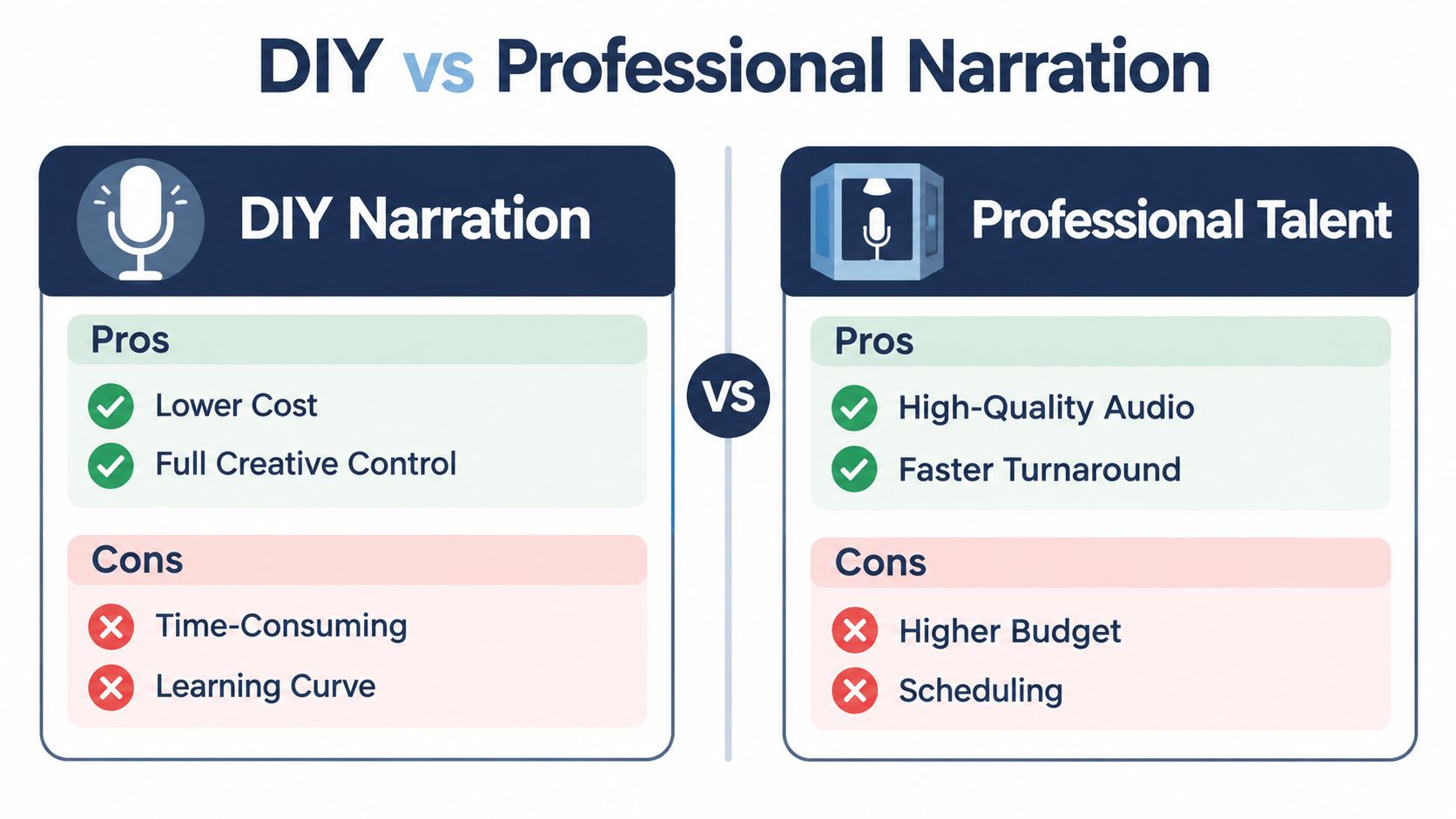
An author can finish a book, build a quiet recording setup, and still discover that narration has become a second production job. DIY appears cheaper because the author controls the session. Professional talent carries a visible fee. The useful comparison includes time, equipment, acoustic control, performance stamina, editing skill, and quality assurance, not only the quoted cash cost.
A practical benchmark is about 6.2 labor hours per finished hour of audio: roughly 2 hours for recording, 3 hours for editing, mixing, and mastering, and 1.2 hours for quality control, according to ACX's production guidance. New narrators may need 5 to 7 hours to record one finished hour, while fluent performers often become faster as their process improves. Finished runtime therefore gives an incomplete picture of the workload.
DIY narration makes sense in specific situations
Author narration can suit a memoir, personal essay collection, or nonfiction book where the author's identity and delivery are part of the product. It can also work for an author with voice-training experience, a treated recording space, dependable equipment, and time to learn editing and mastering.
The operational cost is the risk of rework. Home sessions can contain room reflections, background noise, microphone-distance changes, mouth noise, uneven pacing, or fatigue-related shifts in tone. Repair requires identifying the fault, recording a usable replacement, aligning the edit, and checking continuity. Those tasks can consume the time that made DIY seem economical.
DIY saves money only when you price your time honestly and can deliver files that meet the platform requirements.
Professional narration generally fits novels, character-heavy fiction, commercial nonfiction, and books where a polished listening experience matters more than authorial presence. A trained narrator contributes performance judgment and a repeatable recording process. Many professionals also provide editing and mastering, reducing handoffs between performance and technical preparation. Production services such as BarkerBooks audiobook production services can coordinate those functions for authors who prefer one supplier.
Use a decision matrix, not a preference
| Decision factor | DIY narration | Professional talent |
|---|---|---|
| Creative control | The author controls every interpretation | The author directs while sharing performance responsibility |
| Upfront cash | Potentially lower, though equipment and engineering still matter | Higher, with costs easier to forecast when quoted per project |
| Time demand | High, especially for new narrators | Lower for the author if the producer is reliable |
| Performance consistency | Depends on training, stamina, and preparation | Supported by professional technique and experience |
| Technical delivery | The author manages editing and specifications | Often handled by the narrator, engineer, or production team |
| Revision risk | Errors can spread across recording and editing | Contract terms can define samples, revisions, and approvals |
If you hire a narrator, audition with representative passages rather than a generic script. Test dialogue, exposition, emotional shifts, and difficult terminology. Ask who owns the raw files, who edits and masters them, how revisions work, and whether distribution preparation is included. Those answers define both the production workload and the business risk.
Technical Specifications and Quality Control Requirements
A strong performance can still fail delivery if the files miss platform requirements. ACX requires MP3 files at 192 kbps or higher, constant bit rate, and 44.1 kHz, with every file consistently mono or consistently stereo. Each chapter or section must stay under 120 minutes, while mastering should target -23 dB to -18 dB RMS with peaks near -3 dB, according to the ACX audio submission requirements.
Put these specifications in the production brief before editing begins. A technically inconsistent project may be expensive to repair at the end. Confirm the delivery format, channel configuration, loudness targets, file-naming convention, opening and closing credits, chapter breaks, and cover requirements in writing. Authors handling the technical side can compare audiobook recording software against those requirements, although software cannot replace experienced engineering judgment.
Separate technical checks from editorial listening
Technical inspection identifies measurable faults. Editorial listening catches issues that a meter cannot detect. A narrator may pronounce a name differently between chapters, flatten an emotional moment, skip a line, misread a number, or leave an awkward pause. Listeners hear these as production errors even when the file passes automated checks.
Keep a review log with the chapter, time stamp, problem, and requested correction. Listen on headphones and ordinary speakers, since noise, sibilance, and balance can present differently across devices. Review the opening minutes closely. They establish expectations for voice, pacing, noise level, and credits.
A controlled review process includes:
- Checkpoint listening: Review the recommended 15-minute sample before full recording, using the requirements and approval process described by ACX.
- Full proof-listening: Compare the narration with the approved manuscript rather than relying on memory.
- Technical inspection: Confirm bit rate, sample rate, channel consistency, duration, loudness, and peaks.
- Correction verification: Recheck every repaired passage in context, including the preceding and following transitions.
- Final approval: Keep approved masters separate from the version submitted to the distributor.
ACX allows up to two full rounds of changes, so consolidate feedback before sending it. “The tone feels wrong” gives a narrator little direction. Identify the passage, describe the problem, and state the intended result. That approach limits revision time and protects the production budget.
A final quality check should cover both compliance and listener trust. AI narration, remote recording, and rapid production do not remove the need for human review. Inconsistent pronunciation or unnatural phrasing can undermine confidence in the audiobook, even when every file meets the technical specification.
Distribution Models and Royalty Structures Explained
The production decision and the distribution decision should be made separately. You can commission a high-quality audiobook and still choose a model that restricts its reach or gives away flexibility you wanted to preserve. The central question is whether the additional economics of exclusivity justify limiting where the audiobook can appear.
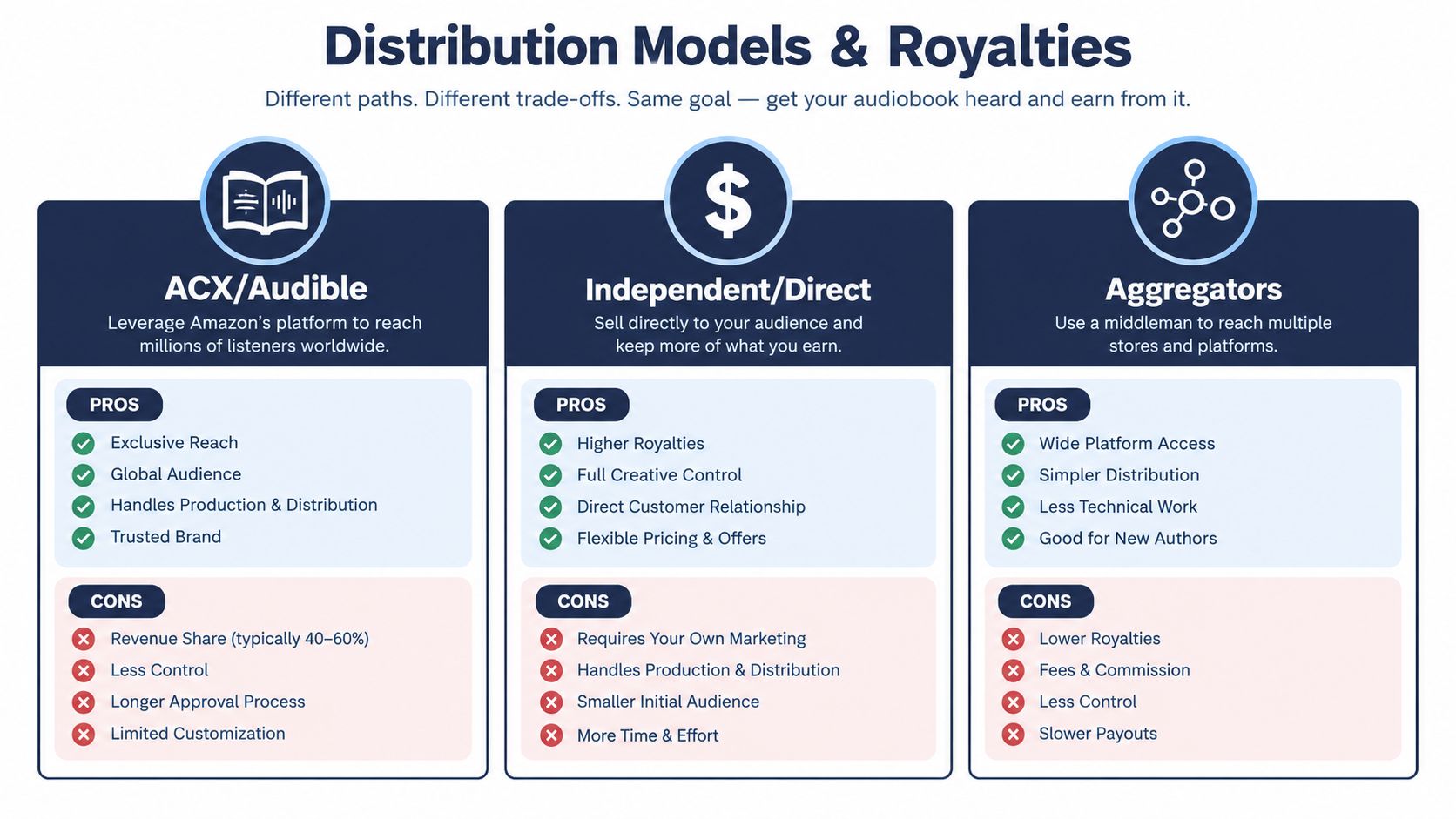
Under Audible's 2026 royalty model, creators can earn 50% for exclusive distribution and 30% for non-exclusive distribution, replacing the legacy 40% and 25% rates by year-end, according to Audible's new royalty model information. Those rates change the calculation, but they don't make exclusivity automatically correct. A higher rate on one channel may be less valuable than broader availability if your audience buys through multiple retailers, libraries, or international outlets.
Exclusive distribution
Exclusive distribution gives one retailer the primary commercial relationship. It can simplify administration and may provide access to that retailer's audience, merchandising, and promotional systems. The cost is reduced flexibility. You may be unable to place the same edition on other platforms during the exclusive term, depending on the agreement.
This model suits authors who prioritize a concentrated Audible strategy and can accept channel limitations. Review the contract carefully, particularly the term, rights covered, payment rules, content requirements, and exit provisions. Don't treat a higher royalty percentage as the only variable.
Non-exclusive and direct distribution
Non-exclusive distribution preserves the option to sell through multiple outlets. It can support a wider retail and library strategy, but it often creates more work around metadata, pricing, payments, updates, and reporting. Direct sales may offer more control, yet the author must create or manage the customer journey, payment process, fulfillment, and support.
A related rights decision deserves attention. Keep audiobook rights separate from print and ebook rights when possible if you want to change narrators, license translations, or move the audio edition to another distributor later. Authors coordinating formats can also review practical guidance on KDP ebook setup and pricing, then assess whether the ebook and audiobook should share a launch plan without being tied to the same rights arrangement.
Aggregators and the administrative trade-off
Aggregators distribute to multiple channels through one relationship. That convenience can reduce repetitive uploads and centralize reporting, but it may come with fees, revenue shares, or less direct control over retailer-specific decisions. Compare the agreement rather than relying on the label alone.
Rights question: Which model gives you the best combination of audience access, control, administrative effort, and income for this particular title?
Evaluating AI Narration Versus Human Performance
AI narration is no longer a purely theoretical option. Publishers are using it to expand backlist production, create editions in additional languages and accents, and reduce costs in developing markets, according to recent industry coverage of AI and audiobook publishing. The commercial question isn't whether synthetic speech can produce intelligible audio. It can. The question is whether the result matches what your audience expects from this book.
The trust gap matters. The Audio Publishers Association reported that willingness to try AI narration fell from 70% in 2025 to 61% in 2026, even as AI-narrated audiobook consumption and publication increased, as reported in the association's audiobook surveys. That combination points to a difficult market reality: adoption can grow while listener acceptance remains uneven.
Where AI may fit
AI narration may be practical for a niche backlist title, a multilingual edition, a short informational work, or a project whose budget can't support a full human production. It can also help publishers test demand across a broad catalog. Those uses make sense only when the rights holder understands the limits and labels the production accurately where required.
Listen to complete samples before approving a voice. Test proper nouns, emotional passages, dialogue, punctuation, technical terms, and changes in sentence length. Synthetic narration may sound smooth in a short sample but expose unnatural emphasis, timing, or emotional interpretation across longer passages.
Where human performance earns its place
Human narration remains especially important for debut releases, memoirs, literary fiction, romance, suspense, and any book that depends on intimacy, humor, tension, or character distinction. A trained narrator interprets subtext, adjusts breath and pacing, and responds to the changing stakes of a scene. Those choices create value that a technically clean voice may not reproduce.
The right comparison isn't “cheap AI versus expensive humans.” It's audience expectation versus production purpose. If the audiobook is a core expression of your author brand, a human performance may protect listener trust and reviews. If it is one edition in a broad backlist strategy, AI may be worth testing with careful disclosure and a realistic understanding of the trade-off.
Launching Your Audiobook and Maximizing Sales
A finished audio file doesn't create demand by itself. Treat the audiobook as a new edition with its own positioning, sample, launch message, and review plan. The print and ebook audience gives you a starting point, but audio buyers respond to the voice, listening experience, genre promise, and convenience of the format.
Begin promotion before approval. Prepare a short narrator introduction, a clean sample, square cover artwork, retailer copy, and a list of readers or reviewers who already understand the book. Ask the narrator whether they're comfortable sharing the release with their audience, but agree on messaging and timing in advance.

Build the launch around listening behavior
Use a practical checklist:
- Create an audio-specific sample: Open with narration rather than a long credit sequence, and choose a passage that demonstrates the genre and narrator's strengths.
- Activate existing readers: Tell ebook and print buyers that the audio edition is available, but write the announcement around the listening experience rather than repeating the original launch copy.
- Invite informed reviews: Give advance access to people who read the genre and can comment on narration, pacing, clarity, and overall enjoyment.
- Use behind-the-scenes material: Share a short recording-room story, narrator interview, or pronunciation decision to make the production process visible.
- Coordinate retailer promotion: Check the available promotional tools for your chosen distribution model, including samples, price campaigns, and featured-list opportunities.
- Measure channel quality: Track which links, newsletters, partnerships, and paid campaigns produce meaningful sales or listener engagement, then adjust future promotion around the strongest sources.
Don't rely on a single launch week. Audiobooks can continue finding listeners through recommendations, series read-through, podcasts, creator partnerships, and renewed attention around the print edition. Keep the metadata consistent across formats, make the narrator's name easy to find, and ensure the cover remains legible at thumbnail size.
Before you upload, confirm that the rights agreement, narration choice, technical files, distribution model, and promotional assets all support the same commercial plan. Authors who want one team to coordinate audiobook narration, editing, mastering, and distribution preparation can contact BarkerBooks to discuss turning a completed manuscript into a release-ready audio edition. Ask for a scope that clearly defines the narrator, revision rounds, file delivery, quality checks, rights, and launch support.