
The popular advice is simple: finish your manuscript, hire an editor, and publish. That advice is incomplete. Book editing isn't one service, one pass, or one invoice. It's a sequence of decisions, and the order matters more than most authors realize.
A professional editor can't rescue a plot that doesn't work by correcting commas. A proofreader can't repair a chapter whose purpose is unclear. An AI tool can flag possible errors, but it can't reliably decide whether a character's motivation survives a major rewrite. If you're learning how to do book editing, start by matching the problem to the right stage, then spend money only where your manuscript has a genuine risk.
Why Book Editing Is a Sequence, Not a Single Pass
Hiring one editor for one sweep and calling the book finished is the most expensive shortcut in publishing. A single pass forces one person to look for structure, voice, grammar, continuity, and typesetting errors at the same time. Those tasks compete with one another, and a manuscript can receive a polished surface while its central problems remain untouched.
Professional publishing workflows separate the work into self-editing, developmental editing, line or copyediting, and proofreading. Each stage answers a different question:
- Self-editing: Does the manuscript say what I intend?
- Developmental editing: Does the book work as a complete reading experience?
- Line editing: Does the prose sound clear, controlled, and distinctive?
- Copyediting: Is the text accurate, consistent, and mechanically correct?
- Proofreading: Does the designed book contain visible errors?
A publishing timeline commonly stretches across six to eighteen months, with developmental work and beta-reader feedback often receiving the earliest and longest allocation, followed by copyediting, formatting, and a post-layout proofread. The publishing process guide from Georgetown University Library supports this staged view of production planning. The exact schedule depends on manuscript length, revision speed, editor availability, and the complexity of the final format.
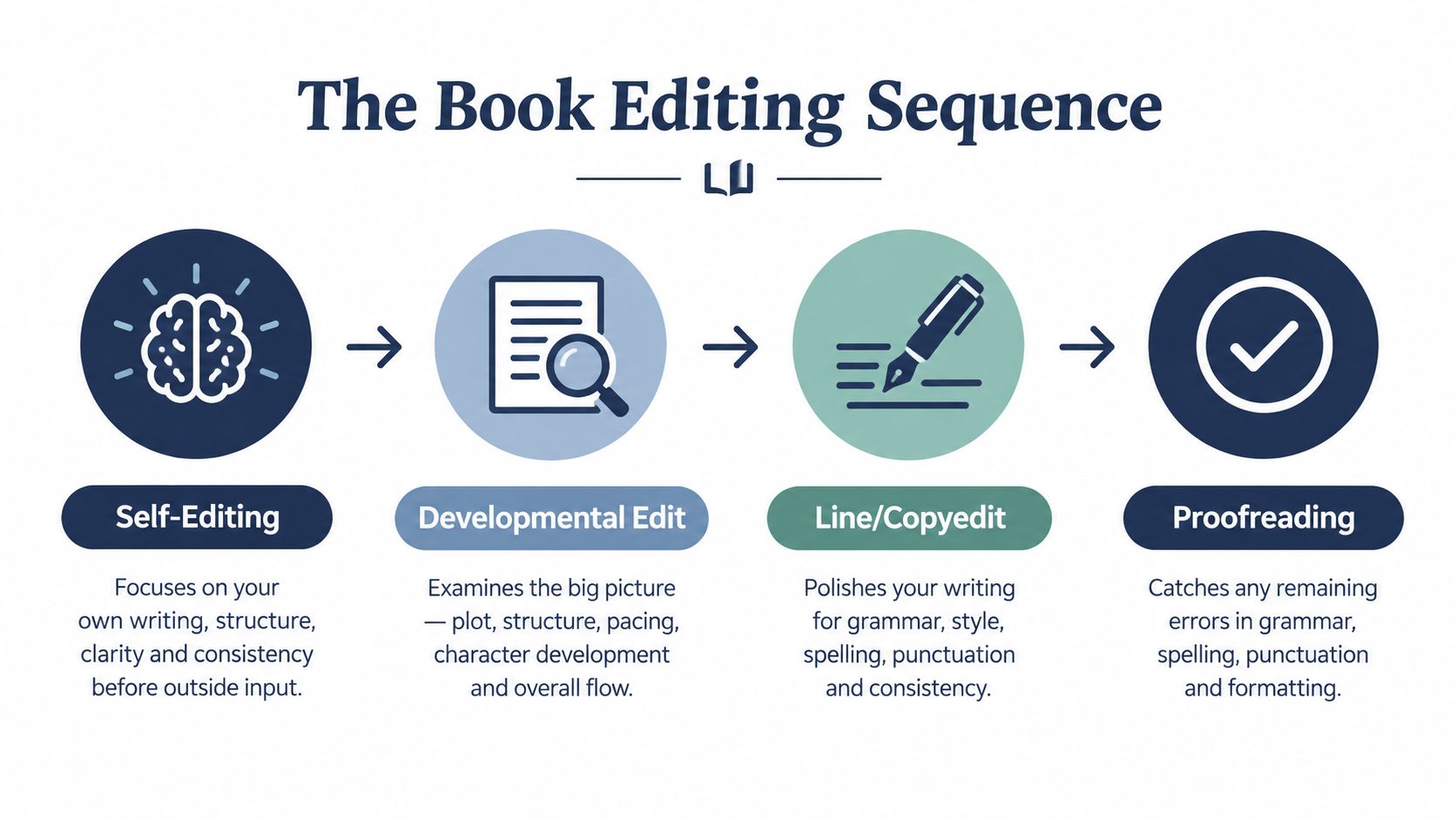
Match the defect to the stage
For a full-length novel, expect months rather than a rushed four-week transformation. Your first investment is time, not money. Let the draft cool, revise the architecture, and resolve the largest problems before paying someone to polish sentences that may later be deleted.
Developmental editing is the highest stage because it can expose a weak premise, an unearned ending, a slow opening, a confused point of view, or a nonfiction argument that lacks a usable spine. Line editing then improves expression. Copyediting enforces consistency. Proofreading checks the book after layout, when the text has become a designed object.
Practical rule: Never pay to polish material you already suspect you'll cut.
Skipping stages doesn't always mean hiring fewer people. It can mean asking the wrong professional to perform work outside the agreed scope. That creates unclear feedback, repeated revisions, and a larger bill. Sequence the work first, then decide which stages you can handle yourself.
Starting With Self-Editing Before You Spend a Dollar
Self-editing works when you treat it as an audit, not a hopeful reread. Don't open the document at page one and make random sentence changes. Use separate passes so your brain evaluates one category of problem at a time.
Use five deliberate passes
Pass one is structural. Write a one-sentence summary for every chapter, then compare those summaries with the book's promise. A mystery should escalate questions and evidence. A business book should move readers toward a clear outcome. If a chapter has no identifiable job, cut it, combine it, or redesign it.
Pass two is scene-level. For fiction, record each scene's goal, conflict, turn, and consequence. For nonfiction, identify the claim, evidence, explanation, and practical payoff. Mark scenes that repeat information or chapters that make the same argument in slightly different language.
Pass three targets dialogue and pacing. Read conversations aloud. Remove greetings, repeated explanations, and dialogue that exists only to deliver information the characters already know. Check the opening pages of every chapter, because delayed movement often signals a structural issue rather than a sentence problem.
Pass four tightens prose. Cut throat-clearing, duplicate modifiers, empty intensifiers, and abstract phrasing. Replace vague verbs with precise ones where the change strengthens meaning. Protect intentional rhythm and voice. Tight prose isn't automatically good prose, and flattening every unusual sentence can make a manuscript lifeless.
Pass five handles grammar and consistency. Check names, capitalization, chapter headings, tense, spelling variants, numbers, quotation marks, and recurring terminology. Build a simple style sheet in Google Docs, Word, or a spreadsheet. Record decisions instead of trusting memory.
Create distance before judging the draft
Take a cooling period of two weeks before the first serious reread. Then read the manuscript aloud, or use text-to-speech in Microsoft Word, Google Docs, or NaturalReader. Your eyes will glide over familiar wording. Your ears will catch missing words, repetitive rhythms, abrupt transitions, and dialogue that no person would say.
Beta readers and critique partners serve different purposes. A critique partner usually understands craft and can discuss technique. A beta reader responds as a normal member of the intended audience. Recruit five to eight readers when the project justifies broad feedback, but don't treat every opinion as an instruction. Ask focused questions:
- Where did you lose interest?
- Which character or idea felt unclear?
- What did you expect to happen next?
- Which section felt repetitive?
- What did the ending leave unresolved?
Lulu's 2025 Books and Business Insights report indicates that 68% of creators edit their own work, while 36% hire a professional editor. The same report records AI editing software use at 18% and peer crowdsourcing at 16%. Those figures explain why authors need a decision framework, not another instruction to “edit carefully.”
Your job is to fix what you can see clearly. A professional's job is to expose what your closeness to the manuscript prevents you from seeing.
Handle redundancy, obvious pacing problems, unclear sentences, and continuity you can verify. Leave market positioning, deep structural logic, voice consistency across a long manuscript, and complicated cause-and-effect chains for an experienced editor.
Developmental Editing and the Structural Overhaul
Developmental editing changes the book's architecture. It doesn't exist to make every sentence prettier. A developmental editor studies the reader's journey and identifies where the manuscript loses force, clarity, credibility, or momentum.
For fiction, that may mean examining plot escalation, character motivation, scene order, point of view, stakes, setting, and the relationship between promise and payoff. For nonfiction, it may involve clarifying the central argument, reorganizing chapters, strengthening transitions, removing competing ideas, and identifying places where readers need evidence or application.
A serious developmental package often includes a detailed editorial letter, margin comments, and chapter-level recommendations. The report might be eight to twenty pages, depending on scope and manuscript complexity. The useful deliverable isn't the page count, however. It's a revision map you can follow.
When the investment makes sense
Hire developmental help when you're a first-time author, changing genres, working on a manuscript longer than 80,000 words, or receiving conflicting feedback from readers. You should also consider it when you can't describe the book's promise in a sentence, when the middle sags, or when your ending works only because the author knows information the reader hasn't been given.
Experienced authors with tightly plotted thrillers, established series conventions, or a strong outline may reasonably reduce the scope. A manuscript isn't automatically safe because its author has published before. The question is whether the author can diagnose the specific structural risk without defending the draft.
The listed benchmark for developmental editing is $0.04 to $0.10 per word, which places a standard novel in the $3,600 to $9,000 range. A typical turnaround is four to eight weeks. These are planning benchmarks, not a universal price list. Complexity, editorial depth, genre, and the editor's availability can change the quote.
| Deliverable | Format | Typical Length | 2026 Cost |
|---|---|---|---|
| Editorial assessment | Report with revision priorities | Varies by scope | $0.04 to $0.10 per word benchmark |
| Structural editorial letter | Detailed document with chapter guidance | 8 to 20 pages | Included in a developmental package or quoted separately |
| Margin comments | Comments in Word or another manuscript platform | Throughout manuscript | Usually included or scoped separately |
| Revision consultation | Video call or written follow-up | Based on agreement | Quoted by editor |
Before signing, request a sample edit. A useful sample should reveal how the editor thinks, not merely demonstrate how many commas they can correct. Ask what they would prioritize, what they wouldn't change, how they define a successful revision, and whether the contract includes a follow-up conversation.
For a fuller explanation of the stage, review what developmental editing covers. Then compare the editor's description with your actual problem. If your manuscript needs a structural overhaul, buying a copyedit because it costs less is false economy.
Line Editing and Copyediting Side by Side
Authors regularly confuse line editing with copyediting because both happen inside the manuscript. Their purposes differ. Line editing improves how the writing works on the reader, while copyediting controls correctness, consistency, and adherence to an agreed style.
Consider a sentence such as: “She walked quickly across the room in a way that was hurried because she was very nervous.” A line editor might reshape it to improve rhythm and emphasis: “Nervous, she hurried across the room.” A copyeditor might accept the original sentence, query an awkward construction, or correct a specific grammatical issue, but copyediting isn't a license to rewrite the author's voice.
Compare the service before you buy it
| Dimension | Line Editing | Copyediting |
|---|---|---|
| Primary concern | Flow, clarity, rhythm, emphasis, and voice | Grammar, punctuation, spelling, usage, and consistency |
| Typical intervention | Recasts sentences and paragraphs when needed | Corrects or queries errors without reshaping the prose unnecessarily |
| Fiction focus | Narrative voice, dialogue, transitions, emotional precision | Tense, names, facts, capitalization, punctuation, and continuity |
| Nonfiction focus | Readability, explanation, organization within passages | Terminology, references, headings, style rules, and factual presentation |
| Main risk | Prose feels flat, repetitive, or difficult to follow | Book contains distracting errors and inconsistent decisions |
| Best position in workflow | After structural revisions | After line-level changes are complete |
A line editor may strengthen “He was really angry and he started shouting loudly” into “He shouted.” Or the editor may preserve the longer version if the repetition creates a deliberate emotional effect. A copyeditor records the choice, checks whether similar constructions appear elsewhere, and ensures the manuscript follows the style sheet.
Read what line editing means for a manuscript before requesting quotes. Describe the service you want in terms of outcomes, not labels. Ask whether the editor will rewrite for flow, preserve voice, annotate changes, create a style sheet, check continuity, or verify external facts.
Sequence the passes
Run line editing before copyediting. If a copyeditor corrects sentences that a later line editor substantially rewrites, earlier corrections may disappear or become inconsistent. Send the next editor a clean file, a style sheet, a glossary, and a list of flagged continuity items from the developmental revision.
Full-manuscript work commonly takes three to six weeks, though the actual schedule depends on length and editorial depth. Editors may quote by word, page, project, or hour. Don't compare quotes until you know whether they cover one pass, two passes, queries, style-sheet creation, and a response to author questions.
The common mistake is hiring a copyeditor to perform line editing, then complaining that the prose remains awkward. The opposite mistake produces a beautiful voice with unresolved mechanical errors. Buy the intervention your draft needs.
Why Proofreading Happens After Layout, Not Before
Proofreading belongs to the designed book, not the pre-layout manuscript. Typesetting can create widows and orphans, alter pagination, expose bad line breaks, shift fonts, damage kerning, break running headers, and separate captions from the material they explain. An EPUB introduces its own display behavior across devices.
A proofreader checks the PDF or EPUB readers will receive. That includes chapter openings, page numbers, headers, footers, front matter, back matter, copyright pages, contents links, section breaks, image placement, styling, and visible typographical errors. The proof is a distinct document because every file conversion can introduce new problems.
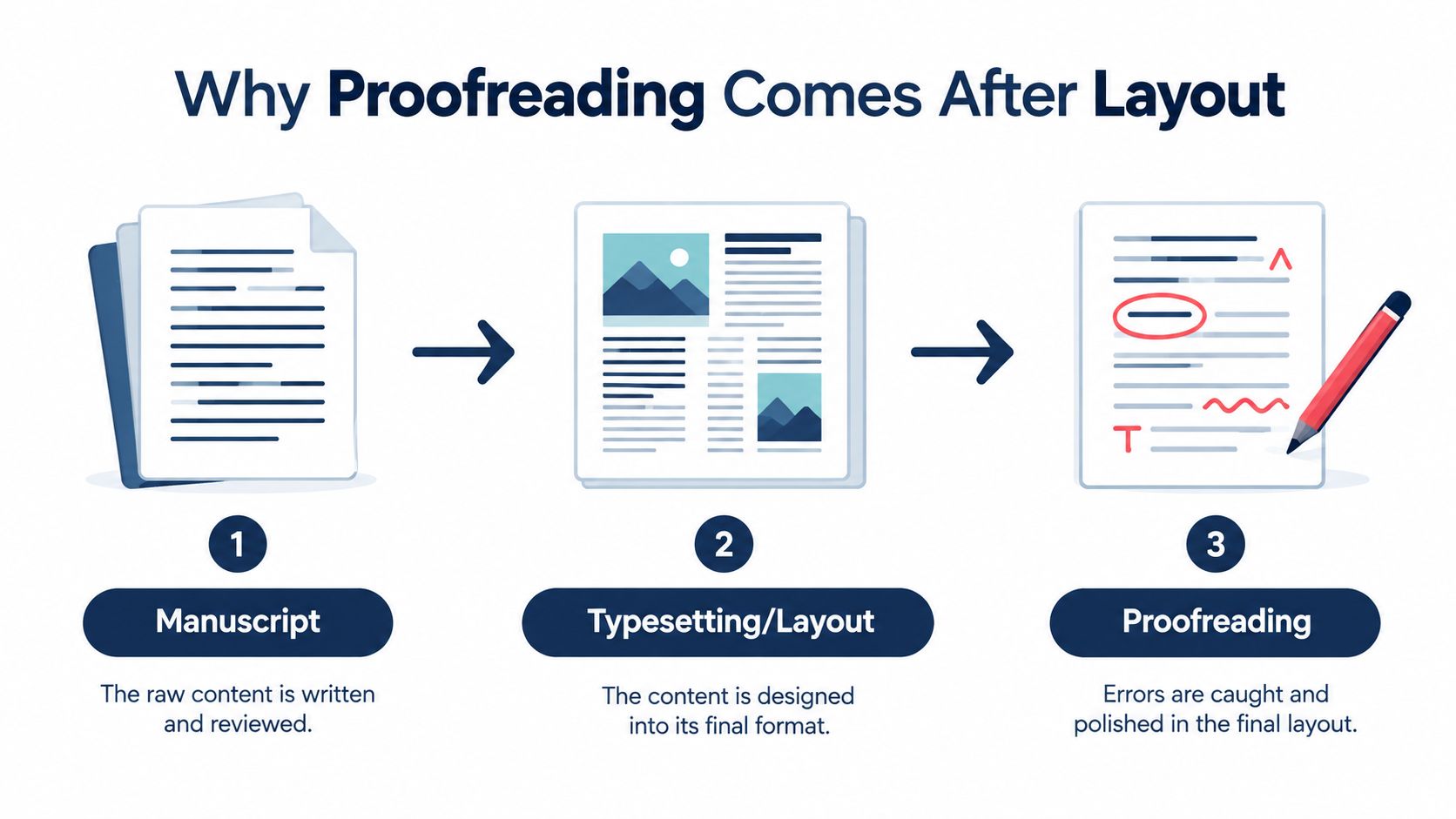
Use two focused reads
Start with a visual and typographical pass. Read the pages in order and mark misplaced breaks, uneven spacing, inconsistent headings, missing elements, duplicated text, blank pages, and layout defects. Don't make broad prose revisions at this point unless an error affects meaning.
Then perform a backwards read, moving from the final page toward the first and checking word by word. The disrupted narrative context makes it easier to notice spelling mistakes, homophones, duplicated words, and small omissions. If the book has both print and digital editions, proof each format separately.
Human review has limits. A summary of Dr. Ray Panko's proofreading research reports catch rates of about 81% for nonword errors and 66% for word errors, while the highest catch rate observed across the summarized studies was 95%. See the summary of proofreading error catch rates for the research context. The conclusion is practical: layered review reduces risk, but no single human pass guarantees perfection.
AI can help identify possible spelling, grammar, and consistency issues, especially during a preliminary check. It shouldn't replace a proofreader's judgment about layout, meaning, intentional style, or whether a suggested change damages voice. For a broader workflow, this AI-powered proofreading guide can help you use automated tools without treating their suggestions as final decisions.
Proofreading is usually the final editorial service, with turnaround and cost set by page count, format count, and the condition of the laid-out file. Skipping it is one of the clearest ways to release a book with visible errors, even when the manuscript copy was carefully edited. For the distinction between the two stages, see proofreading versus copyediting.
Budgeting Editing Tiers Without Overspending
Don't budget editing from page count alone. Budget from the book's purpose, audience, revenue plan, and risk. A private memoir, a lead-generation book, and a commercial novel don't require identical editorial investment.
The most useful framework has three tiers.
The low-stakes pipeline
A $300 to $800 DIY-and-beta pipeline can suit a personal project, a short book with limited distribution, or an author testing a concept. The author performs the five self-editing passes, uses text-to-speech, gathers beta feedback, and pays for a targeted professional review or final mechanical check.
This tier fails when the author expects it to produce commercial polish without doing the labor. It also fails when beta readers are asked to diagnose structural problems they aren't equipped to identify. Spend this money on a clearly defined gap, not on a vague “full edit” from an unknown provider.
The serious publishing pipeline
A $1,500 to $3,500 professional pipeline can cover selected developmental guidance, line editing, copyediting, or a combination with carefully limited scope. It suits serious fiction and nonfiction when the author has already revised heavily and can identify the manuscript's main weakness.
Do not commission copyediting before structural work is complete. If chapters will move, scenes will disappear, or the argument will change, mechanical corrections applied now may need to be repeated. Phase the work by milestone instead: deposit when the agreement is signed, a second payment after the developmental deliverable, and the balance when the clean copyedit is delivered.
The premium pipeline
A $4,000 to $10,000 or higher premium pipeline may suit a book positioned for demanding commercial, professional, or international distribution. It can include deeper developmental involvement, line editing, copyediting, proofreading, and more extensive communication. Higher spend doesn't automatically create higher sales. It buys more editorial attention, greater process depth, or broader risk coverage.
Written Word Media's 2025 Indie Author Survey reports that authors earning over $10,000 per month overwhelmingly spend within the $250 to $999 and $1,000 to $1,999 editing tiers. The survey also reports no strong income advantage from spending far above those ranges. Treat that as a warning against prestige spending, not as permission to under-edit.
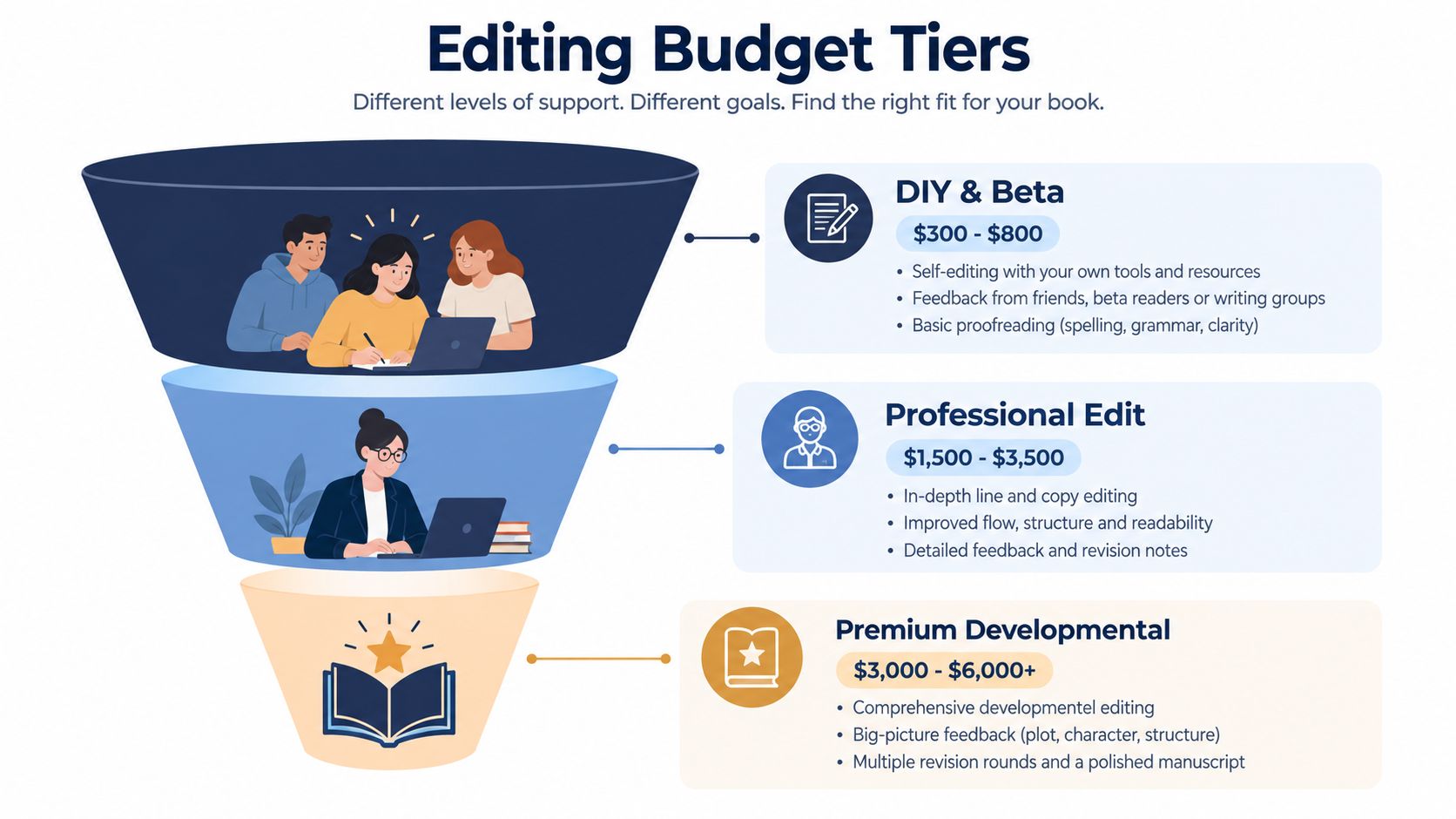
For a 90,000-word novel, begin with a manuscript audit and sample edit before committing to a package. If the story is structurally sound, direct funds toward line editing, copyediting, and proofing. If the story has major issues, reserve money for developmental work first and accept that the launch date may move.
A sensible rule is to keep total editing near 5% to 10% of projected first-year revenue, but that is a planning heuristic, not a guarantee of royalties. Don't borrow heavily to purchase editorial prestige. Equally, a budget is too thin when it leaves no room for structural review, no post-layout proof, or no revision time between services.
Your 90-Day Editing Plan and Final Checklist
A 90-day plan works only when the manuscript is complete enough to revise. If you're still drafting chapters, don't pretend you're editing. Finish the draft, save a locked version, and start the clock after the story or argument is stable.
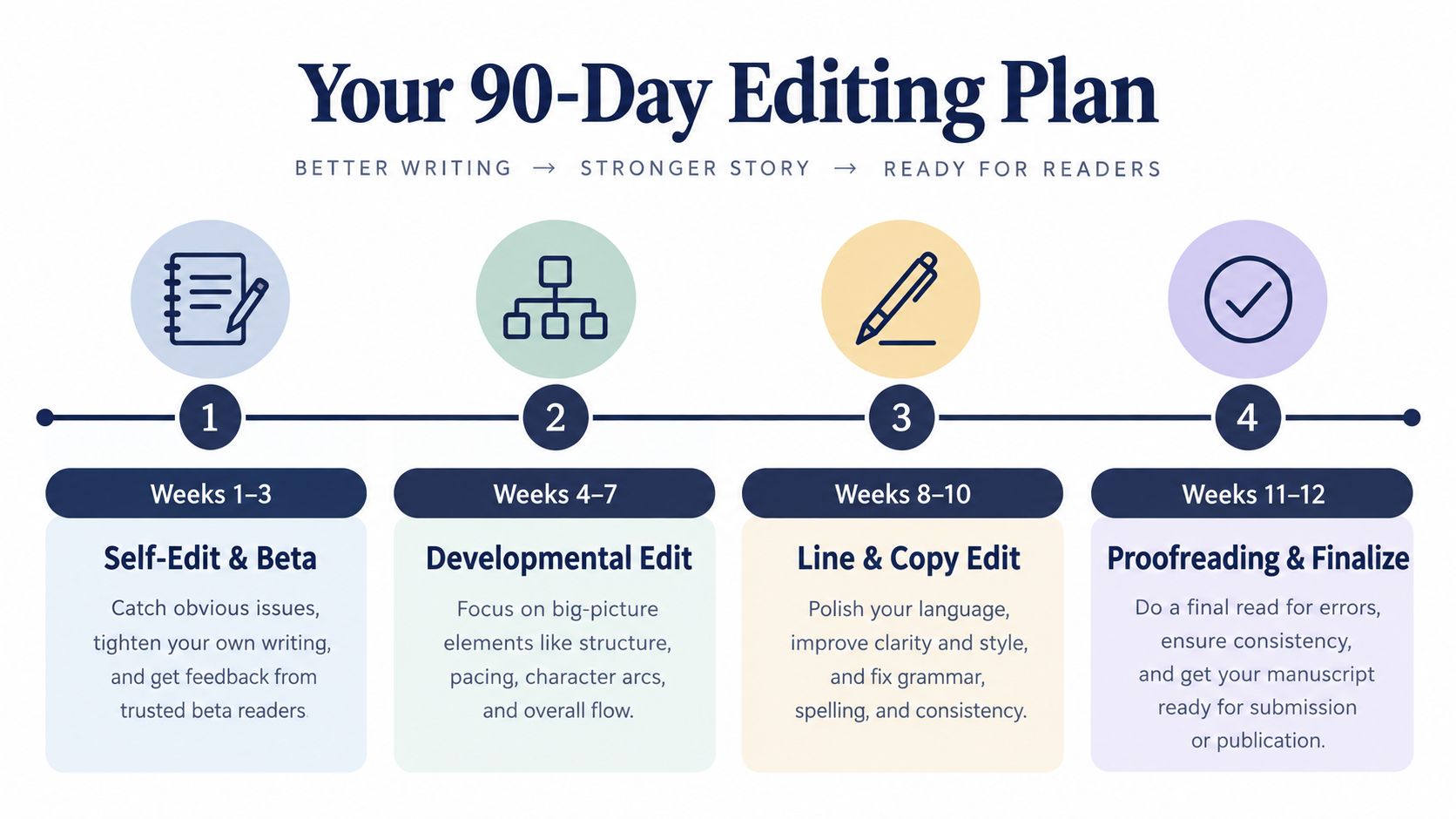
The schedule
Weeks 1 to 3, self-edit and beta feedback. Take the cooling period, complete the structural, scene, dialogue, prose, and grammar passes, then send the revised manuscript to selected readers. Look for patterns, not isolated preferences. Record every continuity concern in one document.
Weeks 4 to 7, developmental revision. Give the editor a clean manuscript, synopsis or project description, intended audience, comparable titles, and specific concerns. Read the editorial letter before defending the draft. Build a revision plan, then make the changes yourself unless hands-on restructuring is part of the contract.
Weeks 8 to 10, line and copyediting. Send the revised file, style sheet, glossary, character or terminology list, and continuity notes. Review queries promptly, but don't introduce major structural changes without understanding the downstream impact.
Weeks 11 to 12, layout and proofreading. Approve the interior design, generate the print proof and digital file, then proof each format. The final two weeks should cover launch preparation, metadata, ISBN work, retailer setup, cover delivery, and marketing assets. A full publishing calendar can extend beyond this plan, especially when the editor or designer has a queue.
Vet the editor before hiring
Ask for a relevant sample, a written scope, the file format, the number of passes, the expected turnaround, the revision policy, and the payment milestones. Request references or verifiable client feedback where available. Confirm whether fact-checking, sensitivity reading, citations, glossary work, and post-edit questions are included or billed separately.
Before moving forward, check the manuscript against these stage gates:
- Self-edit complete: Every chapter has a purpose, repeated material is marked, and the style sheet records key decisions.
- Development complete: Major structural recommendations are accepted, rejected with reasons, or converted into a documented revision plan.
- Line edit complete: Voice, pacing, clarity, and paragraph flow have been reviewed after structural changes.
- Copyedit complete: Names, terms, facts, capitalization, punctuation, and formatting conventions are consistent.
- Proof complete: The laid-out PDF or EPUB has been read, corrections have been applied, and the corrected file has been checked again.
A 2026 benchmark for scientific writing found that one factual edit can require an average of 15.6 dependent updates, with 1,907 dependent sentences across 122 benchmark items spanning 89 manuscripts. The benchmark's detailed findings offer a useful warning for book authors too. A changed date, name, age, location, or chapter reference must be propagated through every dependent mention. Make a master list, audit every occurrence, and reread continuity after the revision.
The three shortcuts are predictable. Skipping developmental work leaves structural weaknesses intact. Rushing proofreading leaves layout errors and typos in the published file. Editing while drafting creates rework because later chapters change the assumptions earlier chapters depend on.
Editing is a system, not a sprint. BarkerBooks offers developmental editing, line editing, copyediting, proofreading, formatting, and broader publishing support for authors preparing books for English and Spanish markets. If you want an editorial plan matched to your manuscript and publishing goals, visit BarkerBooks and request a consultation before commissioning the wrong stage.