
So, you have an idea for a children's book. That's fantastic. But before you dive into writing, it's worth knowing that the journey from a spark of an idea to a finished book involves a few key phases: shaping the story, writing and editing the manuscript, bringing it to life with illustrations and design, and finally, getting it into the hands of young readers.
The very first step, and honestly the most important one, is deciding who you're writing for. Your target age group will shape every single decision you make, from the number of words on a page to the style of the pictures.
Your First Steps in Creating a Childrens Book
Writing a children's book is more than just a passion project; it's a chance to enter a surprisingly robust market. The global children's book industry is valued at over USD 10.40 billion and is expected to climb past USD 15.52 billion in the next few years. What's driving this? A real hunger for fresh stories that reflect diverse backgrounds and cultures, which is great news for new authors with unique voices.
While the creative part is exciting, having a clear roadmap from the start can save you a lot of headaches later. Thinking through the whole process keeps you from getting bogged down.
This simple chart lays out the basic path you'll follow.
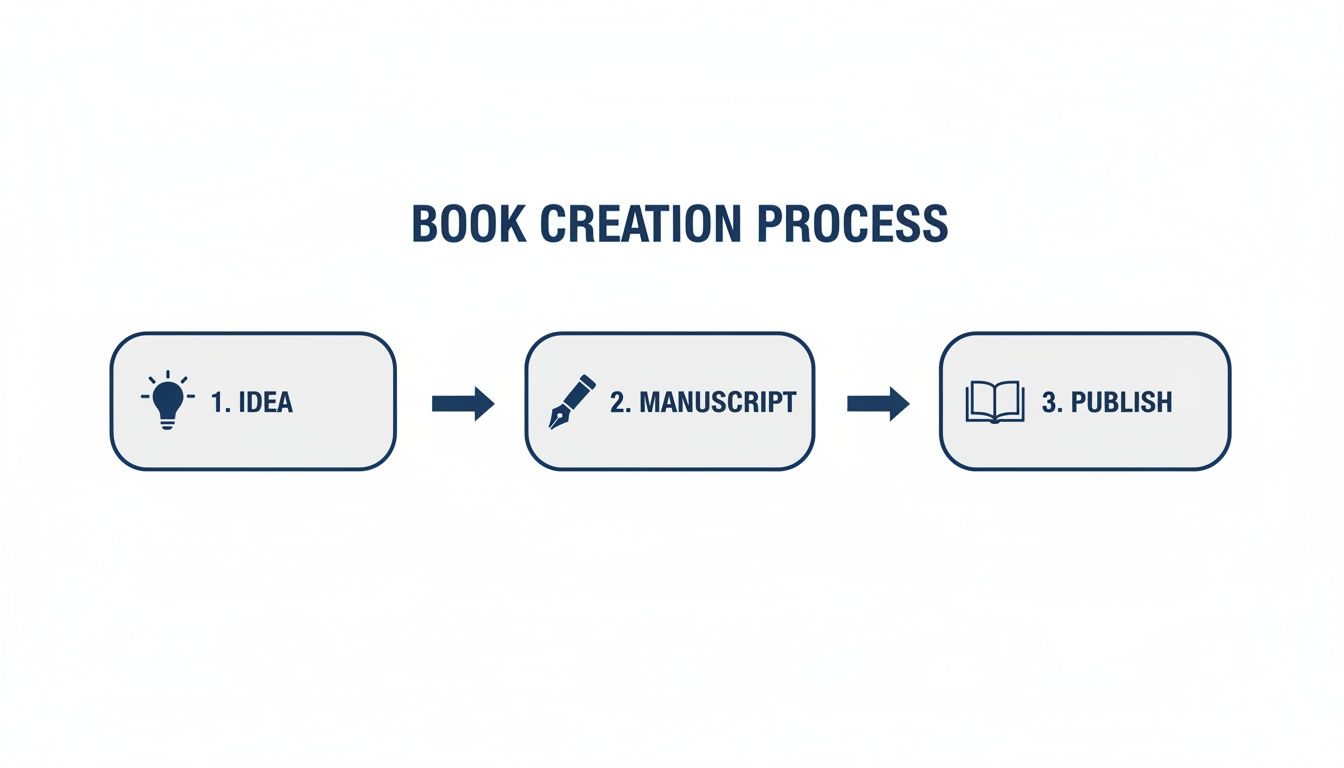
It’s a straightforward progression: a great idea turns into a polished manuscript, which then gets illustrated, designed, and finally published.
Define Your Target Reader First
Before you even think about your main character or the first sentence, you need to answer one question: Who is this book for?
A story that makes a three-year-old giggle will fly right over the head of an eight-year-old, and a chapter book designed for a newly independent reader will be far too much for a toddler. Everything hinges on this decision.
Here’s why it’s so critical:
- Word Count: A board book might only have 50 words, but an early reader can easily top 1,000.
- Story Complexity: Toddlers connect with simple, everyday themes. Older kids, on the other hand, can handle more intricate plots and deeper emotional journeys.
- Illustration Style: For the little ones, you want bright, bold, and simple images. For older readers, the art can be more detailed and nuanced, adding another layer to the story.
Defining your reader isn't just a suggestion; it's the foundation of your entire project. It ensures your story, language, and illustrations are perfectly aligned to create a book that a child will truly love and engage with.
Understanding Childrens Book Categories
To help you figure out where your story fits, it helps to know the main categories in the kids' book world. These aren't just arbitrary labels; they're based on developmental stages and have their own set of reader expectations. If you want to dig deeper, our guide on the complete book writing process is a great resource.
The table below breaks down the most common formats. Think about your story idea and see which category feels like the right home for it.
Children's Book Categories by Age Group
| Book Type | Target Age | Typical Word Count | Key Features |
|---|---|---|---|
| Board Books | 0-3 years | Under 75 words | Durable, thick pages. Focus on simple concepts like colors, animals, or feelings. Very interactive. |
| Picture Books | 3-8 years | 300-800 words | The classic format where illustrations and text work together to tell a complete story with a clear plot. |
| Early Readers | 5-9 years | 1,000-2,500 words | A bridge to chapter books. Simple sentence structures and illustrations that support the text for new readers. |
| Chapter Books | 7-10 years | 5,000-15,000 words | Longer stories broken into chapters with fewer illustrations. Characters often face relatable, real-world problems. |
Once you've picked a category, you have a solid framework. It gives you the creative guardrails you need to build a story that really connects with its intended audience, turning your dream into a concrete plan.
Crafting a Story That Captivates Young Readers
A great idea is the spark, but the real magic of a children's book is in the telling. This is where you transform a simple concept into a living, breathing story that sticks with a child long after you've closed the cover. We’re moving beyond the initial idea and into building a manuscript that an editor and illustrator will be thrilled to work on.
Your first job is to find that story spark—something that feels fresh but also deeply familiar. It's easy to get caught up trying to tackle huge, complicated ideas, but honestly, the most powerful stories for kids explore a simple truth through their eyes. Think about the big moments of a small life: the nervous jitters of the first day of school, the pure joy of finding a new friend, or the tough lesson of learning to share.
These everyday experiences give your story an emotional core that kids just get. The trick is to give it your own unique spin. Instead of another story about a child scared of the dark, what if your main character is a little monster who's terrified of the light? A simple twist like that can take a universal theme and make it completely unforgettable.
Building Characters Children Will Love
The heart and soul of your story is your main character. Kids need a protagonist they can cheer for and connect with, someone they see a little bit of themselves in. This doesn't mean your character needs to be perfect—in fact, it's their quirks and flaws that make them feel real.
When you're sketching out your character, nail down a few key things:
- A Clear Desire: What does your character want more than anything else in the world? Maybe it's finding a lost teddy bear, winning the big race, or just getting a hug from their grandpa. This desire is the engine that drives your plot.
- A Relatable Flaw: Is your character a bit clumsy? Maybe they’re painfully shy or a little too stubborn for their own good. Giving them a small weakness makes their eventual success feel so much more earned and satisfying.
- A Distinctive Voice: Think about how your character sounds and acts. A loud, brave adventurer will have a very different energy than a quiet, thoughtful observer.
A classic example I’ve seen work time and again is the picky-eater bunny. The desire is simple: he only wants carrots. His flaw is that he refuses to try anything new. Right away, you’ve created a relatable conflict that countless kids and parents have lived through.
Structuring a Simple and Satisfying Plot
The plot of a picture book needs to be straightforward. Young minds don't need complex subplots or shocking twists; they need a clear path they can follow. The most effective structure, and one that has worked for generations, is beautifully simple: a character has a problem, they try (and maybe fail a few times) to solve it, and they finally succeed, learning a little something in the process.
A strong, simple plot acts like a sturdy clothesline for your story. It holds everything together, from the character's first challenge to their final, triumphant moment, ensuring the reader never gets lost.
Think of your story as having three essential parts:
- The Beginning: Introduce your main character and their world. Make it crystal clear what they want and what problem is standing in their way.
- The Middle: This is where the fun happens. Your character tries to solve their problem. This "try-fail" cycle is perfect for building a bit of gentle tension and keeping kids turning the pages.
- The End: The character figures it out, achieves their goal, and experiences a small but meaningful change. The ending should feel satisfying and well-earned.
If you want to go a bit deeper into building a narrative that really sings, you can find some fantastic advice on how to write your own story. It’s a great resource for structuring a plot that will resonate with young readers.
The Power of Rhythm and Repetition
Finally, don't forget how your words sound. Children's books are meant to be read aloud, so the rhythm and flow of your language are just as important as the story itself. This is why reading your manuscript out loud is non-negotiable. Seriously, do it. Do you stumble over any clunky phrases? Does the rhythm feel off?
Lean into the literary devices that make a story delightful to listen to:
- Repetition: Repeating a key phrase or a silly sound creates a comforting, predictable pattern. It's an open invitation for kids to join in on the reading.
- Rhyme: Not every book needs to rhyme, but a good, natural rhyming scheme can make a story feel musical and much easier to remember.
- Alliteration: Playing with words that start with the same sound ("the big, blue balloon bounced") adds a fun, poetic texture to your writing.
By focusing on a fresh idea, a character kids can root for, a simple plot, and language that’s a joy to hear, you’ll have a manuscript that’s truly ready for the exciting next steps of editing and illustration.
Bringing Your Story to Life With Illustrations
Words tell a story, but illustrations make it magical. This is the moment your manuscript stops being just a text document and starts becoming a vibrant world a child can step into. The pictures are every bit as important as the plot, shaping how a young reader connects with your characters and their journey.
The author-illustrator relationship is a true partnership. It’s not just about finding someone who can draw well; it’s about finding a visual storyteller whose style clicks with the heart of your story. A zany, laugh-out-loud tale needs a completely different artistic touch than a quiet, soothing bedtime book.
Finding and Collaborating With an Illustrator
So, where do you find this perfect partner? A great place to start is online. Platforms like Behance and Upwork have massive communities of artists, but I also love digging through social media. Just search hashtags like #kidlitart or #childrensbookillustrator on Instagram, and you’ll find an incredible treasure trove of portfolios.
Once you’ve found a few artists whose work you adore, it’s time to reach out professionally. Your first email should be clear and concise.
- A Quick Synopsis: A single paragraph summarizing your story.
- The Manuscript: Attach the full, edited text so they know exactly what they're working with.
- Project Scope: Be specific. Mention the number of illustrations you need (e.g., 16 full-page spreads).
- Budget & Timeline: Be upfront about what you can pay and when you need it done.
A great collaboration is built on clear communication and mutual respect. Remember, you're hiring them for their artistic vision, not just to trace the ideas in your head.
Crafting a Detailed Illustration Brief
This might be the single most important document you create for your illustrator: the illustration brief. Think of it as the blueprint for your book's visual world. It’s your chance to guide the artist without micromanaging their creativity.
A solid brief gives specific direction for each page. For instance, instead of just saying, "Show the bunny being sad," try something more descriptive: "Page 4: Leo the bunny is sitting under a big, drooping willow tree. His long ears are flopped down, and he’s clutching his little worn-out teddy bear. A single tear is rolling down his cheek. Let's use a muted palette of blues and grays here to really show his mood."
Your illustration brief is the bridge between your written story and its visual life. Detail character expressions, setting specifics, color palettes, and the emotional tone of each scene. It gets you and your illustrator on the same page from day one.
The Fundamentals of Book Design and Layout
Beyond the individual illustrations, the book's overall design is what makes it feel polished and professional. This covers everything from the font you choose to the all-important cover. The font needs to be crisp, readable, and right for your target age. A playful, rounded font is perfect for a picture book, while a more traditional serif font might suit a middle-grade chapter book.
And the cover? It's your number one marketing tool. It has just seconds to grab the attention of a parent or a child. A powerful cover should:
- Showcase the main character.
- Hint at the story's main adventure or theme.
- Use a title font that’s easy to read and pops off the shelf.
While you can try to design it yourself, hiring a professional book designer can make a world of difference. They understand all the technical specs for printing and know how to make your book look incredible both online and in a bookstore. For a deeper dive into the technical side, take a look at our tips for preparing color books for print-on-demand.
The children's book market in the US is a massive $3.3 billion industry. Even with screens everywhere, there's a huge appetite for unique, beautiful books. In fact, the market for personalized children's books is expected to almost double, which shows how much families crave stories where kids can see themselves as the hero. It's proof that a well-illustrated, beautifully designed book has a real chance to find its audience and thrive.
Navigating Your Path to Publication
Your manuscript is polished, the illustrations are breathtaking, and your story finally feels alive. So, what's next? This is where your creative vision meets the business of books, and the choices you make now are critical to getting your story into the hands of young readers.
Before you can think about printing or distribution, you need to handle a couple of essential, non-negotiable details. These are the building blocks that make your book official.
Securing Your ISBN and Copyright
First up is the International Standard Book Number (ISBN). Think of it as your book's unique fingerprint—no two are alike. You’ll need a separate ISBN for every single format you release: one for the hardcover, another for the paperback, and yet another for the e-book version. In the U.S., the official source for purchasing ISBNs is Bowker.
Next is copyright. Here’s the good news: the moment you create your story, you technically own the copyright. But "technically" isn't enough. Officially registering your work with the U.S. Copyright Office creates a public record of your ownership. This is your legal shield if you ever need to defend your work from infringement. It's a small investment for some serious peace of mind.
Securing an ISBN and registering your copyright aren't optional extras. They are the fundamental steps that transform your manuscript into a legitimate product ready for the marketplace, protecting your hard work and making it discoverable.
Choosing Your Publishing Path
With the legal nuts and bolts sorted, you’ve reached the biggest fork in the road: how to actually publish your book. There are three main paths, and each comes with its own set of trade-offs. Your decision will hinge on your personal goals, your budget, and how much control you want to maintain over your creation.
For a deeper dive, we have a whole guide exploring the differences between traditional and self-publishing.
The timing couldn't be better. The picture book market is forecast to grow substantially, from $12.34 billion to $21.68 billion, fueled by a growing appetite for more interactive and educational content. This trend opens up a huge opportunity for authors who understand how to navigate their publishing options. You can find more data on the children's book market's growth at globalmarketstatistics.com.
Comparing Your Publishing Options
Making this choice can feel overwhelming, so let's break down the main publishing avenues. Each offers a different mix of creative freedom, financial investment, and potential audience reach.
The table below gives you a quick snapshot of what to expect from each path, helping you align your goals with the right strategy.
Comparing Publishing Paths for Children's Authors
| Publishing Path | Creative Control | Upfront Cost | Distribution Reach | Best For |
|---|---|---|---|---|
| Traditional | Low | None | High | Authors with agent representation who want the prestige and marketing power of a major publisher and are willing to give up creative control. |
| Self-Publishing | High | High | Varies | Authors who want full creative and financial control, have an entrepreneurial spirit, and are prepared to manage the entire process themselves. |
| Hybrid | Medium | Medium | Medium-High | Authors who want professional guidance and distribution support but are willing to invest financially to retain higher royalties and more creative say. |
Ultimately, there's no single "best" path—only the one that's best for you and your book.
Deciding on Your Book Format
Finally, you need to decide on the physical (or digital) form your book will take. The right format connects directly with your target age group and how they'll interact with your story.
- Board Books: These are the tanks of the book world. Built for babies and toddlers (ages 0-3), their thick, durable pages with rounded corners are made to survive teething and tiny, grabby hands.
- Hardcover: The classic, premium choice. A hardcover gives a book a sense of permanence and high quality, making it perfect for keepsake picture books and gifts.
- Paperback: More affordable and lightweight, paperbacks are a fantastic option for early readers and chapter books. They're less intimidating for kids to carry around and read on their own.
- E-book: A must-have in today's world. E-books offer instant, global distribution and are a lifesaver for parents traveling or looking for on-the-go entertainment.
Choosing your publishing path and format is the last big creative step. It’s all about matching your vision with a practical strategy to give your book its very best shot at finding a home on a child's bookshelf.
Marketing Your Book to Find Its Audience
Having a beautiful, finished book is an incredible milestone, but it's really just the beginning. The next chapter is all about getting that book into the hands of the kids who will fall in love with it.
Forget the idea of splashy, expensive ad campaigns. For most new authors, marketing is about building real connections and finding the people who are already looking for stories just like yours—parents, teachers, and librarians. It’s less about selling and more about sharing your passion.
Build Your Author Platform
Your author platform is simply your home base on the internet. It doesn't need to be fancy or complicated. A clean, simple website with an "About the Author" page, some info about your book, and a contact form is a fantastic start. This is your digital storefront, establishing you as a professional.
From there, dip your toes into social media. You absolutely don't need to be everywhere at once. Just pick one or two platforms where the adults who buy children's books actually hang out.
- Instagram: Since children's books are so visual, Instagram is a natural fit. You can share beautiful illustrations from your book, post behind-the-scenes sketches, or even share fun facts related to your story's theme.
- Facebook: This is great for tapping into parent groups and local community pages. It's the perfect place to share information about an upcoming library reading or chat directly with people in your town.
Remember, consistency beats frequency. A couple of thoughtful posts each week will do more for you than a daily flood of content that feels generic.
Your author platform isn't about a hard sell; it's about sharing. Use it to tell the story behind the story, connect with your community, and make it easy for new fans to find you.
Connect With Your Core Audience Online
Once you've set up your home base, it's time to go out and find your readers. Put yourself in the shoes of a book buyer. Where do parents and educators get their recommendations? They look for trusted voices, and that's where you want your book to be.
One of the most effective strategies is to connect with "kidlit" bloggers and reviewers. These are people who are genuinely passionate about children's literature and have built a loyal following. Do some research to find blogs that cover books similar to yours in genre and age range. A quick, personalized email explaining why your book would be a great fit for their readers can open a lot of doors.
Don't ignore the promotional tools built right into platforms like Amazon. Running a Kindle Countdown Deal, for example, can temporarily discount your e-book. This can trigger a big wave of downloads, boost your book's sales rank, and make it much more visible to new readers. That visibility often translates into more reviews and organic sales long after the promotion is over.
Even a small, highly-targeted ad campaign on Amazon or Facebook can make a difference. The key is to narrow your audience to specific interests, like "early childhood education" or "parenting blogs."
Take Your Book Into the Real World
While online marketing is crucial, nothing replaces the magic of real-world interaction, especially with children's books. Building connections in your own community creates a foundation of support that can have a ripple effect.
Start by reaching out to the places that serve your audience right in your backyard:
- Schools and Libraries: Offer to do a free reading or a short presentation about your journey as an author. Teachers and librarians are almost always looking for local authors to feature.
- Local Bookstores: Indie bookstores are often the biggest champions for local talent. Pop in and ask if they offer consignment or if you can participate in a local author event.
- Community Fairs and Markets: Setting up a booth at a local craft fair, farmers' market, or school festival puts your book directly in front of hundreds of families in a single afternoon.
These events aren't just about selling copies; they're about creating experiences. When a child gets to meet the person who wrote a story they love, it forges a powerful, lasting connection to reading itself.
Marketing a children's book is a marathon, not a sprint. Every social media post, every school reading, and every new review is a small step forward, helping your story find its way onto the right bookshelf.
Your Top Questions About Creating a Children's Book
Getting ready to create your children's book is thrilling, but it's completely normal to have a ton of questions swirling around. What's this really going to cost? How long will it take? Let's clear up some of the most common worries and queries that pop up for authors just starting out.
Think of this as the practical side of bringing your book to life. Getting straight answers now will give you the confidence to take those final, exciting steps.
How Much Does It Cost to Self-Publish a Childrens Book?
This is always the first question, and the most honest answer is: it really depends. Your total investment is a direct result of the choices you make—specifically, how much of the work you're willing to do yourself versus hiring seasoned professionals.
Here’s a realistic breakdown of where your budget will go:
- Illustrations: This is almost always the biggest piece of the pie. A professional illustrator might charge anywhere from $2,000 to over $10,000 for a typical 32-page picture book. Their experience, style, and the complexity of the art are the main factors.
- Editing: Don't even think about skipping this. For a polished, professional book, you'll need an editor. A developmental edit can run $500–$1,000, with a final proofread costing another $200–$500.
- Design and Formatting: You need a designer who understands how to lay out a children's book for both print and digital. Expect to invest between $500 and $1,500 for a beautiful cover and interior.
- ISBNs: You'll need these to sell your book. A single ISBN from a service like Bowker is about $125, but you'll save a lot by buying a block of 10 for around $295.
When you add it all up, producing a high-quality, self-published picture book can easily land somewhere between $4,000 and $15,000. It’s a serious investment, but it's what separates a passion project from a book that can truly compete in the marketplace.
How Long Does the Whole Process Take?
Patience is your best friend on this journey. From that first messy draft to actually holding a printed copy, the timeline is almost always longer than authors expect.
The path from idea to bookshelf is a marathon, not a sprint. A realistic timeline is one to two years, especially when you're coordinating with editors, illustrators, and designers.
Let’s map out what that looks like:
- Writing & Revising: This is all on you. It could take 2 to 6 months, depending on your writing schedule and how many rounds of feedback you get.
- Finding & Working with an Illustrator: This is a huge chunk of time. The illustration process alone—from initial character sketches to the final, colored pages—often takes 6 to 12 months.
- Editing, Design, & Formatting: Once the words and pictures are final, pulling them together into a print-ready file takes another 1 to 3 months.
- Printing & Distribution: If you go the print-on-demand route, setup is fast. But if you’re doing a larger offset print run, you’ll need to add another 2 to 4 months just for printing and shipping.
What Are the Biggest Mistakes First-Time Authors Make?
You can save yourself a world of trouble by learning from the missteps of others. Too many new authors get so excited about publishing that they rush through the most critical steps, and it shows in the final product.
These are the most common pitfalls I see:
- Skipping Professional Editing: Nothing screams "amateur" faster than typos and clunky sentences. A good editor does more than fix your grammar; they make sure the story actually works for your target age group.
- Underestimating the Art: The illustrations carry at least 50% of the storytelling in a picture book. Hiring an illustrator just because they're cheap is a recipe for disaster. The art needs to elevate your story, not just fill the page.
- Bad Book Design: An ugly cover, a font that's hard to read, or a clumsy layout will kill a sale instantly. Your book's design is its silent salesperson on the shelf.
- Ignoring the Target Audience: Are you writing for a 3-year-old or an 8-year-old? The language, themes, and illustrations are completely different. A book that tries to be for everyone often ends up connecting with no one.
Do I Need a Literary Agent?
This one is simple: it all comes down to your publishing goal.
If you dream of seeing your book published by one of the "Big Five" traditional publishers like Penguin Random House or Simon & Schuster, then yes, a literary agent is non-negotiable. These publishers do not accept unsolicited manuscripts. An agent is your champion, your negotiator, and your guide through that highly competitive world.
However, if you're planning to self-publish or use a hybrid publisher, you do not need an agent. In that model, you are in the driver's seat. You act as the project manager, hiring your own team and keeping total creative and financial control.
Navigating the path to publication can feel complex, but you don't have to do it alone. The expert team at BarkerBooks offers full-service support to guide you from manuscript to a globally distributed book. Explore our publishing packages and start your journey today.