
Your book's title is so much more than a name; it’s the most important piece of marketing you'll ever write. A great title has to do three things at once: fit neatly into your genre, make it easy for readers to find, and stir up some real emotion. It’s your first—and often only—chance to tell a reader exactly what kind of experience they’re about to have.
Aligning Your Title with Genre Expectations
Before you even start brainstorming, you have to get a feel for the literary neighborhood your book will live in. Picture a reader scrolling through Amazon or browsing a bookstore shelf. They have a specific craving, a certain kind of story they're in the mood for. Your title is the first signal that tells them, "Hey, this is the one you're looking for."
Getting this wrong is the fastest way to confuse potential readers and lose them completely. A title like Chronicles of the Starforged Blade instantly screams epic fantasy adventure. Meanwhile, The Last Secret of Mulberry Lane whispers of a cozy mystery. If you swapped those two, you’d just leave everyone scratching their heads.
Decoding Bestseller Lists
The best shortcut to learning the language of your genre? Go study what’s already working. Block out an afternoon to dive into the Amazon, New York Times, or USA Today bestseller lists for your specific category. But don't just skim the titles—break them down.
- Look for patterns in length. Are most thrillers just 2 to 4 words long? Do romance titles tend to be a bit more flowery and descriptive?
- Identify common structures. You’ll notice a lot of nonfiction books use a catchy main title followed by a very clear, descriptive subtitle. Think of something like Atomic Habits: An Easy & Proven Way to Build Good Habits & Break Bad Ones.
- Analyze the emotional tone. What feelings do the words bring up? Mystery? Passion? Danger? The words used in top-selling sci-fi are going to be worlds apart from what you see in self-help.
This process is all about understanding how to meet your reader's expectations, which are shaped by the books they already love.
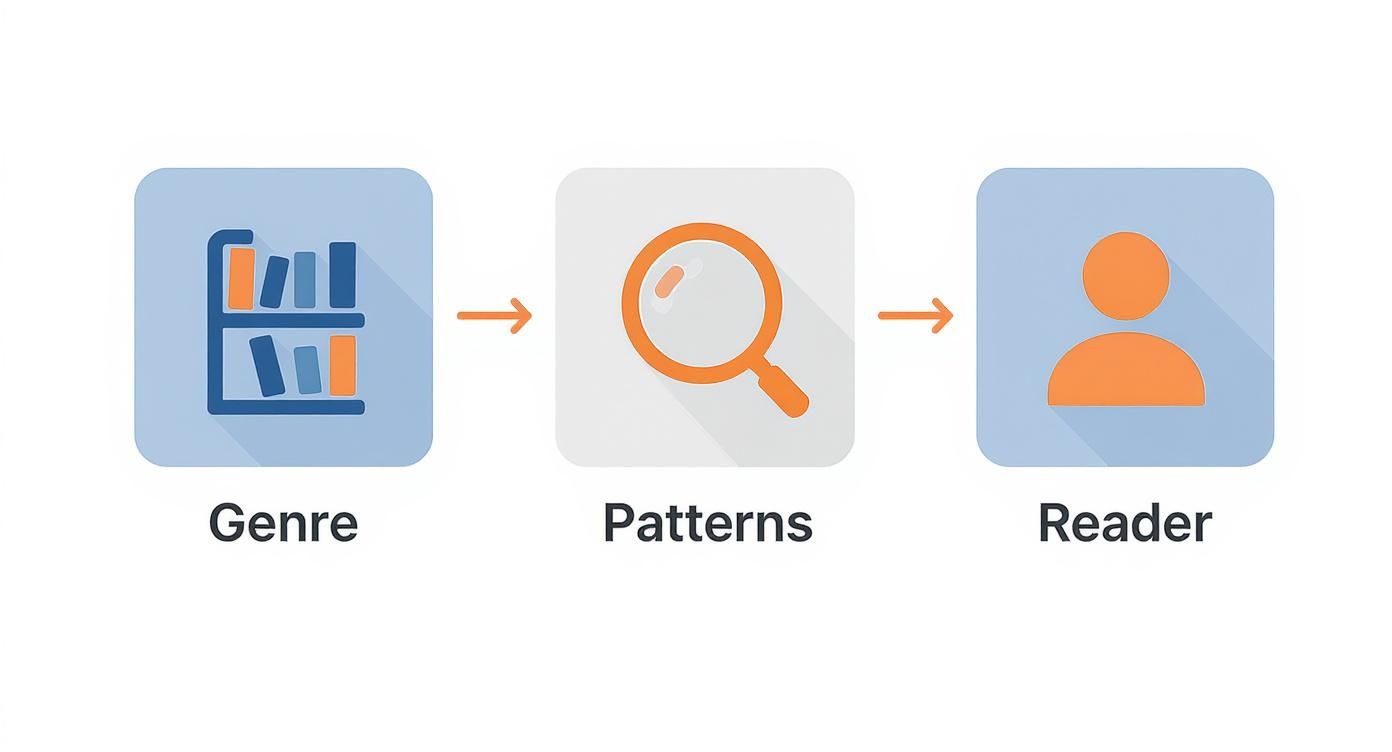
As you can see, your title is the critical bridge connecting what’s inside your book to what your reader is hoping to find.
Speaking Your Reader's Language
This isn't about just copying what's popular. It's about getting inside your reader's head and speaking their language. You’re building on a shared understanding. For example, check out the naming conventions in some popular historical fiction series—you'll see themes of time, place, and legacy repeated over and over.
The goal is to create a title that feels both fresh and comfortingly familiar. It’s a delicate balance, but it’s where bestsellers are made.
A genre-appropriate title removes friction. It confirms for readers that they’ve found the kind of story they love, making the decision to click "buy" that much easier.
A thriller, for instance, often uses a short, punchy title that creates a sense of urgency, like The Girl on the Train or Gone Girl. They are intentionally concise and mysterious, hinting at the puzzle inside. By contrast, a historical romance might have a more lyrical and sweeping title like Outlander or The Bronze Horseman, suggesting an epic journey.
Book Title Conventions by Popular Genre
To give you a head start, here’s a quick look at the common title patterns you’ll find across different genres. This isn't a set of hard rules, but rather a guide to understanding what readers have come to expect.
| Genre | Common Title Length (Words) | Typical Tone/Style | Example Pattern |
|---|---|---|---|
| Thriller/Mystery | 2–4 | Tense, intriguing, direct | The [Adjective] [Noun], The [Location], [Verb]ing [Person] |
| Fantasy | 3–6 | Epic, evocative, magical | A [Noun] of [Noun] and [Noun], The [Adjective] [Object] |
| Romance | 3–5 | Emotional, descriptive, personal | The [Noun]'s [Promise/Vow], [Adjective] [Feeling] |
| Science Fiction | 2–5 | Conceptual, futuristic, technical | Project [Name], The [Concept] [Noun], [Number] [Unit] |
| Self-Help | 2–4 (Main Title) | Empowering, clear, aspirational | The [Adjective] Art of [Verb], How to [Achieve Goal] |
| Business/Finance | 2–5 (Main Title) | Authoritative, practical, benefit-driven | The $[Number]-Hour [Noun], [Action] and [Result] |
Looking at these patterns makes it clear how much a title’s structure and tone can signal its genre. Your job is to find a creative way to play within these conventions, not break them entirely.
Make Your Title Search-Ready
Let's be honest: the first place most readers shop for books isn't a cozy corner bookstore anymore. It's a search bar. Whether on Amazon or Google, your book's title has to do some heavy lifting. It's not just a creative label; it’s your number one marketing tool for getting found online.
This is where many authors stumble. They fall in love with a poetic title but forget that search engines don't understand poetry. A non-fiction book on urban gardening titled Green Dreams is beautiful, but it's invisible to a reader searching for "how to grow vegetables on a balcony."
Your title and subtitle are prime digital real estate. Packing them with the right keywords transforms your book from a needle in a digital haystack into a magnet that pulls in your ideal readers, day and night.
Think of it like this: your creative title catches the eye, but your search-optimized elements get you in front of the right eyes in the first place.
How to Find the Right Keywords for Your Title
"Keyword research" might sound intimidating, but it's really just about putting yourself in your reader's shoes. What words would they type into a search bar to find a book like yours? What problems are they trying to solve or what kind of escape are they looking for?
Start by brainstorming the core ideas and themes of your book. Once you have a list, it's time to see what real people are actually searching for.
- Play with the Amazon Search Bar: This is my favorite trick. Go to Amazon and start typing in your book's topics. The autocomplete feature is a goldmine—it literally shows you the most popular phrases people are searching for right now. Type "ketogenic diet," and you'll see suggestions like "ketogenic diet for beginners," "ketogenic diet cookbook," and "ketogenic diet meal plan." Those are your keywords.
- Spy on the Competition: Take a hard look at the bestselling books in your genre. What words keep popping up in their titles and subtitles? Those aren't there by accident. They're proven to work.
- Use the Pros' Tools: If you want to dig deeper, a tool like Google Keyword Planner can show you how many people are searching for specific terms each month.
The goal is to find that sweet spot: keywords that get a decent amount of traffic but aren't so competitive that you'll be drowned out. It’s worth noting that many general content marketing best practices apply directly to book titles, as you're essentially marketing your content to a search-driven audience.
Unleash the Power of Your Subtitle
For non-fiction authors, the subtitle is your secret weapon. Seriously. It’s the perfect place to load up on those powerful keywords without making your main title sound like it was written by a robot.
A great subtitle makes a clear promise to the reader. It answers their silent question: "What's in it for me?"
Let's say you wrote a guide for introverts who are terrified of public speaking.
- Weak Title: Finding Your Voice
- Strong Title & Subtitle: The Quiet Orator: A Public Speaking Guide for Introverts to Conquer Fear and Captivate Any Audience
See the difference? The second one is a powerhouse. It grabs anyone searching for "public speaking guide," "introverts," "conquer fear," or "captivate an audience." It's clear, compelling, and incredibly discoverable.
Getting this right lays the groundwork for all your other marketing efforts. Once your title is optimized, you can explore other avenues, like the ones in our guide on book promotion ideas.
Don’t underestimate the impact of this. With online book sales projected to nearly double in the next decade, a title optimized for discoverability is no longer a "nice-to-have"—it's a necessity for your book's financial success.
Crafting a Title That Evokes Emotion and Intrigue
Alright, let's move beyond the mechanics of keywords and genre rules. This is where the real magic happens. The most powerful book titles do more than just describe; they make a reader feel something.
Your title is your first handshake, the opening line in a conversation with a potential reader. It’s a promise of the emotional journey to come. A purely functional title might get a click, but one that sparks curiosity, hints at conflict, or creates an immediate sense of wonder? That’s what forges a real connection.
Think of it as the difference between a simple label and a compelling invitation. You want to invite them in.

Weaving Emotion into Words
The trick is to choose words that carry some emotional weight. This is where you lean on powerful verbs, sensory details, and evocative adjectives. Forget straightforward descriptions and aim for a title that suggests a story all by itself.
For example, which title grabs you more: A Story About a Man Who Lost His Memory or The Man Who Mistook His Wife for a Hat? The first is clear but flat. The second is bizarre, fascinating, and makes you immediately wonder what on earth could have happened. That question is the hook that pulls the reader in.
Here are a few ways to brainstorm more evocative titles:
- Use Action Verbs: Words implying movement, struggle, or conflict create instant energy. Look at titles like To Kill a Mockingbird or The Hunt for Red October.
- Appeal to the Senses: Titles that tap into sight, sound, or touch can be incredibly memorable. Where the Crawdads Sing is a perfect example.
- Create a Juxtaposition: Mash two unexpected ideas together to create intrigue. The classic Do Androids Dream of Electric Sheep? makes you stop and think.
This creative process is a lot like writing a great blurb. In fact, learning how to write book blurbs is fantastic practice for conveying emotion and intrigue in just a few words—a skill that’s directly transferable to titling.
The Art of Alliteration and Metaphor
Literary devices aren’t just for poets in ivory towers; they are workhorses for making a title memorable and musical. A title that rolls off the tongue is far more likely to stick in someone’s head and get shared through word-of-mouth.
Alliteration, that repetition of initial sounds, can make a title snappy and rhythmic. Just say Gone Girl or Pride and Prejudice out loud. They just sound good, which makes them easy to remember.
Metaphor, on the other hand, packs in layers of meaning. A title like The Fault in Our Stars uses a metaphor borrowed from Shakespeare to hint at heavy themes of fate and tragedy without spelling them out. It gives the reader credit for their intelligence and invites them to dig deeper.
Your title doesn't need to summarize the plot; it needs to capture the book's soul. It should hint at the central theme or the core emotional conflict that drives the story forward.
Finding this sweet spot is the goal. You want to give just enough information to get them interested but leave enough to the imagination to make them open the book.
Balancing Clarity with Curiosity
This is the tightrope walk every author must master: crafting a title that is both evocative and clear. Go too abstract, and you'll confuse people. Go too literal, and you'll bore them. You're aiming for that perfect balance in the middle.
A great way to test your title is to see if it asks an implicit question.
- Where the Wild Things Are: Where is that place? Who are these wild things?
- The Silence of the Lambs: Why are the lambs silent? What does that even mean?
- Are You There God? It's Me, Margaret: What is she going through? What does she need to ask?
These titles work so well because they create a knowledge gap. They present a small puzzle that our brains instinctively want to solve, and the only way to do that is to read the book. When you’re choosing your title, you aren't just slapping a name on a product; you are starting a conversation. Make that first line count.
8. Test, Validate, and Get Real-World Feedback
You’ve got a shortlist. These are the titles that feel right, sound good, and fit your genre like a glove. But a gut feeling isn't enough. Before you lock anything in, you need to put your top contenders in front of real people and see how they react.
This isn’t about asking for approval—it's about gathering cold, hard data. You are way too close to your own book to see it objectively. What sounds like pure genius to you might be confusing, dull, or totally forgettable to someone who has never heard of you or your story. This final step is your chance to catch hidden problems and discover which title truly connects with your ideal readers.
Who to Ask (and Who to Avoid)
Your first impulse might be to run your list by friends and family. My advice? Be careful. While their support is fantastic, their opinions are almost always biased. They love you, so they’ll probably love whatever you show them.
What you really need are opinions from people who represent your target audience. Beta readers are perfect for this. They’ve already read your manuscript and get the story’s core themes, so their feedback on how well a title fits is incredibly valuable. If you need a hand assembling your team, our guide on how to find beta readers walks you through the entire process.
Key takeaway: Don't just ask, "Which one do you like best?" That's a beauty contest. You need to ask smarter questions that reveal how each title actually performs its job.
For more objective feedback, you can't beat a simple, anonymous survey. Tools like SurveyMonkey or Google Forms are free and easy to set up. Share the link in relevant author communities, genre-specific Facebook groups, or with your email list if you have one.
How to Structure Your Title Test for Killer Insights
A good test doesn't just pick a winner; it tells you why it's the winner. When you send out your survey, you're not just looking for a vote count. You’re testing each title on a few critical jobs it needs to do.
Try asking questions like these for each title on your shortlist:
- Genre Radar: "Based only on this title, what kind of book do you think this is? (e.g., sci-fi, romance, business)"
- The Curiosity Gap: "On a scale of 1-5, how much does this title make you want to read the back cover?"
- Clarity Check: "In a few words, what do you think this book is about?"
- The Stickiness Factor: "Which of these titles is the easiest to remember?"
Comparing the answers will paint a much clearer picture. You might find that your favorite title is super intriguing but makes everyone think your epic fantasy is a self-help book—a huge red flag you'd be glad you caught now.
Quick and Dirty Validation Tricks
Beyond formal surveys, there are a few simple gut checks you can run yourself in just a few minutes. Think of these as a final sanity check.
First is the "Coffee Shop Test." Say the title out loud. Imagine telling a friend about it, or being introduced on a podcast. Does it roll off the tongue, or do you stumble over it? Titles that look great on a screen can sometimes be a clunky, awkward mouthful. If it's hard for you to say, it’ll be hard for readers to remember and recommend.
Second, do a quick "Digital Shelf" search. Type each of your top titles into Google and, more importantly, into Amazon’s search bar.
- Is it already the title of a massive bestseller in your genre?
- Is it so generic that your book gets buried on page 20 of the search results?
- Does it bring up weird or inappropriate results you don't want to be associated with?
You’re looking for a title that’s unique enough to be easily found.
Industry data often shows that the best-performing titles are those that blend familiar genre cues with a fresh twist. We're also seeing a huge rise in subtitles being used to explicitly state a book's promise, which is critical for converting online shoppers who rely heavily on that first impression. Keeping an eye on these kinds of trends in the global book market can give you that final edge.
Last-Minute Checks: Going from "Great Title" to "Ready to Publish"
So, you've brainstormed, tested your ideas, and a clear winner is starting to emerge from your list of potential titles. It’s an exciting moment! But before you pop the champagne and fire up your cover design software, we need to run a couple of final, absolutely critical checks.
Think of this as the final due diligence phase. It’s all about protecting your hard work, avoiding nasty surprises down the road, and making sure your book is set up for success not just locally, but globally.
Avoiding Legal Headaches: The Trademark Check
There’s nothing worse than falling head-over-heels for a title, only to discover you can’t legally use it. It’s a gut-wrenching, and potentially expensive, mistake to fix later.
Now, it's a common misconception, but individual book titles generally can't be copyrighted. However, they can be trademarked, especially if they're part of a series or a larger brand. You wouldn't want to launch your new sci-fi epic called Quantum Leap only to realize it shares a name with a massive TV franchise. That kind of brand confusion can land you in hot water.
This is why a trademark search is non-negotiable. It’s not just for the big publishing houses; it’s a crucial step for every single author. You need to make sure another company or author hasn’t already registered your title as a trademark for books.
Here’s how you can do a basic check yourself:
- Scour the Big Bookstores: Do a deep dive on Amazon, Barnes & Noble, and other major retailers. Is your title already out there, especially in your genre? A little overlap might be okay, but a direct match with a bestseller is a red flag.
- Go to the Source: In the U.S., the official database is the U.S. Patent and Trademark Office's (USPTO) TESS system. It can be a bit clunky to use, but it’s the definitive source.
- Think International: Don’t forget to check the databases in other major markets where you hope to sell, like the UK's Intellectual Property Office or the European Union Intellectual Property Office (EUIPO).
If you find a direct conflict, especially with a big series or an established author, my advice is simple: walk away. Find another title. If you're on the fence, spending a little money to consult with an intellectual property attorney is one of the smartest investments you can make.
Is Your Title Ready for the World Stage?
Your book has the potential to find readers anywhere on the planet. That's the magic of digital publishing. But a title that sings in English might fall completely flat—or worse, be unintentionally offensive—in another language.
It’s the classic marketing blunder, like when Chevrolet tried to sell the "Nova" in Latin America. "No va" literally means "it doesn't go." Not exactly a great selling point for a car. Your book title is no different.
A title that fails to consider cultural and linguistic nuances can inadvertently create a barrier between your story and an entire international market. Your goal is to invite readers in, not confuse or offend them.
Before you lock it in, give your title a quick localization check. A first pass with Google Translate can sometimes flag obvious problems in major languages like Spanish, French, German, or Mandarin. For a more reliable check, I highly recommend asking native speakers for feedback. Tap into your network or post in an online author community.
You're just looking for confirmation that your title travels well, carrying the same punch and meaning across borders. It's a simple step that can save you a world of trouble later.
Before we move on, let's consolidate these final checks into a handy checklist you can use for every book you publish.
Pre-Publication Title Checklist
This table serves as a final "go/no-go" gauge before you commit. Run your top title candidate through each of these steps to ensure it's not just creative, but also legally sound and market-ready.
| Check/Test | Objective | How to Perform |
|---|---|---|
| Trademark Search | To verify the title isn't a registered trademark in the book category. | Search the USPTO TESS database (US), EUIPO (EU), and other relevant national databases. |
| Retailer Saturation | To ensure the title isn't already heavily used by a direct competitor. | Search Amazon, Barnes & Noble, and other major online booksellers within your genre. |
| Series Conflict | To avoid confusion with an established book series. | Google search variations of "[Your Title] book series" or "[Your Title] saga". |
| Domain Availability | To check if a matching .com domain is available for marketing. | Use a domain registrar like GoDaddy or Namecheap to search for YourBookTitle.com. |
| Social Media Handles | To secure matching handles for branding and promotion. | Check for availability on Instagram, X (Twitter), TikTok, and Facebook. |
| Localization & Translation | To avoid awkward or offensive meanings in other languages. | Use online translation tools for a quick scan; ask native speakers for a more reliable check. |
Completing this checklist gives you the confidence that your title is ready for launch day and beyond. It’s the professional polish that separates amateur efforts from a serious author brand.
Your Book Title Questions, Answered
You've done the research, brainstormed dozens of ideas, and run them through all the tests. But even with a solid process, a few nagging questions can pop up just when you think you're ready to commit. Let's tackle some of the most common uncertainties I hear from authors.
Can I Change My Book Title After I've Already Published?
This question comes up a lot, and the honest answer is: yes, but you really, really shouldn't. While technically possible on platforms like Amazon KDP, changing a title post-publication is a logistical mess and a marketing headache waiting to happen.
Think of it this way: your book's original title is tied to its ISBN, the unique identifier for that specific edition. If you change the title, you need a brand-new ISBN. In the eyes of the publishing world, you’ve just created an entirely new book.
Here’s the fallout you can expect:
- Angry Readers: Imagine a reader who bought your book under the old title sees the new one and buys it again, thinking it's a sequel. That's a surefire way to get a one-star review.
- Vanishing Reviews: All the hard-earned reviews, ratings, and sales rank you built up under the old title? They don't move over to the new one. You're literally starting from square one.
- Dead Links Everywhere: Every link you've ever shared—on your blog, in your newsletter, on social media—will now lead to an old, possibly defunct product page.
Treat your title decision as final. The groundwork you do before publishing is your best insurance against post-launch regret. A title change should only ever be a last-ditch emergency measure, like if you discover a major legal issue.
What's the Perfect Length for a Book Title?
There’s no single magic number here—the "right" length is all about your genre. As we talked about earlier, thrillers and commercial fiction often lean on short, punchy titles of 2-4 words. Think Gone Girl or The Guest List. They’re quick, memorable, and intriguing.
On the other hand, a sprawling epic fantasy can get away with something longer and more descriptive, often in the 4-6 word range. A Game of Thrones and The Name of the Wind perfectly set the stage for a complex world.
Nonfiction plays by a different set of rules entirely. The main title is usually short and hooky, while the subtitle does all the explanatory work.
A Few Guiding Principles
- The Recommendation Test: Is it easy for someone to remember and tell a friend about? Or search for online?
- The Thumbnail Test: Will the title be readable and look good on a tiny cover image on a retailer's website?
- The Clarity Test: Does the title get the point across without becoming a whole sentence?
For fiction, the trend is definitely towards being concise. For nonfiction, the strategy is a short, catchy main title paired with a longer, keyword-focused subtitle.
Does My Fiction Book Really Need a Subtitle?
Subtitles are non-negotiable for most nonfiction books, but for fiction, the water is a bit murkier. The short answer is: probably not. Most of the time, a subtitle on a fiction book just adds clutter and can even create confusion.
That said, there are a few specific situations where a subtitle can be a brilliant strategic move.
- To Pinpoint a Niche Genre: Let's say your title is something evocative like The Last Echo. Is it a sci-fi novel? A romance? A historical drama? Adding a simple subtitle like The Last Echo: An Alaskan Wilderness Thriller gives readers instant clarity.
- To Signal It's Part of a Series: This is the most common and effective use for a fiction subtitle. Using a phrase like "A [Series Name] Novel" is the industry standard for telling readers this book belongs to a larger story. It's fantastic for encouraging them to read the whole series.
- To Target a Specific Audience: This is especially helpful in genres like Young Adult. A title like Starlight Fades could be for anyone, but adding A YA Dystopian Romance tells your target readers, "Hey, this one's for you!"
For most standalone novels, a powerful main title is all you need. A subtitle shouldn't be an afterthought or a place for more creative flourishes—it should serve a distinct purpose by providing context and managing reader expectations.
Ready to turn your manuscript into a professionally published book with a title that sells? The team at BarkerBooks has helped over 7,500 authors navigate every step of the publishing journey. From expert editorial guidance to global distribution, we provide the support you need to see your book succeed. Explore our publishing packages today!