
Let's get right down to it. The honest answer to "how much does it cost to publish a book?" can be anything from $0 to over $10,000. If you're looking to create a professionally self-published book that can truly compete, most authors find themselves investing somewhere between $2,000 and $5,000.
Your Publishing Cost: An Honest Overview
Think of publishing your book like renovating a kitchen. You could do it all yourself with materials from a hardware store for a minimal cost. You could hire an expert plumber and a separate electrician for the tricky parts. Or, you could bring in a full-service contractor to manage the entire project from start to finish. Each choice comes with a different price tag and a different level of your own time and effort.
This guide will walk you through the three main paths you can take—Traditional, Self-Publishing, and Hybrid—and what each one really means for your bank account.
Knowing these paths is crucial, especially when you consider the sheer size of the book world. The global book publishing market is worth around $100.47 billion, and it's expected to climb past $122 billion by 2033. That's a huge, thriving marketplace waiting for new voices. You can dig into these industry trends to see just how much potential is out there. A smart investment now helps your book stand out in that crowded field.
Comparing Your Publishing Options
To give you a quick snapshot of how these paths stack up financially, let's look at what you, the author, will have to pay out of pocket. This sets the stage for the nitty-gritty service costs we'll cover next.
Publishing Path Cost at a Glance
Here’s a quick comparison of what an author typically pays upfront across the three main publishing routes.
| Publishing Path | Author's Upfront Cost | Key Considerations |
|---|---|---|
| Traditional Publishing | $0 | The publisher foots the entire bill. In return, you get a smaller slice of the royalties and hand over most of the creative control and rights. |
| Self-Publishing | $500 – $7,000+ | You're the investor and the boss. You pay for everything (editing, design, marketing) but keep 100% of your rights and earn the highest royalties. |
| Hybrid Publishing | $2,000 – $15,000+ | Think of this as a partnership. You pay for professional services and get expert guidance, but you keep higher royalties than a traditional deal. |
The key takeaway is this: the cost to publish a book isn't a fixed price—it's a flexible investment. Your budget directly reflects your goals, the quality you're aiming for, and how much creative control you want to keep.
Each of these routes offers a completely different mix of financial risk, creative freedom, and potential reward. As we break down the individual costs in the next sections, keep these three paths in mind. It will help you figure out which one is the right fit for you and your book.
Decoding the Three Paths to Publication
Before we can even start talking numbers, you need to decide which road you're going to take to get your book into the world. Think of it like this: you can fly on a major airline, charter a private jet, or learn to pilot the plane yourself. Each gets you to your destination, but the experience, control, and cost are worlds apart.
Your publishing journey will follow one of three main routes: traditional, self-publishing, or hybrid. The path you choose is the single biggest factor that will shape your upfront budget.
The Traditional Publishing Route
This is the classic path you see in movies. An author writes a manuscript, signs with a literary agent, and that agent sells the book to a publishing house like Penguin Random House or Simon & Schuster.
In this scenario, the author pays $0 upfront. That's the big draw. The publisher foots the entire bill, investing its own money to cover editing, cover design, printing, distribution, and marketing. In return, the author usually gets an advance (a sum paid against future earnings) and a relatively small slice of the sales, known as royalties.
While it might sound like a free ride, the trade-off is huge. You surrender a great deal of creative control and the vast majority of the profits. This path is also intensely competitive—only a tiny fraction of manuscripts ever make it past the gatekeepers.
The Self-Publishing Route
Self-publishing puts you squarely in the captain's chair. You become the publisher, which means you fund the entire project from start to finish and you call all the shots. It’s on you to hire your own team of editors, cover designers, and formatters to turn your manuscript into a polished, professional book.
Your upfront investment here can run from a few hundred dollars to several thousand, all depending on the level of quality you're aiming for. But here’s the upside: you keep 100% of your creative control and earn a much higher royalty rate. We’re talking 60-70% on platforms like Amazon KDP, a massive jump from the typical 5-15% in traditional deals. You're the entrepreneur of your own book.
This decision tree can help you visualize which path might be the right fit for your specific goals.
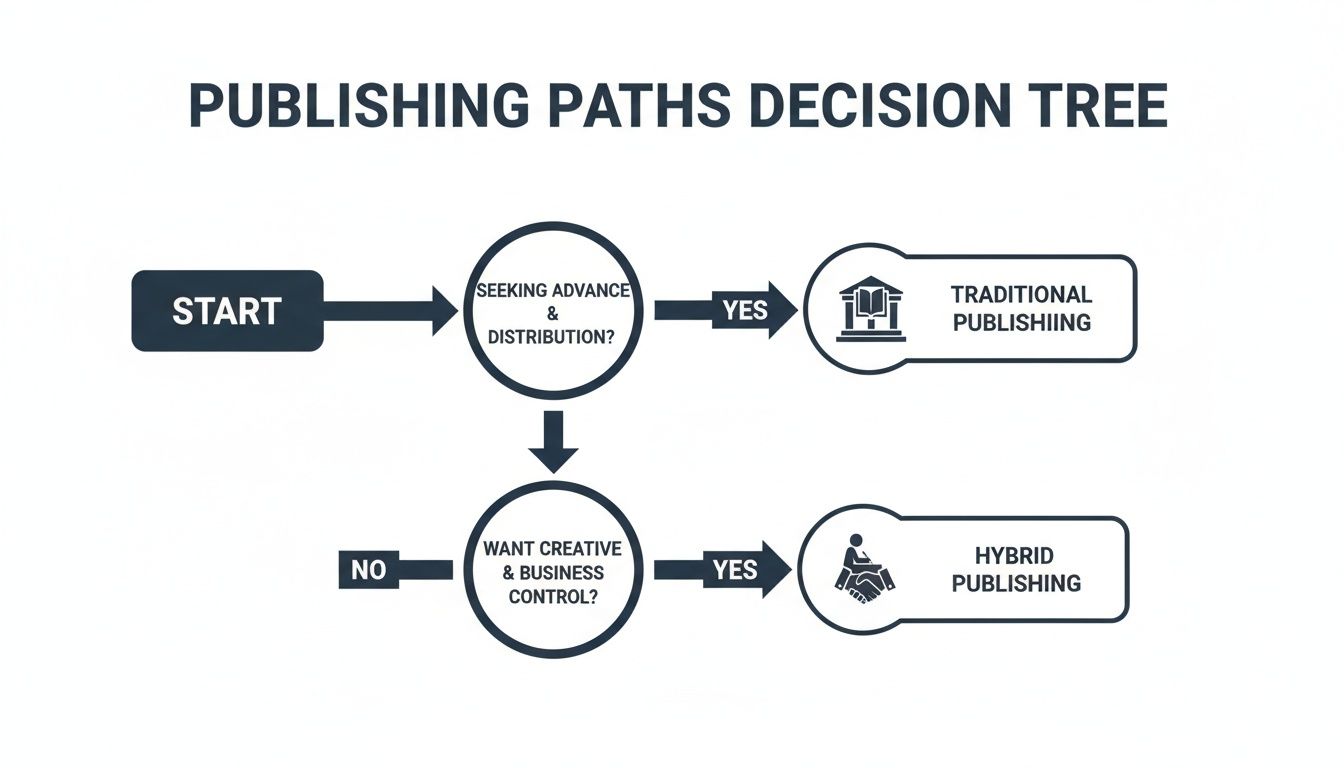
As you can see, your priorities—whether that's minimizing initial cost, maximizing creative freedom, or finding a professional partner—point you directly to one of these models.
The Hybrid Publishing Route
Hybrid publishing is the middle ground, offering a genuine partnership. It’s a bit like co-investing in a business venture: you bring the product (your book), and the hybrid publisher provides the professional production and distribution machine.
With this option, you pay a fee for a package of services, which typically includes high-level editing, design, and access to distribution channels that can be tough to crack on your own. This model is perfect for authors who want expert guidance and a top-tier final product without the headache of vetting and managing a dozen different freelancers.
Hybrid publishing blends the professional support of a traditional house with the higher royalties and creative control of self-publishing. It’s a structured, supported path for the author-entrepreneur.
You keep ownership of your rights and earn a better royalty share than in a traditional deal, though not quite as high as going 100% solo. For many authors, this path strikes the perfect balance of investment, control, and professional support, answering the "how much does it cost" question with a clear, service-based fee.
A Service-by-Service Cost Breakdown for Self-Publishing
When you choose to self-publish, you’re not just the author—you're the project manager. Think of yourself as the general contractor building your dream home. There's no traditional publisher footing the bills, so you're the one hiring the experts, from the architect (editor) to the interior designer (formatter).
This à la carte approach gives you incredible control over both the final product and your budget. You get to decide where to splurge and where to save. Let's walk through the essential services you’ll need to line up and what you can realistically expect to invest in each.
The Critical Cost of Editing
If there's one place you absolutely cannot afford to cut corners, it's editing. This is the single most important investment you will make in your book's success. A brilliant story idea can be completely sunk by clunky prose or plot holes, and readers are not forgiving.
Editing isn't a single task; it’s a multi-stage process, with each layer building on the last.
- Developmental Editing: This is the high-level, structural work. A developmental editor looks at the big picture: plot, pacing, character development, and the overall narrative arc. It’s the most intensive—and therefore most expensive—stage, typically running from $2,500 to $4,500 for a standard manuscript.
- Copy Editing: Once the story's bones are strong, a copy editor polishes the language. They focus on grammar, syntax, and sentence flow, ensuring your writing is clear, consistent, and powerful. Expect to budget between $1,500 and $2,500 for this.
- Proofreading: This is the final, meticulous quality check right before you go to print. A proofreader is your last line of defense against typos, stray punctuation, and formatting glitches. This service usually costs between $800 and $1,500.
It's crucial to do these in order. Proofreading a manuscript before it's been developmentally edited is a complete waste of money, as any major rewrites will just introduce new errors. To get a better handle on these costs, check out our deep dive on how much book editing costs in our detailed guide.
Designing a Professional Book Cover
Never, ever judge a book by its cover? That’s a nice thought, but every reader does exactly that. Your cover is your #1 marketing asset. It has about three seconds to grab a potential reader's attention on a crowded Amazon page and convince them your book is worth a click.
A professional design instantly signals quality and legitimacy. An amateur one screams "hobby project" and can kill your sales before they even start. Costs here can vary wildly. A simple, striking typography-based cover might be on the lower end, while a custom illustration for a fantasy novel will be a much bigger investment.
A great cover doesn’t just look good; it communicates genre, tone, and audience expectations at a glance. It’s a silent salesperson working for you 24/7.
Interior Formatting and Typesetting
If the cover is the grand entrance, the interior layout is the comfortable, well-designed living space where your reader will spend their time. Professional formatting, also known as typesetting, is all about creating an effortless and enjoyable reading experience.
You want readers to get lost in your story, not pulled out of it by weird spacing, awkward page breaks, or a font that’s hard on the eyes. While DIY tools exist, a professional handles all the technical nuances for both print and ebook versions. This service generally runs between $450 and $1,200, with the price increasing for complex layouts that include images, tables, or lots of footnotes.
The Nuts and Bolts: ISBNs and Distribution
To sell your book pretty much anywhere, you need an International Standard Book Number (ISBN). It’s the unique barcode that identifies your book in the global retail system. Some platforms, like Amazon KDP, will give you a free one, but there's a catch: they will be listed as the publisher.
For true independence, you’ll want to buy your own ISBNs from Bowker. This lists you or your publishing imprint as the publisher, giving you complete control over your book’s metadata and distribution.
Looking at the whole picture, recent industry data suggests a professionally produced self-published book costs between $2,940 and $5,660. Editing is a huge slice of that pie, ranging from $500 for a final proofread to over $7,000 for a comprehensive editorial package. A solid cover design averages around $880, and you'll have smaller but essential costs like setup fees for platforms like IngramSpark ($49) and purchasing your own ISBNs ($125 for one or a much better deal of $295 for a block of ten).
Budgeting for Book Marketing and Promotion
Here's a hard truth: creating a beautiful, professionally edited book is only half the battle. The old "if you build it, they will come" fantasy simply doesn't fly in the crowded world of publishing. A brilliant book that nobody knows about won’t sell a single copy.
That’s where your marketing budget comes in. It's not an optional add-on; it's a critical investment in your book's future.
Think of it this way: the production costs—all that editing, design, and formatting—built you an incredible race car. But marketing is the fuel, the pit crew, and the promotional tour that gets your car on the track in front of a cheering crowd. Without it, your powerful machine just sits in the garage, unseen.
Building Your Author Platform
The foundation of any solid book marketing plan is your author platform. This is your personal slice of the internet where you connect directly with readers, build a loyal following, and control your own brand. It's home base for your most dedicated fans.
The key costs for building your platform usually include:
- Author Website: A professional website is non-negotiable. It’s your central hub for everything: book info, your bio, a blog, and that all-important email list sign-up. You can expect to spend $200 to $500 for a clean, polished site using something like Squarespace or a self-hosted WordPress setup.
- Email List Service: Your email list is pure gold—your most valuable marketing asset. Services like MailerLite or ConvertKit let you talk directly to your audience. Many start free, but as your list grows, plan for around $30-$50 per month.
Securing Early Reviews and Buzz
Social proof is everything in the book world. Before a reader will risk their time and money on an author they don't know, they want to see that other people have already read and enjoyed the book. Generating early reviews is one of the best ways to build that crucial initial momentum.
Investing in services that get your book into the hands of avid readers is a smart move. Platforms like NetGalley or Booksprout specialize in sending Advanced Review Copies (ARCs) to their networks of reviewers. A campaign on one of these sites will typically run you between $50 and $150.
Marketing isn't just about finding buyers; it's about building a community of readers who will champion your work. Your budget should reflect this long-term goal of creating genuine connections, not just making one-time sales.
The average marketing spend for a self-published book can be as little as $60 or as much as $1,750, depending entirely on the author's strategy. For those treating their book launch like a serious business, budgets can easily climb past $5,000, especially if professional PR firms or ad agencies get involved.
Paid Advertising and Promotional Assets
To reach readers beyond your immediate circle, you’ll likely need to turn to paid advertising. This is where your budget can really scale up or down depending on your goals.
Common advertising costs to consider:
- Amazon Ads: Running ads directly on the platform where people buy your book is incredibly effective. A starting budget of $10-$20 per day is a great way to start testing the waters and see what works.
- Meta Ads (Facebook & Instagram): These platforms are fantastic for targeting readers based on their specific interests, favorite authors, and demographics. You can start small here, too, with a budget of just $5-$10 per day.
- Book Promotion Sites: Services like BookBub or Fussy Librarian charge a fee to feature your discounted book in their newsletters, which go out to tens of thousands of readers who are hungry for books in your genre.
If influencer outreach is part of your plan, it’s important to know the going rates. Learning how much to pay influencers will help you budget effectively for that. For a complete rundown of different tactics, check out our guide on https://barkerbooks.com/book-marketing-strategies/.
Choosing Your Publishing Package: What to Look For
If the thought of juggling a dozen different freelancers feels more like herding cats than a creative journey, an all-in-one publishing package might be the answer. These services bundle everything—from editing and design to distribution—into one cohesive experience.
But here’s the thing: not all packages are created equal. The trick is to dig deep and make sure you're getting genuine, professional-grade value, not just a bundle of cheap, ineffective services.
It’s a bit like booking an all-inclusive resort. The right one handles all the details, leaving you to relax and enjoy the experience. The wrong one can leave you with hidden fees, a lousy room, and a mountain of stress. You need to know what to look for.
Vetting Potential Publishing Partners
Before you even think about signing a contract, you need to find a partner who values transparency. A truly reputable company will be crystal clear about what’s included and what isn’t.
Start by asking these non-negotiable questions:
- Is the pricing transparent? Demand a clear, itemized breakdown of costs. Vague "administrative fees" are a major red flag.
- What services are actually included? "Editing" can mean anything. Does it cover a deep developmental edit and a thorough copy edit, or is it just a quick proofread?
- What does distribution really mean? Will your book be available on major platforms like Amazon, Barnes & Noble, and Apple Books, or just a few obscure online stores?
- Who owns the rights? This is critical. You must always retain 100% of your rights and creative control. If a company asks for them, walk away.
- What kind of support will I get? Will you have a dedicated guide to walk you through the process, or will you be left to fend for yourself with a generic help desk?
A trustworthy publishing partner acts as a guide, not a gatekeeper. Their goal should be to empower you with professional tools and expertise, making the complex process of publishing feel manageable and exciting.
By asking these tough questions, you can slice right through the marketing fluff and get to the heart of what’s being offered. It’s a vital step in understanding how much it really costs to publish a book with the right team in your corner. See how different services compare by checking out our guide to the best self-publishing companies and what they bring to the table.
Matching a Package to Your Author Goals
The perfect package for you hinges entirely on what you want to achieve with your book. An author writing a family memoir has wildly different needs than an entrepreneur aiming to build a global brand.
To help you find the right fit, it helps to think in terms of author profiles. See which one sounds most like you and what services you should prioritize.
Choosing Your Publishing Package Based on Author Goals
Finding the right level of support starts with being honest about your primary goal. Are you creating a passion project or launching a career? This table breaks down common scenarios to help you match your needs to the right services.
| Author Profile | Primary Goal | Essential Package Services | Potential BarkerBooks Package |
|---|---|---|---|
| The Hobbyist Author | Create a beautiful book for family, friends, and a small community. | Professional cover design, interior formatting, and print-on-demand setup. | Essential Package |
| The Niche Expert | Establish authority in their field and use the book as a high-end business card. | High-level copy editing, professional design, and targeted marketing support. | Advanced Package |
| The Ambitious Novelist | Launch a professional author career and reach a wide audience. | Developmental editing, premium cover design, global distribution, and a robust marketing campaign. | Premium Launch Package |
When you can see your own ambitions reflected in a clear plan, it becomes much easier to decide which package tier will give you the best return on your investment. For many authors, a well-structured package ends up being more cost-effective and far less stressful than trying to piece everything together on their own.
Your Path Forward: Choosing the Right Publishing Partner
We’ve covered a lot of ground, haven't we? From the nitty-gritty details of editing costs to the big-picture marketing budgets, it’s clear there’s no single answer to the question, "how much does it cost to publish a book?" The truth is, it’s an investment that you tailor to fit your own ambitions.
The journey from a finished manuscript to a book in a reader's hands is paved with important decisions. But whether you’re drawn to the DIY spirit of self-publishing or the guided structure of a hybrid model, the most critical choice you'll make is who you trust to help you along the way.
Why a Partner Simplifies Everything
Let’s be honest: hunting down, vetting, and then managing a small army of freelancers—an editor here, a cover designer there, a formatter somewhere else—is a full-time job in itself. It can be completely overwhelming. A good publishing partner cuts through that chaos.
Instead of juggling a dozen moving parts, you get one dedicated team, one point of contact, and one unified goal: bringing your book to life professionally and beautifully. It turns a fragmented, stressful process into a clear, manageable, and genuinely exciting one.
This approach also takes the guesswork out of budgeting. A partner provides a transparent roadmap with clear costs and predictable timelines, so you won’t get hit with surprise fees. You get to focus on what you love—writing and sharing your message—while a team of experts handles the technical heavy lifting.
Think of it this way: your investment in publishing isn't just a transaction. It's the first real step in building your career as an author. A partnership is about making sure that investment is sound, secure, and set up to succeed from day one.
Taking the Next Step with Confidence
You’re now armed with a real understanding of the costs involved and the immense value behind each service. What might have once seemed like a confusing menu of options—developmental editing, cover design, global distribution—should now feel like what they truly are: the essential tools for crafting a book that can stand shoulder-to-shoulder with the best of them.
That dream of holding your finished book is closer than you think. By finding the right partner, you're not just buying a package of services. You're building a team that's committed to guiding you through the industry with skill and confidence. You have the knowledge. You're ready to make it happen.
A Few More Common Questions About Publishing Costs
As you start piecing together your budget, you’re bound to have a few lingering questions. Getting these details ironed out is crucial for building a realistic financial plan and making sure there are no surprises waiting for you later. Here are some quick, straightforward answers to the questions I hear most often from authors.
Can I Really Publish a Book for Free?
The short answer is yes, you technically can. You could upload your manuscript to a platform like Amazon KDP, use their free cover creator tool, and click "publish" without spending a single dollar.
But here’s the catch: “free” almost always comes at the expense of quality.
When you skip the professional services, you’re giving up the very things that make a book successful:
- A sharp edit: Readers are notoriously unforgiving of typos, grammar mistakes, and messy plotlines.
- A compelling cover: An amateur-looking cover is the fastest way to get a potential reader to scroll right past your book.
- A real marketing plan: A book nobody knows exists is just a file on a server.
So, while you can publish for free, it essentially positions your book as a personal hobby project. If you want it to be a professional product that can actually compete for readers' attention, an investment is necessary.
How Much Do Authors Actually Make Per Book?
This is a big one, and the reality is that author royalties are all over the map depending on your publishing path. It’s so important to set realistic expectations from the start.
- Traditional Publishing: Here, you can expect to earn royalties of about 5-15% of the net receipts (what the publisher gets after discounts).
- Hybrid Publishing: This model offers a better split, usually somewhere in the 25-50% range.
- Self-Publishing: This is where you have the highest earning potential. On platforms like Amazon KDP, authors can keep 60-70% of the book's list price.
Think of it this way: your upfront investment is directly tied to your long-term earning potential. The more you control and invest in your own project, the bigger your slice of the pie will be for every copy sold.
Are There Hidden Costs I Should Watch Out For?
Absolutely. There are always a few expenses that tend to sneak up on first-time authors. Once you’ve covered the main production costs, make sure you’ve also considered these:
- Author Copies: You'll definitely want physical copies for yourself, for giveaways, or to sell at local events. You'll have to buy these directly from your printer or distributor.
- Post-Publication Revisions: What if you spot a typo after the book is live? Uploading a corrected file isn't always free and can sometimes cost anywhere from $25 to $250.
- Ongoing Marketing: Your marketing budget isn't a one-and-done deal. A successful book needs consistent promotion long after launch week. This is an ongoing investment, not a single expense.
How Long Will It Take to Make My Investment Back?
If there were a simple answer to this, we’d all be bestsellers! A book is a long-term asset, not a get-rich-quick ticket. For some authors, breaking even happens within the first year. For many others, it can take several years of steady sales.
Your return on investment really hinges on your genre, how well you market your book, and, of course, the quality of the book itself. The most sustainable goal is to build a steady stream of "long-tail" sales over time, rather than pinning all your hopes on a huge launch.
Ready to turn your manuscript into a professionally published book without the guesswork? The team at BarkerBooks offers comprehensive packages that handle everything from editing and design to global distribution, letting you focus on what you do best—writing. Explore our publishing packages today.