
If you're looking to become a professional ghostwriter, the path really boils down to three core pillars: mastering the art of capturing someone else's voice, building a portfolio that proves you can do it, and then strategically getting your skills in front of the right clients. It's a fascinating career that sits at the intersection of writing talent, genuine empathy, and sharp business sense. You get to be the hidden force behind experts who have incredible ideas but just don't have the time or the specific skillset to put them on paper.
What a Ghostwriter Actually Does
Before we get into the "how," let's quickly break down the most common tasks and skills involved. It's a lot more varied than just writing books.
| Content Type | Primary Role | Key Skills Required |
|---|---|---|
| Books & Memoirs | Structure a narrative, conduct deep interviews, and write a cohesive manuscript. | Long-form storytelling, interviewing, project management. |
| Executive Blog Posts | Translate expert ideas into thought leadership articles for platforms like LinkedIn. | Voice mimicry, persuasive writing, SEO basics. |
| Speeches & Keynotes | Craft a compelling narrative that connects with a live audience. | Public speaking rhetoric, emotional storytelling. |
| Social Media Content | Create concise, engaging posts (e.g., on X or LinkedIn) that build a personal brand. | Brevity, audience engagement, platform-specific formatting. |
| White Papers | Produce in-depth, research-backed documents to explain complex topics. | Technical writing, research, data analysis. |
This table gives you a snapshot, but the bottom line is that your job is to be a strategic communication partner for busy, brilliant people.
What Modern Ghostwriting Really Looks Like
Let's clear something up right away: the old stereotype of a ghostwriter tucked away in a dusty attic, secretly penning a celebrity's tell-all memoir, is mostly a thing of the past. Today’s ghostwriting is a highly respected, dynamic profession that’s all about building thought leadership.
You’re not just a writer for hire; you become the trusted communication partner for CEOs, founders, consultants, and top-tier experts. These people have a wealth of knowledge and unique perspectives, but they’re busy running companies and leading teams. They don't have the bandwidth to write articles, craft social media threads, or outline a book.
That's where you step in. Your job is to act as their voice, translating their complex, often-unspoken ideas into clear, compelling content that builds their authority and personal brand.
A Rapidly Growing Industry
This isn't some niche, underground profession anymore. The demand for high-quality, authentic content is creating a massive opportunity. The global ghostwriting services market was valued at around USD 1.5 billion in 2025 and is on track to nearly double to an estimated USD 2.95 billion by 2033.
That's not just a trend; it’s a clear signal that the need for skilled writers who can expertly channel another person's voice is stronger than ever.
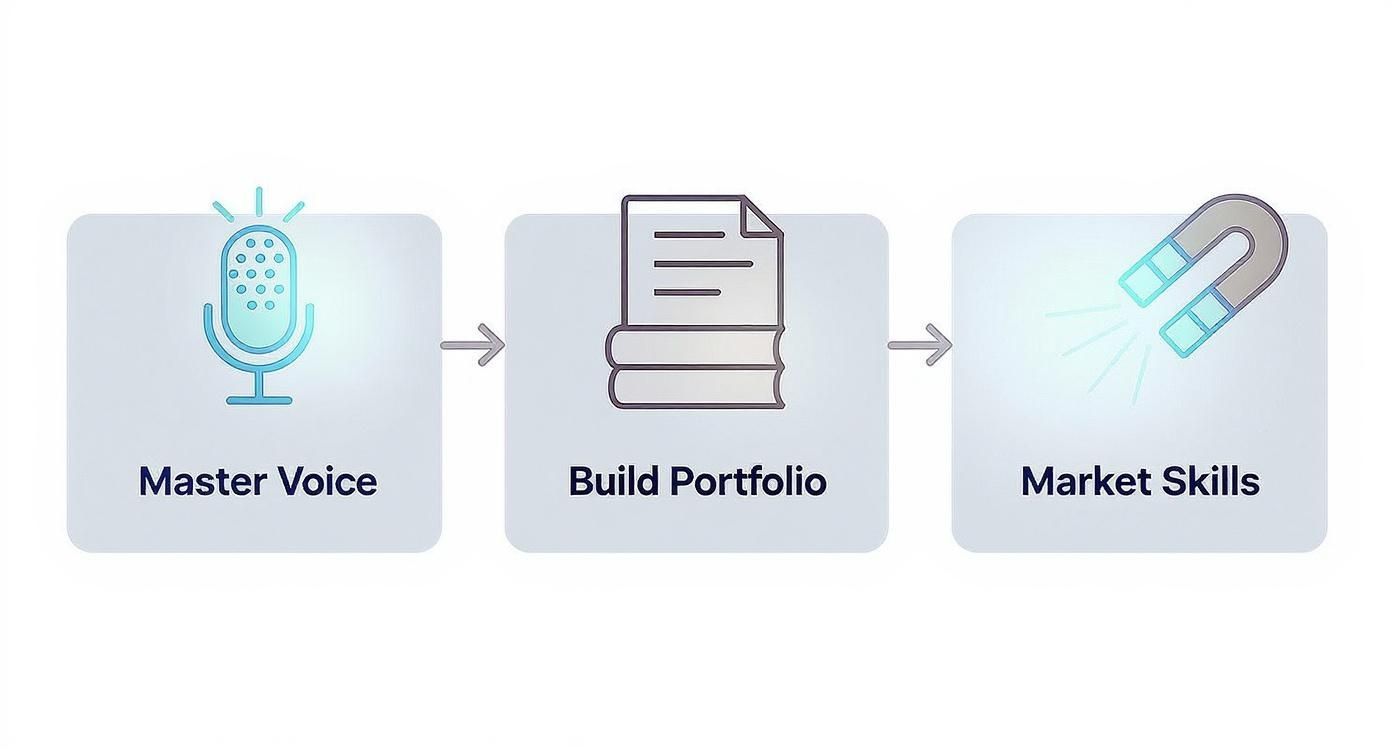
As you can see, it's a constant cycle. You develop your skills, use those skills to create tangible work, and then leverage that work to land new clients. Then you repeat, getting better with every project.
The core of this job isn't just about being a good writer; it's about being an exceptional listener. Your real work is to absorb a client’s perspective, their unique cadence, and their deep knowledge so thoroughly that the final text is completely indistinguishable from their own.
You are, in essence, an invisible amplifier. By putting your ego aside and focusing entirely on your client's message, you empower them to connect with their audience, build their reputation, and secure their legacy. If you want a deeper dive into the day-to-day, you can learn more about what a ghostwriter does and see how multifaceted the role truly is.
Developing Your Core Ghostwriting Skills
Being a great writer is just the price of admission. It’s the starting point, not the finish line. To really make a career out of ghostwriting, you have to get comfortable with becoming someone else on the page—a skill that’s part empathy, part research, and part structural engineering.
Your most important job isn't writing; it's listening. You’re not just taking dictation. You’re absorbing a person's entire way of being so you can recreate it authentically.

Mastering the Art of Voice Mirroring
This is the one skill that separates the pros from the amateurs. Voice mirroring is your ability to capture all the little quirks of a client’s personality—their rhythm, their go-to analogies, their unique vocabulary, and how they see the world. When you nail it, no one can tell they didn’t write it themselves.
But you can’t just guess. You have to become a bit of a detective and immerse yourself in their world.
- Listen like a hawk: Record every interview (with permission, of course). Pay attention to how they say things. Do they use short, punchy sentences? Do they love a good sports metaphor? Note the words and phrases they repeat.
- Study their digital footprint: Dig into everything they’ve already put out there. Read their blog posts, listen to podcast interviews, watch their conference keynotes, and even check out their LinkedIn comments. This is a goldmine for their public voice.
- Create a ‘Voice Bible’: I do this for every single client. It's a simple document where I log their favorite jargon, common sayings, words they avoid, and overall tone. Is it academic? Casual and funny? Direct and no-nonsense?
This "bible" becomes your North Star for the entire project. It keeps the writing consistent and, more importantly, keeps it theirs.
Conducting Interviews That Uncover Gold
The best stories and deepest insights are never just sitting on the surface. A simple Q&A won't get you there. You need to become a master interviewer, someone who can guide a conversation and pull out the compelling stuff.
Your goal isn't just to gather facts. It's to create a space where your client feels comfortable enough to think out loud, chase down ideas, and share stories they haven't thought about in years.
Think of yourself as part journalist, part therapist. Ask open-ended questions that demand a story, not a "yes" or "no." For instance, instead of asking, "Was that a successful project?" try something like, "Take me back to the biggest roadblock you hit on that project. How did you feel when you finally cracked it?" That small shift is everything—it invites emotion and detail, which is the heart of any great piece of writing.
Structuring and Outlining Like an Architect
A mountain of incredible interview transcripts is just noise without a solid structure. Clients are paying you to bring order to their chaos, to organize their brilliant thoughts into a narrative that flows, whether it’s a 1,500-word article or a 60,000-word book.
This is all about seeing the big picture before you get lost in the details. A detailed outline is your best friend.
- It creates a logical path. An outline maps the journey from A to B to C, ensuring the reader never gets lost.
- It prevents scope creep. Once the client signs off on the outline, it’s your roadmap. It keeps the project focused and prevents endless new ideas from derailing the work.
- It makes you a faster writer. With a clear plan, you can just write. You're focused on crafting great sentences, not constantly wrestling with where the piece is going.
For a book, this means a detailed, chapter-by-chapter breakdown. For an article, it means bullet points for each section. This architectural skill is non-negotiable, and frankly, it's often the part clients appreciate the most.
Building a Portfolio When Your Work Is Invisible

This is the classic ghostwriting paradox. You need a killer portfolio to land great clients, but your best work is locked away behind confidentiality agreements. It’s a real chicken-and-egg problem.
So, how do you prove your skills when you can't show off what you've written? Simple. You build a portfolio that showcases your talent without ever breaking a client’s trust. This isn't just about collecting a few random articles; it's about strategically creating assets that prove you can think like an executive and write like a pro.
Create Powerful Spec Samples
Your best friend here will be speculative samples, or "spec" work. These are pieces you write on your own dime, specifically to show clients what you're capable of. The trick is to make them feel like real-world projects, not generic writing exercises.
Don’t just write a blog post about leadership. Invent a client and a specific goal.
- The Tech CEO: Write a sharp, opinionated thought leadership article for a fictional SaaS founder. Give her a name, a company, and a strong take on an emerging industry trend. Aim for the style you'd see in Forbes or Fast Company.
- The Business Author: Outline a book proposal and write the first chapter for an imaginary executive coach. Hook the reader with a compelling personal story and connect it to a universal business lesson.
- The Marketing Consultant: Draft a punchy LinkedIn post and a more in-depth newsletter for a fictional consultant. This demonstrates you can adapt a core message for different platforms and audiences.
Creating three to five of these high-quality spec samples is a game-changer. It immediately shows prospective clients you have the versatility to handle different voices, formats, and industries—exactly what they're looking to hire.
Leverage Anonymized Case Studies
While you can’t share the ghostwritten work itself, you can absolutely talk about the process and the results. A well-crafted case study is an incredibly powerful sales tool that tells a story of how you helped a client succeed.
Naturally, you'll need the client's permission for this. Once a project is wrapped up, simply ask if they'd be comfortable with you sharing an anonymized summary of your collaboration. Most are happy to agree, especially when you frame it correctly.
The key is to focus on the challenge, your solution, and the outcome. You aren't showcasing the specific words you wrote; you're showcasing your strategic thinking and the real-world impact of your work.
Here’s a straightforward way to structure a case study for your portfolio:
| Section | Description |
|---|---|
| The Challenge | "A C-level executive in the renewable energy sector needed to establish a public profile to attract investors but had zero time to write." |
| The Process | "I conducted a series of six deep-dive interviews to capture her unique insights and voice, then developed a three-month content calendar." |
| The Outcome | "Ghostwrote 12 LinkedIn articles that led to a 400% increase in profile views and two unsolicited speaking invitations." |
See how that works? It tells a compelling story of success and proves your value without revealing a single confidential detail.
Your Portfolio Is Your Entire Online Presence
Ultimately, your portfolio isn't just a hidden folder of PDFs. It's the sum total of your professional footprint online. Since so much of a ghostwriter’s work is invisible, you have to build a robust online presence that attracts clients and establishes your authority.
This ecosystem includes:
- A professional website featuring your spec samples and case studies.
- An active LinkedIn profile where you share your own ideas on writing, leadership, and communication.
- Guest articles written under your own name for relevant industry blogs.
These public assets become your living, breathing portfolio. They prove your expertise in real-time and act as a magnet for the high-caliber clients you're looking for, answering the question "how do you become a ghostwriter" with undeniable proof of your skills.
Getting Paid: Pricing Your Work and Crafting Bulletproof Contracts
Let's get right to it—the part that trips up most new ghostwriters: money. Figuring out what to charge can feel like pulling a number out of thin air, but this is the moment you stop being an aspiring writer and start being a business owner. Nailing your pricing and backing it up with a solid contract is non-negotiable.
The reality is, ghostwriting income is all over the map. Sure, the U.S. Bureau of Labor Statistics might report a median salary for writers around $67,120 per year, but that figure doesn't really capture the freelance ghostwriting world. Because our work is confidential, a lot of the high-end project data stays private. I can tell you from experience that seasoned pros command anything from a few thousand dollars for a short ebook to well into six figures for a comprehensive business book. For a wider look at the industry, you can check out some helpful writing salary statistics and trends.
Choosing Your Pricing Model
You're not just selling words on a page. You're a strategist, an interviewer, a project manager, and a confidant. Your pricing needs to reflect that immense value. Most ghostwriters use one of three models, and knowing when to use each is key.
- Per-Project Fee: This is the industry standard for any significant project, like a book or a major white paper. You quote one flat fee for the entire job, from the first interview to the final manuscript. This gives the client budget certainty and lets you price based on the total value you're creating, not just the hours you clock. A 50,000-word business book, for instance, might land anywhere from $25,000 to $60,000+.
- Per-Word Rate: Honestly, this model is a poor fit for most ghostwriting. It completely ignores all the "invisible" work—the hours of interviews, research, and outlining. It also sets up a weird dynamic where you're incentivized to add fluff and the client is scrutinizing every sentence. Save this for very small, predictable projects, like a short article with a clearly defined scope.
- Monthly Retainer: This is my go-to for any kind of ongoing work. Think managing a CEO’s LinkedIn content or ghostwriting a couple of blog posts every month. The client pays you a fixed fee each month, you deliver the agreed-upon work, and everyone wins. You get predictable income, and they get consistent expert support without project-by-project negotiations.
For a much deeper dive, our guide on how much a ghostwriter costs breaks down the specific price ranges you can expect for different project types.
Your Contract: The Most Important Tool in Your Business
Your contract isn't a sign of mistrust; it's a sign of professionalism. It’s the rulebook that protects you and your client by creating crystal-clear expectations from day one. A handshake deal is a recipe for disaster when you're dealing with thousands of dollars and sensitive intellectual property.
A strong contract prevents misunderstandings before they happen. It turns potential conflicts into simple procedural questions with pre-agreed answers, preserving the client relationship and your sanity.
Make sure your agreement is written in plain English, not legalese. It needs to cover a few critical bases.
Scope of Work and Deliverables
Get incredibly specific here. "Write a book" is not a scope of work; it's an invitation for chaos. You need to define exactly what the client is paying for.
- Final Word Count: Spell out the target, like "approximately 50,000 words."
- Included Services: List everything your fee covers. Be explicit: number of interview hours, research, outlining, drafting, and the number of revision rounds.
- Excluded Services: Just as important is stating what's not included. This could be sourcing stock photos, travel for in-person meetings, or conducting more interviews than the agreed-upon number.
Payment Schedule
This is a big one. Never, ever agree to get paid 100% at the end. You'll be working for months with no cash flow. A milestone-based schedule keeps the client invested and your bills paid.
- Initial Deposit: Always take a deposit. 25-50% of the total project fee is standard. This gets paid upfront before you write a single word. It secures your spot in their calendar and shows they're serious.
- Mid-Project Milestones: Tie subsequent payments to tangible progress. For example, "25% due upon approval of the detailed outline" or "25% due upon delivery of the first half of the manuscript."
- Final Payment: The final balance is due upon delivery of the completed manuscript—before you hand over the final, editable files.
Revisions and Scope Creep
The dreaded "one more little change" can kill your timeline and your profit margin. Your contract must set firm boundaries around revisions.
I recommend including two full rounds of revisions in your base price—one after the first draft, and another after the second. Anything beyond that is billed at your hourly rate, which you should also clearly state in the contract.
This clause is your single best defense against "scope creep," where the project slowly balloons beyond its original agreement. When a client's vision changes mid-stream (and it sometimes does), this clause ensures you're compensated for the extra work, turning a potentially awkward conversation into a simple business transaction.
How to Find and Attract Your First Paying Clients
Alright, your skills are sharp and your portfolio is ready. This is where the rubber meets the road. Answering the question "how do you become a ghostwriter?" now boils down to one thing: getting paid for your work. It's time to stop waiting for clients to discover you and start actively finding them.

This means you need to put on your marketer hat. The great thing is, you don’t need a massive budget—just a smart, consistent plan.
Dial in Your Freelance Platform Profiles
For many new ghostwriters, platforms like Upwork are the first port of call. But just having a profile isn't a strategy. You have to treat that profile like a dedicated sales page designed to attract a specific type of client.
- Write a Niche-Specific Headline: "Freelance Writer" is forgettable. "Ghostwriter for Tech Founders & CEOs" is not. It immediately signals that you get their world.
- Create a Benefit-Driven Bio: Don’t just list what you can do; explain the result. Instead of "Expert in voice mirroring," try something like, "I help busy executives transform their raw ideas into compelling thought leadership that builds their personal brand."
- Feature Your Best Samples: Pin your most relevant work right at the top. That spec article you wrote for a fictional SaaS CEO? That's your hero piece now.
This kind of focused positioning helps you rise above the noise and attract much better inquiries from the start.
Use LinkedIn for Smart Outreach
Passively waiting for clients is a recipe for a slow start. Real momentum comes from proactive outreach, and LinkedIn is your best friend here. I'm not talking about spammy, copy-and-paste connection requests. This is about building real relationships.
First, figure out who your ideal clients are. Are they startup founders, business coaches, consultants, or VPs at mid-sized companies? Once you know, your mission is to add value before you ever ask for business.
The best outreach is never a cold pitch. It's a warm conversation that starts with genuine interest. Your first goal isn't to land a contract; it's just to start a dialogue.
Here’s a simple, human way to approach it:
- Engage First, Connect Later: Follow a handful of target clients. For a week or two, just like and leave thoughtful comments on their posts. Let them see your name.
- Send a Hyper-Personalized Request: When you finally reach out, make it about them. For example: "Hi [Name], I really enjoyed your recent post on the future of AI in marketing. Your point about [specific insight] was spot-on. Would love to connect and follow your work."
- Follow Up with Value, Not a Pitch: Once they accept, your job still isn't to sell. Share a relevant article or mention a resource you think they'd find helpful. After a little back-and-forth, you can naturally introduce what you do.
Because ghostwriting is so service-oriented, a lot of the same strategies for acquiring consulting clients apply here and can give you even more ideas.
Cultivate a Strong Referral Network
Honestly, some of your best-fit, highest-paying clients will come from referrals. The trick is to build relationships with other professionals who already have the trust of your ideal clients.
- Book Coaches & Editors: They frequently work with authors who are stuck and need a ghostwriter to get their manuscript across the finish line.
- Marketing & PR Agencies: These firms are always on the lookout for skilled ghostwriters to produce content for their executive clients.
- Business Consultants: As trusted advisors, they are perfectly positioned to recommend your services to leaders who want to build their authority.
Start connecting with these folks on LinkedIn. A powerful way to build goodwill is to send a referral their way if a potential client isn't a good fit for you. That kind of generosity almost always comes back to you.
It also helps to get inside a potential client's head. Understanding their process for how to hire a ghostwriter will give you a huge advantage by helping you anticipate their questions and concerns.
Growing Your Ghostwriting Business for the Long Term
Getting that first client feels like crossing the finish line, but it’s really just the start of the race. If you want to build a ghostwriting business that lasts, you need to think strategically about where you're headed and how the industry is evolving.
The days of being a jack-of-all-trades are fading. Specialization is where the real money and fulfillment are. Carve out a niche for yourself—become the go-to expert for fintech founders, healthcare executives, or B2B SaaS thought leaders. This laser-focused approach not only lets you charge premium rates but also attracts high-caliber clients who see the value in your specific industry insights.
Navigating the Future with AI
Let's talk about the elephant in the room: AI. It’s not here to take your job; it’s here to be your new assistant. The smartest ghostwriters I know are already using it to speed up tedious tasks like research, brainstorming outlines, and playing with title ideas.
Think of it like this: AI can gather all the raw ingredients, but you're still the chef who creates the masterpiece. Your real value is in the human touch—conducting nuanced interviews, capturing a client’s authentic voice, and weaving a story that connects on an emotional level. No machine can do that.
The real skill is knowing how to use AI to make your human-centric work more efficient, not replace it. Your strategic thinking and emotional intelligence remain your most valuable assets.
Looking ahead, most experts see the market splitting. There will be a high-end, premium tier for purely human-crafted content and a lower-cost tier for AI-assisted work. You absolutely want to position yourself in that premium category. It’s also worth noting that ghostwriting is seeing a boom in fiction, as authors need help bringing complex narratives to life. You can actually explore more ghostwriting industry predictions here to see what's on the horizon.
So, how do you actually scale up? It's not just about working more hours.
- Raise Your Rates: This is the most direct path. As your portfolio thickens and your reputation grows, your prices should reflect that increased value.
- Build a Team: You don't have to do it all. Find trusted freelancers to subcontract specific tasks like research, transcription, or even first drafts.
- Partner with Agencies: Get on the radar of marketing and PR firms. They often have a steady stream of clients who need top-tier ghostwriters and are happy to pay for reliability.
Got Questions? Let's Talk About Ghostwriting
Jumping into a new career path always stirs up a few questions. When people are figuring out how to become a ghostwriter, a few common queries pop up time and time again. Here are some straightforward answers based on real-world experience.
Do I Need a Degree to Be a Ghostwriter?
Nope. While a degree in English, journalism, or a related field can give you a solid foundation, it's not a ticket into this industry. I've seen incredibly successful ghostwriters from all sorts of backgrounds—lawyers, marketers, even engineers.
Clients care about one thing above all else: your ability to write well and capture their voice. A powerful portfolio will always trump a diploma. Your work is your resume.
Think of it this way: a client would much rather see one killer writing sample that sounds like them than a framed degree on your wall. Your portfolio is what gets you hired, period.
How Do I Handle Credit and Bylines?
This is a big one. The industry standard is simple: you receive no public credit. The whole point of ghostwriting is that the work is published under the client's name. You are the invisible force behind the words.
This arrangement needs to be crystal clear in your contract. Your fee isn't just for the writing; it's also for your complete anonymity.
Occasionally, you might find a client who offers an "as told to" or "with" credit, but don't count on it. That's the exception, not the rule. Your reward is the paycheck and the pride of a job well done.
What Are the Toughest Parts of Starting Out?
For new ghostwriters, two challenges tend to stand out. First, you have to build a portfolio without breaking confidentiality agreements from past work. It's a classic catch-22. As we covered earlier, the best way around this is by creating targeted spec samples and anonymizing case studies.
The second, and arguably bigger, challenge is mastering the client's voice. This isn't just about mimicking their word choice; it's about channeling their cadence, their perspective, and their personality. It takes deep listening, a lot of research into how they communicate, and a willingness to revise until it's perfect. It's a skill that honestly just gets better with every single project.
Ready to take your own story from idea to published book? The expert team at BarkerBooks offers comprehensive ghostwriting, editing, and publishing services to bring your vision to life. Explore our author services and start your journey today.