
Getting your book noticed on Amazon really boils down to two things: making your book’s page irresistible so people want to buy it, and then driving the right kind of traffic to that page. It's a one-two punch of conversion and visibility. You need a killer book description, the right keywords and categories, a solid base of early reviews, and a smart approach to using Amazon's own promotional tools.
Laying the Groundwork for Amazon Success

Before you even think about running ads or shouting about your book from the digital rooftops, you have to get your own house in order. So many authors make the classic mistake of driving traffic to a product page that isn't ready to convert. It's like pouring water into a leaky bucket—a total waste of effort and money.
A winning promotional strategy starts long before you spend your first dollar. It’s all about making your book as discoverable and appealing as possible, both to Amazon's algorithm and, more importantly, to actual human readers. And before you get lost in the weeds of Amazon tactics, it's wise to have a comprehensive marketing plan and strategy to guide your efforts. This way, every move you make on the platform is part of a bigger, smarter plan.
Craft a Compelling Book Description
Your book description is your sales pitch, plain and simple. It's not a book report; it's an ad designed to grab a reader and make them feel like they have to know what happens next. The first few lines are everything, especially since Amazon hides the rest behind that "Read more" link.
Start with a powerful hook. Ask a question. Make a bold statement. Use short paragraphs and simple HTML like bolding (<b>) and italics (<i>) to break up the text and make it easy to scan. Think of it as the trailer for your book.
- For Fiction Authors: Zero in on the core conflict, the stakes, and what your protagonist desperately wants.
- For Non-Fiction Authors: Be crystal clear about the problem you solve for the reader. List the key benefits or takeaways they’ll walk away with.
Choose Your Keywords and Categories Wisely
Keywords and categories are the breadcrumbs that lead readers to your book. This isn't a time for guesswork. You need to get inside the head of your ideal reader.
What exact phrases would they type into that search bar? A thriller author shouldn't just use "thriller." They should be thinking about things like "psychological thriller with a twist ending," "unreliable narrator suspense novel," or "domestic noir mystery."
Here's a powerful and often overlooked strategy: get specific with your categories. Instead of duking it out in a massive category like "Mystery, Thriller & Suspense," drill down into something like "Mystery, Thriller & Suspense > Thrillers & Suspense > Spies & Political Thrillers." Your chances of hitting that coveted #1 Bestseller tag in a smaller pond are infinitely higher.
Optimize Your Author Central Profile
Think of your Author Central page as your professional home base on Amazon. It builds instant credibility and gives readers a way to connect with you beyond just one book. A complete, professional-looking profile signals that you take your writing career seriously.
Make sure it’s filled out with:
- A professional, high-quality author photo.
- A well-written bio that gives a glimpse into who you are.
- Links to your website, blog, or social media.
- Any editorial reviews or awards your book has earned.
Taking a few minutes to complete your profile adds a huge layer of professionalism. As you're getting these foundational pieces in place, it's also a great idea to understand the mechanics behind the curtain. Our guide on how to publish an ebook to Amazon offers a detailed walkthrough, ensuring your groundwork is built on a solid understanding of how the platform actually works.
Crafting a Killer Book Launch
Think of your book launch not as a single event, but as a meticulously planned campaign. The entire goal is to generate a massive, concentrated wave of sales and reviews right out of the gate. This initial surge is what makes Amazon's algorithm sit up and take notice. You're essentially telling the system, "Hey, people love this book—show it to more readers!"
Those first 30 days are everything. A strong start creates a snowball effect: initial sales boost your ranking, higher rankings lead to more visibility, and that visibility drives more organic sales. It's a powerful cycle, but it all starts with a smart, deliberate plan.
Assemble Your Street Team of Advance Readers
Long before your book goes live, you need a crew of dedicated readers ready to buy it and, more importantly, leave a review during launch week. This is your ARC (Advanced Reader Copy) team, and they are your secret weapon for building social proof. Let's face it, a book page with zero reviews is a tough sell.
You don't need a massive team, just a reliable one.
- Start with Your Core Audience: Tap into your most loyal fans first. This means your email subscribers, die-hard social media followers, or members of a private reader group you run.
- Look to Reviewer Platforms: Services like Booksprout or StoryOrigin are fantastic for connecting with vetted reviewers who are actively looking for new books in your genre.
- Be Crystal Clear on Expectations: Let them know the deal upfront. They get a free copy before anyone else, and in return, you'd be incredibly grateful for an honest review posted during the first week.
A classic rookie mistake is scrambling for reviews on launch day. Get your ARC out to your team at least two to three weeks ahead of time. This gives them a chance to actually read and enjoy the book, which leads to much better, more genuine reviews when they matter most.
The Art of Launch Pricing
One of the most powerful levers you can pull during launch week is aggressive pricing. Dropping your ebook to $0.99 for a limited time is a potent psychological trigger for impulse buys.
This isn't about undervaluing your work; it's about eliminating friction for new readers. A low price makes it an easy "yes" for someone just discovering you. The resulting spike in sales can catapult your book up the bestseller charts in its niche categories, exposing it to thousands of new potential buyers browsing those lists.
Remember, though, that this initial surge is just one piece of the puzzle. Amazon's algorithm has grown smarter over the years, and it now rewards sustained performance more than short-term promotional tricks. A launch discount gives you that critical initial boost, but long-term success comes from building a loyal readership that sticks around.
Coordinate Your Marketing Blitz
To really make a splash, you need to synchronize every single promotional effort to hit within the first 72 hours of your launch. This concentrated activity sends the strongest possible signal to Amazon that your book is a big deal.
Here’s what your launch-week checklist should look like:
- Hit Your Email List Hard: Your email list is your warmest audience. Announce the launch and shout about the limited-time discount. They should be the very first to know.
- Unleash the Social Media Storm: Schedule posts across all your platforms. Use eye-catching graphics, share quotes and early reader excitement, and constantly remind your followers about the special launch price.
- Drive Outside Buzz: Getting attention beyond Amazon is huge. If you want to get featured on blogs, podcasts, or in the media, you need a solid strategy. This modern guide to pitching the media is a great place to start learning how to get noticed.
When all these pieces come together at once, you create a powerful wave of traffic and sales that gives your book the best possible shot at long-term success.
Using Amazon Ads to Find Your Readers
While building your audience organically is the long game, sometimes your book needs a direct, well-aimed push to get noticed. That's exactly what Amazon Advertising is for. It’s a powerful platform that lets you put your book right in front of the very people who are on Amazon, actively looking for their next read.
Don't think of it as just an expense. It's an investment in visibility and, more importantly, in data. Even a small, controlled budget can reveal so much about what hooks a reader and what makes them click. The trick is to start small, stay focused, and remember that your first campaigns are for learning, not necessarily for turning a massive profit from day one.
The Main Ad Types at a Glance
Amazon offers a few ad formats, but most authors will find their sweet spot with two main campaign types: Sponsored Products and Sponsored Brands. They each play a different, but equally important, role in a solid promotion plan.
-
Sponsored Products Ads: This is the absolute workhorse for authors. These ads show up directly in search results and on the product pages of other books. They're perfect for driving sales to a single title, whether it’s your brand-new release or a gem from your backlist that needs a little love.
-
Sponsored Brands Ads: Got a series or a collection of related books? This is where you want to be. These ads appear as a banner at the top of the search results, showcasing your author logo, a custom headline, and up to three of your books. They're fantastic for building name recognition and encouraging readers to dive into your whole series.
So, which one should you choose? It all comes down to your goal. If you're pushing a standalone novel, Sponsored Products is your go-to. If you're launching book three of a trilogy, a Sponsored Brands ad showing all three books together can be a game-changer.
Choosing the Right Amazon Ad for Your Book
Deciding between ad types can feel overwhelming, but it's really about matching the ad's strengths to your specific promotional goals. This table breaks down the key differences to help you choose the right tool for the job.
| Ad Type | Best For | Targeting Options | Key Strategy |
|---|---|---|---|
| Sponsored Products | Driving sales for a single book (new release or backlist). | Automatic, Keywords, Product/Category | Target specific competitor authors or hyper-relevant keywords to capture high-intent readers. Great for granular control. |
| Sponsored Brands | Building author brand awareness and promoting a series or collection. | Keywords, Product/Category | Showcase multiple books in a series to encourage binge-reading. Use a strong headline to establish your brand's genre. |
Ultimately, many successful authors use a mix of both. They might run a Sponsored Products ad for their newest book while using a Sponsored Brands ad to keep their entire series visible to new readers.
Zeroing In on Your Ideal Readers
The real magic of Amazon Ads is how precisely you can target your audience. This is how you make sure your ad dollars are spent on people who are genuinely interested in your book. You've got two main approaches: automatic and manual targeting.
An Automatic Targeting campaign is the simplest way to get started. You just tell Amazon your book and your daily budget, and its algorithm goes to work, showing your ad for search terms and on product pages it thinks are relevant. It's an incredible way to uncover keywords you would have never thought of on your own.
Manual Targeting is just what it sounds like—you're in the driver's seat. You tell Amazon the exact keywords or products you want your ad to show up for.
-
Keyword Targeting: You can bid on specific phrases readers type into the search bar, like "post-apocalyptic sci-fi romance" or "historical mystery set in Victorian England."
-
Product Targeting: This lets you put your ad directly on the product pages of other, similar books. Think of it as placing your book on a virtual shelf next to your biggest competitors or influences.
Pro Tip: One of the most effective strategies is to run an automatic campaign for a week or two. Then, download the search term report it generates. You'll have a goldmine of real keywords that actual shoppers used before clicking your ad. You can then copy the best-performing ones into a new manual campaign where you have more precise control over your bids.
Setting Your Budget and Bids Without Breaking the Bank
The budget question always feels intimidating, but the good news is you don't need a huge war chest to start. A daily budget of just $5 to $10 per campaign is more than enough to start collecting priceless data.
For your bids, start conservatively. Something around $0.35 to $0.50 per click is a safe starting point. You can—and should—adjust this later based on how the ad is performing. The initial goal is just to get some clicks without blowing through your daily budget in the first hour.
As you gain more confidence, you can explore more advanced tactics. For example, using dynamic bidding strategies can be incredibly effective. One analysis found that applying a +30% bid boost to shoppers Amazon identifies as having a 'high likelihood to purchase' can result in a 77% higher Return On Ad Spend (ROAS).
Getting the basics down is the first step, but a deeper dive can unlock even more powerful strategies. For a more detailed look at building and scaling your campaigns, check out our comprehensive guide on Amazon advertising for books, which is packed with advanced tips. Just remember, your initial ad spend isn't a cost—it's tuition for learning exactly what works for your book.
Building Long-Term Organic Sales Momentum
Paid ads are great for that initial launch-week explosion, but a real author career isn’t built on a foundation of constant ad spend. It's built on organic momentum—that steady, quiet hum of sales that keeps going long after a big campaign ends. This is the long game. It's all about making your book's sales engine self-sufficient.
The goal here is to get Amazon’s own machinery and your growing base of readers to work for you, creating a powerful flywheel effect. Every new reader, every good review, and every smart little promotion feeds back into the system, making your book more visible and more appealing over time.
The Power of Reader Reviews
Reviews are the absolute lifeblood of your book's visibility on Amazon. They do two crucial things: first, they provide the social proof that convinces a potential reader to take a chance on you. Second, they send a massive signal to Amazon's algorithm. A book with a healthy stream of positive reviews simply gets shown to more people.
Getting those reviews, though, takes a gentle and ethical nudge.
- Add a Call to Action: On the very last page of your book, add a polite, brief request for a review. I like to frame it as a way for them to help other readers find a book they might enjoy.
- Email Your List: A week or two after your launch, send a follow-up email to your subscribers. Ask if they liked the book and gently mention how much a review helps indie authors like you.
The golden rule here is to never offer anything in exchange for a review. That's a fast track to getting your account flagged, and it violates Amazon's terms of service. Your focus should be on making it easy for people who genuinely loved your book to share their thoughts. A simple, heartfelt ask is usually all it takes.
Leveraging Amazon's KDP Select Tools
If you’ve enrolled your book in KDP Select, you've got some powerful promotional tools at your fingertips. These are designed to create temporary sales spikes that can seriously goose your book's ranking and introduce your work to a whole new crowd.
The two main levers you can pull are Kindle Countdown Deals and Free Book Promotions.
Kindle Countdown Deals
This feature lets you run a limited-time discount on your ebook for up to seven days. The best part? You still get your 70% royalty rate on the discounted price, which is a massive advantage over just dropping the price manually. If you time a Countdown Deal with a promotion on a book discount site like BookBub or Freebooksy, you can trigger a huge wave of new buyers.
Free Book Promotions
You can also make your book completely free for up to five days during each 90-day KDP Select term. You won't earn royalties on the downloads, but a successful free run can result in thousands of people grabbing your book. This is an incredibly powerful strategy for the first book in a series, turning it into a high-volume "lead magnet" that pulls readers into your paid sequels.
Your Most Valuable Asset: The Email List
Look, Amazon is a fantastic marketplace, but at the end of the day, you're building your author business on rented land. Amazon can change its algorithm, its ad policies, or its royalty structure whenever it wants. Your email list, on the other hand, is an asset you own outright.
Building a direct line to your readers is the single most important thing you can do for your long-term career. An email list gives you the power to:
- Announce new releases directly to a warm audience of fans who are ready to buy.
- Drive a concentrated burst of sales and reviews during launch week.
- Ask your most dedicated readers for help with reviews or sharing.
- Run exclusive promotions and share bonus content to build loyalty.
Make growing your email list a top priority. You'll need to offer a compelling "reader magnet"—something valuable like a free short story, a prequel novella, or a helpful checklist—in exchange for their email address. Then, put a link to this offer in both the front and back matter of every single book you publish.
This direct connection cuts down your reliance on any one platform and puts you in control of your own destiny. While social media is great for engagement, and our guide on social media for authors can help you get started, nothing beats the direct, unfiltered access of an email list. It's the ultimate engine for building lasting organic momentum.
Your First 90 Days of Book Promotion
https://www.youtube.com/embed/4pzpqxjmolo
All the strategies we've covered are powerful, but let's be honest—without a clear timeline, it can all feel a bit overwhelming. The key is turning theory into a practical, day-by-day plan. That’s how you build real sales momentum.
This 90-day roadmap will guide you from the pre-launch jitters to sustained post-launch growth, making sure you’re taking the right actions at the right time. Think of it as three distinct phases, each with its own mission-critical objective.
The 30-Day Countdown To Launch
Welcome to mission control. This is the month where you meticulously set the stage for a powerful liftoff. Getting these foundational pieces right before your book goes live isn't just a good idea; it's non-negotiable.
Your primary focus is simple: assemble your launch team and perfect your book’s digital storefront.
- Rally Your ARC Team: Start reaching out to your most engaged readers and fellow authors in your genre. You can also use services like Booksprout to find reliable reviewers. The goal is to have a committed group ready to post honest reviews the moment you launch.
- Finalize Your Amazon Page: Your book description, keywords, and categories should be locked in and ready to go. Double-check that your Author Central profile is complete with a professional bio, headshot, and any other content that tells readers who you are.
- Prep Your Marketing Materials: Get all your social media graphics, email announcements, and ad copy created and organized. With everything ready to deploy, you can focus on pure engagement during launch week instead of scrambling to create content.
Launch Month: The First 30 Days
This is it. All that preparation is about to pay off. The goal this month is to generate a concentrated burst of sales and reviews to get noticed by Amazon's algorithm.
Your energy should be laser-focused on execution and engagement.
This initial sales velocity is a massive signal to Amazon that your book is relevant. A strong first week can trigger the algorithm to show your book to new readers organically, creating a snowball effect that can carry you for months.
Here’s what to focus on:
- Launch Your Promotion: Run a launch-price discount (like $0.99) for the first 3-7 days to drive impulse buys.
- Activate Your Reviewers: Send a friendly reminder to your ARC team to post their reviews as soon as the book is live.
- Switch On Your Ads: Start a low-budget Amazon Ad campaign. An automatic targeting campaign is a great way to begin gathering performance data right away.
- Coordinate the Blitz: Announce the launch to your email list and post consistently on social media, driving all traffic straight to your Amazon page.
The Next 60 Days: Building On Success
Once the launch-week excitement cools down, your job shifts from sprinting to running a marathon. This phase is all about analyzing what worked, optimizing your strategy, and building a sustainable sales engine.
This long-term view is critical. The global ebook market is projected to hit $14.92 billion, and in the U.S. alone, $5.38 billion in sales are expected. A smart Amazon strategy is your ticket to reaching a piece of that massive audience of an estimated 141 million American readers. You can find more insights on book sales statistics to see just how big the opportunity is.
The cycle of reviews, promotions, and list-building is what creates long-term success, as you can see below.
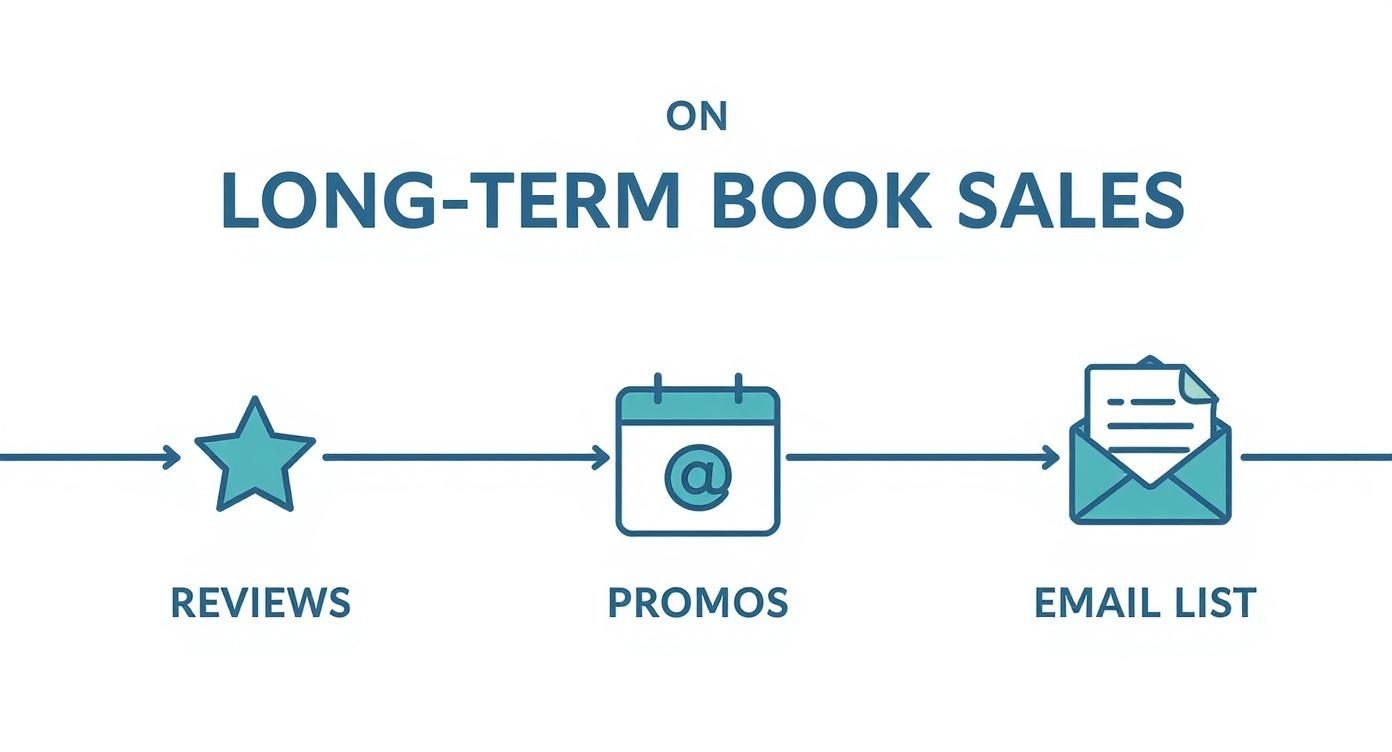
This process isn't just a one-time thing; it's a loop. Gaining reviews helps your promotions convert better, which in turn helps you grow your email list for the next launch.
Your focus now turns to sustainability. Dig into your Amazon Ads data to see which keywords are actually converting and put more budget behind them. Schedule a Kindle Countdown Deal or a Free Book Promotion to create another spike in visibility. Most importantly, keep nurturing your email list—provide value, share your journey, and get them excited for whatever you write next.
Sample 90-Day Promotional Calendar
To bring it all together, here's a sample timeline you can adapt for your own launch. This calendar breaks down the key activities across the three phases we've discussed.
| Phase | Key Activities | Primary Goal |
|---|---|---|
| Days -30 to -1 (Pre-Launch) | Assemble ARC team. Finalize KDP metadata & Author Central. Create all social media & email marketing assets. Schedule early interviews or guest posts. | Build anticipation and prepare all assets for a smooth launch day. |
| Days 1 to 7 (Launch Week) | Execute launch-price promotion. Send launch email to your list. Announce on all social channels. Activate first low-budget Amazon Ads. Remind ARC team to post reviews. | Maximize initial sales velocity and secure early reviews to trigger Amazon's algorithm. |
| Days 8 to 30 (Post-Launch) | Raise price to its regular level. Analyze initial ad performance. Send a "thank you" email to your list, possibly sharing early results or reviews. | Transition from launch sprint to sustainable marketing. Gather data and reader feedback. |
| Days 31 to 90 (Sustained Growth) | Optimize Amazon Ads based on performance data. Schedule a Kindle Countdown Deal or Free Book Promotion. Continue engaging with readers on social media and via email. Begin teasing the next project. | Build long-term sales momentum, grow your readership, and maintain visibility on Amazon. |
Think of this calendar not as a rigid set of rules, but as a flexible framework. The most successful authors are consistent. They show up, they engage, and they keep the momentum going long after launch week is over.
Burning Questions About Promoting Your Book on Amazon
Even the most detailed playbook can leave you with a few nagging questions. When it comes to the nitty-gritty of Amazon book promotion, a few common uncertainties pop up time and time again. Let’s clear the air on some of the biggest ones so you can move forward with confidence.
How Much Should I Really Spend on Amazon Ads?
This is where so many authors get stuck, but the answer is simpler than you think: start small. I'm talking $5 to $10 a day for your first campaign. Seriously, that's it.
Right now, your job isn't to sell a million copies overnight. Your job is to gather data. Run one, maybe two, simple campaigns. An automatic targeting campaign is perfect for this because you're letting Amazon's algorithm do the initial discovery work for you.
The only number you need to obsess over at this stage is your Advertising Cost of Sale (ACOS). Your entire goal is to keep your ACOS lower than your royalty rate.
Think of it this way: if your book nets you a 70% royalty, an ACOS of 40% is fantastic. You’re still making a healthy profit on every single sale that ad generates. Once you find a campaign that hits this sweet spot, then you can feel good about pouring more money into it.
KDP Select or Go Wide? The Million-Dollar Question
Ah, the classic debate: exclusivity versus reach. Going all-in with KDP Select means your book is available to the massive pool of Kindle Unlimited (KU) readers. It also unlocks powerful tools like Kindle Countdown Deals and Free Book Promotions.
This is often a no-brainer for new authors, or for anyone writing in genres that KU readers devour—think romance, sci-fi, and fantasy. The page-read income can be a significant boost.
"Going wide," on the other hand, puts your book on other major storefronts like Apple Books, Kobo, and Barnes & Noble. This diversifies your income, but it also divides your marketing efforts. A common path I've seen work well is to start with KDP Select for the initial 90-day term. You build momentum on Amazon’s massive platform, gather reviews, and then, after those 90 days, you can re-evaluate whether going wide makes sense for you.
How Many Reviews Do I Need Before Running Ads?
There's no official rule from Amazon, but from years of experience, I can tell you this: running ads to a book with zero reviews is just throwing money away. It’s like pouring water into a bucket full of holes. You’ll get clicks, but those shoppers will hesitate when they see no one else has taken a chance on your book.
As a solid rule of thumb, aim to have at least 10-15 positive reviews up on your page before you turn on your paid ad campaigns. This is the baseline of social proof you need to convince a stranger that your book is worth their money. It dramatically increases the chance that a click on your ad will actually turn into a sale. Make building that initial ARC team your top priority during your launch—it pays off big time.
Ready to transform your manuscript into a professionally published book with global reach? BarkerBooks offers a complete suite of services, from editing and design to worldwide distribution and targeted marketing, to help you succeed. Learn more and start your publishing journey with us today!