
If you want to sell more books, you have to stop thinking of reviews as a nice-to-have vanity metric. They are a powerful sales tool, plain and simple. Building a steady stream of authentic reader feedback is how you build social proof, which is the secret sauce to boosting your visibility on Amazon and convincing a hesitant browser to click "buy now."
Why Book Reviews Are Your Secret Weapon for Sales

Okay, let's get past the obvious: reviews matter. But do you know why they're the most effective (and most overlooked) tool in your marketing kit? It all comes down to a potent mix of human psychology and cold, hard algorithms.
When a potential reader lands on your book’s page, the cover and blurb only get them so far. The real question they're asking is, "Is this worth my time and money?" They immediately start hunting for validation from other readers.
Reviews provide that critical social proof. They signal that other people took a chance on your book and felt it was a worthwhile experience. That validation instantly lowers the perceived risk for a new buyer, turning your book from an unknown gamble into a trusted choice.
The Algorithm and Reader Trust
Retailer algorithms, especially Amazon's, are built for one thing: to sell more products. And a consistent flow of reviews is one of the clearest signals to that algorithm that a book has an engaged audience and is actively selling.
This kicks off a fantastic feedback loop:
- Better Visibility: More reviews tell the algorithm your book is relevant. In return, it rewards you with better placement in search results and those coveted "also bought" carousels.
- Greater Credibility: Think about it from a reader's perspective. A book with 50 reviews feels like a much safer bet than one with just two.
- Sales Momentum: This increased trust and visibility lead directly to more sales. More sales tell the algorithm to show your book to even more people.
This isn't a new phenomenon. Way back in 1995, a study found that 78% of book purchases were influenced by reviews. Fast forward to today, and the data is even more compelling: books with over 100 reviews and a 4.5-star average rank 2.3 times higher on bestseller lists. The power of reviews has only grown stronger. You can dig into more book market insights on Mordor Intelligence.
The goal isn't just to get a few shiny stars next to your book title. It's to build a rock-solid foundation of social proof that sells your book for you, even while you sleep. Every single review is a brick in that foundation.
Making the Most of Review Platforms
Platforms like Goodreads have become the town square for book lovers. It's where reviews spark conversations and drive discovery.
An active profile with a healthy number of reviews on sites like these builds your author reputation and sends organic traffic right back to your sales pages. When you make reviews the cornerstone of your marketing, you're not just chasing a launch-week spike—you're investing in the long-term health of your author career.
How to Prepare a Reviewer-Ready Book Package
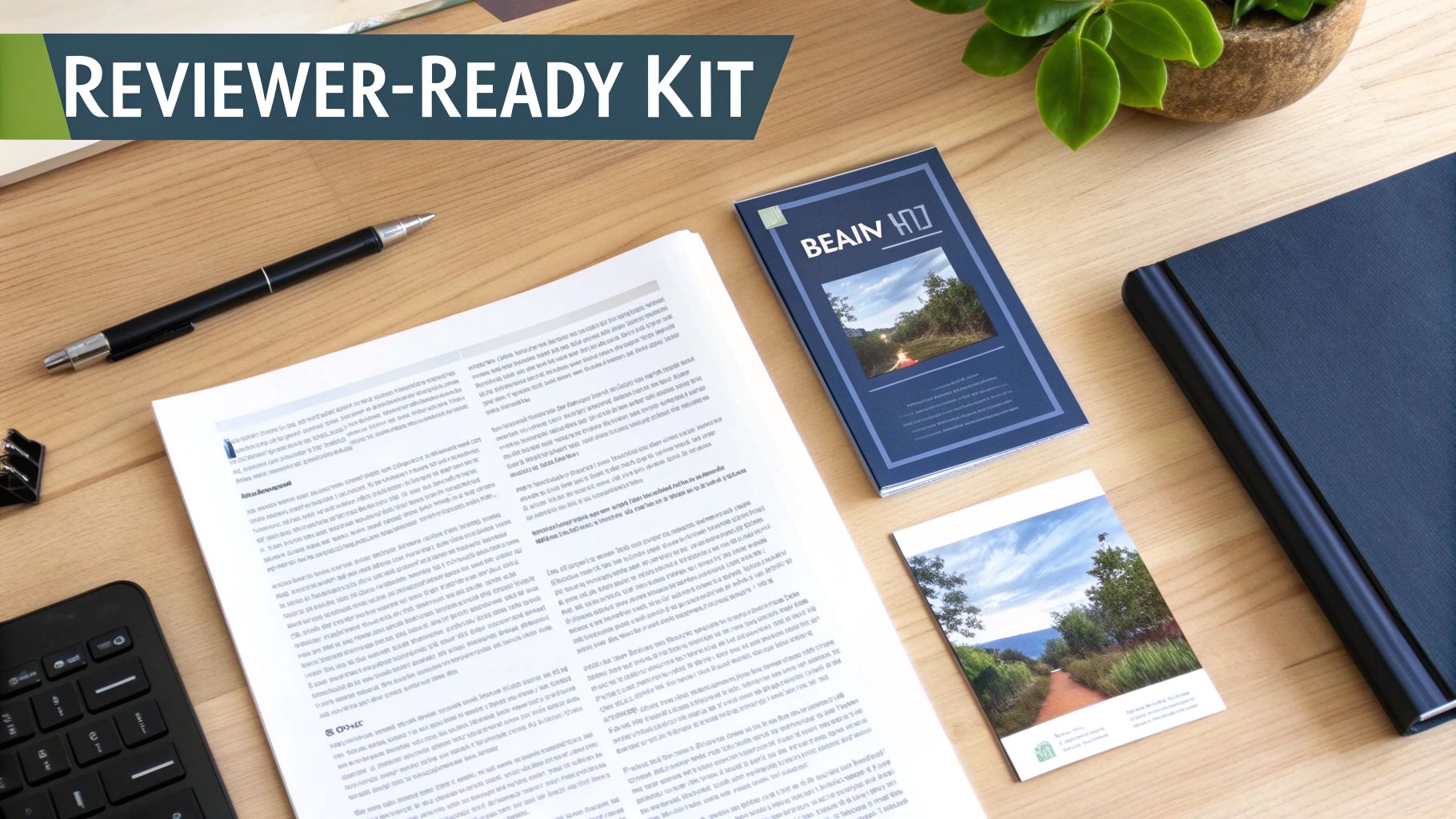
Before you can even think about asking for a review, you need to get your house in order. Think of it this way: asking a reviewer to read your book is like asking a chef to taste your signature dish. You wouldn't hand them a messy plate, would you? Sending a sloppy, unpolished manuscript to a busy reviewer is a surefire way to get ignored.
When you present your work professionally, you signal that you're a serious author who respects the reviewer's time. A polished package makes their job easier, builds genuine excitement for your story, and puts your book on par with releases from major publishing houses. Trust me, putting in this effort upfront is a non-negotiable step toward landing the reviews you want.
Crafting the Perfect Advance Reader Copy
The heart of your pitch is the Advance Reader Copy (ARC). This is a nearly-finished version of your book that goes out to reviewers before your official launch day. The quality of your ARC is a direct reflection of your book's quality in the reviewer's eyes—no pressure!
Your ARC needs to be professionally edited and formatted. While a few minor typos might be forgiven, the manuscript has to be clean enough for a seamless reading experience. If you haven't gone through rounds of feedback yet, I highly recommend learning how to find beta readers to iron out the big wrinkles first.
You’ve got two main choices for ARCs:
- Digital ARCs (.epub, .mobi, .pdf): These are the go-to for most authors. They're cheap, easy to send out, and perfect for platforms like NetGalley and Booksprout. Most modern book bloggers and reviewers actually prefer digital copies because they can load them right onto their e-readers.
- Physical ARCs (Paperbacks): Don't underestimate the power of a physical book. A printed copy can make a huge impression, especially with well-known reviewers, Instagram influencers, or traditional media folks. Yes, they cost more to print and ship, but a physical book stands out in a crowded inbox and feels like a real gift, which can often be the nudge someone needs to pick it up.
Pro Tip: Always, and I mean always, check the reviewer's submission guidelines for their preferred format. Sending a paperback to a digital-only blogger is a waste of money, and sending a file to someone who only reviews physical copies is a waste of your time. Respecting their process is the first step in building a good relationship.
Assembling Your Reviewer Kit
Beyond the ARC itself, you need a "reviewer kit." This is your secret weapon. It’s a collection of all the essential information a reviewer might need, saving them the hassle of digging around for details. A great kit makes it incredibly easy for them to write about you and your book, which means you're more likely to get a feature.
I recommend putting everything into a cloud folder (like Dropbox or Google Drive) and sharing a single link. It keeps your outreach email from getting cluttered and looks incredibly professional.
Essential Components of a Reviewer Kit:
- The Book One-Sheet: Think of this as your book's resume, all on one page. It should be clean, visually appealing, and include the cover, title, author name, publication date, ISBN, a killer blurb, a few key selling points, and your website/social media links.
- Author Bio and Headshot: Have a professional bio ready to go in a couple of different lengths (say, 50 words and 100 words). Pair it with a high-resolution, professional author headshot. This makes it a simple copy-and-paste job for the reviewer.
- High-Resolution Images: Give them everything they need to make their post look good. Include a high-res JPG or PNG of your book cover. It's also a great idea to include a 3D mockup.
- Key Information and Talking Points: This is a simple document that can make a huge difference. List the book's genre, word count, target audience, and any relevant content warnings. You can even suggest a few interesting themes or talking points to get their wheels turning, like "a story about overcoming betrayal" or "perfect for fans of classic whodunits with a modern twist."
When you prepare all this ahead of time, you give reviewers the tools they need to succeed. This level of professionalism not only helps you get book review opportunities but ensures that when you do, the final post is accurate, detailed, and truly shines.
Finding the Right Reviewers Who Will Genuinely Love Your Book
Sending your book out into the void and hoping for the best is a fast track to disappointment. The real strategy behind a successful review campaign isn't a numbers game of mass emailing; it's about precision. You need to connect with reviewers who are already looking for a book just like yours—people who love your genre, your tropes, and your style.
This isn't just about finding people who review books. It’s about finding your people.
When you approach someone who consistently raves about romantic fantasy, and that’s exactly what you’ve written, you’re no longer an interruption. You’re offering the perfect solution to their constant need for fresh content that their audience will devour.
Starting Your Search on Familiar Ground
So, where do you begin? The best place to start is where your ideal readers already hang out. Think like them: how do they discover their next favorite book? Following that trail will lead you straight to the most influential voices in your corner of the literary world.
Your best bets for finding these people are:
- Book Blogs: These are the heart and soul of the online reading community. A simple Google search for something like "[Your Genre] book blog" or "reviews of books like [Comparable Title]" will immediately open up a world of potential reviewers.
- Goodreads: This place is a goldmine. Look up books similar to yours and start digging into the people who reviewed them. You're looking for reviewers with detailed profiles, a solid following, and a history of writing thoughtful, in-depth reviews.
- Instagram (Bookstagram): Visuals sell, and Bookstagrammers are masters of it. Search hashtags like
#[YourGenre]Books,#[ComparableAuthor], or#BookReviewer. You'll find tons of creators who build their entire brand around books just like yours.
The digital shift has completely changed how readers find their next read. After the 2008 financial crisis, traditional media budgets for book coverage evaporated, and 62% of readers turned to online reviews instead. This move ignited platforms like Amazon, where the volume of reviews exploded by 300% between 2008 and 2012.
Fast forward to today, and a staggering 85% of indie authors say over half their sales come directly from these reader-driven reviews. It’s a powerful trend that has helped self-publishing claim 30% of the U.S. fiction market. You can explore more data on the global book market size on Booketic.
Vetting Potential Reviewers: The Quality Control Step
Once you've got a running list of names, the real work begins. This is where you vet each person, separating the casual reader from the dedicated reviewer who can actually move the needle for your book. Think quality, not quantity.
For every name on your list, do a little digging. Ask yourself:
- Do they review my specific subgenre? A general "fantasy" reviewer might not be the right audience for your grimdark epic. Get specific.
- What's their review style? Are they writing deep, analytical pieces or short, punchy summaries? Make sure their style is a good match for the kind of feedback you're hoping for.
- Is their audience engaged? Don't just look at follower counts. Check the comments, likes, and shares. A reviewer with 1,000 active, passionate followers is often far more valuable than one with 10,000 who are barely paying attention.
- Do they have a clear review policy? This is your most important clue. Most serious reviewers have a "Review Policy" or "Submissions" page. It will tell you if they're even open to requests, what formats they prefer, and exactly how to get in touch.
A curated list of 25 perfectly matched reviewers is infinitely more valuable than a generic list of 200. Your goal is to build a high-impact outreach list of people who are most likely to become true advocates for your work.
After you've identified a good fit, the next hurdle is getting their contact information. Of course, knowing how to find anyone's email address is a key skill here. Many bloggers list it right on their site, but you might have to do some sleuthing for others.
Building Your High-Impact Outreach List
As you vet each person, start populating a spreadsheet. This document will become the command center for your entire review campaign. Don't just jot down names—capture the data that will let you personalize your outreach and track everything.
To help you decide where to focus your energy, it helps to understand the trade-offs of each platform.
Review Channel Comparison for Authors
This table helps authors compare the effort, cost, and potential impact of different review channels to prioritize their outreach strategy.
| Channel | Best For | Typical Cost | Time Investment | Potential Reach |
|---|---|---|---|---|
| Book Blogs | Niche genre targeting and in-depth reviews | Free | High | Medium to High |
| Goodreads | Reaching avid readers and building credibility | Free | Medium | High |
| Visual appeal and reaching younger audiences | Free | High | Medium to High | |
| Editorial Sites | Securing professional, quotable reviews | Paid | Low | High |
By comparing these options, you can build a more balanced and effective strategy.
Your spreadsheet should have columns for the reviewer's name, their website or profile link, contact info, preferred genres, and notes on their review policy. I also recommend adding a column for the date you plan to reach out. This level of organization keeps you from sending duplicate requests and lets you tailor each pitch perfectly.
This isn't just a list; it's your strategic playbook for getting the reviews your book deserves.
Writing Outreach Emails That Actually Get Opened
You've got your reviewer kit locked and loaded, and you've built a killer list of people who could become your book's biggest champions. Now for the make-or-break moment: the first email.
This pitch is, without a doubt, the most critical piece of the puzzle. A generic, copy-and-paste message gets deleted in seconds. But a thoughtfully crafted, personal email? That’s what opens the door to the reviews that can truly move the needle.
Think about it from their perspective. A popular book blogger might get dozens, if not hundreds, of review requests every single week. To stand out, your email has to do more than just ask for a favor. It needs to show you've done your homework and that you genuinely respect their time and their platform. You need to prove you're not just another author blasting an email to a purchased list.
This is where you need a multi-channel approach. Don't put all your eggs in one basket.
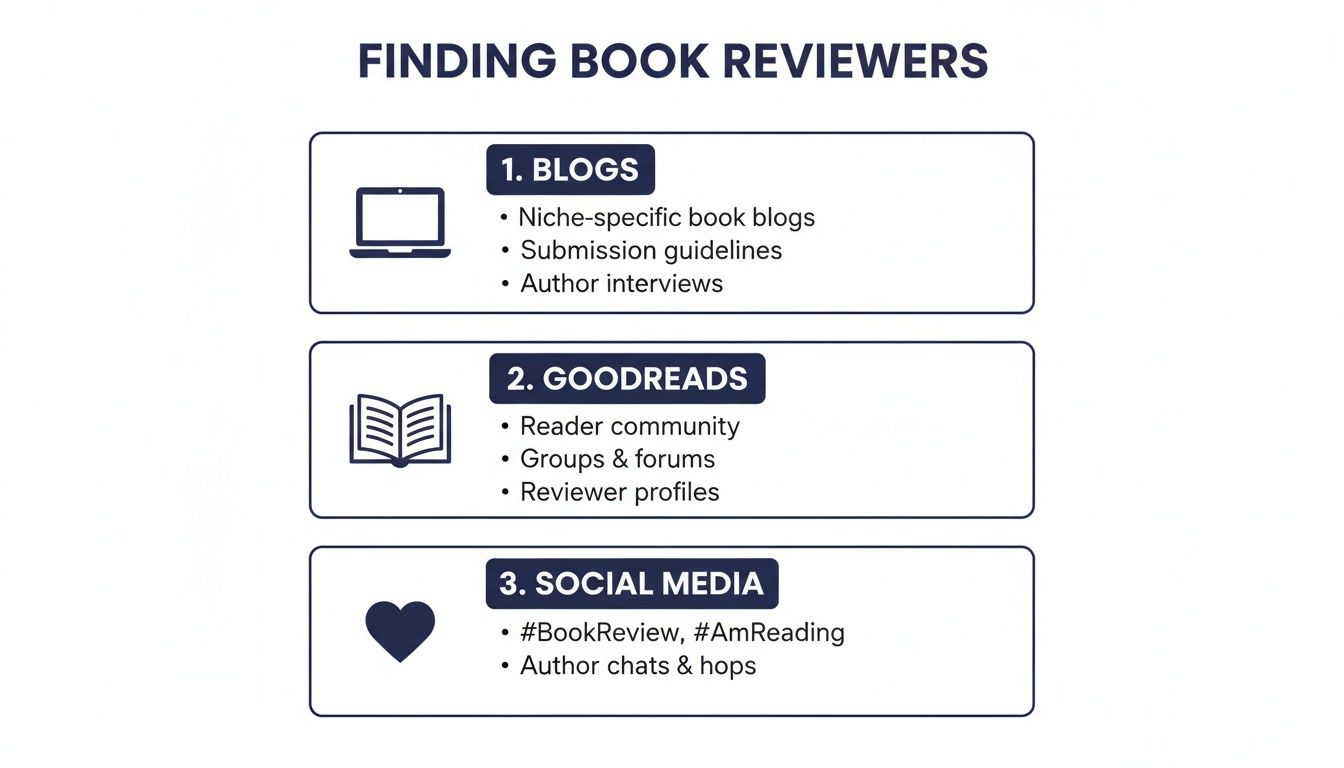
As you can see, a solid outreach strategy involves a mix of dedicated blogs, community hubs like Goodreads, and the visual-first world of social media. Each requires a slightly different touch.
The Anatomy of a Perfect Pitch
A winning pitch email has three core parts, and if any one of them is weak, the whole thing collapses. Let's break down what makes an email impossible to ignore.
- The Subject Line: This is your digital handshake. It needs to be clear, concise, and just intriguing enough to earn that click. Ditch boring subject lines like "Book Review Request." Instead, try something more personal and relevant, like "For fans of [Popular Comp Title]" or "A sci-fi novel for your readers."
- The Personalized Opener: Here's where you prove you're not a robot. Mention a specific review they wrote that resonated with you. Connect your book to a theme you know they're passionate about. This single gesture instantly separates you from 90% of the other requests flooding their inbox.
- The Clear and Concise Pitch: Get right to it. Briefly introduce your book—title, genre, and a killer one-sentence hook. Then, connect the dots for them. For example: "Since you loved the moral quandaries in The Midnight Library, I thought my character-driven sci-fi about second chances might be a great fit."
The goal here isn't just to get a review; it's to start a professional relationship. A personalized, respectful email shows you see the reviewer as a valued colleague, not just a stepping stone.
Building Your Pitch Template
Look, you don't need to write every single email from scratch. That's a recipe for burnout. The smart move is to create a solid template that serves as your framework. This saves a ton of time while making sure you hit all the essential notes.
Your template should be built around personalization. Include obvious placeholders that you have to fill in, like [Reference a specific post/review here] or [Explain why my book is a good fit for THEIR audience]. This structure keeps you on message while forcing you to do the custom work that matters.
As you send more pitches, you'll naturally refine what works for your voice and genre. This hands-on process is a vital part of any good book marketing plan, helping you build both your skills and your professional network.
The Art of the Follow-Up
So you sent the perfect pitch… and heard nothing back. Silence. Don't take it personally. Reviewers are incredibly busy, and even the best emails get buried. A gentle, polite follow-up is often all it takes to get noticed.
The key is to be persistent without being a pest.
Wait at least one to two weeks before reaching out again. Keep it short and sweet. Simply reply to your original message with something like, "Hi [Reviewer's Name], just wanted to gently bump this up in your inbox in case it got missed. Would love to know if this might be a good fit for you."
One follow-up is standard practice. Two is the absolute maximum. If you still don't get a reply after that, it's time to respectfully move on. Pushing any harder will only burn a bridge. Remember, a "no" (or no response) isn't a judgment on your book's quality—it's just part of the business. Stay professional, track your outreach, and keep moving.
Staying Organized and Navigating Feedback
Once your ARC campaign is live, the real work begins. You’re not just sending out your book; you're managing relationships, tracking progress, and hopefully, turning a wave of positive feedback into powerful marketing assets. This isn't a one-and-done task—it’s a marathon that requires a solid system to keep everything from falling through the cracks.
Think of it as your campaign’s command center. You need a simple, clear way to see who you’ve pitched, who said yes, and who might need a friendly reminder. This helps you avoid common mistakes, like contacting the same reviewer twice or forgetting to follow up with someone who showed interest.
Your Campaign Command Center: The Humble Spreadsheet
You don’t need any fancy or expensive software for this. Honestly, a simple spreadsheet is your most powerful tool. Set one up to track every moving part of your outreach.
Here’s a practical layout I’ve used for years:
- Reviewer Name: The person's name or blog/channel name.
- Website/Profile URL: A direct link so you can easily check their work.
- Contact Email: Their preferred email for review pitches.
- Date Pitched: The day you sent your first email.
- Follow-Up Date: The date you sent a follow-up (if needed).
- Status: This is crucial. Use a dropdown with options like "Pitched," "ARC Sent," "Declined," or "Review Live."
- Review Link: The moment a review goes live, pop the URL in here.
- Notes: A spot for personal details. "Loves epic fantasy with dragons," or "Prefers .epub files." Little things like this make a huge difference.
This spreadsheet does more than just keep you organized for one launch. Over time, it becomes a goldmine of contacts for your next book, giving you a list of warm leads who already know and appreciate your work.
When the Inevitable One-Star Review Appears
Okay, let’s talk about the moment every author dreads: the bad review. It feels personal. It stings. Your first instinct might be to charge in and defend your story, your characters, your very soul.
Don’t.
Rule number one for handling negative reviews is simple: Never, ever engage. Replying to a bad review is like pouring gasoline on a fire. It makes you look thin-skinned, draws more attention to the criticism, and can turn a single negative opinion into a full-blown comment war.
Step away from the keyboard. Take a breath. The best way to deal with a bad review is to bury it under a mountain of good ones. Put your energy back into your outreach, not into a fight you can’t win.
Finding the Silver Lining in Criticism
While you should never reply publicly, that doesn’t mean you should ignore the feedback completely. After the initial sting wears off, go back and read the review with a more objective eye. Is there a kernel of truth in what they’re saying?
Sometimes, a critical review can point out a weakness you were too close to see.
- Did a few readers get tripped up by the same plot point?
- Is "the pacing dragged in the middle" a recurring comment?
- Did they find a main character’s motivation hard to believe?
This kind of feedback, though tough to swallow, is incredibly valuable. It’s free insight that can help you sharpen your skills and make your next book even stronger. The goal is to develop a thick skin and learn from every piece of feedback—the good, the bad, and the ugly.
Believe it or not, a few less-than-perfect reviews can actually help your book. A page of exclusively five-star raves can feel a bit suspicious to savvy readers. A mix of opinions looks more authentic and helps potential buyers decide if your book is truly for them, which leads to happier readers in the long run.
Reviews are a huge driver in today's market. Recent data shows that 70% of global book buyers check reviews before they even think about clicking "buy." And for indie authors, the numbers are even more compelling: books with 50 or more reviews can outsell those with none by a staggering 3.5x. You can see more data on the book market's reliance on reviews on StellarMR.
A great review campaign doesn't just stop on launch day. To keep the momentum going, check out our guide on leveraging social media for book marketing. Keeping the conversation alive ensures a steady stream of reviews, signaling to readers and retail algorithms that your book has staying power.
Got Questions About Book Reviews? Let's Clear Things Up.
Navigating the world of book reviews can feel like you’re trying to find your way through a maze blindfolded. There's a ton of conflicting advice out there, and it’s easy to get bogged down by all the unwritten rules. Most authors I talk to have the same core questions, so let’s tackle them head-on.
We'll cut through the noise and give you some straight answers. From the ethics of paying for reviews to that gut-punch feeling you get from a one-star rating, knowing how to handle these situations is half the battle.
Is It Okay to Pay for Book Reviews?
This is the big one, and the answer is a very firm "it depends." Let's be crystal clear: you should never, ever pay someone directly for a positive review. Not only does this violate the terms of service for major retailers like Amazon and Goodreads, but it will tank your credibility if you get caught. Readers can smell a fake review a mile away.
However, there's a huge difference between that and paying for a service that facilitates reviews. This is where things get interesting and, frankly, perfectly ethical. Think about platforms like Kirkus, Reedsy Discovery, or NetGalley. With these, you're not buying a five-star rating. You're paying for access to their established network of vetted reviewers or for a professional, unbiased editorial assessment.
The key distinction is this: you’re paying for the service, the access, and a reviewer's valuable time—not a guaranteed outcome. This is a standard, respected industry practice that keeps things fair for everyone.
How Many Reviews Do I Really Need?
There isn't a single magic number, so don't get hung up on chasing one. It’s far more useful to think in terms of key milestones that unlock certain benefits for your book. A book with zero reviews is a tough sell, so your first job is just to get on the board.
Here are a few targets to aim for:
- Your first 10-15 Reviews: This should be your immediate post-launch goal. Getting to double digits provides that crucial initial social proof. It tells potential readers, "Hey, other people have read this and it's worth your time."
- The big 50 Reviews: Hitting 50 reviews is a major milestone. Why? Many of the best book promotion sites (like BookBub or Freebooksy) have minimum review counts, and 50 is often the magic number that makes your book eligible for their powerful newsletters. It also gives Amazon's algorithm a much stronger signal that your book is relevant and worth showing to more people.
Once you've passed those milestones, the game shifts from quantity to consistency. A book that steadily picks up new reviews month after month looks far more appealing and alive than one that got 100 reviews at launch and then flatlined.
What Should I Do If I Get a Bad Review?
First, take a deep breath and step away from the keyboard. Seriously. It’s going to feel like a personal attack, but I promise you, firing back a defensive comment is the worst thing you can do. It almost never ends well. You risk looking unprofessional and can even draw more negative attention to the review. It’s a phenomenon called the Streisand effect, and you want no part of it.
Once the initial sting wears off, here's a healthier way to handle it:
- Don't engage. Your silence is your best weapon. A defensive reply just bumps the negative review to the top of the pile.
- Look for a nugget of truth. Is there any constructive criticism hidden in there? Maybe the pacing really did drag in the middle. Use it to make your next book even better.
- Report it, if it crosses a line. If the review is just a personal attack, contains spoilers, or uses hate speech, don't hesitate to report it to the platform. It might get taken down for violating community guidelines.
- Bury it with good reviews. The best revenge is success. Put your energy back into your outreach campaign and get more positive reviews to push that negative one so far down the page nobody will ever see it.
And remember, a few critical reviews sprinkled among a sea of positive ones can actually make your book’s page look more authentic.
How Early Should I Start Sending Out ARCs?
When it comes to building launch-day momentum, timing is everything. You have to give reviewers enough lead time to actually read your book and write a thoughtful review without feeling rushed. The most sought-after book bloggers and reviewers often have their reading schedules filled up for months.
As a rule of thumb, start sending out your ARCs 2 to 4 months before your publication date. This might feel early, but this generous window is your best friend. It gives you time to build genuine buzz, gather amazing quotes you can use in your marketing, and line up a solid base of reviews to go live the moment your book is for sale. This is how you turn a quiet launch into an event.
At BarkerBooks, we know that getting reviews is just one piece of the giant publishing puzzle. Our team is here to help you get your manuscript into prime shape, create a cover that grabs attention, and build a marketing strategy that gets your book into the right hands. Learn how we can help you publish with confidence.