
So you’ve typed “The End” on your manuscript. That’s a huge milestone! But now comes the question that trips up so many new authors: what’s this actually going to cost me?
Let’s cut to the chase. To self-publish a book that looks and feels as professional as one from a major publishing house, you should plan on investing somewhere between $2,000 and $5,000. That’s the typical range for getting all the essential, non-negotiable services that turn a Word document into a book people are excited to buy and read.
Understanding Your Initial Investment
Figuring out the exact cost to self-publish can feel like trying to nail Jell-O to a wall. Sure, you could technically publish for free if you did every single task yourself. But let’s be honest—that path rarely leads to a book that sells. To create something readers will trust with their time and money, you need to make a smart financial investment.
Think of it like building a house. You wouldn’t skip the foundation or try to frame the walls yourself (unless you’re a pro!) just to save a few bucks. The same logic applies here. Certain expenses are the very foundation of your book’s quality and its ability to find an audience.
To help you get a clearer picture, here is a quick breakdown of what you can generally expect at different budget levels.
At a Glance Self Publishing Cost Estimates
| Budget Level | Typical Cost Range | Best For |
|---|---|---|
| Budget/DIY | $200 – $1,500 | Authors on a tight budget who are willing to do most of the work themselves, or for very short books/niche projects. |
| Mid-Range/Professional | $2,000 – $5,000 | The sweet spot for most indie authors aiming for a high-quality, commercially viable book that can compete with traditional titles. |
| Premium/Full-Service | $6,000 – $15,000+ | Authors who want a completely hands-off experience, extensive marketing support, or have complex projects (e.g., photo-heavy books). |
These ranges cover the core services that transform your manuscript from a passion project into a professional product.
The Core Pillars of Publishing Costs
Your budget will be spent on a handful of absolutely critical services. These are the things that separate an amateur-hour project from a book that can stand proudly on the same digital shelf as a bestseller. Getting these right is the first step toward building a realistic budget.
Here’s where your money should go:
- Professional Editing: This is your book’s structural integrity. A good editor ensures your story works, your writing is sharp, and every comma is in its place. It’s non-negotiable.
- A Killer Cover Design: Think of this as your book’s curb appeal. It’s the very first thing a potential reader sees and it can make or break a sale in a split second.
- Clean Interior Formatting: This is the layout and typesetting that makes your book a pleasure to read, both in print and on a screen. Bad formatting screams “amateur.”
- Smart Marketing and Distribution: This covers the essentials, like getting your ISBN, and the strategic work of running ads or promotions to help readers actually find your masterpiece.
The most successful authors don’t see these as costs; they see them as investments. A polished, professionally produced book is your single best marketing tool. It leads to better reviews, more word-of-mouth, and, you guessed it, more sales.
After working with thousands of authors here at BarkerBooks, we typically recommend a budget between $2,000 and $4,000 to hit that professional standard. This lines up with what we see across the industry, where other data shows a professionally produced novel often lands in the $2,940–$5,660 range. It all points to the same conclusion: a budget in the mid-thousands is a realistic starting point for giving your book a real shot at success. You can learn more about how publishing costs are calculated on our blog.
Now that you have a big-picture view of the finances, we’ll start breaking down each of these costs piece by piece. This will help you build a budget that makes sense for your book and your goals.
Where Your Money Goes: A Core Expense Breakdown
Thinking about the total cost to self-publish can feel overwhelming, but it’s a lot easier when you see it as an investment in a few key areas. Think of your book as a product you’re building. A master craftsman wouldn’t use shoddy materials, and a serious author invests in services that guarantee quality from the inside out.
Let’s open up the ledger and look at the line items that will make up the bulk of your budget. These are the “Big Three” services that truly separate a polished, professional book from an amateur one.
The Cornerstone of Quality: Professional Editing
Before anyone reads your manuscript, it absolutely needs a professional editor’s touch. This is, without a doubt, the most important—and usually the largest—investment you’ll make. Skipping this is like building a beautiful car with a faulty engine; it doesn’t matter how good it looks if it doesn’t run right.
Editing isn’t just one thing. It’s a multi-stage process, and each step has a specific job:
- Developmental Editing ($800 – $2,500+): This is the big-picture review. A developmental editor examines your story’s structure, plot, character arcs, and pacing to make sure the foundation of your narrative is solid and compelling.
- Copyediting ($600 – $1,500): Once the story is sound, a copyeditor goes through your manuscript line by line. They polish your sentences for clarity and flow, fixing grammar, syntax, and consistency issues along the way.
- Proofreading ($300 – $800): This is the final quality check before launch. After the book is formatted, a proofreader swoops in to catch any last typos, punctuation errors, or weird formatting glitches.
The single biggest piece of the self-publishing cost puzzle is almost always editing, followed by cover design and interior formatting. In fact, these three services alone can easily eat up 70–80% of a serious author’s budget. For a typical full-length manuscript, you can expect professional editing to land somewhere between $1,500–$3,000. Add in the other core services, and you start to see how a professional-level budget takes shape. You can explore a more detailed breakdown of what book editing costs in our dedicated guide.
Your Book’s First Impression: Cover Design
People do judge a book by its cover. It’s just a fact of life. In a crowded digital bookstore, your cover has less than a second to catch a reader’s eye and make them click. A professional design instantly signals that the words inside are worth their time. It’s your most critical marketing tool.
Sure, a pre-made template might only set you back under $100, but a custom cover crafted by a designer who lives and breathes your genre’s conventions can run from $400 to over $1,500. What you’re paying for is their expert eye for typography, imagery, and composition—the things that connect with your ideal reader.
A professional cover isn’t an expense; it’s your storefront. It communicates genre, tone, and quality instantly, making it a powerful sales tool that works for you 24/7.
The Reading Experience: Interior Formatting
Interior formatting, sometimes called typesetting, is the subtle art of arranging your text on the page to create a seamless and enjoyable reading experience. Bad formatting—funky line breaks, mismatched fonts, or cramped margins—is jarring. It can pull a reader right out of the story and even lead to a frustrated one-star review.
Professional formatting ensures your book looks clean and is easy to read, both in print and on a screen. This service usually costs between $200 and $700, though it can be more if your book is complex and includes a lot of images, tables, or footnotes.
Essential Administrative Costs
Beyond the “Big Three,” a few smaller administrative costs are necessary to officially launch your book into the world.
- ISBN (International Standard Book Number): Think of this as your book’s unique fingerprint, used by retailers worldwide. In the U.S., a single ISBN costs $125, but a block of ten is a much better deal at $295. Owning your own ISBNs is important because it lists you as the publisher.
- Copyright Registration: While your work is technically copyrighted the moment it’s written, officially registering it with the U.S. Copyright Office ($45-$65) creates a public record. This is crucial legal protection if you ever need to defend your work from infringement.
If you’re planning on selling physical copies yourself, it’s also worth looking into dedicated book fulfillment services to help manage the logistics and costs of shipping. All these pieces, big and small, come together to form the financial foundation of a successful book.
To give you a clearer picture, here’s a detailed look at the typical cost ranges for individual publishing services.
Itemized Self Publishing Cost Breakdown
This table breaks down the typical costs you can expect, depending on whether you’re taking a DIY approach or investing in premium, full-service support.
| Service | Low-End Cost (DIY/Budget) | Mid-Range Cost (Professional) | High-End Cost (Premium/Complex) |
|---|---|---|---|
| Developmental Editing | $0 – $800 | $1,200 – $2,500 | $2,500 – $5,000+ |
| Copyediting | $0 – $600 | $800 – $1,500 | $1,500 – $3,000+ |
| Proofreading | $0 – $300 | $400 – $800 | $800 – $1,500+ |
| Cover Design | $5 – $250 | $400 – $1,200 | $1,200 – $2,500+ |
| Interior Formatting | $0 – $150 | $200 – $700 | $700 – $1,500+ |
| ISBN | $0 – $125 | $125 – $295 | $295+ |
| Copyright Registration | $45 – $65 | $45 – $65 | $65+ |
| Book Marketing | $50 – $500 | $1,000 – $3,000 | $5,000 – $10,000+ |
| Author Website | $0 – $200 | $500 – $1,500 | $2,000 – $5,000+ |
As you can see, the costs can vary dramatically. This flexibility is one of the biggest advantages of self-publishing—you get to decide where to invest your money based on your skills, budget, and goals.
Choosing Your Publishing Path: DIY vs. Freelancers vs. Full-Service
Okay, we’ve broken down the individual costs, but the biggest factor influencing your total self-publishing bill is how you get everything done. Think of it like building a house. You could grab a hammer and do it all yourself, hire individual plumbers and electricians, or bring in a general contractor to manage the whole project.
Each approach strikes a different balance between your money, your time, and the amount of control you want to have. Let’s walk through the three main ways authors tackle this so you can figure out what’s right for you.
The DIY Author: The Bootstrapper
This is the path of the true self-starter. The DIY author rolls up their sleeves and handles everything from formatting the manuscript to designing the cover with online tools. You’re not just the writer; you’re the editor, designer, and project manager all rolled into one.
- Cost: Without a doubt, this is the cheapest way to publish. Your only hard costs might be a few hundred dollars for an ISBN, maybe some software, but that’s about it.
- Time: The time investment is massive. A task a professional could knock out in an afternoon might take you a full week of watching tutorials, making mistakes, and starting over.
- Best For: This is really for authors on a shoestring budget, people who genuinely love the technical side of book creation, or those working on a passion project where a polished, commercial look isn’t the top priority.
The trade-off is simple: you save a ton of cash but spend an enormous amount of time. The biggest risk here is that your final book can end up looking homemade, which can unfortunately signal a lack of quality to potential readers before they’ve even read a single word.
Hiring Freelancers: The A La Carte Approach
This is the route most serious indie authors take. You become the project manager, carefully selecting and hiring individual experts for each job. You’ll find a cover designer on one site, a line editor on another, and a formatter who specializes in your genre.
This approach gives you ultimate control over your creative team. You get to hand-pick every single person, ensuring their style and expertise perfectly match your vision for the book.
The catch? You’re the one in charge of juggling all those moving parts. It’s on you to manage contracts, chase deadlines, and make sure the edited files get to the formatter correctly. It demands a serious knack for organization and can feel like herding cats at times.
The Full-Service Company: The All-in-One Solution
Working with a full-service company, like us here at BarkerBooks, is the most hands-off way to get your book published professionally. It’s like hiring that general contractor who already has a trusted team of plumbers, electricians, and painters ready to go. You get a single point of contact who coordinates the entire process, from editing and design all the way through to distribution.
This path is all about efficiency. You don’t have to spend weeks sifting through portfolios to find a great editor or a cover artist who understands your genre—the company has already vetted a team of pros. These services are typically bundled into packages, which often ends up being more cost-effective than hiring everyone one-by-one.
A full-service company takes the guesswork and logistical headaches off your plate. It ensures every stage of your book’s creation is handled by a coordinated team, resulting in a seamless, professional final product.
While the initial investment might seem higher than hiring freelancers individually, the real value is in the time you save, the guaranteed quality, and the sheer peace of mind. You’re free to focus on what you do best—writing and connecting with readers—while the experts handle the technical side.
If you’re still weighing the big-picture options, our guide on traditional vs. self-publishing options can help you see where each of these paths fits into the wider publishing landscape.
Let’s Look at Some Real-World Budgets
All those itemized costs are great for understanding the pieces, but what does it all look like when you put it together? The truth is, the cost to self-publish isn’t one-size-fits-all. It’s a direct reflection of your goals, your skills, and what you’re willing to invest—in both time and money.
To make this tangible, let’s walk through three common author scenarios. See if you recognize yourself in one of them. Each path represents a different strategy for balancing quality and cost, giving you a practical starting point for your own budget.
The Bootstrapping Author: $500 – $1,500
This author is scrappy, resourceful, and has more time than cash. Their mission is simple: get a professionally polished book out into the world without going broke. They know they’ll have to roll up their sleeves and do a lot of the heavy lifting themselves.
Their budget is lean, mean, and focused only on the absolute essentials they can’t handle alone.
- Editing: This is their biggest hurdle. After hammering the manuscript with self-editing tools and getting feedback from beta readers, they’ll spend $300 – $600 for a final, professional proofread. It’s the one thing they won’t skip.
- Cover Design: A custom cover is out of reach, so they get smart. They find a high-quality pre-made cover for around $100 – $250, giving them a professional look for a fraction of the price.
- Interior Formatting: They tackle this themselves. Using a free tool like the Reedsy Book Editor or dedicating a weekend to learning a program like Vellum, they keep this cost at $0.
- ISBNs & Copyright: They buy a single ISBN for $125 and file their copyright for $65. No frills, just the necessities.
- Total Investment: $590 – $1,040
The Professional Indie Author: $2,000 – $4,000
This author is running a business, and their book is the main product. The goal here is to release a book that looks and feels completely indistinguishable from something put out by a major publisher. They know that investing in quality up front builds reader trust, earns better reviews, and drives sales in the long run.
Their budget reflects a serious commitment to getting it right.
- Editing: They invest in a solid two-step editing process, usually a comprehensive copyedit followed by a final proofread. This critical foundation costs anywhere from $1,200 – $2,300.
- Cover Design: This isn’t just a cover; it’s a marketing tool. They hire a professional designer who lives and breathes their genre, budgeting $500 – $1,000 for a custom design that sells.
- Interior Formatting: To guarantee a seamless reading experience, they hire a pro to handle both the ebook and print layouts. This runs about $250 – $500.
- ISBNs & Copyright: Thinking ahead, they wisely purchase a block of 10 ISBNs for $295 and register the copyright for $65.
- Total Investment: $2,310 – $4,160
The Author Entrepreneur: $5,000+
For this author, the book is just the beginning. It’s the cornerstone of a larger brand, a speaking career, or a coaching business. They aren’t just launching a book; they’re orchestrating a major event designed for maximum impact. They’re ready to invest heavily to make a big splash.
Their all-in budget covers a top-tier product and a powerful marketing engine to fuel it.
- Full-Suite Editing: They spare no expense, starting with developmental editing to refine the core structure, followed by copyediting and proofreading. This comprehensive process can total $3,000 – $5,000.
- Premium Cover Design: They might commission custom artwork or work with a renowned design agency, setting aside $1,200 – $2,500 for a truly show-stopping cover.
- Interior & Special Formatting: This goes beyond the basics, including print, ebook, and maybe even a custom hardcover or an interior with illustrations, costing $500 – $1,000.
- Audiobook Production: Reaching a whole new audience is key, so they hire a professional narrator and producer. Costs typically range from $2,000 – $4,000.
- Marketing & PR: They hit the ground running with a launch budget of $1,500+ for targeted ads, a publicist, and other promotional materials.
Total Investment: $8,500+
Of course, these are just frameworks. Your final costs will shift based on your book’s length and complexity. And don’t forget, if you’re printing physical copies, you’ll need to account for those expenses. You can get a much clearer picture of what that will look like by plugging your details into a good book printing cost calculator to get some hard numbers.
Smart Strategies to Lower Your Publishing Costs
Publishing a professional-quality book is a serious investment, but a tight budget doesn’t mean you have to cut corners on quality. The real secret is knowing where to spend and where you can save. With a few clever moves, you can stretch your dollars and give your book the polished launch it deserves.
These author budget tiers give you an idea of the different investment levels you might be looking at.
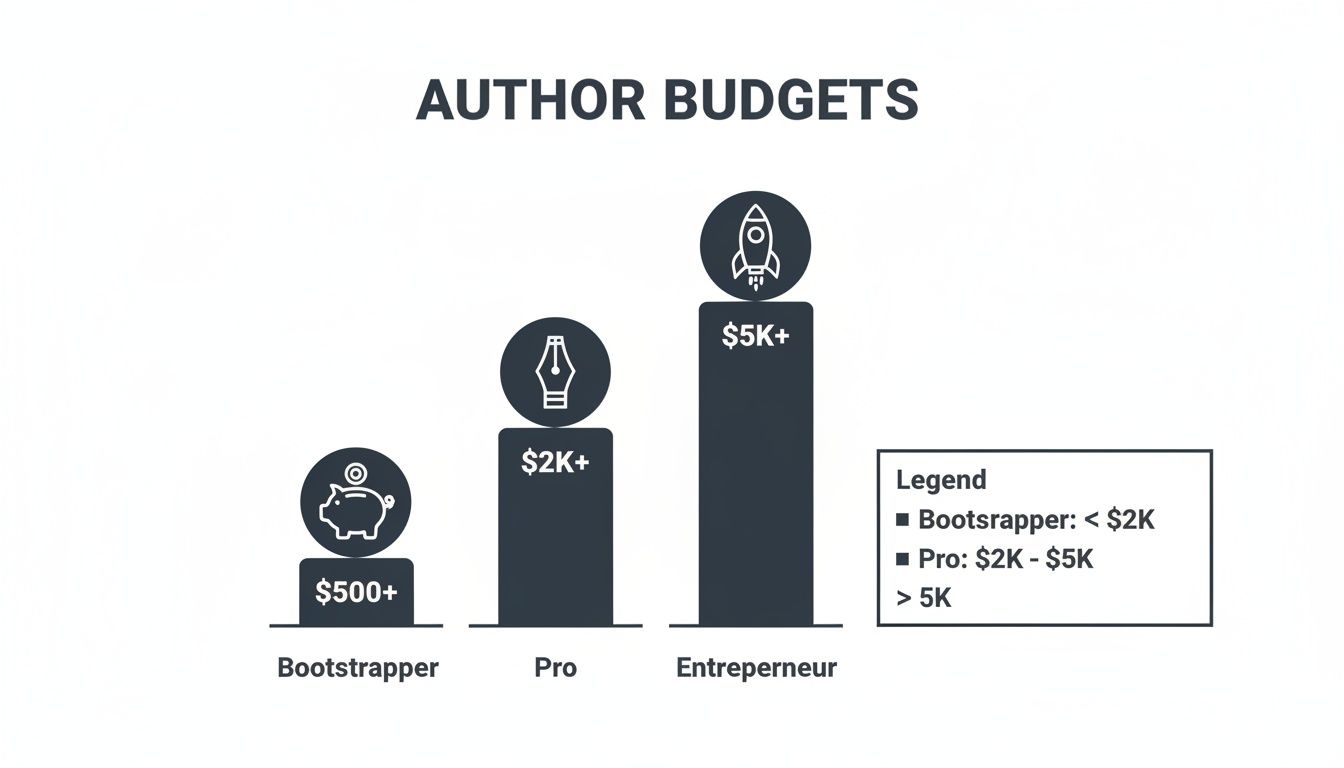
This chart breaks down the typical starting points, from the resourceful “Bootstrapper” author to the ambitious “Author Entrepreneur.”
Prepare Your Manuscript Thoroughly
Want to know the cheapest manuscript to edit? The cleanest one you can possibly deliver. Most professional editors charge by the hour or by the word, so the less time they spend fixing basic mistakes, the smaller your final invoice will be. Before you even think about sending it off, put your manuscript through its paces.
- Self-Edit First: Run your draft through tools like Grammarly or ProWritingAid. They’re fantastic for catching typos, grammar goofs, and other simple errors that can add up.
- Read It Aloud: You’d be amazed at what you catch this way. This simple trick makes clunky dialogue and awkward phrasing jump right out.
- Use Beta Readers: Find a handful of trusted people who are in your target audience. Their feedback on things like plot holes or confusing passages can solve major structural problems before you pay a developmental editor to spot them.
A polished manuscript respects your editor’s time and, more importantly, your budget. Every hour you spend refining your draft can translate directly into savings on your final editing invoice.
Make Smart Service and Administrative Choices
How you purchase essential assets and services can dramatically reduce your costs, especially if you plan on writing more than one book. It really pays to think like a business owner right from the start.
Take ISBNs, for example. In the U.S., a single ISBN costs $125, but you can buy a block of ten for just $295. If you have any plans for a sequel, a paperback version, or a different book entirely, buying in bulk saves you over $950 down the road. It’s a no-brainer.
This long-term thinking also applies to hiring professionals. Full-service companies like BarkerBooks often provide package deals. Bundling editing, cover design, and formatting is almost always cheaper than hiring three different freelancers. Not only does it save you money, but it makes managing the whole project a lot simpler.
Leverage Modern Tools and Bartering
Your creativity isn’t just for the story—it’s your best tool for getting things done on a budget. There are tons of low-cost tools and community-based strategies you can use to lower your expenses without hurting your book’s chances of success.
To seriously cut down on the initial writing and editing time, consider using advanced AI writing tools like ChatGPT and Claude. These platforms can help you brainstorm ideas, polish your sentences, and catch errors, which lightens the load for your human editor.
Don’t forget about the power of a good old-fashioned skill swap. Are you a talented graphic designer? Maybe you could design some marketing graphics for another author in exchange for them proofreading your manuscript. Tap into your network and see what skills you can trade. By thinking strategically, you can take control of your publishing costs and put your money where it counts most.
Why Quality Is Your Best Marketing Investment
After looking at all these numbers, it’s tempting to see the cost to self-publish as a long list of expenses you need to slash. But here’s a little secret from the authors who make a real living at this: they don’t see it that way at all. For them, professional editing and design aren’t just costs—they are the single best marketing investment they can make.
Think about how you shop for books. You land on a book’s Amazon page and, in just a few seconds, you’ve already made a split-second decision based on two things: the cover and the first couple of sentences of the description. A sharp, genre-appropriate cover tells you it’s a professional product. Clean, engaging copy promises a story that won’t waste your time.
That first flicker of trust is what gets a reader to click “Buy Now.” It’s the first domino in the chain reaction that leads to a successful book.
Turning Production into Promotion
A well-produced book acts like your silent, 24/7 salesperson. When a reader dives into your story and isn’t jolted out by typos or clunky sentences, they’re much more likely to finish it and leave a glowing review. Those reviews build powerful social proof, signaling to other potential buyers that your book is a safe bet.
- Great Covers stop the endless scroll and earn that all-important first click.
- Flawless Editing keeps readers glued to the page, which turns into five-star ratings.
- Clean Formatting ensures a smooth reading experience, heading off those pesky negative reviews.
Investing in production quality isn’t just about making your book look pretty. It’s about building an asset that sells itself through reader satisfaction and word-of-mouth.
This is the kind of organic momentum that no amount of paid advertising can replicate. Retailer algorithms, especially on a platform like Amazon, pick up on this reader engagement—the clicks, the good reviews, the high read-through rates—and start showing your book to brand-new audiences.
At the end of the day, skimping on your core production is just a false economy. Sure, a book with a DIY cover and a manuscript full of errors has a lower upfront cost, but it will almost certainly struggle to find readers. When you treat your book like a professional product, you give your story the powerful launchpad it needs to build long-term success.
Wrapping Up: Your Top Publishing Cost Questions Answered
As you get closer to the finish line, a few common questions about the cost to self-publish tend to pop up. It’s easy to get tangled in the numbers, but let’s clear up some of the most frequent uncertainties authors face.
How Much Does It Cost to Publish on Amazon KDP?
This one trips up a lot of new authors, so let’s set the record straight: listing your book on Amazon’s Kindle Direct Publishing (KDP) platform costs absolutely nothing. You can upload your finished manuscript and cover files and get your book in front of a massive global audience without paying Amazon a dime upfront.
So where do the costs come from? The real investment isn’t in the listing, but in getting those files ready in the first place. To stand a chance against the competition, your book needs sharp, professional editing, a cover that grabs attention, and formatting that looks great on any device. While KDP provides the digital shelf space for free, you’re responsible for making sure the product you put on that shelf is top-notch.
Think of it like a bakery. The farmer’s market might give you a stall for free, but you still have to buy the flour, sugar, and chocolate to bake a cake anyone would actually want to buy. KDP is the market stall; your editing and design are the high-quality ingredients.
Can You Self-Publish a Book for Free?
The short answer is yes, technically. But it comes with a huge asterisk. Publishing for $0 means you’re doing every single job yourself—every round of editing, designing the cover with free software, wrestling with interior formatting, and figuring out marketing from scratch.
This DIY-to-the-extreme approach demands an enormous amount of time and a steep learning curve in skills that have nothing to do with writing. While it’s a path some take out of necessity, most authors quickly realize that even a small, strategic investment in a professional cover or one last proofread can make a world of difference to their book’s credibility and sales.
How Much Do Self-Published Authors Typically Make?
This is the million-dollar question, and the answers are all over the map. Author income is notoriously difficult to predict. A handful of self-published authors hit it big and become millionaires, but many more earn modest amounts, especially at the start. Your success hinges on a ton of variables: your genre, the quality of your book, how well you market it, and how many other books you have for sale.
For a first-time author, a more grounded and achievable goal is to earn back your initial production costs within the first year. Building a real, sustainable income usually comes from building a backlist. Once you have several books out, you create a loyal fanbase that is ready and waiting for your next release.
Ready to turn your manuscript into a professionally published book without the guesswork? The team at BarkerBooks offers comprehensive packages that handle everything from editing to global distribution, ensuring your book has the quality it needs to succeed. Explore our publishing packages today.