
So, you've written a book. Congratulations! Now comes the part that often feels a bit murky: figuring out how much it's all going to cost. The truth is, the cost to self-publish a book can be anything from nearly zero to well over $10,000. But for most authors who want a truly professional book that can stand shoulder-to-shoulder with traditionally published titles, a realistic budget falls somewhere between $2,000 and $6,000.
That investment is what pays for the essentials—expert editing, a captivating cover design, and clean, professional formatting.
Your Quick Answer to Self-Publishing Costs
Getting a handle on the financial side of self-publishing is the first real step toward a successful launch. Think of your budget as the foundation you're building for your book's future. A strong investment here pays off massively in how readers perceive your work and, ultimately, in its sales potential.
Sure, you can technically upload a manuscript to a platform for free, but doing that skips the critical steps that turn a Word doc into a polished, desirable book. This initial investment is what elevates a passion project into a legitimate, marketable product.
In fact, recent financial guides highlight this mid-range budget as the sweet spot for serious independent authors. It gives you the funds to hire skilled professionals for the crucial tasks while you keep complete creative control and earn much higher royalties—often up to 70%, a world away from the typical 10-15% offered in traditional publishing deals. For a deeper dive into the numbers, you can explore the complete financial guide on Kharis Publishing.
A Snapshot of Potential Costs
To give you a clearer picture, let's break down where that money actually goes. The table below outlines the low, mid, and high-end costs for the core services every author needs. This isn't just a list of expenses; it's a roadmap for your journey from manuscript to marketplace.
Your book is a business, and like any startup, it requires upfront capital. Investing wisely in production is the single best thing you can do to give your story a fighting chance.
Here’s a look at how the numbers generally stack up.
Typical Self-Publishing Cost Breakdown
This table provides a quick look at the potential costs you might encounter. The "Low-End" column reflects a DIY approach or using budget services, while the "Mid-Range" is what most serious authors should aim for to produce a professional-quality book. The "High-End" represents premium services for authors with a larger budget.
| Service | Low-End (DIY/Basic) | Mid-Range (Professional Standard) | High-End (Premium) |
|---|---|---|---|
| Editing | $0 – $750 | $1,500 – $4,000 | $4,000 – $8,000+ |
| Cover Design | $5 – $250 | $500 – $1,500 | $1,500 – $3,500+ |
| Interior Formatting | $0 – $150 | $250 – $750 | $750 – $2,000+ |
| ISBN & Copyright | $0 – $50 | $125 – $295 | $295+ (bulk purchase) |
| Marketing (Initial Launch) | $0 – $300 | $500 – $2,000 | $2,000 – $10,000+ |
| TOTAL ESTIMATE | $5 – $1,500 | $2,875 – $8,545 | $8,545 – $23,795+ |
As you can see, the total can vary dramatically. Your final cost will depend entirely on the choices you make and the level of quality you're aiming to achieve.
The Four Pillars of Your Publishing Budget
Every author dreams of seeing their book succeed, but that success is almost always built on four key investments. Think of them as the foundation of your author career. If you try to cut corners on these core elements, you’re building on shaky ground. No matter how brilliant your story is, the whole project could crumble.
Getting a handle on these pillars is the first real step in creating a smart, effective budget. These aren't just expenses to be checked off a list; they are the essential steps that transform your manuscript from a passion project into a professional, market-ready book that can stand shoulder-to-shoulder with titles from major publishers.
Let's break them down, one by one, to understand not just what they are, but why they're so critical.
The First Pillar: Professional Editing
Let me be blunt: professional editing is the single most important investment you will make in your book. It’s the invisible architecture that makes your story clear, compelling, and free from the kinds of errors that make readers cringe.
Readers are sharp, and a book filled with typos, clunky grammar, or gaping plot holes will get you one-star reviews faster than anything else. Those early negative reviews can kill your book's chances before it even has a chance to find its audience.
Editing isn't a single step, but a multi-layered process:
- Developmental Editing: This is the big-picture analysis. A developmental editor is your story's architect, checking its structure, pacing, character arcs, and plot to make sure it’s fundamentally sound.
- Copy Editing: This is where the magic happens at the sentence level. A copy editor polishes your prose, ensuring clarity, consistency, and a smooth reading experience. They make your words flow.
- Proofreading: The final, meticulous check. A proofreader is your last line of defense, catching any sneaky typos, punctuation mistakes, or formatting glitches before your book goes public.
Skipping this pillar is the classic rookie mistake. It screams "amateur" to the reader, no matter how powerful the story is. Costs will vary depending on your book's length and how much work it needs, but trust me, it’s a non-negotiable part of the process. For a deeper dive, you can explore how much book editing costs in our comprehensive guide.
The Second Pillar: Compelling Cover Design
Your book cover is your most powerful sales tool, period. In a sea of online thumbnails, a potential reader will scroll past dozens of books in seconds. Your cover has a split second to grab their eye and scream, "This is the book for you!"
A professional cover isn't just decoration; it’s a silent salesperson working 24/7 to hook readers. An amateur cover does the opposite—it actively pushes them away before they even read your blurb.
This is why investing in a professional designer is so crucial. They live and breathe market trends, genre conventions, typography, and visual storytelling. They know how to create a cover that looks like it belongs on a bestseller list. A fantastic cover can pay for itself many times over in sales.
The Third Pillar: Flawless Interior Formatting
If the cover is the first impression, the interior formatting is the conversation that follows. Great formatting, also known as typesetting, creates a seamless and enjoyable reading experience from the first page to the last. It's all about choosing the right fonts, setting perfect margins, designing clean chapter headings, and ensuring the layout works beautifully in both print and digital formats.
Bad formatting is an instant turn-off. It shows up as:
- Weird spacing between lines or paragraphs.
- Awkward page breaks that interrupt a dramatic scene.
- Fonts that are a chore to read on a Kindle or in a paperback.
- An overall cheap, "I did this in Microsoft Word" look that completely undermines your credibility.
While you can try to DIY this with software, a professional typesetter understands the art of book design. They create a clean, elegant interior that lets your story shine without any distractions, making the simple act of reading a true pleasure.
The Fourth Pillar: ISBN and Copyright
The final pillar covers the behind-the-scenes—but absolutely essential—steps of giving your book an official identity and protecting your work. These administrative tasks are what make your book a legitimate product that can be sold, tracked, and distributed worldwide.
An International Standard Book Number (ISBN) is a unique 13-digit ID for your book. You'll need a different one for every format you release (e.g., paperback, ebook, hardcover). While some platforms offer a "free" ISBN, buying your own block of ISBNs from a service like Bowker makes you the official publisher. This gives you total control over how your book is listed and sold.
Copyright registration with your country’s official body (like the U.S. Copyright Office) creates a public record that you are the owner of your work. While your writing is technically copyrighted the moment you create it, official registration is what gives you the legal power to defend it against infringement. These might feel like small costs, but they are the foundational legal blocks of your author business.
Understanding Printing and Distribution Expenses
Once your book has been polished by an editor, wrapped in a beautiful cover, and perfectly formatted, it’s time to actually get it into the hands of readers. In the old days, this was the most terrifying step for an author. It meant shelling out thousands of dollars for a massive print run and then finding a place to store all those boxes of books—usually a garage or a spare bedroom.
Thankfully, those days are over. The entire game has changed thanks to a little something called print-on-demand (POD).
This model is the modern self-publishing author's secret weapon. Instead of paying a fortune upfront, your book is printed one copy at a time, but only after a customer has already paid for it. Companies like Amazon's Kindle Direct Publishing (KDP) and IngramSpark handle all the heavy lifting—the printing, the shipping, everything. This means you have zero upfront inventory cost. You never have to see a box or print a shipping label.
These three pillars—editing, design, and formatting—are the essential groundwork you lay before you get to the production stage.
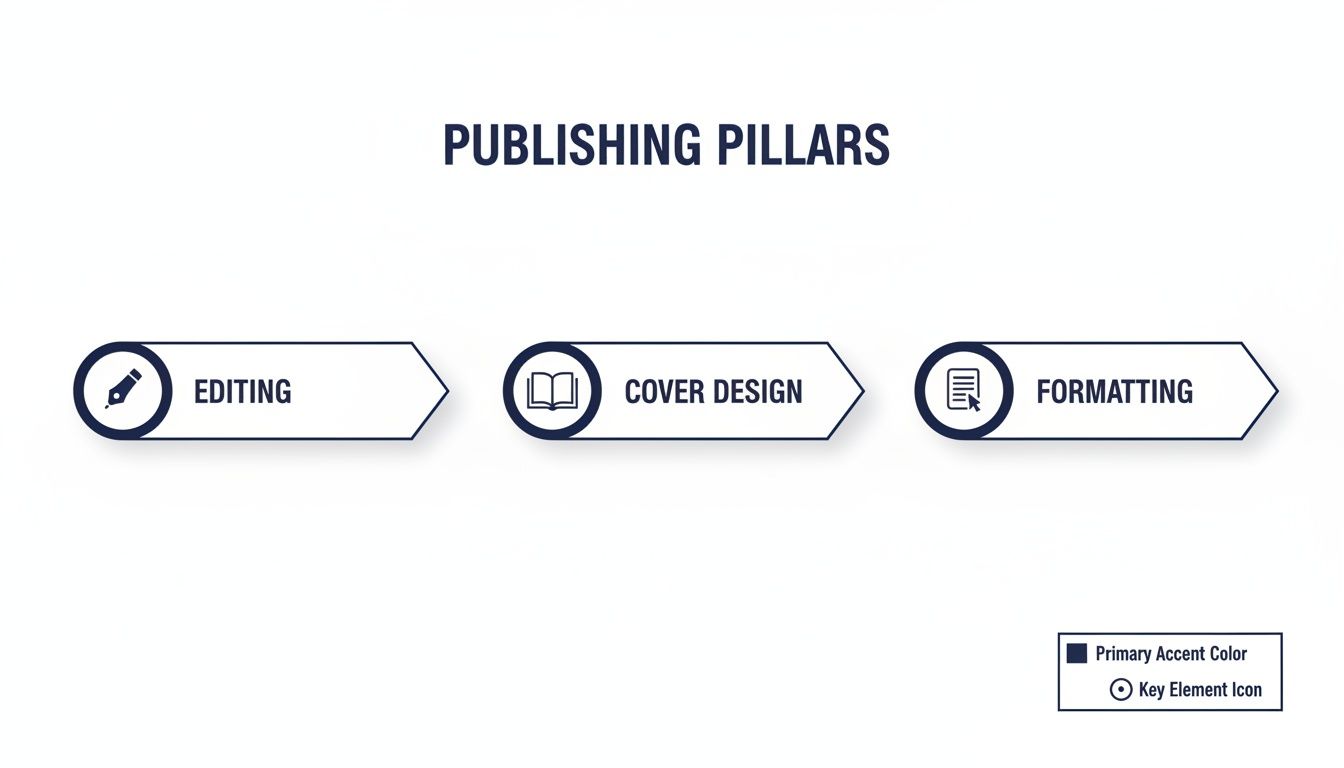
As the infographic shows, getting these professional elements right is what prepares your book for printing and distribution, which has its own unique cost structure.
How Print-on-Demand Affects Your Bottom Line
With POD, the cost for self publishing a book isn't a single, giant expense. Instead, it becomes a simple deduction from each sale. Your profit, which we call a royalty, is what's left after the retailer (like Amazon) takes their cut and the printing cost is subtracted from your book's sale price.
Let's see how this plays out. Say the total professional investment for your 80,000-word novel falls somewhere between $2,940 and $5,660. Once it’s on sale, the numbers are what matter.
If you list your paperback for $16.99, the cost to print a single copy might be around $4.28. When someone buys it on Amazon, they take a 40% cut of the list price, leaving you with a $6.79 royalty. But if that same book sells through what’s called "Expanded Distribution" to another online retailer or a physical bookstore, their cut jumps to 60%, and your royalty drops to $3.40 per copy.
Here's a quick table to visualize how that royalty math works for a hypothetical $16.99 paperback.
Royalty Calculation Example (Paperback)
| Item | Amazon Direct Sale | Expanded Distribution Sale |
|---|---|---|
| List Price | $16.99 | $16.99 |
| Retailer Discount | 40% ($6.80) | 60% ($10.20) |
| Author Revenue | $10.19 | $6.79 |
| Print Cost | -$4.28 | -$4.28 |
| Your Royalty | $5.91 | $2.51 |
This simple formula is the engine of your author business. Getting a handle on it helps you set a price that not only recoups your initial investment but also builds a sustainable income stream over time.
Amazon KDP vs. IngramSpark: Which Is Right for You?
The two biggest names in the POD world are Amazon KDP and IngramSpark, and they don't do exactly the same thing. Understanding the difference is key to maximizing your book's reach and your profits.
Amazon KDP: Think of this as the superhighway to the world's biggest bookstore. It's completely free to upload your files, and you'll earn a higher royalty rate (a 60% royalty minus print costs for paperbacks) on any sale made directly through an Amazon marketplace.
IngramSpark: This is your gateway to the rest of the book world. IngramSpark plugs your book into a massive global distribution network of over 40,000 retailers, libraries, universities, and online stores. While your royalty rate is lower here (closer to 40-45% minus print costs), it makes your book available to brick-and-mortar bookstores that won't order inventory from their main competitor, Amazon.
So what's the best move? Many savvy authors use a hybrid strategy: they publish their paperback directly on KDP for the higher Amazon royalties and also publish it on IngramSpark to reach everywhere else. This two-pronged approach ensures your book is available wherever readers are looking for it. For a deeper dive into print costs, our guide on the price to print a book breaks it all down.
Ultimately, printing and distribution are no longer the gatekeepers they once were. By using POD services strategically, you can eliminate the financial risk of inventory, manage your budget, and build a global sales channel for your book.
Investing in Your Book's Discovery
You’ve poured your heart and soul into writing a fantastic book. The editing is razor-sharp, the cover is a work of art, and the formatting is flawless. But what happens next? A brilliant book that nobody knows about is like a perfectly wrapped gift that never gets opened. Its potential stays completely locked away.
This is where marketing comes in. It’s the part of the journey where the cost for self publishing a book shifts from simply making the book to actively helping people find it. Marketing isn't just some extra step; it's the engine that will drive your book's discovery in a very crowded marketplace.
Building Your Author Platform
Think of your author platform as your digital home base. It’s the one central spot online where readers can find you, learn about your work, and eventually become loyal fans. Putting this together involves a few key expenses, but the payoff is a direct, unfiltered connection with your audience.
These aren't one-off costs, but ongoing investments in your career as an author.
- Author Website: This is your professional storefront. A clean, easy-to-use website gives you instant credibility and a space you own completely. Your main costs are a domain name ($10-$20/year) and website hosting ($50-$300/year), depending on the service you choose.
- Email Newsletter Service: Your email list is arguably your most powerful marketing tool. It’s a direct line to your most passionate readers. Services like Mailchimp or ConvertKit are often free for your first 500-1,000 subscribers, with costs that scale up as your list gets bigger.
Think of your author platform as the land you own in the digital world. Social media sites are rented spaces that can change their rules overnight, but your website and email list belong to you forever.
This platform becomes the launchpad for everything you do, from announcing a new release to sharing behind-the-scenes stories that build a real community around your work.
The Cost of Paid Advertising Campaigns
Once your home base is set up, it’s time to reach readers who have never heard of you. Paid advertising is one of the most effective ways to put your book directly in front of your ideal audience. For most authors, this means using Amazon Ads and social media ads.
Facebook advertising, for instance, can be a game-changer for discovery. Getting a handle on how much Facebook ads cost is key to planning a smart budget. Even a small starting budget of just $5 to $10 per day can give you a ton of valuable data on what ad copy and targeting resonates with your readers.
Amazon Ads are just as powerful, letting you place your book right in front of shoppers who are already looking for their next read. You can target specific keywords (like "dystopian teen fantasy") or even get your book to show up on the product pages of similar, more popular authors.
The best part about these ad platforms is that you can scale your efforts. Start small, see what works, and then reinvest your earnings into the campaigns that are actually delivering results. A solid initial ad budget for a new launch could be anywhere from $300 to $1,500, but you can always adjust that number based on your own goals and resources.
Other Essential Marketing Investments
Beyond your platform and paid ads, a few other marketing expenses can give your book a serious boost. These costs add that final layer of professional polish to your launch and help generate that all-important early buzz.
Here are a few more to consider:
- Editorial Reviews: Getting professional, unbiased reviews from services like Reedsy Discovery or Kirkus Reviews can provide incredible "social proof" for your book's sales page. A single killer quote can be the thing that convinces a hesitant reader to click "buy."
- Promotional Graphics: Sure, you can whip up some basic images yourself. But hiring a designer to create a branded set of graphics for social media, ads, and your website ensures everything looks professional and cohesive.
- Price Promotion Services: Websites like BookBub, Fussy Librarian, or Bargain Booksy have massive email lists packed with avid readers. Paying for a featured deal can drive thousands of downloads, giving your book's sales rank and visibility a massive shot in the arm.
Marketing is a marathon, not a sprint. It’s an ongoing process of experimenting, learning, and finding what works for your book. By budgeting for these key activities, you give your book the best possible chance to find the audience it was written for. For more ideas, check out our complete guide on effective book marketing strategies.
Expanding Your Reach with Audiobooks and Translations
So, you’ve launched your print book and ebook. What’s next? If you're looking to truly grow your audience, the next logical steps are audiobooks and translations. These avenues open up entirely new markets and ways for people to enjoy your story.
Think of them as expansion packs for your book. They aren't mandatory, but for authors aiming to build a lasting, global brand, they can be incredibly powerful. Just remember, this is a separate investment from the initial cost for self publishing a book.
The audiobook world is exploding. More and more people are trading reading time for listening time during commutes, workouts, or just around the house. Getting your book into their ears means producing a professional audio version, and you've got a couple of ways to get it done.
What Does an Audiobook Really Cost?
The most straightforward path is simply hiring a professional narrator. These are voice actors who specialize in bringing books to life, and they usually charge a Per Finished Hour (PFH) rate. For a seasoned pro, you can expect to pay anywhere from $200 to $400 PFH.
So what does that mean in real money? An average 80,000-word novel works out to about 9 or 10 hours of finished audio. That puts your upfront cost in the $2,000 to $4,000 range. It’s a serious chunk of change, but the upside is huge: you own the final audio files outright and keep 100% of your royalties.
Don't have that kind of cash lying around? There's another way. Platforms like ACX (Amazon's audiobook arm) have a royalty-share option.
With a royalty-share deal, you pay zero upfront. The narrator produces the entire audiobook for free, and in return, you split all future royalties 50/50.
This is a fantastic option for authors on a tight budget because it completely removes the initial financial barrier. The trade-off, of course, is that you're giving away half of your potential long-term income. It’s a classic business decision: pay now to earn more later, or save now and earn less over time.
Taking Your Story Global with Translations
Ever dreamed of your book finding fans in Paris, Tokyo, or Mexico City? Professional translation is how you get there. This isn't something you can punch into an online tool; it requires a talented linguist who can do more than just swap words. They need to capture your voice, your humor, and the cultural nuances that make your story work.
Translation services are almost always priced on a per-word basis. The rates can swing quite a bit depending on the language—translating into Spanish is generally less expensive than into Japanese—but a good benchmark is $0.10 to $0.25 per word.
Let's do the math on that 80,000-word novel again:
- You’re looking at a potential investment of $8,000 to $20,000 for each language you translate into.
That's a hefty price tag, which is why it’s so important to do your homework. Research which international markets are hungry for your genre before you commit. To make every dollar count, you'll need a smart strategy to improve marketing ROI and ensure your book gets discovered in its new home. It's a big move, but successfully launching in another country is a massive step toward building a truly international author career.
Choosing Your Publishing Path
So, after looking at all the individual pieces—editing, design, marketing, and the rest—you’ve reached a fork in the road. How are you actually going to get this done? This decision is huge. It doesn’t just affect the final cost for self publishing a book; it determines how much time you'll spend and how many headaches you'll endure along the way.
You really have two main options here.
First, you can go the Do-It-Yourself (DIY) route. This makes you the project manager, the general contractor, the one in charge of everything. You'll be the one finding, interviewing, hiring, and managing individual freelancers for every single task. You're the orchestra conductor, making sure every musician hits the right note at the right time.
The other option is to team up with a full-service publishing company. This is like hiring an expert home builder. You hand over the architectural plans (your manuscript), and they handle all the plumbers, electricians, and painters to bring your vision to life, delivering a polished, finished product.
The DIY Freelancer Approach
Taking the DIY path gives you complete, hands-on control over every choice and every dollar spent. You get to personally pick your editor, commission a cover designer you love, and hire a formatter who fits your budget. It can definitely feel like the cheaper option, since you can hunt for bargains on each individual service.
But this approach has some serious hidden costs, and the biggest one is your own time and sanity. Juggling multiple freelancers means you’re constantly sending emails, checking in on progress, and putting out fires. A fantastic editor and a brilliant cover designer might have completely different ideas, and it's your job to make sure the final book doesn't look like a Frankenstein creation.
The DIY path gives you the most control, but it also demands the most from you. You might save money, but you'll spend your time—and for most authors, time is the one thing you can't get back.
Partnering with a Full-Service Company
Working with a full-service publishing partner like BarkerBooks is a trade-off. You give up a bit of that granular, task-by-task control in exchange for professional expertise, a smooth process, and, frankly, a lot less stress. Instead of managing a dozen different people, you have one dedicated contact and a team that already knows how to work together.
This route has some pretty clear benefits:
- Vetted Professionals: Good publishing service companies have already done the hard work of finding and testing their team. You don't have to spend weeks wondering if the editor you found online is actually any good—they're part of a trusted system.
- A Cohesive Process: The whole journey is mapped out for you. Editing flows right into design, which flows smoothly into formatting. This avoids the kind of communication breakdowns and delays that can cost you both time and money.
- Bundled Savings: While a package price might look bigger than a single freelancer's quote, it's often much more affordable than hiring every professional you need one by one. Think of it like a combo meal—you get a discount for buying it all together.
Our packages at BarkerBooks, for instance, are built to include all the core services we’ve talked about. We roll professional editing, custom cover design, interior formatting, and even global distribution setup into one cohesive plan. This ensures every part of your book is crafted to the same professional standard, so you get a beautiful final product without having to become a publishing expert overnight.
Ultimately, there's no single "right" answer—it all comes down to your personality, your budget, and what your time is worth to you. If you have a knack for project management and need to watch every penny, the DIY approach can be a great learning experience. But if you want to publish a high-quality book efficiently so you can get back to writing, a publishing partner provides the team and the expertise to make that happen.
Frequently Asked Questions About Self-Publishing Costs
Let's cut through the noise and talk real numbers. Figuring out the financial side of publishing your own book can feel like a maze, but getting a handle on the actual costs is the first step toward making smart, confident decisions. Here are some straightforward answers to the questions I hear most often from authors.
Can I Really Self-Publish My Book for Free?
Technically, yes. Platforms like Amazon KDP won't charge you a fee to upload your manuscript. But let's be honest—a book that costs nothing to produce often looks like it.
Without investing in professional editing and a compelling cover design, your work will likely struggle to find an audience. Even worse, it could damage your credibility as an author right out of the gate. Think of it less as a "cost" and more as an investment in your book's future. Even a modest budget of a few hundred dollars for a solid cover and a final proofread can make a world of difference in how readers perceive your work.
How Much Should I Budget for Marketing My First Book?
For a debut author, a realistic starting marketing budget is typically somewhere between $500 and $2,000. This isn't about buying a billboard; it's about covering the essentials that give your book a fighting chance.
That budget can go toward building a simple author website, running some targeted Amazon ads to get in front of the right readers, or creating professional graphics for your social media channels. The key is to start small, see what works, and then reinvest your royalties into the strategies that are actually selling books.
Your marketing budget isn't just an expense—it's the fuel for your book's discovery. A small, targeted investment is far more effective than a large, unfocused one, ensuring your story finds its intended audience without breaking the bank.
Is It Cheaper to Hire Freelancers or Use a Publishing Service?
Hiring freelancers for individual jobs—an editor here, a cover designer there—can look cheaper on paper, at first. But those single-task costs stack up fast. Suddenly, you're not just an author; you're a project manager, responsible for finding, vetting, and coordinating a whole team of people. That’s a huge time-suck.
On the other hand, a full-service publishing company usually offers bundled packages that are more cost-effective when you look at the big picture. More importantly, they handle all the project management for you. This frees you from the stress of juggling multiple professionals and ensures every piece of the puzzle fits together perfectly for a high-quality book.
Ready to turn your manuscript into a professionally published book without the headache of managing a team of freelancers? At BarkerBooks, we offer comprehensive packages that handle everything from expert editing to global distribution. Explore our publishing solutions and find the perfect fit for your book today!