
The most popular advice about choosing a book publishing partner is to compare packages: editing, cover design, formatting, distribution, and marketing. That's a useful purchasing checklist, but it's a poor basis for a career decision. A provider can deliver every file on that list without giving you a credible way to reach readers.
Start with a harder question: What will this partner do to make the right audience find, understand, and consider buying my book? Then examine the evidence, responsibilities, and contract behind the answer. You're not just buying a finished book. You're deciding who gets your money, access to your intellectual property, and influence over your reputation.
Redefining the Publishing Partnership
Global availability isn't global readership. A retailer listing tells you where someone could buy your book, not why anyone would discover it or choose it over another title. Treat distribution as infrastructure, not proof of demand.
The commercial opportunity is substantial. The Association of American Publishers estimated U.S. publishing revenue at $32.5 billion in 2024, including print and digital books and course materials, with consumer-facing trade publishing contributing approximately $21.2 billion, according to its StatShot Annual report. My advice is to approach that environment as a business owner, not a customer shopping for printing.
Demand discoverability accountability
Discoverability accountability means the partner accepts responsibility for defined work that helps readers encounter and evaluate your book. It doesn't mean guaranteed sales. It means someone owns audience research, positioning, retailer presentation, promotional execution, and reporting.
The distinction matters because 29% of creators identified content discoverability as a challenge, 27% identified marketing books or businesses, and 19% identified finding their niche or audience, according to Lulu's Books and Business Insights report. Those findings support a more demanding buying question: what happens after the upload?
Ask prospective partners to describe their responsibilities in concrete terms:
- Audience definition: Identify the reader's interests, buying context, and reasons for choosing this title.
- Positioning: Explain which comparable books inform the cover, description, and promotional message.
- Execution ownership: Name who performs each task and what requires your participation.
- Learning process: Explain how campaign results lead to changes rather than another package proposal.
Separate production from audience development
Production has clear acceptance criteria. A print file can meet specifications, and an editor can complete an agreed manuscript review. Audience development involves uncertainty, so judge the partner by disciplined execution and honest interpretation rather than promises of commercial success.
Your own publishing activity also belongs in the plan. If articles or an author blog support your subject, resources such as VeloCMS's content creation help for bloggers can inform the author-owned side of that work. Don't assume your provider will maintain those channels unless the agreement says so.
Practical rule: Pay for work someone can define, inspect, and explain. Don't pay a premium for enthusiasm disguised as a readership strategy.
A true partner should be willing to tell you when your positioning needs work before encouraging you to spend more on promotion.
Comparing Traditional Hybrid and Full-Service Models
Choose the business model before choosing the company. Labels such as traditional, hybrid, and full-service are useful starting points, but your agreement determines the actual economics and control.
For evaluation purposes, distinguish publisher-funded acquisition from author-funded publication. Then inspect what the provider receives in return: fees, a share of revenue, publishing rights, or some combination. Don't let a prestigious-sounding label substitute for that analysis.
Publishing Model Comparison
| Criteria | Traditional Publisher | Hybrid Publisher | Full-Service Partner |
|---|---|---|---|
| Financial structure | Look for publisher-funded production rather than author service charges | Identify the author contribution and any publisher investment | Expect an itemized author-funded service proposal |
| Rights | Examine the publishing license, territories, formats, and duration | Check whether both fees and rights are being requested | Prefer retained copyright with narrowly defined operational permissions |
| Creative control | Establish approval and consultation rights | Negotiate which decisions are shared | Require clear author approval stages |
| Author earnings | Examine the royalty basis, deductions, and any advance provisions | Calculate earnings after both fees and ongoing deductions | Distinguish retailer deductions from provider charges |
| Marketing | Establish title-specific commitments | Separate included activity from optional purchases | Specify deliverables, reporting, and campaign management |
| Exit | Inspect termination and rights-reversion provisions | Address both rights and recovery of materials | Require file delivery and an orderly account handover |
Match the route to your priorities
A traditional acquisition can suit an author who wants a publisher to invest in the book and accepts negotiated limits on decision-making. Don't choose that route solely for perceived prestige. Ask whether the proposed relationship supports your subject, intended readers, and long-term writing plans.
A hybrid proposal deserves close financial scrutiny. If you're contributing substantial funding, ask what the publisher contributes beyond services you could purchase separately. Editorial selection, investment, distribution work, and marketing commitments should be identifiable, not implied by the word partnership.
Full-service support can suit authors who want coordinated execution without managing separate editors, designers, and distributors. Its value depends on project management and the agreement, not the size of the package. Retained ownership and favorable earnings must be written terms, not assumed benefits.
- Choose control deliberately: Decide which creative and commercial approvals you won't surrender.
- Compare actual proceeds: Request a worked royalty statement showing the selling price, deductions, and amount payable to you.
- Assess capacity: Ask who will handle your manuscript and how you'll communicate with them.
For a legal perspective on proposed shared ventures, consider Coto & Waddington on joint ventures. Use that as context for questions to independent counsel, not as a substitute for reviewing your publishing agreement.
My recommendation: reject any proposal you can't explain plainly to someone outside publishing. Complexity should reflect the project's needs, not obscure who gets paid.
The Hidden Engine of Book Discoverability
A compelling cover helps a reader evaluate a book they've encountered. Metadata helps create the opportunity for that encounter. Your publishing partner should treat it as editorial and commercial work, not clerical cleanup.
In Bowker's indexing experiment, searches using basic fields returned 34 results, while enhanced records containing descriptions, biographies, and tables of contents returned 1,459 results, approximately 43 times as many, according to its full-content indexing datasheet. That's evidence of broader indexing in the experiment, not a promise of equivalent sales growth or retailer rankings.
Build records around reader intent
A useful metadata record describes what the book offers using language its intended readers recognize. Don't stuff a description with disconnected keywords. Ask the team to connect audience needs, accurate subject classifications, and persuasive but truthful positioning.
The relationship between those tasks is summarized below.
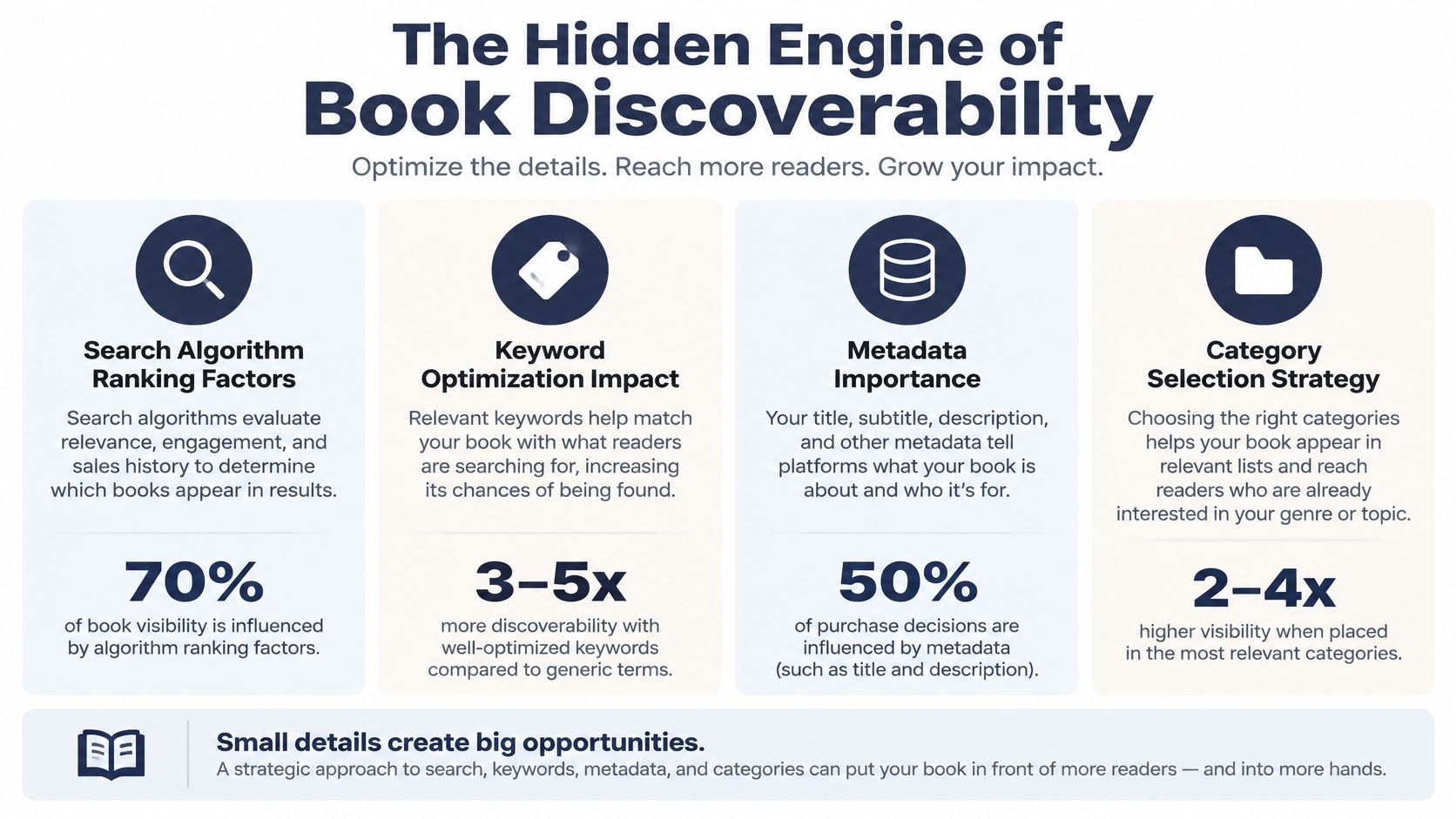
Require a reviewable metadata document containing:
- Descriptions: Concise and extended versions that state the subject, audience, and distinguishing value.
- Classification: Appropriate BISAC or equivalent categories, with a reason for each choice.
- Supporting content: Author biography, contributor credits, series details, and a table of contents where appropriate.
- Market-specific language: Keywords and descriptions adapted to local search habits rather than mechanically copied.
- Version control: An approved master record and a change log for updates sent to distributors.
For the search-focused part of that work, use this book search engine optimization guide to frame questions about descriptions, keywords, and retailer presentation. Ask to review proposed changes before submission.
Audit orderability as well as visibility
ISBN-level accuracy is a separate operational responsibility. Nielsen BookData guidance recommends submitting publication records at least 20 weeks before release, allowing buyers to load information and plan purchasing, as explained in Books Ireland's discussion of ISBN importance. Distinct publication products generally need their own identifiers, so the partner must manage format-specific records rather than treating every edition as interchangeable.
Ask for a prepublication check covering title, contributors, identifier, format, publication date, price, currency, territories, rights status, and availability. After ingestion, require a retailer-page audit against that approved record.
A book isn't launch-ready merely because its files passed inspection. A reader must also be able to identify and order the intended edition.
For international publication, include accents, transliteration, local currencies, and territorial restrictions in that audit. Record who corrects errors and who verifies that the correction appears.
Strategic Format Sequencing for Global Markets
Don't buy an audiobook or translation because it completes a package. Buy it because you can identify an audience, a route to that audience, and a defensible way to recover the additional investment.
Mordor Intelligence's books-market analysis estimates that print represented 76.59% of the market in 2025 and projects audiobook growth at an 8.49% compound annual rate through 2031. Those market-level figures justify considering both formats. They don't establish demand for your particular book.
Start with a format-and-market hypothesis
Write a short commercial rationale before authorizing another edition. Specify the reader, language, preferred buying channel, likely use, and evidence you already have. Relevant evidence might include direct reader requests, existing audience engagement, or sales of an earlier edition.
Use the following sequence to organize the decision.
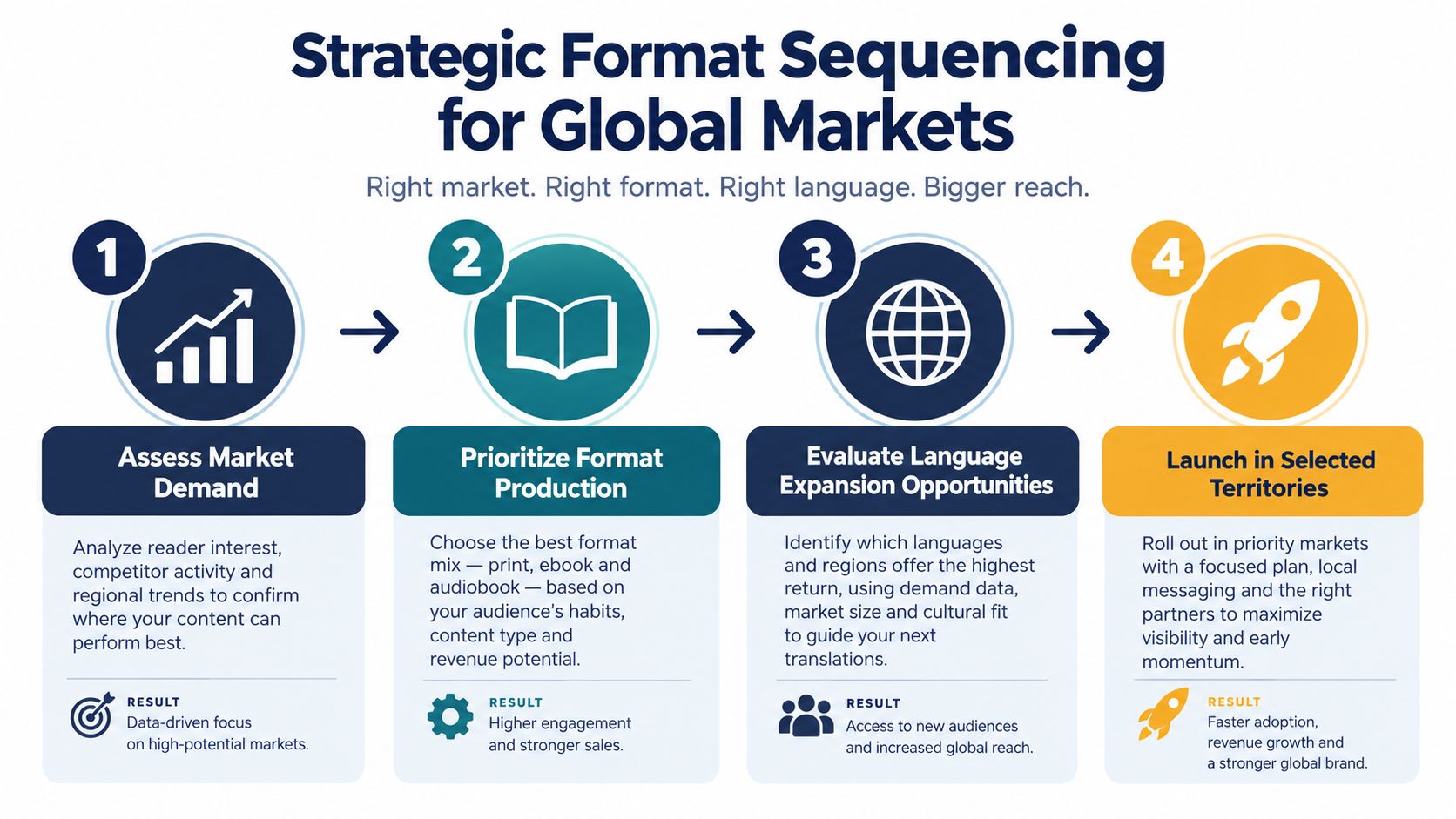
- Assess demand first: Distinguish interest in your topic from willingness to buy a specific edition.
- Choose the initial format: Consider how readers will use the material. A heavily illustrated reference book and spoken-word narrative require different production decisions.
- Test language readiness: Confirm that you can support editing, promotion, and reader communication in the proposed language.
- Select territories deliberately: Verify rights, distribution options, pricing, and local presentation before announcing availability.
A focused print-and-ebook launch may be the sensible starting point when demand remains untested. Audio deserves consideration when listening suits the material, but the decision should survive a budget review without relying on optimistic category forecasts.
Calculate the investment before expanding
Ask for a format-specific cost sheet covering production, quality assurance, distribution setup, and promotion. Then calculate break-even copies by dividing the edition's investment by its expected net contribution per sale. Use proceeds after relevant deductions, not the cover price.
For audio, resolve narration permissions, narrator agreements, pronunciation, cultural references, correction rounds, and ownership of final recordings. Review a representative sample before approving full production. For translation, appoint a qualified reviewer who can assess meaning, voice, and cultural fit independently of the translator.
International discoverability also requires more than translating an advertisement. Use LLMrefs insights on multilingual SEO as a planning resource for questions about language-specific search intent and localized content, without assuming website tactics transfer unchanged to book retailers.
Expand when evidence supports the next investment. Set a review point and decide what evidence would justify proceeding, postponing, or abandoning an edition. A responsible partner should be comfortable recommending postponement.
Evaluating Contracts Costs and Red Flags
A warm consultation isn't protection. Before signing, connect every important promise to a written obligation, a price, and a way to verify completion.
The warning sign isn't only that a company charges authors. It's a mismatch between what the author funds, what the provider controls, and what the provider is obliged to deliver. Evaluate the transaction, not the sales vocabulary.
Use this checklist as a starting point for an independent contract review.
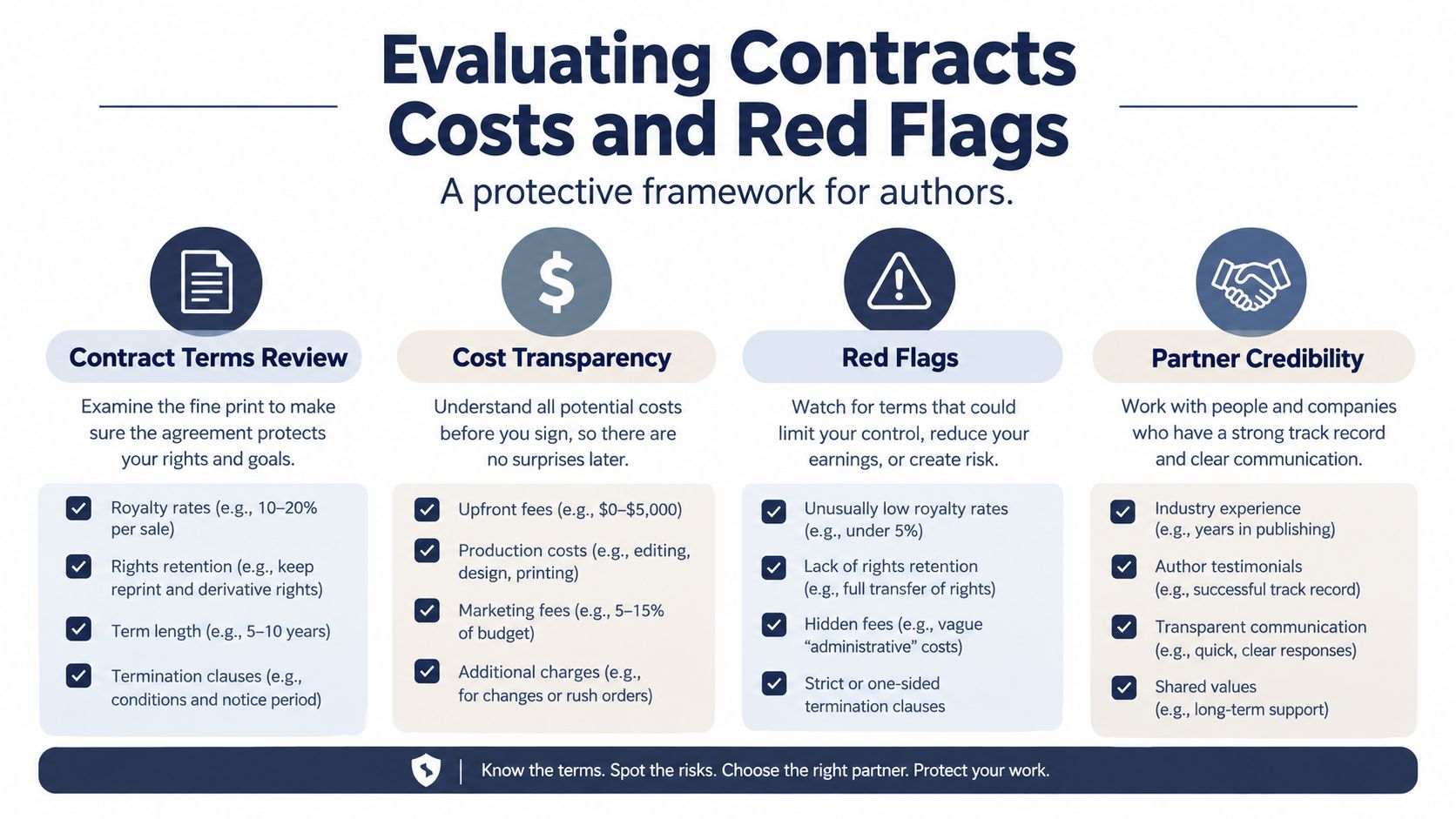
Protect rights and define the money
For an author-funded service arrangement, my default recommendation is retain copyright and grant only the permissions needed to perform the contracted work. If a provider requests broader rights, require a clear commercial justification and independent legal advice.
Inspect the scope of any license: language, territory, format, exclusivity, duration, sublicensing, and termination. Address unused rights and the process for reverting granted rights. Don't surrender translation or audio rights merely because those editions might be produced someday.
A cost proposal should separate editing, design, conversion, administration, distribution setup, marketing labor, and advertising spend. Use this guide to the cost of publishing a book to prepare questions, then request a project-specific quotation.
- Define royalties: State the revenue basis, allowable deductions, reporting schedule, and payment process.
- Control extra charges: Require written approval for work outside scope, including additional revision rounds.
- Secure the materials: Specify delivery of final files, editable source files where agreed, and licensed assets.
- Plan the exit: Address account access, remaining stock, unpaid proceeds, takedowns, and transfer assistance.
Make marketing promises auditable
Ask for a publishing partner scorecard that separates completed work from commercial outcomes. Production acceptance might include approved files and delivered assets. Marketing reporting should identify activity, spend, measurable responses, and the interpretation of those results.
Require clarity about advertising accounts and audience information. Who owns the accounts? Who can access campaign history? Can you export your permission-based mailing list? How will the provider distinguish attributable sales from sales it can't confidently connect to a campaign?
Contract test: If a promise helped persuade you to buy, it belongs in the agreement or an attached scope of work.
Reject guaranteed bestseller claims, unexplained deductions, pressure to sign immediately, and refusal to provide sample reporting. If an initial campaign disappoints, the agreement should still require analysis and a recommendation. It shouldn't force you to purchase another campaign just to learn what happened.
Executing a Seamless Global Publishing Journey
Consider a hypothetical author with a completed English manuscript and a Spanish-language audience. A disciplined partner wouldn't begin by recommending every available format. The team would assess the manuscript, clarify the intended readership, and establish what the author can realistically fund and support.
The working relationship should involve visible decisions and approvals, not a manuscript disappearing into production.

Work through approval gates
The editor would first distinguish structural problems from sentence-level corrections. The author would receive a diagnosis and agree to the editorial scope before design begins. After substantive revisions, the team would prepare the manuscript for layout and proof review.
Cover concepts should reflect the approved positioning, not just the author's aesthetic preferences. Interior proofs need inspection for headings, spacing, illustrations, captions, and reading order. Promotional mockups or videos should use approved cover artwork and accurate publication details.
- Editorial approval: Confirm that substantive changes are resolved.
- Production approval: Review the print proof and digital edition separately.
- Release authorization: Verify that the agreed operational checks are complete before publication.
For the Spanish edition, the author would approve a translation brief and representative sample before committing to the entire manuscript. A translation quality assurance process should address consistency, meaning, voice, and independent review, not merely whether the translated file is complete.
Use the video below as a discussion prompt when asking a provider to explain its workflow.
Require a useful handover
At launch, ask the project manager for an edition-by-edition status record. It should identify approved assets, unresolved issues, responsible team members, and the next review date. For agreed destinations such as Amazon Kindle, Apple Books, or Barnes & Noble, request confirmation of the actual listing rather than a general distribution announcement.
The continuing relationship should produce decisions. Which message attracted the intended readers? Which questions recur? Does the evidence support another edition, a revised description, or a pause in spending?
A smooth publishing journey isn't one without difficult decisions. It's one where you know who makes those decisions, what evidence they use, and what remains yours when the engagement ends.
BarkerBooks offers manuscript editing, cover design, interior formatting, distribution support, and launch services for authors seeking a coordinated publishing process. Visit BarkerBooks to discuss your manuscript and request a written proposal that separates production deliverables, discoverability work, rights, and ongoing costs.