
Let's be honest, your "About the Author" page is one of the most powerful sales tools you have. It’s not just a biography; it's a handshake, a conversation, and the place where a curious browser decides to become a loyal fan. In a market flooded with options, readers aren't just buying a story—they're connecting with the storyteller.
Your Author Page Sells More Than Just Books

Too many authors treat their bio page as an afterthought, a quick summary of their publication history and maybe a mention of their cat. That’s a huge missed opportunity. This page is a strategic asset, bridging the crucial gap between a reader seeing your book's cover and them confidently clicking "buy."
Think of it this way: your book gives readers a world to escape to. Your author page gives them a reason to trust you as their guide for the journey.
Why Your Personal Story Is Your Best Marketing Tool
In the incredibly competitive world of self-publishing, that personal connection is your secret weapon. The global market has exploded, hitting $1.85 billion and is expected to grow at a 16.7% CAGR through 2033. With over 2.6 million self-published books released in 2023 alone, how do you stand out? You do it by being you.
Your personality, your experiences, and your unique voice are assets nobody else can replicate. A well-crafted "About" page gets this across and accomplishes several critical goals at once:
- It builds trust. Showing the human behind the words makes you far more relatable.
- It establishes authority. This is your space to showcase the expertise and unique perspective you bring to your genre.
- It creates a genuine connection. Sharing your passions helps readers feel like they actually know you.
- It drives action. A great page smoothly guides visitors to buy your books, join your newsletter, or follow you on social media.
An author page isn’t a resume; it's a conversation starter. It's your chance to answer the reader's unspoken question: "Why should I spend my time and money on your books?"
The Building Blocks of a Killer Author Page
Your "About" page is the central hub of your author brand and a non-negotiable part of creating an author website. It’s where you blend your personal story with smart marketing.
To get a feel for how the pros do it, check out these inspiring examples of author websites. Notice how they seamlessly combine personal narrative with clear calls-to-action.
This guide is your roadmap. We’ll walk through everything—from planning and writing your bio to weaving in trust signals and making sure readers can actually find you online. By the time we're done, you'll know exactly how to turn your page into a fan-building machine that works for you 24/7.
For a quick overview, let's break down the essential pieces that make an author page truly effective.
Core Components of a High-Converting Author Page
This table summarizes the key elements we'll be diving into. Think of it as your checklist for creating a page that connects with readers and drives sales.
| Component | Purpose | Key Takeaway |
|---|---|---|
| Compelling Headline | Grab attention immediately and state your unique value proposition as an author. | Go beyond "About the Author." Make it intriguing. |
| Engaging Bio | Tell your story in a way that resonates with your ideal reader. | Connect your life experiences to the themes in your books. |
| Professional Headshot | Put a face to the name and build a personal connection. | Invest in a high-quality photo that reflects your author brand. |
| Trust Signals | Build credibility with awards, press mentions, testimonials, or affiliations. | Even small mentions can build significant authority. |
| Book Showcase | Visually display your work and provide direct purchase links. | Make it incredibly easy for visitors to buy your books. |
| Clear Call-to-Action | Tell visitors exactly what you want them to do next (e.g., buy a book, join a newsletter). | Every page needs a purpose. Don't leave your reader hanging. |
| Social Media Links | Encourage ongoing engagement and build a community around your work. | Link to the platforms where you are most active and engaged. |
Each of these components plays a vital role in transforming a simple bio into a strategic asset for your author career. Now, let's get into the specifics of how to build each one.
Crafting an Author Bio That Resonates

Think of your author bio as the first story a potential fan will ever read about you. A dry, corporate-style summary of your accomplishments simply won't cut it. Your bio needs to be a short, compelling narrative that pulls readers into your world and makes them genuinely curious about your books.
This little story is a cornerstone of your about author page, turning a static webpage into a real point of connection. It’s your chance to step out from behind the name on the cover and show them the real person they can root for.
The real goal here is to sidestep the generic templates and dig into your authentic authorial voice. Are you the meticulous researcher who spends months in historical archives? The witty observer who finds the absurd in everyday life? Or the empathetic guide who helps readers through tough times? Figuring this out is the first step toward a bio that actually works.
Finding Your Unique Authorial Voice
The voice you use in your bio should feel like a natural extension of your books. A thriller author’s bio needs a completely different energy than a children’s book writer’s. It’s all about creating a consistent, genuine experience for the reader from start to finish.
Not sure where to start? Try thinking about your persona:
- The Expert: If you write non-fiction, your bio needs to establish authority. This is the place to mention relevant degrees, professional experience, or unique research that gives your work credibility.
- The Storyteller: For you fiction writers, sprinkle in details about your creative process. What sparks your imagination? Do personal experiences find their way into your characters and worlds?
- The Relatable Guide: If your books fall into self-help or memoir, your voice should feel warm, approachable, and empathetic. Share a small piece of your own journey that shows why you’re a trustworthy guide for the reader.
Ultimately, your voice is a mix of your personality and your genre's conventions. Don't be afraid to let a bit of you shine through. That authenticity is what turns a casual reader into a loyal fan.
First Person vs. Third Person: A Practical Choice
One of the first hurdles every author faces is deciding between the first person ("I write…") and the third person ("She writes…"). Honestly, there’s no single right answer—each has its own strategic advantage.
A first-person bio feels immediate and personal, making it perfect for your own website. In contrast, a third-person bio comes across as more formal and authoritative, which is exactly what you need for press kits, book jackets, and retail sites like Amazon.
Most seasoned authors keep versions of both on hand. You can use the more intimate, first-person narrative on your main about author page and have a polished third-person version ready to go for media requests or guest posts. This flexibility means your bio always fits the situation. For a deeper look, BarkerBooks has a fantastic guide on how to write an author bio that explores this choice in greater detail.
Weaving in Personal Details That Connect
Sharing personal details can feel like a tightrope walk. You want to build a connection without veering into oversharing. The trick is to only choose details that are relevant to your writing or your author brand.
Think about what creates a bridge between you and your reader. Do you have a quirky hobby, a beloved pet, or a passion for a cause that echoes the themes in your books? These small, humanizing touches are what make you memorable.
Let's look at a quick example for a fantasy author.
- Before (Generic): Jane Doe is the author of the "Chronicles of Aethel" series. She lives in Oregon.
- After (Connecting): Jane Doe fell in love with fantasy after discovering a worn copy of "The Hobbit" in her grandfather's attic. When she isn't building epic worlds for her "Chronicles of Aethel" series, she spends her time hiking the misty trails of the Pacific Northwest with her rescue greyhound—a noble beast who often inspires her fictional creatures.
See the difference? The "after" version tells a story. It connects a personal memory to her genre, ties her location into her creative process, and adds a charming detail about her dog. Suddenly, readers feel like they know her.
Of course, once your bio is written, it needs a home. You can learn how to add an About page on WordPress and start building the perfect place for your story to live online. This is the crucial technical step that brings your narrative to life for your audience.
Earning Your Reader's Trust
A killer bio gets their attention, but trust is what convinces a reader to actually buy your book. Think about it: they're not just giving you their money, they're giving you their time. Your author page is where you prove you're worth the investment.
This isn't about bragging. It's about strategically placing signals that tell a visitor, "This author knows their stuff, and other people agree." These are the little nudges that help a new reader take a chance on you.
Weave Your Accomplishments into Your Story
Even small wins can have a big impact. The trick is to present them as part of your journey, not just a bulleted list on a resume. You want to add texture to your author persona, not just list credentials.
- Awards and Nominations: Did you win or get nominated for a literary award? Frame it as a nod from your peers. It adds a powerful layer of validation that you can't create on your own.
- Media Mentions and Press: If you've been featured on a podcast, in a local paper, or on a well-known blog, use their logos! That instant recognition lends you some of their hard-won authority.
- Glowing Reviews: A fantastic quote from a respected publication or a big-name author in your genre is pure gold. Pull the most powerful sentence and make it impossible to miss.
For instance, instead of a dry "Winner of the 2023 Indie Book Award," try something with more personality: Her debut novel was honored with the 2023 Indie Book Award for Best Mystery, a moment she calls "both humbling and electrifying." See the difference? It integrates the achievement right into your story.
Let Your Readers Do the Talking
Formal awards are fantastic, but nothing hits home like a recommendation from a fellow reader. Testimonials are the modern-day word-of-mouth, and they're absolutely essential for building that social proof.
When you're gathering testimonials, look for specificity and emotion. "I loved this book!" is fine, but it doesn't sell. "The main character's struggle felt so real it kept me up all night" is what grabs a potential buyer. It paints a picture of the experience they're about to have.
In a publishing world projected to be worth $97.71 billion by 2025, your author page is your digital handshake. Trust signals are what make your handshake firm and memorable. You can find more data on the book publishing market from Research and Markets.
The "New Author" Credibility Checklist
"But I'm just starting out! I don't have any awards or press."
I hear this all the time, and it's a valid concern. But credibility isn't just about fancy awards. You probably have more trust-building assets than you think.
Here are a few things you can use right from the start:
- Your Day Job (or Old Job): Writing a crime thriller? Your past life as a paralegal is a huge credibility booster. A fantasy novel? Your work as a historian gives your world-building weight. Connect your real-world experience to your writing.
- Education: A degree related to your book's subject matter instantly positions you as knowledgeable.
- Early Reader Feedback: Don't underestimate the power of praise from your beta readers. Their genuine, unpolished excitement can be even more convincing than a formal review.
- Memberships and Groups: Are you part of a writers' guild or a professional organization? Mentioning it shows you're serious about your craft and connected to the industry.
When you put these pieces together, you're building a case for your work. You're not just telling people you're a good writer; you're showing them why they should believe it. That’s how you turn a simple bio into a reader-conversion machine.
Designing a Page That Looks as Good as Your Writing

You’ve poured your heart into crafting the perfect bio. Now it’s time to give those words a home that does them justice. Great design isn't about flashy distractions; it's about creating a smooth, professional experience that keeps readers focused on your story and, ultimately, your books.
A well-designed about author page is intuitive. It guides the eye, builds instant credibility, and makes your entire author brand feel more established and trustworthy. You don't need a degree in graphic design to pull this off, either. It really just comes down to clarity, consistency, and readability. A clean, organized layout lets your words and achievements shine.
The Power of a Professional Headshot
Your author headshot is, without a doubt, the most important visual on the page. It’s the digital equivalent of making eye contact, instantly putting a face to the name and forging a real human connection. A professional, high-quality photo shows you’re serious about your career.
On the other hand, a bad headshot can undermine your credibility before a reader even gets to your bio. Steer clear of these common mistakes:
- Outdated Photos: Using a photo from ten years ago just feels off. Your headshot should look like you, today. It's about authenticity.
- Distracting Backgrounds: A cluttered office or a chaotic street scene pulls focus away from you. A simple, neutral background is almost always the best choice.
- Poor Lighting or Low Resolution: A blurry, dimly lit photo screams amateur. Natural light is your best friend, and always use a high-resolution file so it looks sharp on every screen.
Your headshot should also vibe with your author brand. A warm, smiling photo is perfect for a romance novelist, while a more serious, thoughtful expression might be a better fit for a writer of dense historical non-fiction.
Choosing Your Visual Brand Identity
Beyond your photo, the colors and fonts you choose are quietly setting the mood. Your visual identity should feel like an extension of your genre and writing style. A horror author might go for a dark, high-contrast palette, while a children's book author would naturally lean into bright, playful colors.
Think of your color palette and typography as the "set dressing" for your story. They should support the narrative you’re telling about yourself and your work, not clash with it.
When it comes to fonts, always put readability first. Pick one clean, easy-to-read font for your main body text and a complementary, perhaps more stylized, font for your headings. Sticking to just two or three fonts keeps everything looking clean and professional. The goal is to make reading effortless.
If you want to dig deeper into building a cohesive look, getting some professional guidance on author website design can spark a ton of great ideas for your entire online presence.
Creating a Clear and Readable Layout
A great layout is all about strategic use of space. You need to break up your content into bite-sized, scannable chunks that feel inviting, not intimidating. Huge, dense blocks of text are a surefire way to send visitors heading for the "back" button.
Here are a few simple layout principles that work every time:
- Embrace White Space: Don't be afraid of empty space! It gives your content room to breathe, cuts down on clutter, and actually improves how well people absorb the information.
- Use Clear Headings: Break your page into logical sections with descriptive H2 and H3 headings. This helps readers scan the page and find exactly what they're looking for.
- Showcase Your Books: Don't just list your books—show them off. A visually appealing gallery of your book covers, arranged in a clean grid, makes your body of work look impressive and gives readers an easy way to browse and buy.
By focusing on these core design elements, you can build an about author page that looks polished, feels authentic, and does the heavy lifting of turning curious readers into loyal fans.
Getting Found on Google: A Crash Course in SEO for Authors
You’ve poured your heart into crafting the perfect bio and designing a stunning page. But what good is it if readers can't find it? This is where search engine optimization (SEO) comes into play.
Don't let the acronym intimidate you. For an author, SEO is simply about making it easy for search engines like Google to understand who you are and what you write. Think of it as aligning your website with the exact words readers are typing into the search bar when looking for their next favorite author.
Why You Can't Afford to Ignore SEO
Let's talk numbers for a second. The consumer book publishing market is a $70 billion industry. Online book sales alone are projected to hit $26.04 billion by 2025, with total revenue climbing to $142.72 billion.
With giants like Amazon holding 70-80% of the ebook market and 4 million new titles hitting the shelves every year, just being good isn't enough. You have to be discoverable. More details on the growth of the consumer book market show just how crowded it's getting. Your 'About' page isn't just a bio; it's a powerful tool to stand out.
Finding Your Keywords
Keywords are the foundation of SEO. They are the search terms people use to find things online. Your job is to figure out which terms a reader might use to find an author just like you.
For most authors, the important keywords fall into a few buckets:
- Your Name: This is a no-brainer. When someone hears your name at a conference or sees it on a blog, the first thing they'll do is Google you. Make sure you're the first result they see.
- Your Book Titles: Every book you've written is a potential keyword. People will search for "author of [Your Book Title]."
- Your Genre: This is how new readers find you. They search for things like "best new sci-fi authors" or "cozy mystery writers." You want to show up for those searches.
Grab a piece of paper and start brainstorming. Try combining them, too. For instance, "Jane Doe fantasy author" or "author of The Crimson Key" are great long-tail keywords to target.
Putting Your Keywords in the Right Places
Once you have a list of keywords, you need to sprinkle them into a few key places on your page where search engines pay the most attention.
Think of SEO as putting up signposts. You’re giving Google and your readers clear, helpful signs that tell them exactly what your page is about. A page that's easy for Google to understand is also one that's easy for a human to navigate.
Here are the most important spots to get right:
| Element | What It Is | How to Do It Right |
|---|---|---|
| Page Title (Title Tag) | This is the headline that shows up in the browser tab and in Google search results. | It needs to be crystal clear. Try: "Your Name | Award-Winning Thriller Author." |
| Meta Description | The short, punchy summary that appears under your title in search results. | This is your ad! Write a compelling, 155-character blurb that includes your name and genre. Make them want to click. |
| Image Alt Text | A behind-the-scenes description of an image for search engines and screen readers. | Keep it simple. For your headshot, something like "Headshot of fantasy author John Smith" works perfectly. It even helps you show up in Google Image searches. |
The Power of Smart Linking
Links are like votes of confidence online. They show how your website is connected to the rest of the internet and create a clear path for your readers to follow.
Your 'About' page should act as a central hub, linking out to all the important places where readers can find you and your work. Be sure to include direct links to:
- Your book pages on Amazon, Barnes & Noble, Kobo, etc.
- The social media profiles you actually use.
- Your official Amazon Author Page.
- Any press, interviews, or guest posts you’re proud of.
These links aren't just for your readers' convenience; they also signal to search engines that your page is a credible and well-connected resource for information about you.
Turning Readers into Fans with Smart Calls to Action
So, you’ve told your story, built some trust, and made a real connection. Fantastic. But what happens next? If you don't give your reader a clear next step, all that great work can go to waste. This is where a smart call to action (CTA) comes in—it’s the crucial final piece that turns a casual visitor into a genuine fan.
A good CTA does more than just give instructions; it sparks action. It’s the bridge that takes a reader from thinking, "Hey, this author is pretty cool," to actually clicking "buy" or signing up for your newsletter. Without one, your beautifully crafted page is just a pretty dead end.
Guiding Your Reader’s Journey
First, figure out what you really want a new visitor to do. Is the main goal to sell copies of your latest thriller? Or are you playing the long game, focusing on building your email list for future launches? You can have a couple of goals, but you absolutely need to decide which one is the priority.
This focus is key to avoiding what I call "choice paralysis." A page littered with ten different buttons asking for ten different things usually leads to the reader doing nothing at all. Instead, create a clear visual hierarchy.
- Your Primary CTA: This is your number one goal. Make it big, bold, and obvious—a colorful button that practically begs to be clicked.
- Secondary CTAs: These are your "nice-to-have" actions. They can be simple text links, like "Follow my journey on Instagram," tucked away more subtly.
Let's say you're a debut author. Your primary CTA might be a big, unmissable "Buy My Book on Amazon" button sitting right under your bio. Further down the page, you could add a secondary, text-based CTA like, "Get a free prequel novella when you join my newsletter."
Think of your CTA not as a demand, but as a friendly invitation. It should feel like the most natural next step for someone who just spent time getting to know you.
Choosing the right keywords for your page is what gets people there in the first place. This flowchart shows a simple way to think about it, ensuring the right readers find your page and, ultimately, your CTAs.
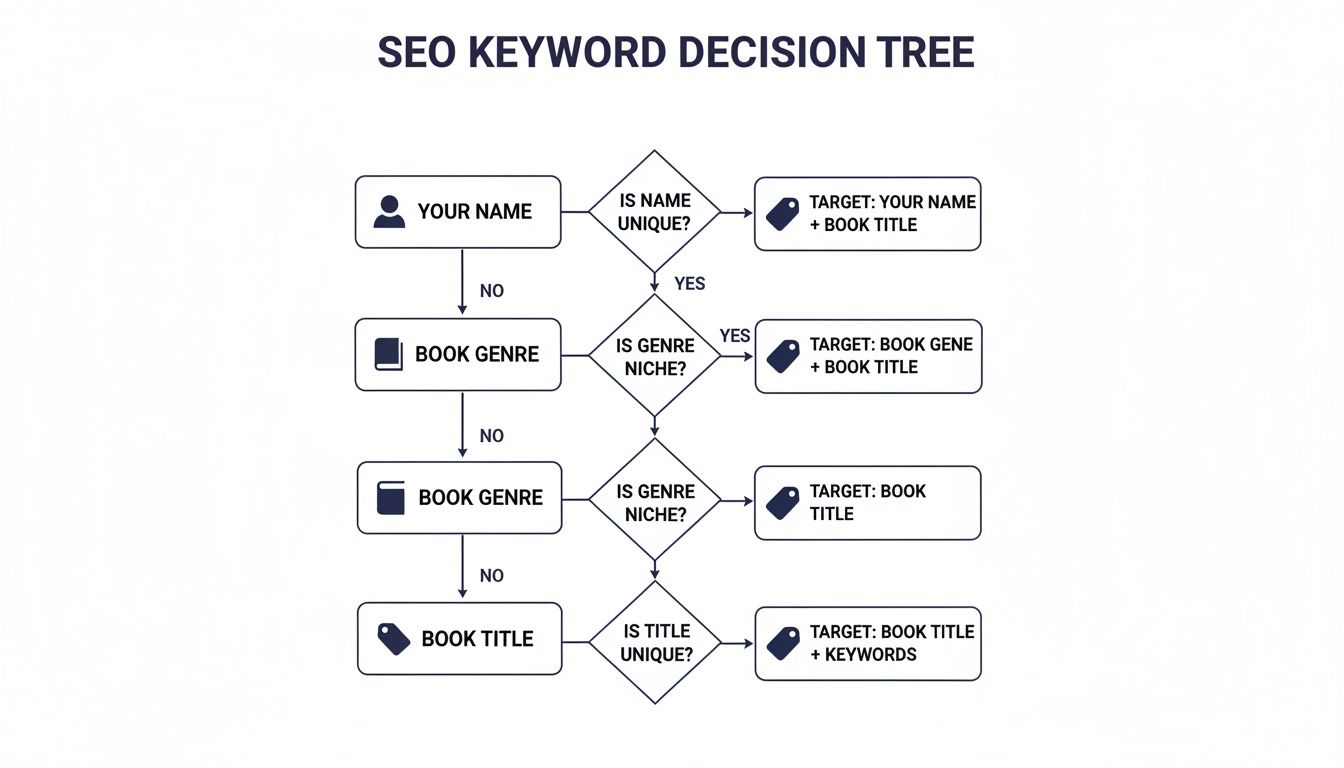
This kind of decision tree helps you zero in on what makes you searchable, whether it's your unique name or the niche you write in. More targeted traffic means more effective CTAs.
Crafting CTAs That Actually Work
The words you choose are everything. Vague, lazy phrases like "Click Here" or "Submit" are conversion killers. You need action-oriented, benefit-driven language that tells the reader exactly what they’ll get.
To help you nail this, I’ve put together a quick comparison of common CTA strategies for authors.
Call to Action Strategy Comparison
| CTA Type | Primary Goal | Example Language | Best Placement |
|---|---|---|---|
| Direct Sale | Sell your latest book. | "Order Your Signed Copy" or "Get the eBook on Kindle" | Prominently below your bio or right next to your book covers. |
| Newsletter Signup | Grow your email list. | "Join My VIP Reader List" or "Get the Free Chapter" | In a dedicated section with a sign-up form or in the footer. |
| Community Building | Boost social media followers. | "Follow My Writing Journey on Instagram" | As text links or icons near your bio or in the page footer. |
| Lead Magnet | Offer a freebie for an email. | "Download My Free Short Story Collection" | In a visually distinct box or a polite pop-up after a delay. |
Notice the pattern? Every strong example focuses on what the reader gets out of it. It’s not about what you want them to do—it's about giving them a compelling reason to do it.
By placing these clear, persuasive invitations throughout your page, your about author page stops being just a bio and becomes one of the most powerful tools you have for building your writing career.
Answering Your Final Questions
As you put the finishing touches on your page, a few common questions always seem to surface. Let's tackle them so you can hit 'publish' with total confidence.
How Often Should I Update This Thing?
Your author page isn't a "set it and forget it" project; think of it as a living part of your author career. I generally recommend giving it a quick review at least twice a year to make sure everything still feels current.
But here’s the most important rule: update it the moment you have new career news. That means jumping in right after you:
- Launch a new book or even a short story.
- Get nominated for or win an award.
- Land a great piece of press or a media mention.
- Are scheduled to speak at an event or conference.
A current page shows visitors you’re active and engaged in your career. An outdated one can accidentally send the signal that you've stopped writing, which is definitely not the impression you want to give.
Should I Write in First Person or Third Person?
This is a classic debate, and honestly, the answer is: you need both. The version you use just depends on where it’s going to live.
First-person ("I write…") is fantastic for your own website. It’s personal, direct, and helps you build a real connection with readers who are visiting your online home.
Third-person ("Jane Doe writes…") comes across as more formal and official. This is the version you’ll need for your press kit, the back of your book, guest post bylines, and your Amazon Author Central page. My advice? Write both now so you have them ready to grab at a moment's notice.
What if I Don't Have Any Awards or Press to Show Off?
Don't panic! Almost every author starts here. Credibility isn't just about a trophy case. If you're early in your career, you just have to lean into the assets you already have.
Focus on what makes you the only person who could tell your stories. Your unique life experience, a fascinating day job, or a deep obsession with your subject matter are just as powerful as a formal award.
Got a great review from a beta reader? Use it! Did your career in marine biology inspire your sea-faring fantasy novel? That’s a fantastic hook. Every single author starts from zero; your job is to build that first bridge of trust by sharing the authentic, interesting parts of your story.
Ready to turn that manuscript into a polished, published book with a stunning author page to match? The team at BarkerBooks has helped over 7,500 authors bring their stories to life. Explore our publishing packages today.