
You can read a chapter aloud at the kitchen table and still lose people by hour four. Audiobook narration coaching treats the book as something listeners hear in cars, on phones, and across borders. A coach in the booth is concrete about pace, voices, and setup, and candid about the limit. Training sharpens awareness. It does not hand you a perfect read.
Why Authors Hire Narration Coaching Now
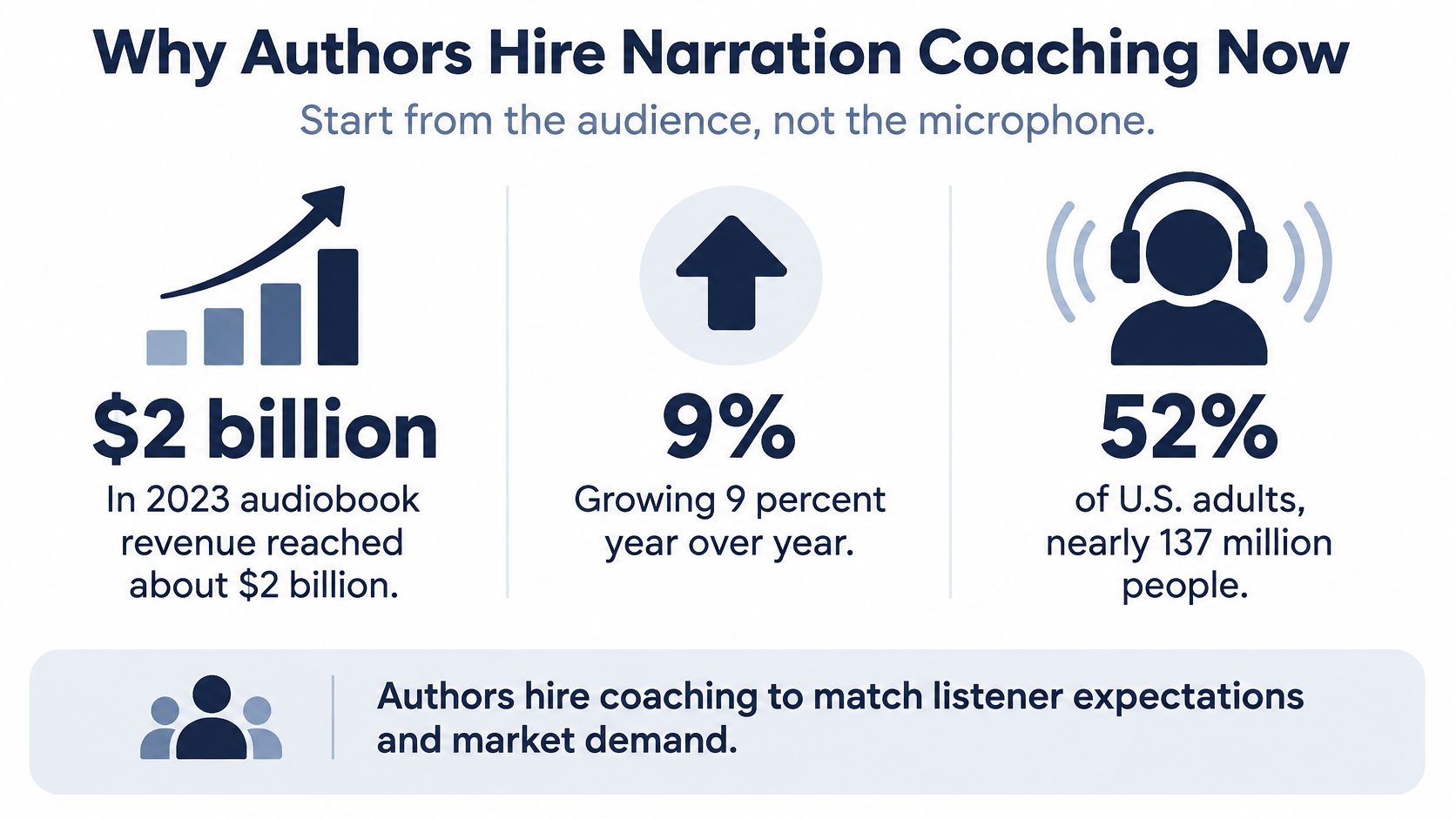
In 2023, audiobook revenue reached approximately $2 billion after growing 9% year over year, according to the Audio Publishers Association's sales survey conducted by Toluna Harris Interactive, as covered by SSRS. The same year, Edison Research reported that 52% of U.S. adults had listened to an audiobook at least once, nearly 137 million people.
Say you have a finished novel and you plan to record it. Reading a scene to a friend is one job. Holding emotion, pace, and vocal ease across many finished hours is another. English-language titles travel on major platforms, so listeners far from your home accent will judge the file.
Print hides faults that headphones reveal. Uneven rhythm, weak breath, unclear diction, mouth noise, and characters that collapse into one tone all show up the moment someone hits play. Coaching is quality control before studio hours are spent, whether you will narrate or you must direct someone else.
The Skills a Narration Coach Actually Trains
A coach does not start with gear shopping. They listen for six jobs, in this order, and they stop a take when the ready-when sign is missing.
| Skill | Coach listens for | Practice target | Ready when |
|---|---|---|---|
| Breath and tone | Strain, shallow breath, pitch drift | Phrases shaped on the breath, not only on commas | A chapter stays even without throat fatigue |
| Pacing | Rushing, flat pauses, lost punctuation | Finished average near 154–155 WPM, with real pauses | Dense lines stay clear on phone, headphones, and car speakers |
| Character voices | One pitch for every speaker, or caricature | A small set of distinct, repeatable voices | A listener can name the speaker without dialogue tags |
| Pronunciation | Guessed names and uneven terms | A glossary read aloud before the take | Names and jargon match on every file |
| Microphone setup | Plosives, room echo, mouth noise | Steady distance, pop filter, quiet room | A raw take needs little noise repair |
| Endurance | Hoarseness after long blocks | Timed breaks and a stop rule for pain or voice loss | Clarity holds across the planned session |
Why one speed fails
The coaching benchmark is about 154–155 words per minute as a finished-book average, not a continuous talking speed. A dataset covering 1,585 audiobooks reported a median of 154 WPM, and the common production estimate of 9,300 words per finished hour equals about 155 WPM, as explained in this audiobook pacing guide. That average includes pauses at punctuation, paragraphs, chapter headings, scene breaks, and room tone.
Genre is not one speed. The same dataset landed near 137 WPM for science fiction and near 189 WPM for young-adult narration. Dense exposition needs more processing time. Action and dialogue can move with shorter pauses.
Record one 500–1,000 word passage at several controlled rates. Then listen on phone speakers, headphones, and in a car for comprehension, emotional continuity, and breath noise. You may speak quicker inside sentences and still land near that book-level average if the pauses stay intentional.
Pitch movement is part of that clarity. Yellow.ai's guide to speech prosody is a useful companion when you are deciding how stress, rhythm, and intonation carry meaning without turning every line into a performance. Pair that idea with how narrative voice works on the page, because the spoken book has to keep the same stance the prose already chose.
Practical rule: If a dense paragraph is clear on a phone speaker in a quiet room and still clear in a moving car, the pace is ready. If you only like it on studio headphones, it is not.
Use the ready-when column as your self-check before you book a longer block. Drills for voices, names, and the room come later. Do not treat a fast cold read as proof that the finished hour will hold.
Who Gains the Most from Coaching
Coaching pays off when the reading choices change with the listening context. A novelist preparing a single narrator needs different guidance from a nonfiction author working with several voices or an international author whose book moves between languages.
Author with a finished manuscript. If you plan to narrate your own book, continuity matters more than a dazzling opening sample. The voice needs to feel like the same guide in the first chapter and the last, while still shifting naturally with each scene or idea.
Working voice actor moving into long form. A short commercial rewards an immediate hook; an audiobook asks the listener to stay with a voice over many chapters. Coaching can help you adapt your performance for that longer arc, rather than carrying a brief, high-energy style through the whole book.
Bilingual or international author. Names, code-switching, and technical terms may need consistent treatment across languages and audiences. A pronunciation map can set a clear reference, while coaching helps decide how each speaker sounds and where an accent supports the book rather than distracting from it.
Author who will not perform. You can still shape the finished narration by briefing the narrator or studio. Be ready to describe the intended listener, the book's tone, and the names or terms that must stay consistent. Without that direction, the performer has to make those choices alone.
The Audie Awards recognize narrator performance, including an award for narration by the author, and the awards have since split their general narrator categories into fiction and nonfiction.
Fiction work and nonfiction work
Fiction coaching focuses on dialogue, a cast the ear can follow, and timing that serves the scene. Nonfiction coaching focuses on clear explanations, a credible speaking voice, and terms the listener can understand. Memoir often combines both: a reflective passage may need a steady, conversational delivery, while a scene calls for distinct characters and sharper dramatic timing.
Multi-voice audio adds another listening challenge. Each character needs a recognizable sound, but the differences should not turn into caricatures. For bilingual or internationally focused books, pronunciation and accent choices also affect how listeners understand the story. A regional accent can serve the work; consistency and respectful character choices matter more than erasing every regional marker.
Start with the book's listening context, then choose what to coach. A solo nonfiction narration needs different direction from a novel with a broad cast, or a bilingual memoir that shifts between languages.
How a Typical Coaching Session Runs
Treat the hour like a short rehearsal. Each move has a reason, and one stop rule sits over the whole block. If pain, persistent hoarseness, or voice loss shows up, you stop or you shorten the take. Coaching can build awareness and a safer load. It should not promise to prevent a voice disorder.
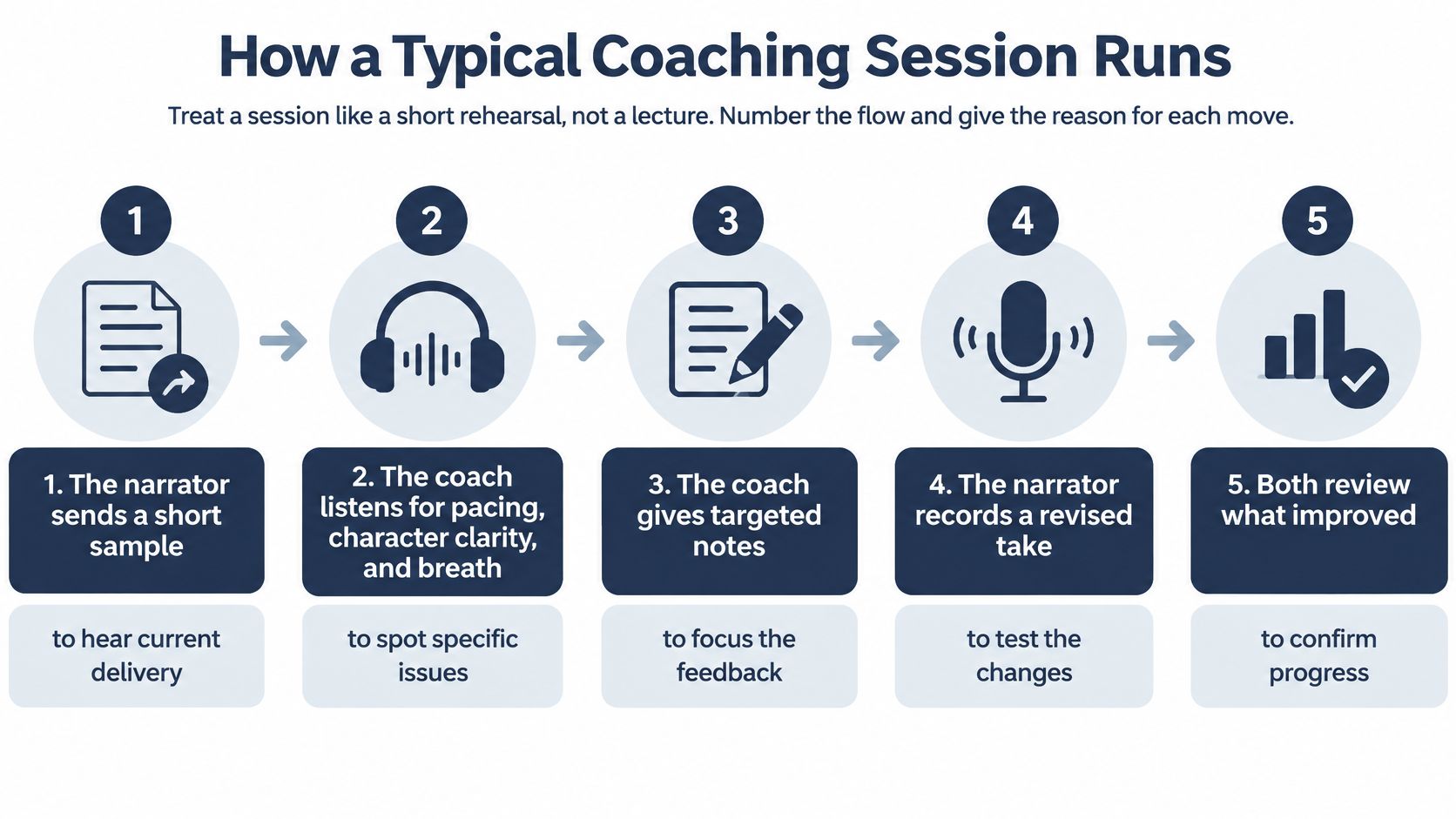
- You send a short sample, often one scene with dialogue or one dense nonfiction passage, plus a note on who the listener is. The coach needs the audience before they need your best party piece.
- You agree the job of that passage. Exposition, argument, or character conflict. A note that fits a fight scene will wreck a careful explanation.
- You do a cold read so the coach hears habits, not a polished audition.
- You mark breath points, pause lengths, and any name or term that must be locked. Guessed names are cheaper to fix here than across forty files.
- You try one adjustment at a time, such as a slower clause or a narrower character contrast, then you record a second take. Two changes at once hide which one helped.
- You listen back on ordinary speakers, not only studio headphones. Phone speakers and a laptop in a normal room tell you what most listeners will hear. If you are choosing audiobook recording software, pick a tool that lets you A/B those two takes without a long export dance.
- You log fatigue. Hoarseness, strain, or fading clarity are operational signs. You stop or you cut the block when pain, persistent hoarseness, or voice loss appears.
- You leave with one written note, one passage to re-record, and a recovery pause before the next long block.
A first session diagnoses. Later sessions compare takes so the voice stays the same person from chapter to chapter. Bring the failed take. A coach cannot hear the habit you deleted.
If you also record lessons or explainers, MEDIAL's eLearning recorder guide walks through a simple capture setup so a practice file is clean enough to review. The same habit, a quiet room and a steady distance, is what makes the second take worth comparing.
This short booth walkthrough shows how a director marks a line, then asks for one change and listens again.
Sample Drills for Voices Names and the Room
You can run three drills this week. Each one has a setup, a pass sign, and a fail sign. Take a five-minute reset between them so you do not drill the voice into fatigue. Bring the failed take to the next session, not only the best one.
Character cards
Pick four speakers from one chapter. Give each a card with age, pace, pitch range, and one physical habit, such as shorter sentences or a lower onset. Read a page of dialogue using only those cards. Change nothing, and read the same page the next day.
It works when a listener can name the speaker without dialogue tags. It fails when a voice becomes a joke, or when you cannot repeat it on day two. Narrow the contrast instead of inventing a new accent. A small, repeatable difference survives a long book. A funny voice usually does not.
The pronunciation map
List every person, place, and specialist term. Mark the stressed syllable. Record the list once as a glossary before any chapter, and replay it at the start of the next file.
It works when the same name sounds the same in chapter one and chapter ten. It fails when you “fix” a name mid-book because a later paragraph made you unsure. Lock the glossary, then record. If two correct pronunciations exist, choose one and write the reason on the card so a director can follow it.
The room check
Record thirty seconds of silence, then a line full of p and b sounds, at the distance you will use. Listen for hiss, echo, clicks, and pops. Move the mic, add a pop filter, or change rooms. Keep the take that needs the least repair.
It works when the raw file is quiet enough that you are not planning a noise-reduction pass before you have even performed. It fails when you lean in for emphasis and the plosives spike, or when the room adds a bathroom ring you only notice on headphones. A closet full of clothes often beats a pretty empty office.
Say the line the way you will say it for an hour, at the distance you will keep for an hour. A perfect whisper six inches off the capsule is not your book.
Do the room check last, when you are slightly tired. A setup that only works on a fresh voice will not survive the second hour. If the silence file already has a hum, fix the room before you spend the afternoon on character cards.
When Human Coaching Still Beats a Synthetic Read
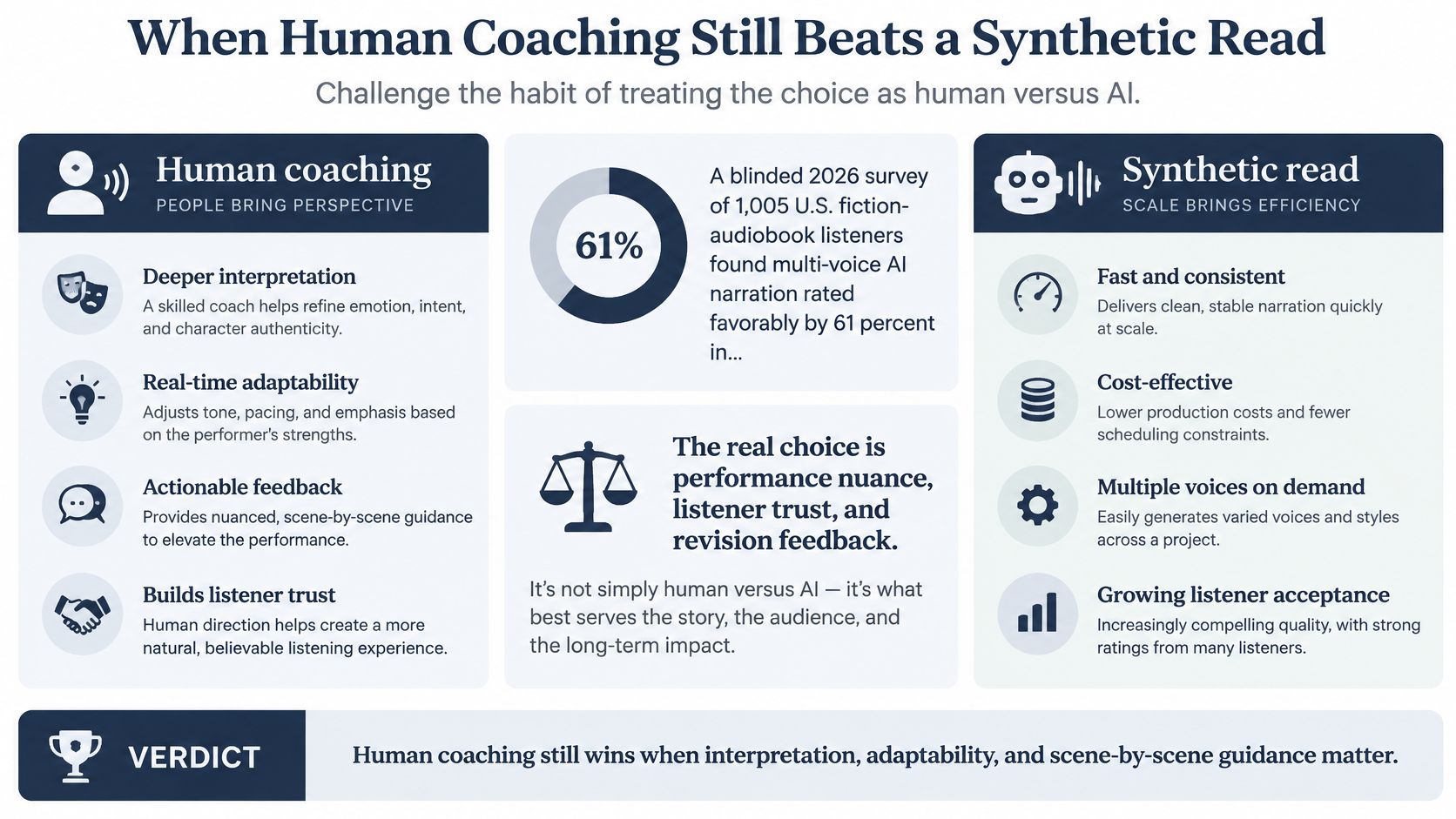
The useful question is not “human versus AI.” It is which performance suits the scene. In a blinded 2026 survey of 1,005 U.S. fiction-audiobook listeners, multi-voice AI narration was rated favorably by 61% in character-driven scenes, against 53% for a single human narrator, while human narration scored better for exposition without several characters, according to Publishers Weekly. 70% preferred distinct voices for characters, rising to 81% among frequent listeners.
Mark each chapter before you pay for coaching or for synthesis.
| Chapter job | Production model | What the coach protects |
|---|---|---|
| Explanation or argument | Restrained single voice | Authority and processing time |
| Dialogue with a trackable cast | Contrasted human or multi-voice | Small, repeatable differences, not caricature |
| Mixed scenes in one file | Hybrid, with a human through-line | Whose point of view the scene belongs to |
What the coach is for now
A coach's newer job is dramatic timing, scene-level perspective, and quality control of a hybrid file. Endurance and pronunciation still matter. They are no longer the only reason to hire a person. Differentiate speakers in dialogue, and keep the contrasts small enough to repeat for hours.
If you are testing how a scene might look as well as sound, you can turn a story into a video with AI and watch whether the point of view still reads when the pictures move. A chapter that falls apart as soon as a second voice enters is a structure problem, not a microphone problem.
For a bilingual or international book, keep an accent when it belongs to the narrator or the character and stays intelligible. Change it when it mocks a community or makes names wrong. Label every chapter as single-voice, contrasted, or hybrid before you book either a coach or a synthetic read. If you cannot label it, you are not ready to spend.
How to Choose a Coach or Package
Pick the format after you know the gap. A cheap hour will not fix a book that needs a cast, and a full studio week will not teach you to hear your own rush.
| Format | Best for | What you receive | Access or price benchmark |
|---|---|---|---|
| Private coaching | An author or actor who will narrate their own book | Notes on their manuscript, pace, and voices across sessions | A series of 1:1 sessions on your own chapters |
| Live workshop | Someone who needs a first diagnosis | About 60 minutes with personalized feedback | $49, or $39 early, John Marshall Media, 2025 |
| Self-paced course | A learner who wants replayable lessons first | Technique they can repeat alone | Replay on your own schedule, with no live ear on your room |
| Publisher studio package | An author who wants a finished audiobook | Directed recording, production, and platform delivery | A finished file from a directed studio, not a performing career |
In 2025, John Marshall Media listed a 60-minute live audiobook-narration workshop with personalized feedback at $49, or $39 for early registration. Treat that as a benchmark for a single feedback hour, not as a full production.
Who should take which route
Private coaching fits you if you will be the voice and you need notes on your own chapters over several weeks. A live workshop fits a first diagnosis, especially if you are unsure whether the problem is pace, cast, or the room. A self-paced course fits replayable lessons before you spend on a coach. It cannot hear your room or your cast. A publisher studio package fits you if you want a finished audiobook more than a performing career. Our audiobook production services sit in that last lane when the goal is a produced file rather than booth practice.
Ask four questions before you pay.
- Will you be the voice? If no, do not buy months of performance coaching.
- Is the manuscript fiction, nonfiction, or bilingual? The notes are not interchangeable.
- Do you need one critique or a multi-hour production? Match the spend to that answer.
- Can you stop a session when the voice tires? A package that ignores that stop rule is a bad fit.
Do not buy studio time to hide diction you have not practiced. Do not buy months of coaching if what you need is distribution of a professionally read file. Match the row, then book a consultation that names the path.
Book a Consultation Before You Record
Book the call with your manuscript status and one sample page in hand. Say whether you want to perform, to be coached through a stuck draft, or to hand the audio to a studio. A useful call covers your goals, how finished the manuscript is, the service options, and the next steps. You should leave with pricing, a target date, and a short task list.
We work in three paths and recommend the one that fits. Writers who are stuck often start with coaching. Authors with a finished book often start with publishing. An idea that still needs structure often starts with ghostwriting. If the goal is a produced Spanish-language audiobook rather than self-narration practice, the Premium Author Publishing package includes everything in Pro plus audiobook recording and production in a professional studio in Spanish, with global publishing on Apple, Audible, and Google using one Spanish voice.
Ask on the call whether the book needs that performed file, a coaching plan, or both in sequence. Coaching alone does not create an award-level read. Match the path to the voice who will be heard.
BarkerBooks helps authors turn a manuscript into a book listeners can finish, including coaching when you are stuck and studio production when someone else should be the voice. If you are deciding between narrating, directing, or handing the file to a Spanish-language studio, start with a consultation that names the path. Visit BarkerBooks and bring one sample page.