
You've finished the manuscript, picked a publication date, and started looking at audiobook recording studios. Then the questions arrive: Do you need a booth, a remote engineer, or a home setup? Should you narrate it yourself, hire a performer, or consider AI? A polished recording can still disappoint if you settle those choices too late. The studio isn't just a room with a microphone. It's a chain of decisions about the voice, manuscript, recording, editing, rights, and delivery.
Plan the Audiobook Before Choosing a Studio
Treat your audiobook like a production, not a shopping list. A studio can capture clean audio, but it can't fix a narrator who doesn't fit the story, an unfinished manuscript that changes during recording, or unclear distribution rights. Start by defining what the book needs and what the finished files must do.
Audiobooks already reach a substantial audience. In 2024, U.S. audiobook revenue reached approximately $2.22 billion, digital audiobooks represented 99% of that revenue, and 51% of U.S. adults had listened to an audiobook, according to RAIN News' summary of audiobook sales and listening data. That's a reason to plan carefully, not to rush into a recording. Your production should match the book, its listeners, and the platforms where you intend to make it available.
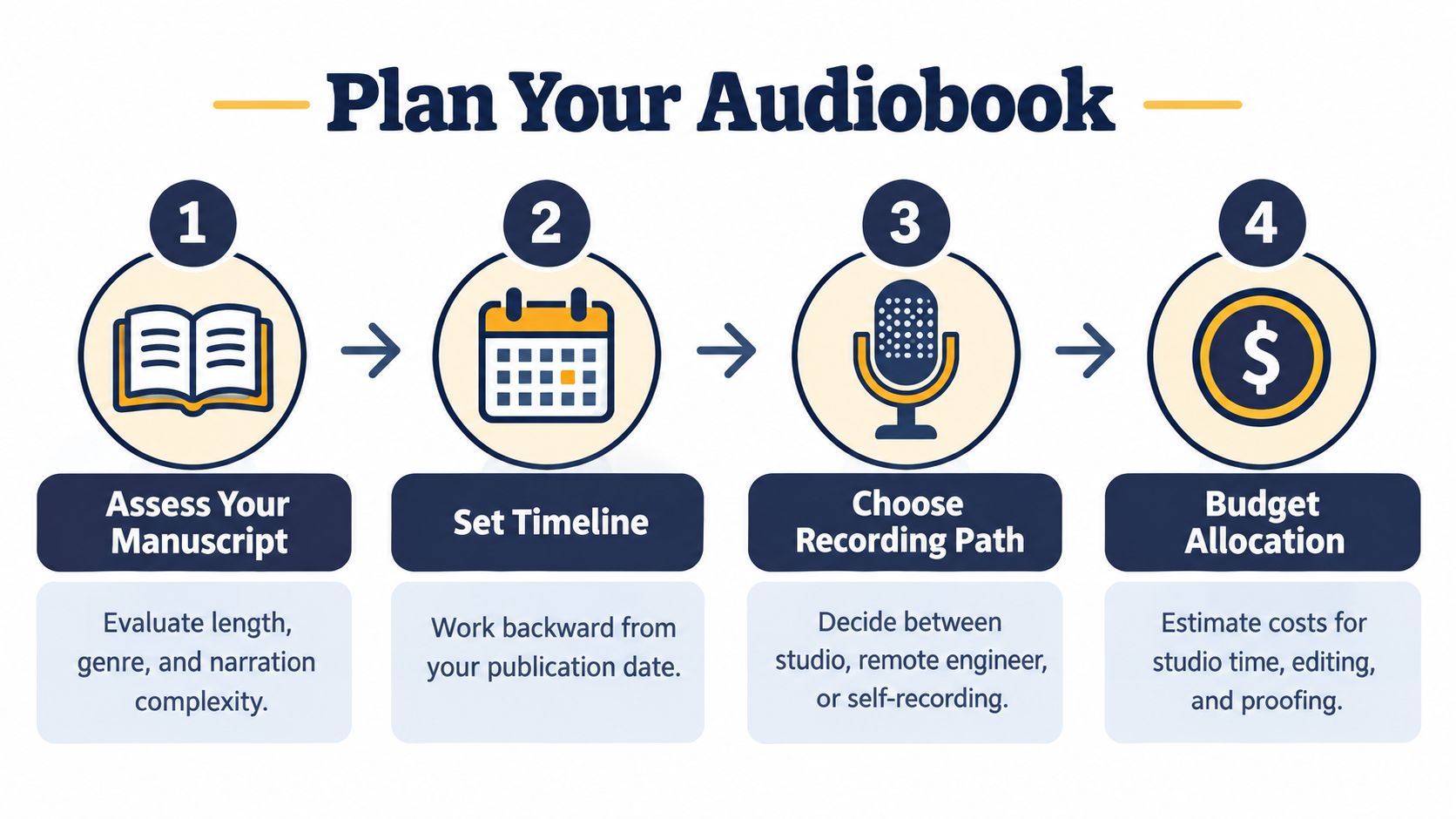
Before requesting quotes, write a short production brief. Include the manuscript's status, intended audience, target languages, narrator preferences, schedule, budget range, technical requirements, and expected deliverables. Note whether the book includes dialogue-heavy scenes, specialist vocabulary, regional language, or material that may need a distinct performance approach.
Use that same brief with each studio or producer. A quote for narration alone isn't comparable to a managed package that includes direction, editing, quality checks, and distribution-ready files. If you're comparing facilities in a city where podcast studios may also offer recording space, this guide to finding podcast recording studios in NYC can help you think about what to ask before booking. Confirm that any space you consider has experience with audiobook production, not just spoken-word recording.
Compare Studio Remote and Self Recording Options
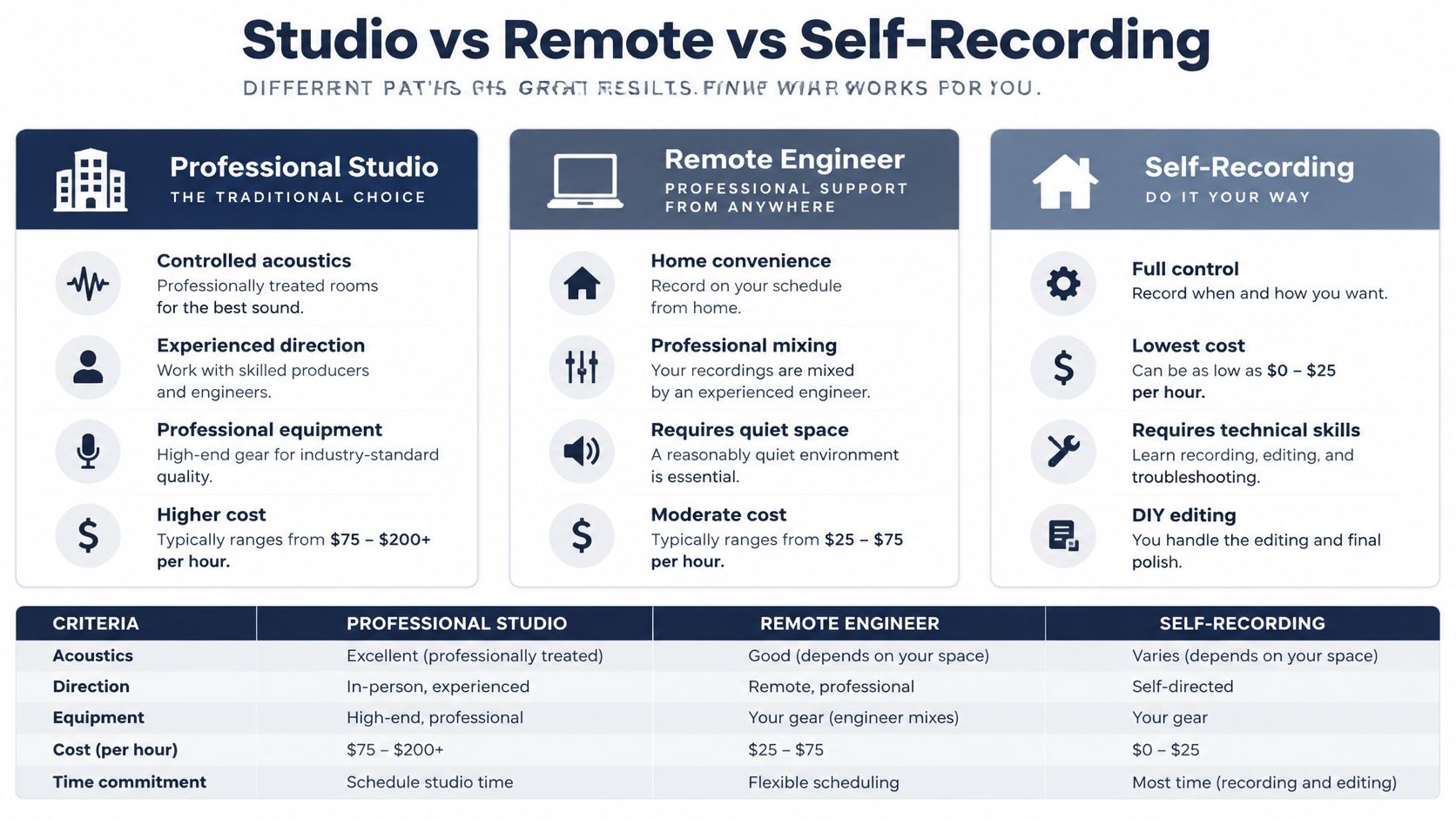
There's no universally right recording route. A professional audiobook recording studio gives you a controlled environment, experienced direction, and a team that can manage technical problems as they arise. Remote production can offer similar production support without requiring you to travel, provided the narrator has a suitable recording space and the engineer can monitor or review the work. Self-recording gives you control, but you take responsibility for performance, room quality, editing, and delivery.
| Production route | Best fit | Primary advantage | Primary trade-off | Quality relies on |
|---|---|---|---|---|
| Professional studio | Authors who want managed sessions and direct support | Controlled recording and access to production expertise | Higher cost and scheduled travel or studio time | The studio team, direction, and a good performance |
| Remote engineer | Narrators or authors with a quiet, suitable space | Convenient recording with professional engineering support | You need a space that works and reliable coordination | Room conditions, setup, and communication with the engineer |
| Self-recording | Experienced narrators comfortable with recording and editing | Full control over performance and sessions | You handle the technical work and quality checks | Your narration skills, room, equipment, and editing |
Match the route to the work you're willing to do
A first-time novelist with a fixed release date may prefer a managed studio because a producer can direct sessions, track missed lines, and coordinate edits. An established narrator with a quiet home setup may work efficiently with a remote engineer. Self-recording makes sense if you already have the voice technique, equipment, room, editing experience, and time to check every chapter. Don't choose it just because you own a microphone.
For a remote or self-led project, settle on recording and file-handling tools before you begin. This guide to audiobook recording software can help you assess the software part of the workflow. Software won't rescue a noisy room or inconsistent performance, so don't let a feature list distract you from the actual recording conditions.
Compare human, hybrid, and AI-assisted narration
Human narration remains a strong default for books that depend on emotional interpretation, distinctive characters, or an intimate connection with the listener. Hybrid workflows may use AI-assisted tools for parts of production, but authors should establish what is generated, what a human reviews, and who approves the final performance. AI narration may suit some projects, but don't assume that a lower production cost makes it the better choice.
The audience evidence calls for a careful decision. The Audio Publishers Association reported that 16% of surveyed audiobook listeners had listened to an AI-voiced title, and AI-generated audiobooks represented 0.03% of audiobook revenue in 2025; Canadian research found that 84% of listeners preferred human narrators, as summarized in the Audio Publishers Association's survey information. Evaluate the options against genre, emotional range, pronunciation, revision needs, rights and consent, multilingual goals, and listener expectations. Ask each provider to explain the trade-offs for your specific book.
Prepare the Manuscript and Narrator
A narrator can't deliver a consistent performance from a manuscript that's still changing. Prepare the text for reading aloud before booking full production. That means resolving editorial changes, making the chapter order clear, and giving the narrator reliable guidance on names, specialist terms, and the way you want the story to sound.
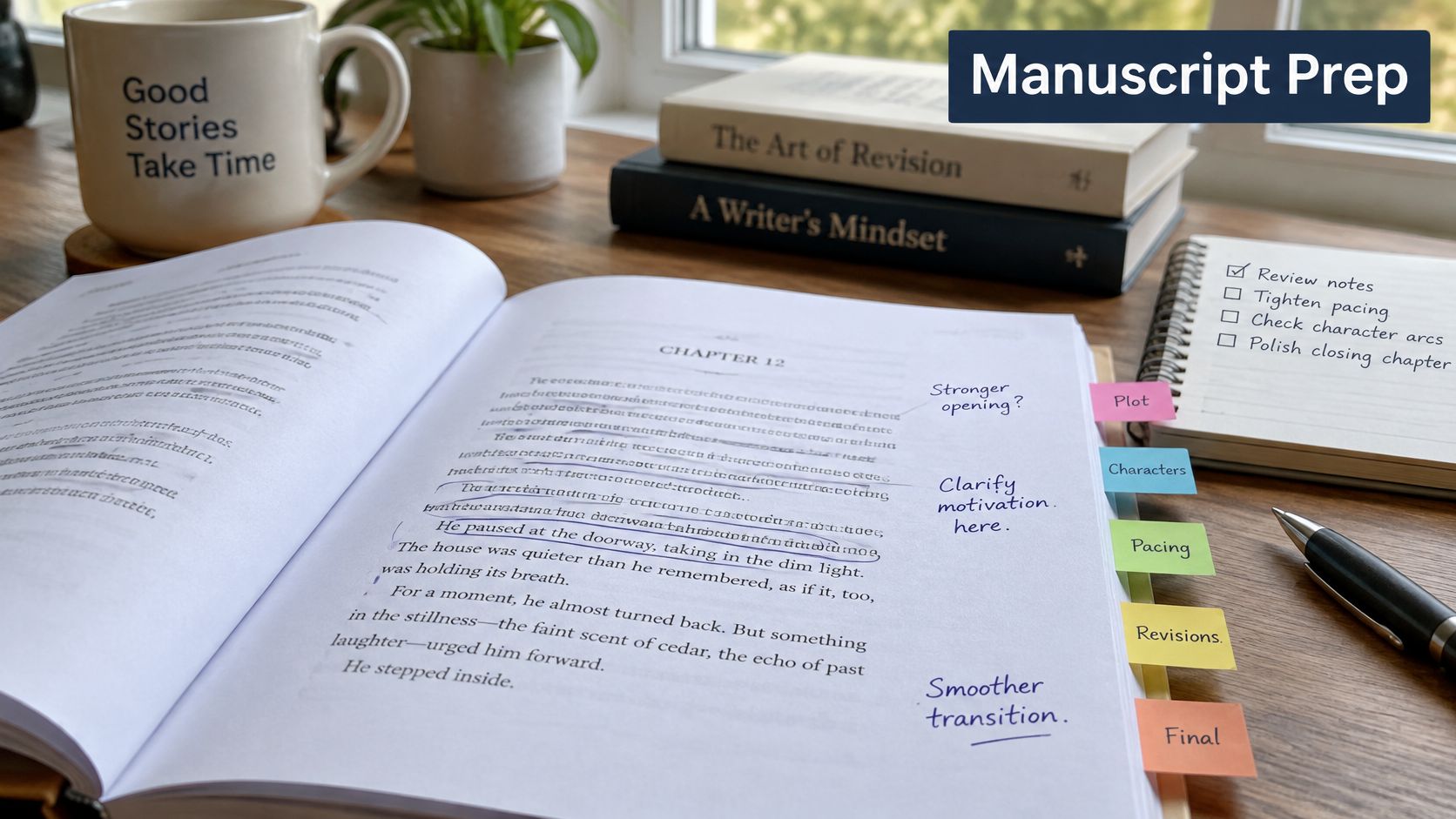
Create a clean performance copy with chapters and headings clearly marked. Flag scene breaks, quotations, abbreviations, numbers that could be read in different ways, and passages where a pause or change in delivery matters. Don't script every breath or emotion. Give the narrator enough direction to understand your intent, while leaving room for an actor to make natural choices.
Audition with representative passages
Ask shortlisted narrators to read material that tests the book, not a generic introduction. Choose an excerpt with typical prose, a denser passage, and dialogue if the book relies on distinct characters. Listen for pacing, clear consonants, emotional restraint, character differentiation, and whether the delivery suits the intended audience. For specialized vocabulary, include terms the narrator will encounter throughout the manuscript.
Narrator fit isn't a minor preference. NielsenIQ's coverage of UK audiobook listening research notes that disliking a narrator's voice can deter listeners, while BookNet Canada found that 66% of listeners had abandoned an audiobook because of the narrator's voice and 64% actively searched for particular narrators. Those findings are a practical reason to audition before committing to a full recording. A technically clean performance still has to be one your audience wants to hear.
For an international release, check whether one voice works for every intended market. Ask the narrator to read the same representative passage in the proposed delivery, and review regional pronunciation and any language-specific vocabulary before approving the audition. If you need distinct language or regional versions, plan them as separate production choices rather than assuming one recording will serve every audience.
Share a pronunciation guide and resolve uncertain interpretations in advance. The document should identify preferred pronunciations, character names, acronyms, and any words where context changes the intended reading. Then approve one audition, archive the performance notes, and give the narrator the final, clean script.
If you're considering how narration decisions affect the finished work, this video offers another perspective on audiobook recording:
Build a Reliable Recording Setup
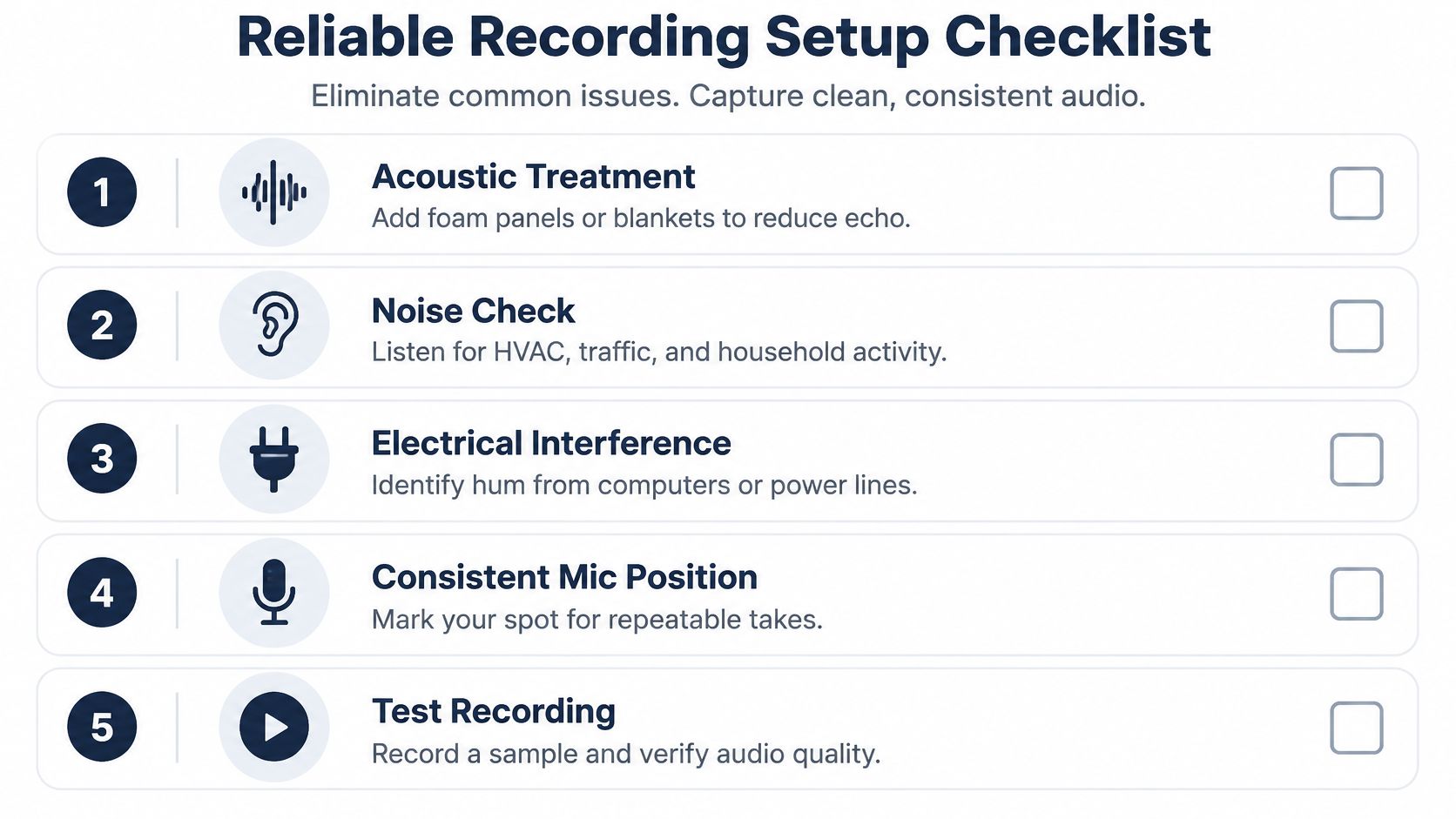
Start with the room, not the microphone. An expensive mic will capture an untreated room's reflections and background noise with impressive clarity. Before recording remotely or at home, listen during the hours you expect to work. Check for HVAC, computers, traffic, household activity, electrical hum, and other sounds that may interrupt a take.
Room treatment should control reflections without making the space sound unnaturally dead. Thin foam may soften high frequencies while leaving rumble and boxy coloration untouched. Use spoken test passages to check how clear consonants sound at ordinary and softer narration levels, and listen for a hollow or echoing quality. Don't place a microphone in the center of a small untreated room and assume the room is ready because it contains a few acoustic panels.
Build a consistent capture chain
Your aim is a clear, repeatable voice recording, not a pile of gear. Set up the equipment you need, mark the microphone position, and keep the narrator's posture and distance consistent between sessions. A pop filter can help manage plosives, while closed-back headphones let the narrator and engineer hear issues without adding sound to the recording.
A practical checklist includes:
- Microphone and connection: Choose a suitable microphone and an audio interface or recorder that works reliably with your setup.
- Monitoring and positioning: Use headphones, a stable stand, and a pop filter. Keep cables secured so movement doesn't create noise.
- Power and storage: Confirm dependable power and enough storage for original takes, edited chapters, and backups.
- Room control: Add broadband absorption or other suitable treatment based on what the test recording reveals, rather than buying materials at random.
- Recording software: Use an application the operator knows well. If you're comparing a USB option for a home setup, the HyperX SoloCast with USB-C is one example to evaluate against your needs, but microphone choice doesn't replace room testing or practiced delivery.
Record clean room tone before and after each session. That quiet sample gives the editor a reference for the space and helps maintain continuity when repairing small gaps. Avoid recording too close to the microphone, which can exaggerate plosives and bass, and don't rely on a noise gate that may chop off quiet word endings.
Set levels before the long session
Use a consistent capture format and leave room for peaks. A practical starting point is 44.1 or 48 kHz, 24-bit, with narration peaks approximately between −12 and −6 dBFS. Keep clean room tone, and listen for clipping before moving forward. These settings and a short test chapter are among the checks recommended in this audiobook recording and delivery guidance.
Record and review a sample chapter before scheduling the full book. Listen for background noise, room reflections, vocal strain, plosives, mouth noise, and editing problems. If the sample reveals a problem, change the setup or performance approach now. A test is useful only if you act on what you hear.
Manage Recording Editing and Delivery
A smooth audiobook workflow depends on clear handoffs. Before booking, confirm who handles narration, direction, engineering, editing, mastering, quality control, and delivery. Put the recording dates, file naming, chapter order, correction process, pickup policy, and revision expectations in writing. Agree on where the files will be stored and how the production team will identify the current approved version.
During recording, keep a record of takes, missed passages, and decisions about pronunciation or performance. That record helps the editor identify the right material and gives the narrator a reference for maintaining continuity across chapters. If you're working remotely, agree on how questions will be raised and resolved rather than leaving feedback scattered across messages.
Review the edit in stages
Editing should make the performance clean and consistent without making it sound processed. Remove errors, coughs, distracting mouth noise, and unwanted gaps manually. Preserve room tone when repairing pauses, apply light processing, and avoid aggressive noise reduction that can leave metallic artifacts. A gate can also cut off quiet word endings, so listen closely instead of trusting a setting to make decisions for you.
Practical rule: Approve a test chapter against the agreed sound and delivery requirements before the production team moves through the full manuscript.
Quality control should happen chapter by chapter, not just on the audiobook as a whole. Listen for clipped plosives and harsh sibilance, inspect peaks, measure the metrics required by your delivery specification, check noise floor and room tone, and compare loudness between chapters. If a specification calls for RMS, use RMS for that check rather than substituting integrated LUFS, which measures loudness differently.
Approve files before delivery
After the edit, render the required format and listen to the encoded files. Check chapter order, openings and endings, transitions, and any corrections from the review process. Don't assume that a master sounds right because it passed a visual inspection. The final audition is where you catch distracting edits, missing lines, or inconsistencies that survived the technical checks.
For authors who want to understand the final mastering handoff, this resource on professional audio mastering offers useful context. If a production team manages the whole process, ask them to describe their mastering and quality-control checks in plain language. BarkerBooks offers audiobook production that includes narrator casting and direction, recording, editing, mastering, quality control, and preparation of final audio files through its audiobook production services.
Keep a change log and an organized archive of the source recordings, edited chapters, corrections, and approved final files. That makes future revisions easier and leaves you with a clear record of what was delivered and approved.
Control Budget Rights and Distribution
A quote is only useful if it describes the whole job. Ask vendors to separate narration, studio or engineering time, direction, editing, mastering, pickups, rush work, project management, usage rights, taxes, and distribution fees. A low session rate may not reflect the final cost if extra recording time, revisions, or rights are excluded. Ask the same questions of every provider so you can compare proposals on equivalent terms.
Production costs have changed as digital recording and workflows developed. An Audible representative reported that recording an audiobook cost approximately $25,000 in the late 1990s and about $2,000–$3,000 by 2014, as described in the audiobook history overview. That historical comparison illustrates a shift in production economics, but it doesn't predict what your project will cost. Your quote depends on the services, talent, editing, schedule, and rights you need.
Resolve rights before recording
Get written answers about ownership and use before anyone begins narration. Clarify who owns the raw recordings and mastered files, which territories and languages the agreement covers, whether you can create revised or new versions, and how long the rights last. If the narrator or provider uses AI tools, state what materials may be processed, what consent is required, and whether generated or modified audio can be reused.
Check how pickups and revisions are handled. Does the quoted service include corrections for recording errors? What happens if you change the manuscript after approval? Who pays for a new session caused by a late editorial revision? A clear agreement prevents a small ambiguity from becoming a costly dispute.
Tie the budget to distribution
Ask what files and supporting information you'll receive, including chaptered audio, metadata, and any required cover or chapter assets. Confirm the intended retailers, library services, languages, and technical specifications with the distributor before mastering. Don't assume one set of files meets every platform's requirements.
Build your quotation checklist with each cost, service, revision allowance, rights term, and delivery item. If audiobook expenses fall within a broader publishing budget, compare them alongside other production decisions using this guide to publishing a book's costs. The result should be a written agreement, a defensible budget, and a delivery package you can distribute.
Finalize a Reliable Audiobook Workflow
Before booking, make sure your decisions connect. A narrator affects listener fit; the manuscript affects session efficiency; the room affects editing; the contract affects future use; and distribution requirements determine what the production team must deliver. A recording studio is a system for managing those dependencies, not just an expensive room.
Use this checklist to keep the project on track:
- Define the project: Record manuscript status, audience, target languages, schedule, budget, technical needs, and deliverables.
- Choose the production route: Compare studio, remote, self-recording, and human or AI-assisted options against the work involved.
- Approve the voice and script: Audition representative passages, settle pronunciation questions, and prepare the final performance copy.
- Test before recording: Review a sample for room noise, voice quality, pacing, and editing issues. Correct problems before full production.
- Track each handoff: Keep session notes, review edited chapters, check specifications, and audition the final encoded files.
- Protect the finished work: Archive rights documents, source files, approved masters, and distribution information.
If you don't feel ready to request a quote, gather the manuscript status, target market, narrator preference, budget, schedule, and delivery specifications first. Then ask studios and producers for proposals that cover the same work. You'll make a more confident decision when you can compare the full production, not just the room or microphone.
BarkerBooks offers audiobook recording and production as part of its broader publishing support, including recording, editing, mastering, and preparation of final audio files. Visit BarkerBooks to discuss how its services could fit your manuscript, production requirements, and distribution plans.