
You've finished a manuscript, uploaded it to an online retailer, and expected the hard part to be over. Then someone asks where bookstores can order it, whether libraries can find it, or if readers in another country can buy the right edition. A book can be listed and still be difficult to discover, purchase, borrow, or receive.
That's why how book distribution works is a question about more than retailer logos. It's the combined work of making a title available, helping the right readers find it, and fulfilling orders under terms that make sense for the author. Once you understand the supply chain, publishing models, format-specific choices, and market-by-market requirements, distribution becomes a practical operations problem rather than a mystery.
What Authors Actually Mean When They Ask About Distribution
A first-time author may think distribution means pressing “publish” and waiting for the book to appear everywhere. In practice, uploading a file is only one step. A reader might see a listing but find the wrong language edition, face an impractical delivery option, or discover that a local library or bookstore can't order it.

It helps to think of distribution as four connected jobs:
- Move the book: Get printed copies or digital files from the publisher or printer to a retailer, library, institution, or reader.
- Make it identifiable: Give each edition accurate identifiers and metadata so ordering systems know which book they're handling.
- Make it findable and purchasable: Ensure the title can surface in relevant searches and that readers in intended territories have a workable way to buy or borrow it.
- Account for sales: Track orders and apply the relevant contract terms so revenue can be reported and paid.
These jobs overlap, but they aren't interchangeable. A wide retailer listing won't fix missing rights in a territory. Accurate metadata won't help if a title can't be fulfilled. And a well-stocked book still needs readers to find it.
Practical rule: Evaluate distribution by asking who can find the book, who can order it, where it can be fulfilled, and how sales are reported.
The rest of the decisions follow from those questions. A publisher may manage most of the process, or an author may coordinate separate services. Either way, understanding the mechanics makes it easier to choose a route without confusing availability with actual readership.
The Traditional Supply Chain From Printer to Reader
A printed book usually travels through several businesses before it reaches a reader. The easiest analogy is a grocery supply chain: a producer makes goods, a warehouse keeps them available, a distributor moves them to stores, and the store sells to the public. In book publishing, the names and contract arrangements vary, but the basic stages are familiar.
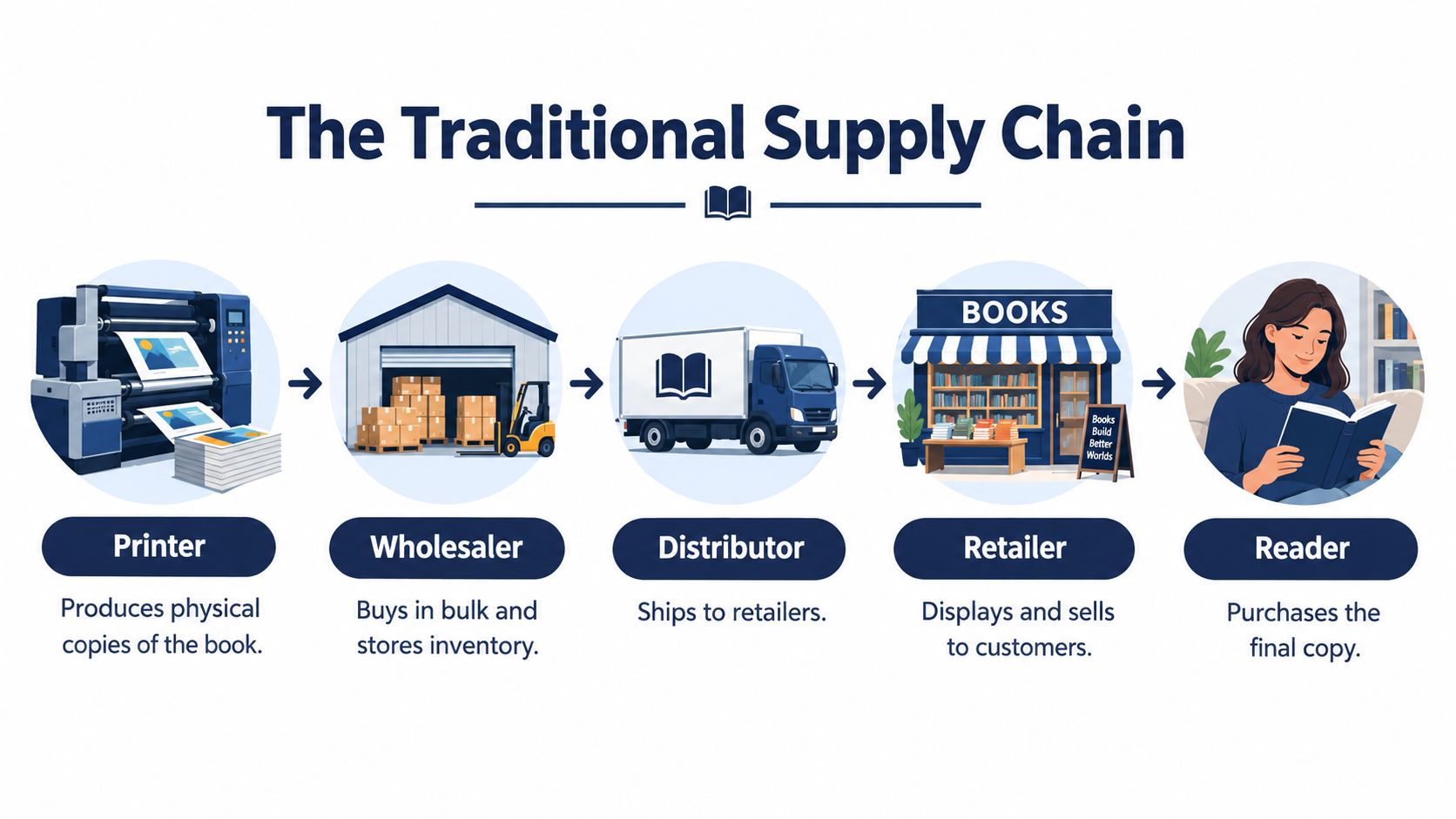
- Publisher and printer: A publisher arranges for a book to be manufactured, either by commissioning a print run or using a print-on-demand service. Some publishers own inventory; others rely on a printing partner.
- Wholesaler and distributor: Wholesalers hold or route inventory and process orders. Distributors may handle services such as sales representation, order processing, and shipping. The roles can overlap, so authors should check what a particular partner does.
- Retailer or institution: Bookstores, online retailers, libraries, schools, and academic institutions place orders through the channels available to them.
- Reader: The reader buys or borrows the book, but only if the title is discoverable and can be supplied through the chosen channel.
The U.S. book, magazine, and newspaper wholesaling industry generated approximately $14.89 billion in revenue in 2017, based on figures derived from the U.S. Census Bureau Economic Census (IBISWorld's industry overview). That scale helps explain why intermediaries matter. They consolidate orders, maintain inventory, and connect publishers with many outlets, rather than requiring every publisher to negotiate and fulfill every store's order individually.
A bookstore's ability to order a title doesn't begin and end with its publication date. The title must be catalogued, identifiable in ordering systems, stocked or available for order, and routed through a network that can fulfill it. For a first-time author, “available to bookstores” may therefore mean an order can be placed, not that copies are sitting on shelves.
A process diagram can help make the handoffs easier to picture. The video below offers another view of how supply-chain stages connect.
Supply chains become easier to manage when teams clarify who owns inventory, ordering, and fulfillment at each handoff. For a broader operations perspective, Next Point Digital supply chain insights can help readers think about those responsibilities beyond publishing.
Traditional, Hybrid, and Self-Publishing Distribution Compared
The publishing model determines who pays for production, who manages distribution, and how much control the author keeps. Labels such as “global distribution” don't answer those questions by themselves. Read the contract and service description to learn whether a partner is printing, listing, warehousing, selling, or handling several of those jobs.
| Model | Who Funds Production | Typical Royalty | Timeline | Global Reach |
|---|---|---|---|---|
| Traditional publishing | Publisher generally funds production | Set by the publishing contract; calculated under its royalty terms | Publisher controls the schedule | Publisher may coordinate retail and institutional channels, subject to rights and territory agreements |
| Hybrid publishing | Author funds some or all production, according to the agreement | Contract-specific; confirm how sales and deductions are calculated | Depends on the provider's production schedule | Depends on the services, retailer coverage, and rights granted |
| Self-publishing | Author funds or manages production | Depends on platform, retailer, and distribution agreement | Author controls more of the schedule but coordinates the work | Can include international retail access, but setup and market fit remain the author's responsibility |
Traditional publishing can reduce the amount of distribution administration an author handles directly. The trade-off is that the publisher's contract may determine key decisions about rights, pricing, formats, production, and royalty accounting. Ask how print, ebook, and audio rights are handled, and whether territorial rights are included.
Hybrid publishing can provide professional production and distribution services while requiring the author to invest in the project. The term covers different arrangements, so don't assume every provider offers the same retail access or assumes the same responsibilities. Ask for a written explanation of costs, services, rights, and the author's role after publication.
Self-publishing gives the author direct responsibility for choosing services and coordinating the workflow. An author might use a retailer's own tools, hire a distributor, or use an aggregator to send a digital edition to multiple stores. For authors weighing direct ebook sales against marketplace access, this guide to selling ebooks online without marketplaces can help frame the channel choice.
A useful comparison goes beyond the royalty label. Ask who owns the ISBN, who can change the metadata, who handles returns, how often sales are reported, and what happens to distribution rights if the agreement ends. The model that fits best is the one whose responsibilities and economics match your goals, not necessarily the one with the most retailer names in its sales pitch.
ISBN, Metadata, and Rights as the Distribution Backbone
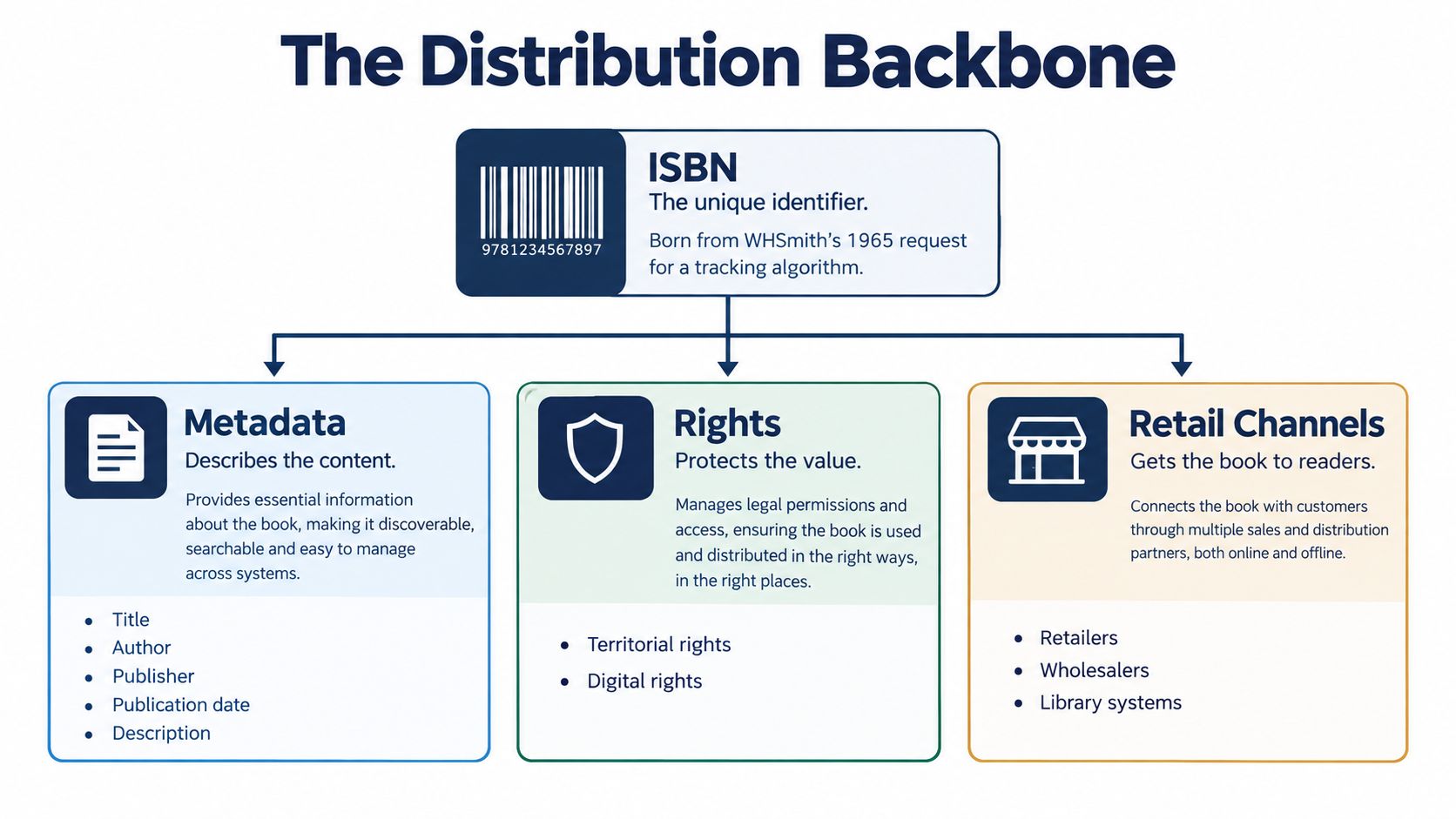
A book's ISBN works like an identifier on a product in a warehouse. It helps ordering and inventory systems distinguish one edition from another, while metadata supplies the descriptive details that help people and systems understand what the book is.
The ISBN system began after U.K. bookseller WHSmith asked statistician Gordon Foster to develop a tracking algorithm in 1965; the first ISBN was generated in 1967. The system later developed into the 13-digit identifier widely used across publishing. Each distinct edition or format, such as a hardcover, paperback, ebook, or audiobook, normally needs its own identifier so the supply chain can keep price, stock, and availability records straight. A practical overview of what an ISBN number on a book is can help authors understand how the identifier fits into publishing operations.
The U.K. market shows how identification connects to sales systems. In 2018, booksellers sold 190.9 million print books worth £1.63 billion, with sales tracked using ISBN-linked data (UNESCO Courier's account of the book market and ISBNs). Retailers use ISBN records for ordering and stock control, which helps them distinguish versions of a title and manage replenishment.
Metadata is the descriptive record attached to that identifier. Before publishing, check that the title, author name, publisher, publication date, description, category, language, format, and price are accurate and consistent wherever the book is listed. A misspelled author name or a description in the wrong language can make a correct ISBN less useful to a reader searching for the book.
Rights set the boundaries. An author may control print rights in one territory while a contract assigns ebook or audio rights elsewhere. Before distributing an edition, confirm that the rights agreement covers the format and countries you intend to serve.
Metadata isn't decorative copy. It's part of how buyers, retailers, and libraries identify and assess the book.
Wholesale Discounts, Returns, and the Money Mechanics
A bookstore doesn't usually pay the cover price when it orders through the trade. The wholesale discount is the gap between that price and the retailer's purchase cost. It gives the store room to cover operations and earn money if the book sells.
Retailers commonly receive an approximately 40% discount from the cover price, while large online retailers and wholesale branches may require discounts near 55%. For a $22.95 book at a 40% discount, the retailer pays $13.77 before accounting for its own costs. Those terms affect whether a store sees the book as commercially workable, not just whether it can place an order.
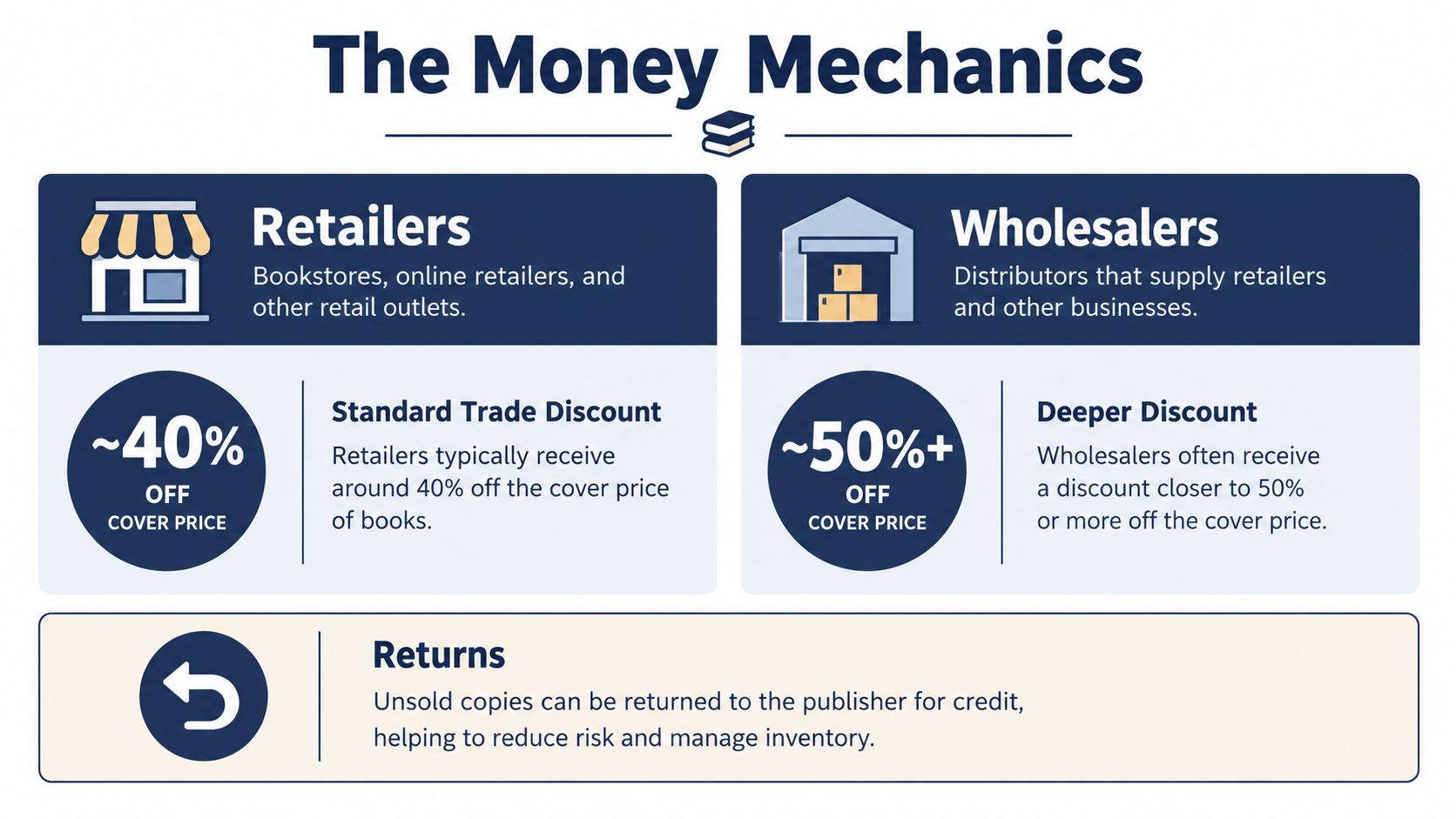
The other major term is returnability. Under a returnable arrangement, a retailer can generally send unsold copies back for credit or a refund. That lowers the retailer's risk, but shifts financial exposure toward the publisher. Returned books also create reverse-shipping, handling, accounting, and sometimes pulping costs. Industry discussion of how book returns work and why they matter explains why returns can make distribution costly even when the original order looked promising.
What to confirm in a distribution agreement
- Discount: Check the discount by channel and format, not only the headline rate.
- Returns: Find out whether copies are returnable, how credits are calculated, and who absorbs related costs.
- Reporting: Confirm when sales, returns, and payments appear in statements.
- Demand planning: Use preorders, promotion, and realistic forecasts to reduce the chance of shipping more stock than the market can sell.
Nonreturnable terms can reduce a publisher's exposure, but a retailer may be less willing to order an unfamiliar book without the option to return it. Returnability can improve access while increasing risk. A sensible choice depends on the audience, demand, and contract terms, not a blanket rule that one arrangement is always better. BarkerBooks' overview of wholesale book distribution provides further context on the role of wholesale channels.
Print on Demand and the Forecast Versus Fulfillment Choice
Print on demand, or POD, changes when a physical copy is made. With a traditional bulk run, a publisher forecasts demand, pays to manufacture copies in advance, and stores inventory until orders arrive. With POD, a printer produces a copy after receiving an order, then sends it to the customer or retailer.
That difference matters most when demand is uncertain. A backlist title, a multilingual edition with a smaller audience, or a book that sells steadily rather than in a concentrated launch can remain available without requiring a large stock of copies. POD also reduces the need for warehouse space and limits the risk of holding inventory that no longer matches demand.
The trade-off is per-copy cost. POD generally costs more per copy than offset printing when a publisher has enough predictable demand to justify a larger print run. A publisher planning a launch with dependable demand may use offset printing for the initial supply, then switch to POD for replenishment or low-volume markets.
One study in a university-publishing context reported an 86% reduction in waste and a 33% reduction in distribution costs with POD methods (the study's findings). Those figures describe that context, not a guaranteed outcome for every title or publisher. POD can also coexist with returnable bookstore terms, so authors shouldn't assume that printing a book only after an order automatically removes return risk.
The practical choice is between paying more per copy to avoid building a large stock and paying less per copy while taking on more forecasting and inventory responsibility. A mixed approach can work when an author can forecast part of the demand but wants continued availability without storing copies indefinitely.
Audiobook Distribution as a Strategy Not a Format
An audiobook isn't just an ebook read aloud. It involves separate rights, production decisions, metadata, and routes to market. Before approving a distribution agreement, confirm whether the audio rights are available, who controls the recording, and whether the narrator's performance and related permissions are covered.
The commercial options can differ, too. A listener may buy a single audiobook, access it through a subscription, or borrow it through a library. The way the author is paid and the way listening activity appears in reports depend on the agreement and channel. Exclusivity can simplify some arrangements but may limit other routes; a wider release can expand access while making performance harder to compare across services.
The scale of the U.S. audiobook market is substantial: sales reached $2.43 billion in 2025, up 9% year over year, according to the audiobook market overview (Self Publishing's publishing-by-the-numbers discussion). Estimates of channel share don't always align, because they can count revenue, units, or listening access differently and may cover different markets. Treat market-share figures cautiously rather than assuming that one headline settles the right strategy for your book.
For a bilingual or international release, check that each audio edition has accurate language and territory metadata, and that your rights permit distribution in each intended market. Ask how subscription use, library licensing, and one-time purchases appear in reports, and whether reporting schedules differ by channel. An audiobook producer can help authors address recording and production choices; for example, BarkerBooks describes its audiobook production services.
Going Global Without Going Broke or Getting Lost
“Available worldwide” can mean that a listing exists, but it doesn't guarantee readers in every country can find the correct edition, pay an acceptable price, or receive it conveniently. Global distribution works better as a set of local checks than as a single switch.
Online retail accounted for 51.71% of the global books market in 2025, while NielsenIQ's analysis covered 18 national markets. That framing underscores that demand and point-of-sale conditions are tracked by territory, not as one uniform global market (Mordor Intelligence's books market analysis).
For each market you care about, check:
- Rights and formats: Confirm that your agreement allows print, ebook, and audio distribution in that territory.
- Language and discoverability: Prepare descriptions, keywords, and categories that make sense in each language edition. A Spanish-language listing needs Spanish-language metadata, not just an English description copied over.
- Access and fulfillment: Check retailer eligibility, print-on-demand availability or local stock, delivery options, and whether readers can buy or borrow the title through channels they use.
- Price and identifiers: Review local pricing and currency handling, and confirm any market-specific expectations for identifiers and catalog records.
For planning, start with the markets and languages you can support well. Then verify rights and metadata, choose fulfillment options, and review listings as a reader in each market would see them. If a contract includes foreign or format rights, check the terms for duration and what happens if distribution ends.
Set aside time to complete those checks before launch, then review sales and fulfillment reports after publication. A listing that looks global from the author dashboard may still need market-specific adjustments. More retailer logos don't automatically create international readership; discoverability and fulfillment determine whether availability can turn into a completed order.
If you're preparing a book for publication, BarkerBooks offers publishing support that can include ISBN registration, multilingual publishing, distribution setup, and audiobook production. Visit BarkerBooks to discuss which services fit your manuscript, rights, formats, and target markets.