
You've finished the manuscript, but the publication decision is still open. Should you release an ebook first, invest in print, record an audiobook, or turn the content into a workbook, bilingual edition, or large-print title? The answer affects production cost, audience reach, distribution, accessibility, and how readers use the book long after launch day.
These ten book format ideas solve different author problems. Some are efficient starting points for a first release. Others justify extra editorial, design, printing, or recording work because they serve a distinct audience or create a more useful reading experience. The right choice depends on your genre, reader behavior, budget, and ability to support the format properly. For work intended to support young readers who struggle with reading, resources such as ReadLab for struggling young readers can also help clarify the audience's practical needs.
1. Ebook as a reflowable digital edition
An ebook is usually the most flexible starting point for a novel, memoir, business book, or other text-led manuscript. A reflowable edition lets readers adjust font size, typeface, spacing, and screen orientation. The text adapts to phones, tablets, e-readers, and reading apps instead of locking every page into one visual arrangement.
That flexibility comes with a production obligation. A badly converted ebook can contain broken chapter navigation, inconsistent spacing, missing italics, or images that interrupt the reading order. Build a clean EPUB, tag headings correctly, add a navigable table of contents, and test the file across several devices and apps before distribution.
The decision it solves
Choose an ebook first when you need broad digital reach without committing to inventory. It works particularly well for fiction, practical nonfiction, short books, and international releases where readers may buy through different retailers. The format also suits frequent updates, although substantial revisions should be managed carefully so readers know which edition they own.
Amazon Kindle, Apple Books, Barnes & Noble, and Google Books each present the manuscript through their own reading environments. That makes metadata important. Your title, description, keywords, and categories need to describe the book accurately and place it in the right search context.
Practical rule: Treat ebook formatting as publishing production, not as a last-minute file conversion.
Launch-stage recommendation: Release the ebook first if your manuscript is text-heavy, your audience is digitally comfortable, or you want to validate demand before adding print.
Budget-risk note: The format limits physical production expense, but saving money on professional EPUB cleanup can create avoidable retailer errors and accessibility problems.
2. Print paperback as the dependable core edition
The trade paperback remains the practical default for many novels and nonfiction books. Its soft cover keeps the book portable and less expensive to produce than a hardcover, while its physical presence supports author events, bookstore conversations, library circulation, and direct sales.
Print-on-demand reduces the need to buy and store a large quantity of copies. It doesn't remove the need for quality control. Order a physical proof and read it as a physical object. Check the gutter, page breaks, running heads, chapter openings, cover alignment, spine width, and the way the paper handles the text.
What authors often underestimate
A print file can look correct on screen and still feel wrong in the hand. Margins that seem generous in a PDF may feel cramped after binding. A spine designed from an estimate may misalign at the printer. Page numbers, blank verso pages, and chapter starts also need a final review after the interior layout is complete.
Paperback is particularly strong for fiction, memoir, business books, and practical nonfiction. It gives readers a familiar object without asking them to pay for the premium construction of a hardback. The physical book format also makes signed copies and event sales straightforward.
Register the paperback as its own edition in your publishing records, keep the cover file separate from the ebook cover, and use the printer's current specifications rather than relying on an old template.
Launch-stage recommendation: Make paperback the core launch edition when readers expect a physical book, you plan events or library outreach, or your subject benefits from highlighting and shelf presence.
Budget-risk note: Print-on-demand controls inventory risk, but proofing, cover revisions, and interior corrections still consume production time and may delay launch.
3. Hardcover for premium positioning
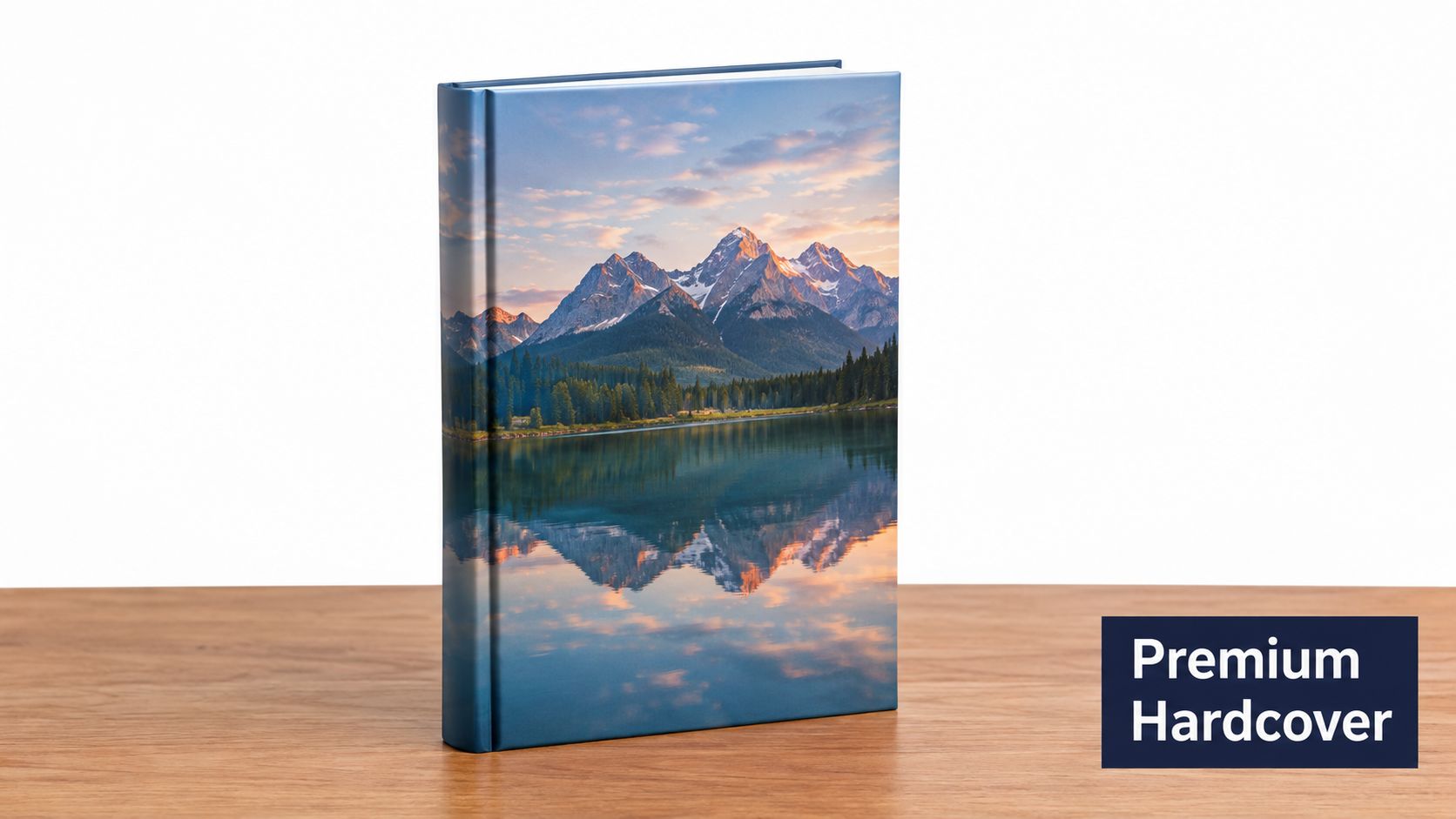
A hardcover changes the reader's expectation before the first page. Rigid boards, a printed case, cloth treatment, or a dust jacket can make the book feel like a gift, a keepsake, or a lasting reference. That makes the format useful for debut novels, illustrated books, commemorative titles, premium nonfiction, and special editions.
The additional material isn't automatically valuable. A plain hardcover with an underdeveloped cover can look like an expensive version of the paperback rather than a deliberate edition. The design needs to justify the premium through stronger materials, better image treatment, special endpapers, signed content, or a clear collector purpose.
When the extra production is justified
Hardcover works well when the book will be given as a present, displayed in a home, or purchased by readers who want a durable edition. It can also create a strong launch object while a paperback follows later for broader affordability.
Request the dust jacket design early. Its flaps, spine, trim, and back-panel copy affect the complete cover file. If you expect to order many copies, compare print-on-demand production with a short-run printer. A larger order may change the economics, but it also introduces storage, shipping, and unsold-stock risk.
Launch-stage recommendation: Start with hardcover when premium presentation is central to the sales proposition, then add paperback for readers who need a lower-cost physical option.
Budget-risk note: Hardcover multiplies design and manufacturing decisions. Don't commit until you've priced the full cover treatment, proofing, shipping, and storage implications.
4. Audiobook for readers who don't read print
An audiobook reaches people during commutes, exercise, household tasks, and other situations where a printed page or screen isn't practical. It also supports readers who prefer listening, including people with visual limitations, reading fatigue, or limited time.
The manuscript doesn't become an audio file. Narration requires performance direction, pronunciation decisions, chapter markers, clean audio, and quality control against the final edited text. A narrator who sounds right for a memoir may not suit a thriller, children's book, or business title. Audition several voices and request sample chapters before making the commitment.
The production decision
Author narration can add intimacy to memoir and personal development books, but it demands vocal stamina and technical consistency. A professional narrator may bring better pacing, character distinction, and recording discipline. Royalty-share arrangements can reduce the initial payment, while pay-for-production terms give you clearer ownership economics. The right arrangement depends on the book and your available cash.
Before recording, prepare a pronunciation guide, confirm names and specialist terms, and lock the manuscript. Correcting a sentence after recording may require rerecording several sections. Platform delivery requirements also matter, including chapter naming, file structure, noise control, and loudness.
For practical production support, authors can review audiobook recording software for publishing workflows.
Launch-stage recommendation: Add audio early when your audience includes commuters, professionals, younger listeners, or readers who prefer hands-free access. For a first release with limited funds, begin with print or ebook and schedule audio once the text is stable.
Budget-risk note: Narration, studio time, editing, mastering, and quality assurance make audio a substantial production project, not a simple derivative file.
5. Serialized novel for an audience that likes return visits
Serialization changes the launch from one transaction into a sequence of reader appointments. Instead of publishing the complete novel at once, you release installments on a planned schedule. The format can suit romance, fantasy, mystery, literary fiction, and stories built around cliffhangers or recurring characters.
The advantage is ongoing attention. Each installment gives readers a reason to return, discuss the story, and share the next release. You can also learn which titles, cover concepts, and promotional messages attract the strongest response before compiling the complete edition.
The discipline behind the format
Plan the entire manuscript before publishing the first installment. Writing each episode only after the previous one appears creates continuity risks, especially with character arcs, clues, timelines, and foreshadowing. The reader experiences the release schedule as a promise, so missed publication dates can damage confidence.
Each installment needs enough shape to feel satisfying. A section can end with a question or revelation, but it still needs a clear purpose and controlled pacing. Edit the episodes individually, then perform a full developmental pass when you assemble the complete book. Repeated introductions, inconsistent terminology, and chapter transitions often become visible only in the compiled edition.
Launch-stage recommendation: Use serialization when you can maintain a reliable release rhythm and your story naturally creates anticipation between episodes. Announce the schedule before the first installment.
Budget-risk note: Serialization spreads production and promotion across multiple launches, but it increases coordination work and can make a weak opening installment harder to recover.
6. Graphic novel and illustrated comics format
A graphic novel solves a different communication problem from a prose book. It lets panels, composition, facial expression, pacing, lettering, and text carry meaning together. The format can serve fiction, memoir, history, biography, educational nonfiction, and stories whose emotional or visual dimensions would disappear in plain prose.
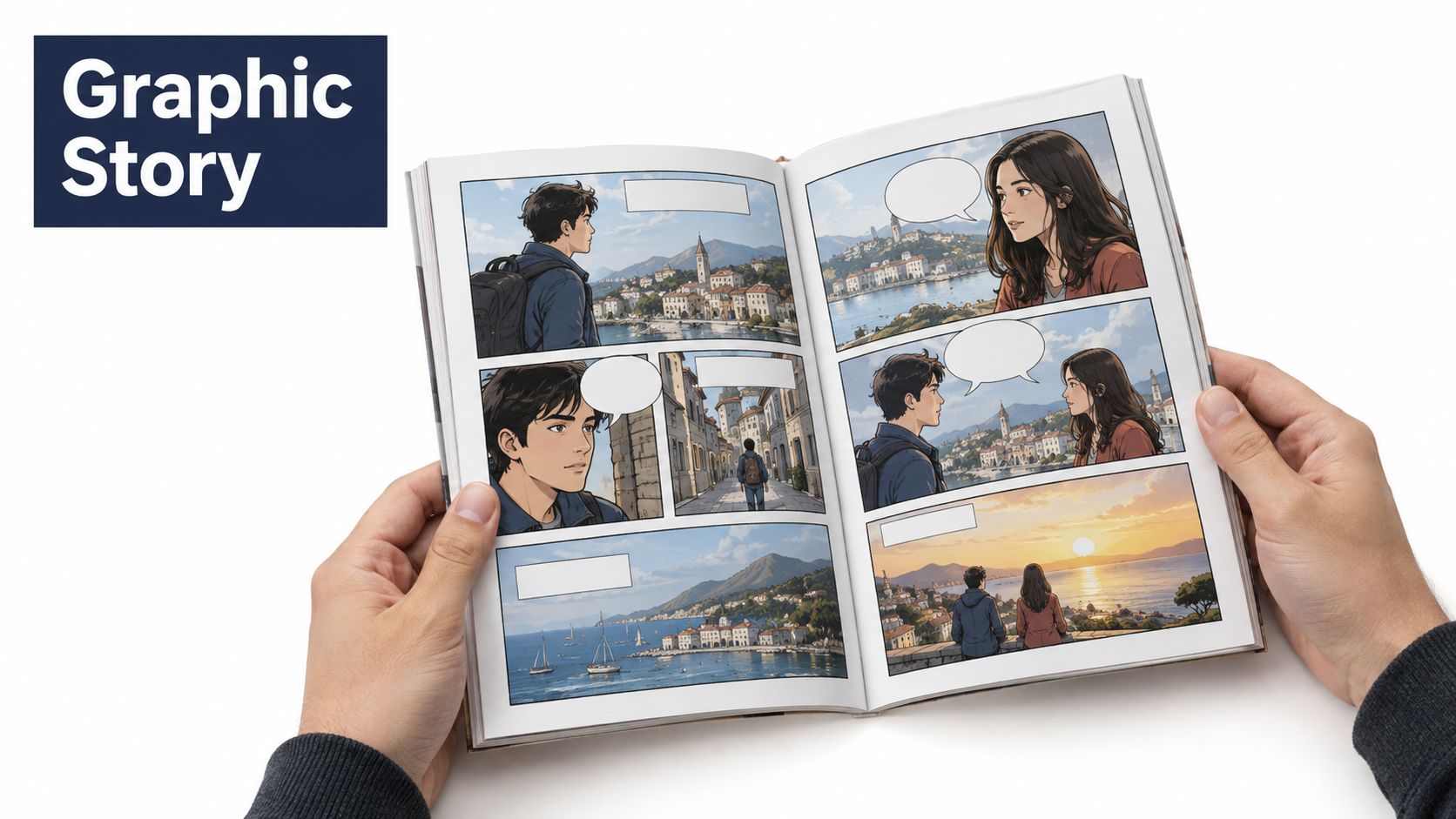
The first production mistake is commissioning finished illustrations before the story has been broken into pages. Write a page-by-page script and create thumbnail sketches first. Those small planning drawings reveal whether a conversation needs one panel or a full spread, whether a page turn creates a reveal, and whether the visual rhythm becomes repetitive.
More than an illustrator
A graphic project may need an illustrator, letterer, colorist, editor, and production designer. One person can handle several roles, but the responsibilities still exist. Lettering that looks attractive at full size may become unreadable in the final printed edition. Color files also need correct print preparation, including CMYK handling and the printer's required profile.
For authors who need help shaping the visual narrative, BarkerBooks' graphic novel creation service is relevant to the planning and production process.
A short animated or promotional treatment can help readers understand the visual world, but it shouldn't replace strong sequential pages. The book has to work when the reader holds it, turns pages, and controls the pace.
Launch-stage recommendation: Choose this format when images carry essential narrative information and you can budget for the complete art and lettering pipeline.
Budget-risk note: Illustration is usually the dominant cost and schedule risk. Reducing page planning often creates expensive redraws later.
7. Illustrated picture book for young readers and families
A picture book depends on the relationship between words and images. The text may be short, but the visual storytelling is not secondary. Page turns, spread design, character continuity, color, and quiet space all influence how a child experiences the story with an adult or independently.
This format suits early readers, family reading, classroom use, and bilingual publication. A strong picture book manuscript is usually concise enough to read aloud comfortably. Read it aloud yourself and listen for rhythm, repeated sounds, awkward phrasing, and places where the image should carry information instead of the text.
Design the page turn
Plan the manuscript with spreads rather than treating the text as one continuous block. A page turn can reveal a character, change the setting, deliver a joke, or create a moment of suspense. If the illustration repeats what the sentence already says, the book may feel visually flat.
Work with an illustrator who understands children's book composition and print production. The illustrator needs to know the trim size, bleed, binding, color expectations, and intended reading direction before creating final art. A bilingual edition requires even more planning because text length can change the balance of a spread.
Launch-stage recommendation: Use a fixed-layout print edition when the illustrations and page turns are essential. Add a carefully built fixed-layout digital edition only after testing text legibility on small screens.
Budget-risk note: The page count can look modest while illustration, revisions, lettering, and print proofs create a large production commitment.
8. Workbook, journal, or interactive guide
A workbook turns a book into something readers use repeatedly. Exercises, prompts, tracking pages, checklists, reflection spaces, and practical frameworks make the title suitable for coaching, education, professional development, creative practice, and self-help.
The key question is whether the reader can act on the content. A chapter that explains a method belongs in a conventional nonfiction book. A workbook needs a clear sequence, instructions, space to respond, and a visible connection between one exercise and the next.
Build for actual use
Test the exercises with real readers before final layout. Watch where they hesitate, misunderstand an instruction, or run out of space. A writing prompt that sounds clear to the author may require a full page for the reader. A checklist may work better as a detachable or printable resource than as a dense interior spread.
Binding affects usability. A workbook that must remain open on a desk may need spiral or lay-flat construction. A journal designed for handwriting needs enough contrast and writing space, not just attractive decoration. A companion PDF, video resource, or downloadable template can extend the product, but it should support the physical tool rather than compensate for poor page design.
Launch-stage recommendation: Choose this format when the reader must practice, record, plan, or measure something. Prototype the exercises before commissioning the final interior.
Budget-risk note: Interactive design adds testing and layout work. A standard bound book may cost less, but it can fail if readers can't keep it open or write comfortably.
9. Bilingual or dual-language edition
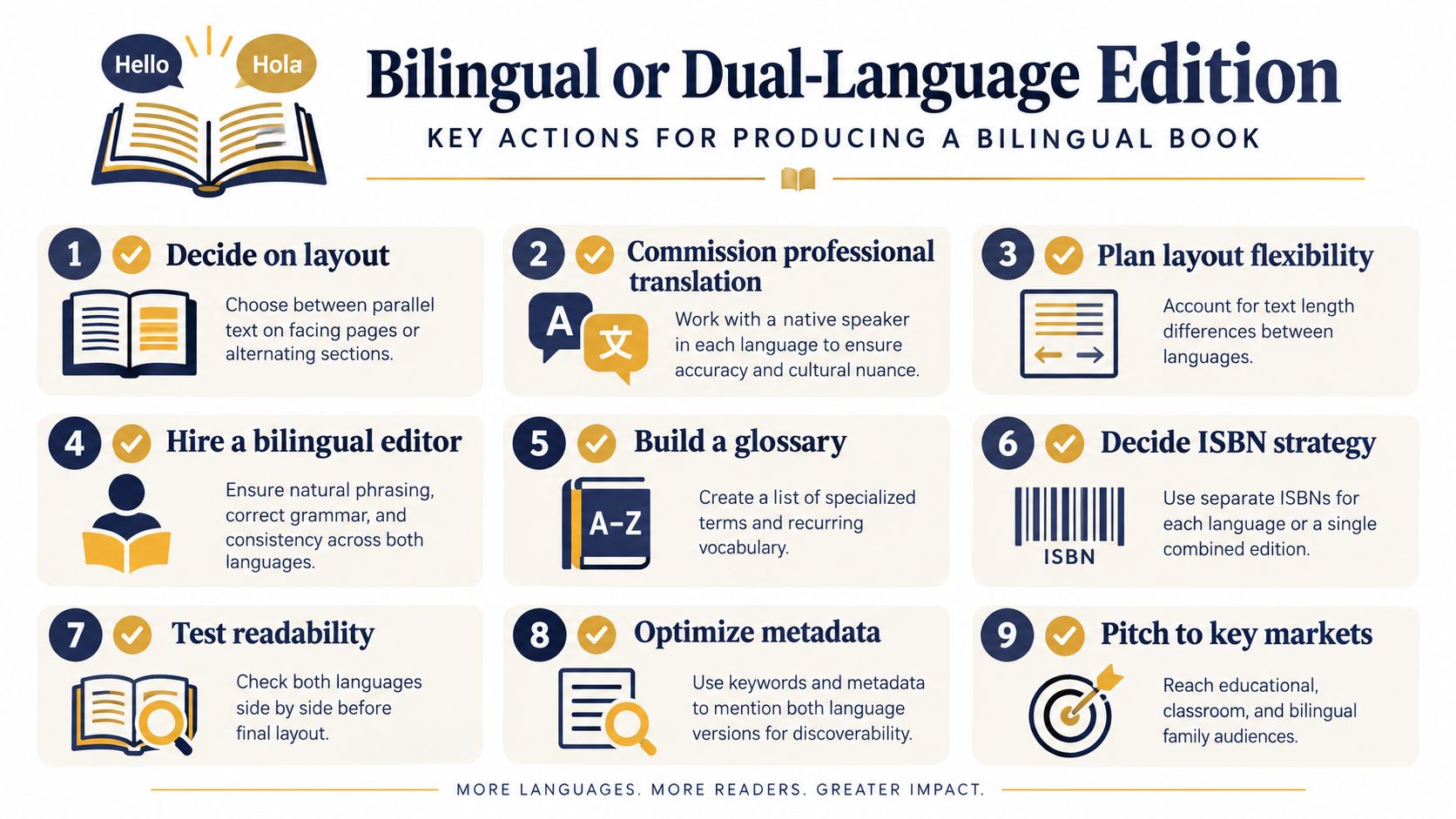
A bilingual edition reaches readers who move between languages at home, school, work, or community life. It can support language learners, heritage-language families, multilingual classrooms, and international audiences. The two languages may appear on facing pages, in alternating sections, or in separate editions bound as one volume.
Translation is only one part of the decision. A literal rendering may preserve the sentence but lose its tone, rhythm, cultural reference, or age-appropriate vocabulary. Use a native-speaking editor for each language and establish terminology before the full translation is locked, especially for technical, educational, or recurring concepts.
Choose the structure early
Side-by-side pages support comparison and language learning, but they consume space and can make a physical book thicker. Alternating sections create a cleaner reading flow, although readers may need to move between parts to compare passages. Separate language editions simplify page design and metadata, but they require distinct files, covers, and distribution decisions.
The cover, subtitle, description, keywords, and online metadata should make both languages visible to the intended audience. For practical guidance on this route, see Spanish-English bilingual book publishing.
Launch-stage recommendation: Choose a combined edition when comparison and shared reading matter. Choose separate editions when each language has a distinct market, reading direction, or design requirement.
Budget-risk note: Translation, bilingual editing, typesetting, proofreading, and metadata multiply the review process. Cutting language quality to protect the schedule undermines the reason readers chose the edition.
10. Large-print edition for comfortable access
A large-print edition removes a practical barrier for readers with low vision, aging eyes, or a preference for less visual strain. It can also support libraries and readers who find standard pages uncomfortable for long sessions. This isn't just a matter of increasing the font size and exporting the file.
Larger type changes the entire interior. Line spacing, margins, paragraph breaks, running heads, page count, and chapter openings all need review. A layout that feels balanced in a standard edition may become crowded or awkward when enlarged. Keep the text comfortable to scan, and verify that headings, page numbers, and navigation remain clear.
Make accessibility visible
Describe the edition accurately in its metadata and cover copy so readers can find the version intended for them. Distribution through library and accessibility channels may be especially relevant, but the book still needs a readable thumbnail, clear edition labeling, and a reliable physical proof.
Large print also works as part of a broader accessibility strategy. A reflowable EPUB can offer adjustable text, while audio provides another reading route. The best format depends on the reader's preference and circumstances, not on a single idea of what accessibility means.
Launch-stage recommendation: Add large print early for titles aimed at older readers, library users, or audiences likely to benefit from increased typography. For other books, release it after the standard edition has been proofed.
Budget-risk note: Enlarged typography can increase page count and printing expense. Poorly adjusted spacing can make the edition harder, not easier, to read.
Comparison of 10 Book Formats
| Format | Implementation complexity 🔄 | Resource requirements ⚡ | Expected outcomes 📊⭐ | Ideal use cases 💡 | Key advantages ⭐ |
|---|---|---|---|---|---|
| Ebook (Reflowable Digital Edition) | Low, formatting, metadata, validation | Low, ebook file, cover, metadata | Fast global distribution; variable per-copy revenue | Self-publishing, genre fiction, backlist | Low cost, quick updates, high royalties |
| Print Paperback (Trade Paperback) | Medium, print-ready PDF, proofing | Medium, printing, ISBN, distribution | Physical retail/library presence and steady sales | Bookstores, events, library circulation | Widely accepted; affordable for readers |
| Hardcover Edition | Medium–High, rigid binding, jacket, finishes | High, higher unit & shipping costs | Premium positioning; higher unit revenue | Launch editions, gifts, collectors | Prestige, durability, retail gift appeal |
| Audiobook | High, narration direction, studio production | High, narrator fees, studio time, editing | Expands audience; strong growth in listenership | Commuters, memoirs, popular fiction | Reaches non-readers; accessibility; bundling |
| Serialized Novel (Episodic Release) | Medium, schedule, episodic editing | Low–Medium, ongoing writing & promo time | Audience building and iterative feedback | Web platforms, audience growth, testing market | Builds loyal readers; lower upfront risk |
| Graphic Novel & Illustrated Comics | Very high, art coordination, lettering, layout | High, artists, colorists, print quality | Strong visual impact; crossover/adaptation potential | Visual storytelling, YA, adaptations | Appeals to visual readers; media potential |
| Illustrated Picture Book | High, fixed layout, image-text integration | High, illustrator fees, color printing | Strong early childhood & educational impact | Children's books, bilingual editions, schools | High visual appeal; strong gift and classroom demand |
| Workbook / Journal / Interactive Guide | Medium, interactive layout and UX | Medium, design, potential lay-flat binding | High engagement and repeat use; course tie-ins | Coaching, courses, self-help, education | Encourages action; supports products/services |
| Bilingual / Dual-Language Edition | High, translation, parallel-layout management | High, translation, bilingual proofreading, more pages | Access to multiple language markets; educational value | Language learning, multicultural families, classrooms | Expands reach; differentiates in market |
| Large Print Edition | Low–Medium, increase type size, spacing, reflow | Medium, higher page count and printing costs | Improves accessibility; library and institutional demand | Readers with low vision, seniors, libraries | Accessibility-focused; expands audience |
Match the Format to the Goal Before You Commit a Budget
Return to the finished manuscript on your desk. The question isn't which format looks most impressive. It's which edition gives the book the right reader experience at the stage you can support properly.
Start with the simplest decision. If the manuscript is a novel, memoir, or text-led business book, compare reflowable ebook and paperback first. An ebook offers adaptable reading and digital distribution, while paperback gives readers a physical object for shelves, events, libraries, and gifts. A print-first core can be sensible for authors who want a tangible edition, especially because print remains commercially important. In the United States, Circana BookScan recorded approximately 782.7 million print units sold in 2024, compared with about 778.3 million in 2023 according to the industry summary.
Then consider what your audience does when they aren't reading from a page. Digital audio and ebooks together represented 14.2% of total U.S. publisher revenue in 2025, with digital audio reaching $2.5 billion and ebooks reaching $2.2 billion, as reported by the Association of American Publishers. Those figures don't mean every author needs audio immediately. They do show why an audiobook can be a meaningful extension when your readers listen during commutes, exercise, work, or household tasks.
A serialized release makes sense when you can maintain a dependable schedule and your story benefits from anticipation. A hardcover works when premium presentation or gifting is central. A graphic novel or picture book requires a visual production system, not just a different cover. A workbook should give readers enough space and structure to act. Bilingual and large-print editions should begin with audience need, then guide the design and distribution choices.
Accessibility should enter the decision before production, not after publication. Pew Research data cited in industry reporting found that U.S. adults read across formats, with print, ebooks, and audiobooks each serving substantial audiences. That overlap supports a practical approach: build one strong core edition, then add the format that removes the next barrier for your readers.
Use the same discipline for promotion. A print event, retailer page, audiobook sample, classroom partnership, or bilingual launch needs assets suited to that channel. If you plan to share the release across several platforms, review these cross-posting tips for multiple platforms so the message stays consistent without becoming repetitive.
Before spending money, write down your top two format choices. Estimate the editorial, design, production, proofing, distribution, and promotional work for each. Then choose the option that matches your audience, your manuscript's actual structure, and the budget you can sustain through launch and revision.
BarkerBooks supports authors with format planning, editorial work, interior layout, cover design, multilingual publication, audiobook recording, and worldwide distribution. If you need help deciding between ebook, print, audio, bilingual, or interactive editions, visit BarkerBooks to discuss the production path that fits your manuscript and audience.