
Book marketing is the coordinated process of making a title discoverable, communicating its value, and converting reader interest into purchases or sustained readership. In a 2023 Canadian leisure-and-reading study, word-of-mouth led discovery at 28%, followed by bookstores at 27%, public libraries at 25%, social media at 22%, and online book retailers at 22%. The Canadian study allowed respondents to select up to three methods, so these figures overlap rather than represent exclusive shares.
Your manuscript is finished. The last typo has been corrected, the cover is nearly ready, and you're eager to put the book into readers' hands. Then an uncomfortable question appears: how will those readers find it?
Many authors assume marketing begins with a social post or a paid advertisement. In practice, those activities work best after the book has been positioned clearly, packaged professionally, listed accurately, and connected with the places where likely readers already search, browse, ask for recommendations, and exchange opinions.
Book marketing is therefore less like shouting into a crowded room and more like building a reliable path. Metadata attracts discovery, positioning explains relevance, reviews reduce uncertainty, and channel measurement shows what deserves more attention. Social media may form one part of that path, but it isn't the whole system.
From Finished Manuscript to Book Marketing Plan
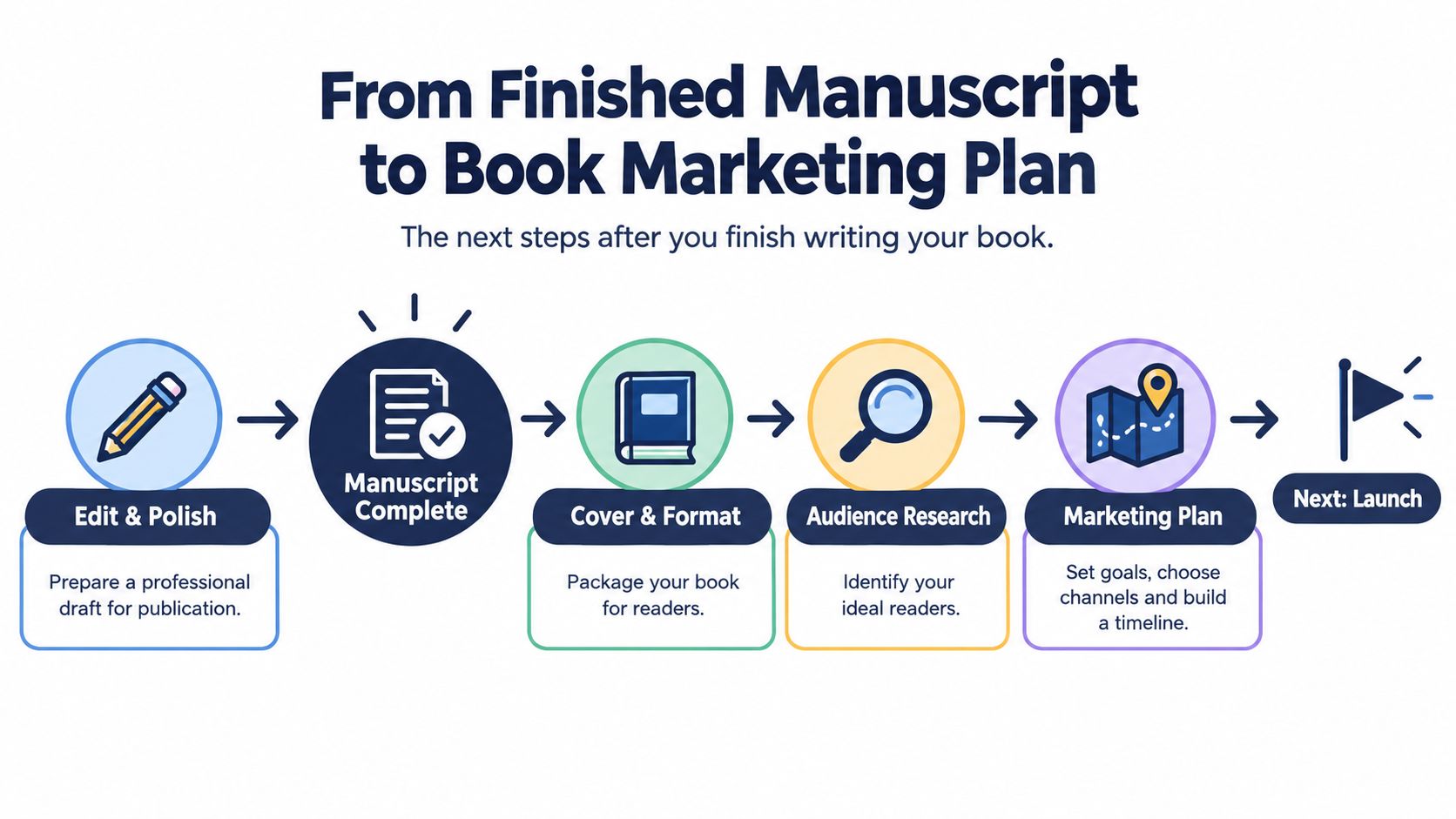
Finishing a manuscript feels like reaching the destination. In publishing, it's closer to arriving at the station before the journey begins. Readers can't respond to a book they can't find, can't understand from its presentation, or can't trust enough to purchase.
A useful definition of what is book marketing starts with three connected actions: make the title discoverable, communicate why it matters, and convert interest into a purchase or continued readership. That definition includes advertising, but it also includes editing, cover design, retailer metadata, audience research, reviews, email, publicity, partnerships, and follow-up.
Start with the reader, not the platform
Begin by describing the person most likely to choose your book. A professional nonfiction title might serve founders, teachers, clinicians, or managers. A novel might appeal to readers who want a particular genre, emotional experience, setting, or combination of familiar conventions.
Then prepare the book itself:
- Edit and polish: Remove distractions that can weaken confidence in the author.
- Package the book: Use a cover, title, subtitle, format, and description that signal the right reading experience.
- Research discovery language: Record the phrases readers use when discussing comparable books and problems.
- Set practical objectives: Decide whether success means purchases, sustained reading, professional leads, event invitations, or another outcome.
A written book marketing plan turns these decisions into a sequence rather than a collection of last-minute tasks. It also makes gaps visible before money goes into promotion.
Practical rule: Don't promote a book until you can explain who it's for, what promise it makes, and where those readers are likely to look for it.
Marketing should enter the publishing process before release, not after every foundational decision has been locked. When positioning, metadata, and presentation are settled early, promotion has a clearer message to repeat.
Why Book Marketing Is Not Just Social Media Promotion
An author can post every day and still watch sales stay flat. The problem is not effort. The problem is confusion about what marketing does. Posting is only one small part of it, and often not the part that helps a reader find, trust, and choose a book.

A reader rarely moves from a random post straight to a purchase. Book discovery works more like a chain of signals. Someone hears about a title from a friend, notices it in a bookstore, sees it mentioned in a library display, spots it in a newsletter, or encounters it through a community they already trust. Social platforms can support that process, but they do not replace it.
As noted earlier, the 2023 Canadian leisure-and-reading study found that word-of-mouth led discovery at 28%. Bookstores followed at 27%, public libraries at 25%, and both social media and online book retailers at 22%. Because respondents could choose up to three methods, those results describe overlapping behavior rather than one winning channel.
That changes the practical question an author should ask. A better starting point is, “Where does my reader already look for help, entertainment, or recommendations?” Marketing begins there.
Reach and trust do different jobs
Social media is useful for visibility. It can show your voice, give readers something to share, and help a timely or visually appealing book circulate. But impressions are not recommendations, and recommendations are not the same as purchases. Reach creates exposure. Trust reduces hesitation.
That trust often forms in places authors overlook:
- Advance readers: Early readers who can describe the book clearly to others.
- Book clubs: Groups that keep a title in active conversation.
- Libraries and bookstores: Browsing spaces where readers compare options and ask for guidance.
- Professional communities: Associations, newsletters, podcasts, and events tied to a nonfiction topic.
- Personal referrals: Readers who know exactly who else would care about the book.
For many first-time authors, these routes are stronger than a large follower count. A writer may have modest online visibility but solid access to a workplace network, a local community, a specialist audience, or a cultural group. A bilingual author may find that readers gather through institutions and community circles rather than on one dominant platform. Those audiences are not side paths. They may be the most believable way into the book.
The channel mix has also widened over time. Print publicity still matters, but it now sits beside retailer search, digital catalogues, email, video, social platforms, and virtual events. According to Nielsen BookData and GfK Entertainment reporting, fiction revenue increased in 14 of the 16 territories surveyed during the first eight months of 2024, while children's and young-adult books grew in nine regions. The lesson for authors is straightforward. Book marketing works best as a discoverability system, not as a posting routine.
How Book Marketing Works as a Discoverability System
Effective marketing follows a cause-and-effect chain. The book first needs accurate information attached to it. Readers then use search terms, categories, recommendations, and browsing behavior to encounter that information. The listing must match their expectations well enough to earn a visit, and the page must provide enough evidence to support a decision.
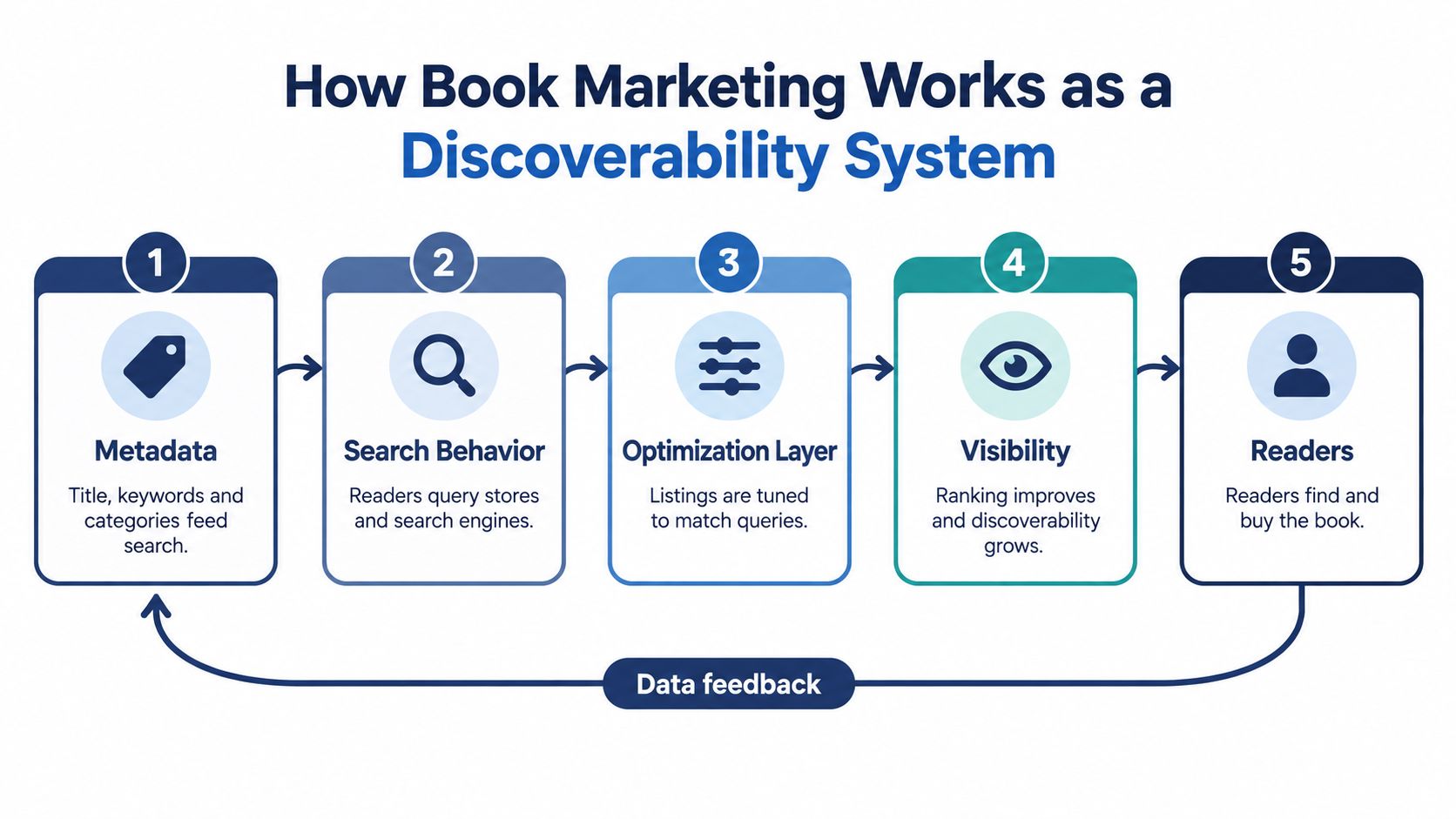
This is why metadata is more than administrative data entry. Nielsen BookData research identifies keywords, short and long descriptions, author biography, and reviews among the core descriptive-metadata elements that influence discovery and buying decisions. The same research found that 15% of books purchased in 2019 were discovered through online browsing and 14% through offline browsing.
The five parts of the chain
Metadata gives retailers, libraries, search systems, and readers the language needed to understand the book. It includes the title, subtitle, author name, categories, keywords, description, series information, format, and biography.
Search behavior reflects how readers look. They may search by genre, problem, audience, trope, comparable author, topic, or format. Your private description of the book matters less than the language readers use when seeking it.
Positioning clarifies the book's promise. A description should tell the right reader what kind of experience or benefit to expect without making claims the book can't support.
Conversion signals help resolve hesitation. A suitable cover, clear description, credible reviews, consistent author information, and accessible retailer links make the next action easier.
Feedback comes from behavior after launch. Search terms, page visits, reviews, sales patterns, and reader questions can reveal that the original positioning needs refinement.
You can apply book search engine optimization across retailer listings and author-owned pages. The aim isn't to force a book into every search. It's to make the title accurately visible in the contexts where qualified readers already look.
A book page should answer three questions quickly: What is this book, who is it for, and why should this reader continue?
Finalize the core metadata before launch, then keep a controlled record of the exact wording used across Amazon, Apple Books, Google Books, libraries, distributors, and the author website. Inconsistent details can fragment discovery and make the book harder to identify as one coherent product.
Choosing Book Marketing Channels for Your Audience
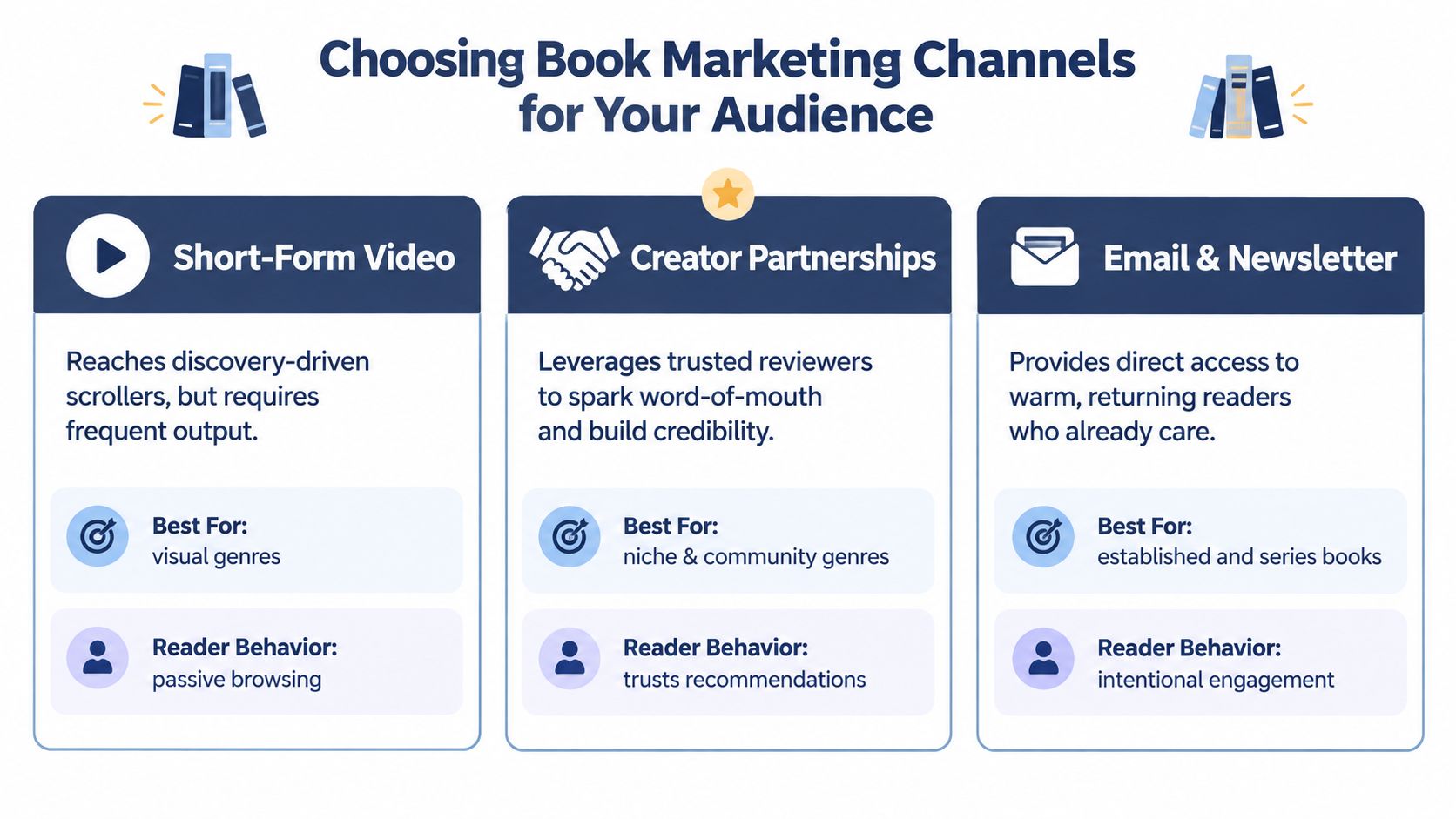
Channel selection should follow reader behavior, not the loudest trend. A platform may be popular and still be a poor use of time if your likely readers rarely use it to find books.
Nielsen BookData research on TikTok and books reported that social media and video sites accounted for 5% of book purchases discovered in 2021, rising to nearly 9% among readers aged 13 to 24. A separate survey of UK readers aged 14 to 25 found that 34% discovered new books on YouTube and 32% on TikTok, while 41% used friends' recommendations and 36% responded to physical-bookshop exposure.
Those figures don't mean every author should abandon social media or move immediately to video. They show why a channel portfolio needs context.
Match the channel to the job
| Channel | Useful when | Watch closely |
|---|---|---|
| Short-form video | The genre or subject is visual and readers discover through browsing | Views that don't lead to visits or sign-ups |
| Creator partnerships | Trusted reviewers, hosts, or community leaders already reach your audience | Relevance and audience fit, not follower count alone |
| Email and newsletters | You want a direct relationship with interested readers | Sign-ups, clicks, and later purchases |
| Bookstores and libraries | Readers value physical browsing or local recommendations | Requests, events, conversations, and availability |
| Search and retailer listings | Readers already look for the topic, genre, or comparable titles | Product-page visits and conversion |
A book aimed at younger readers or a highly visual genre may deserve short-form video testing. A professional guide may gain more from a podcast conversation, industry newsletter, conference partnership, or targeted email. A literary novel may benefit from reviewers, book clubs, bookstores, and reader recommendations.
Start with one primary channel and one supporting channel. Give each a distinct job. A video may create initial interest, while an optimized retailer page captures the visit and reviews support the decision. An email announcement can bring warm readers back when the book is available.
For retailer-specific execution, authors may also need guidance on marketing a book on Amazon. The important point isn't to appear everywhere. It's to learn which path brings qualified readers, then improve that path before adding another.
Building a Practical Book Marketing Plan
A practical plan follows the reader's journey from first recognition to continued interest. Consider an author preparing a nonfiction book for a defined professional audience. The author doesn't begin by buying broad advertising. The first task is to make the book understandable and credible.
Before release
The author writes a concise positioning statement, checks comparable titles, confirms the audience, and prepares the title, subtitle, categories, keywords, description, biography, cover, and format. Early readers receive access under clear review expectations, while the author contacts relevant communities, organizations, newsletters, bookstores, libraries, and event hosts.
The author also prepares a landing page with a clear description, retailer links, an email sign-up option, and a useful reason to stay connected. If email delivery is unfamiliar, resources covering top email warmup tools can help explain how senders prepare a new outreach process responsibly.
Around launch
At launch, the author doesn't need a new message for every platform. The central promise remains consistent, but the expression changes:
- Email: Announce availability and explain who will benefit.
- Retailer page: Present the strongest cover, description, categories, keywords, and reviews.
- Community outreach: Offer a discussion, interview, event, or resource relevant to the audience.
- Social content: Share a concise idea, excerpt, visual, or reader question.
- Publicity: Pitch a timely angle connected to the book's subject.
The sequence matters. Promotion that sends people to an unclear or incomplete listing creates friction. Promotion that follows strong preparation gives each visit a better chance of becoming a purchase, sign-up, review, or referral.
After launch
Marketing continues through reader follow-up, additional reviews, refreshed descriptions, partnerships, events, and measured experiments. The author records which messages attract qualified visits and which audiences respond, then adjusts rather than repeating every activity indefinitely.
International publishing reinforces this need for coordination. Fiction revenue grew across most of the territories surveyed in the cited 2024 report, while children's and young-adult books also expanded across multiple regions. A title may need different retailer pages, language choices, partnerships, and promotional messages in different markets, even when the underlying positioning remains stable.
Measuring Book Marketing Results Without Vanity Metrics
Followers and views can indicate attention, but they don't prove that the right readers found the book. A small campaign that produces qualified visits and purchases may be more useful than a large campaign that attracts curiosity without action.
Track the journey in stages:
- Discovery: Which channel produced relevant conversations, search appearances, or product-page visits?
- Interest: Did visitors join the email list, request information, attend an event, or click a retailer link?
- Conversion: How often did a retailer visit become a purchase or another defined action?
- Value: Did readers leave reviews, recommend the book, continue into a series, return for another title, or create a professional opportunity?
- Efficiency: What did each acquired reader or qualified action cost?
Use distinct links, retailer-specific attribution codes, or campaign landing pages where possible. Keep a baseline period before changing several variables at once. If you alter the cover, description, audience, and advertisement simultaneously, you won't know which change affected the outcome.
A 2025 survey of 2,065 authors, creators, publishers, and business owners identified content discoverability and book marketing as leading challenges. It also found that higher-earning respondents generally had at least 1,000 email subscribers and/or social followers and were more likely to use paid advertising. That association doesn't establish that audience size or paid ads alone caused higher earnings.
Measure the decision, not the applause. A view matters when it helps a qualified reader take the next useful step.
Authors working with several campaigns can explore marketing attribution tools for media buyers to understand how different touchpoints contribute to results. Small-budget authors don't need an elaborate system on day one. A spreadsheet with campaign name, date, link, visits, sign-ups, conversions, cost, and observations can create a valuable feedback loop.
Scale only after a message proves it can attract the intended audience and move readers toward the defined outcome. If the objective is professional authority, track qualified inquiries or speaking invitations. If the objective is commercial fiction, track purchases, reviews, and read-through. The correct metric depends on the book's purpose.
How BarkerBooks Supports Author Marketing
Marketing becomes easier when the publishing foundation doesn't introduce avoidable friction. BarkerBooks supports authors with services including proofreading, editorial editing, ghostwriting, cover design, interior layout, ISBN registration, copyright protection, and global distribution through platforms such as Amazon Kindle, Apple Books, Barnes & Noble, and Google Books.
Those services matter to marketing because each one affects the reader's path. Editing supports confidence, cover design communicates genre and tone, formatting improves presentation, and consistent publishing information helps retailers and libraries identify the title accurately. Author landing pages, multilingual publication, audiobook recording, and targeted advertising campaigns can extend that path for authors with suitable goals.
BarkerBooks reports having published over 7,500 authors and serving readers in more than 91 countries. Authors considering professional support should still ask for a clear scope of work, ownership details, delivery expectations, reporting arrangements, and the exact channels included in a package.
The right support fills operational gaps. It doesn't replace audience definition or strategic judgment, but it can give an author a cleaner product page, coordinated distribution, stronger presentation, and a more manageable launch process.
Key Takeaways for Authors Starting Their Marketing Journey
The answer to what is book marketing is broader than “promoting a book online.” It's a coordinated discoverability system that connects the book's presentation with reader behavior, trusted recommendations, retailer search, community activity, and measurable follow-up.
Keep these priorities in order:
- Define the reader: Describe the audience precisely enough to choose relevant language and channels.
- Position the promise: Explain what the book offers and why the intended reader should care.
- Prepare the metadata: Make titles, descriptions, keywords, categories, biography, and series details accurate and consistent.
- Build trust: Encourage honest reviews, reader discussion, professional recommendations, bookstore visibility, library interest, and useful partnerships.
- Choose selectively: Start where qualified readers already search, browse, or exchange recommendations.
- Measure movement: Watch visits, sign-ups, conversions, reviews, referrals, and cost per acquired reader instead of relying on attention alone.
- Test before scaling: Use low-cost outreach to learn which message and audience respond before increasing paid promotion.
- Keep going: A launch is an important moment, not the entire life of the book.
Don't wait for a viral post to solve a positioning problem. A clear book, accurate metadata, credible signals, deliberate channel choices, and steady measurement give authors a more dependable route to readership.
BarkerBooks offers end-to-end publishing support, including editorial work, cover and interior design, distribution, ISBN and copyright services, author landing pages, and targeted advertising options. Visit BarkerBooks to discuss how professional publishing support can turn your manuscript into a more discoverable, market-ready book.