
Proofreading is the final visual inspection of a manufactured car, while editing is the engine repair, bodywork, and assembly that happen before it rolls off the line. In a major copyediting study, incorrect or missing references made up 42.7% of recorded changes, while typographical, grammatical, and stylistic corrections accounted for 34.5%, so a manuscript can be technically clean and still need substantial editorial work.
You may be at the point where your book feels finished. The chapters are written, the cover is taking shape, and publication is close enough to feel real. Then you spot a character's name spelled two ways, a chapter that repeats information from an earlier one, or a reference that points to the wrong source. These errors are rarely dramatic while you're drafting. They become expensive when readers, reviewers, or clients find them after publication.
The practical problem is usually not a lack of effort. Authors often buy the wrong service because proofreading and editing sound interchangeable. They aren't. One service checks the final product for residual surface errors. The other may reshape the manuscript, clarify its argument, protect continuity, and prevent polished weaknesses from reaching the page.
Understanding Proofreading and Editing Differences
An author once sent a nearly finished book for what they called “a quick proofread.” The sentences looked smooth, the spell-checker had found little, and the launch date was already fixed. A closer review revealed that the central argument changed halfway through the book, two chapter summaries contradicted the main text, and several sources were incomplete. Correcting commas would have made the pages cleaner, but it wouldn't have made the book reliable.
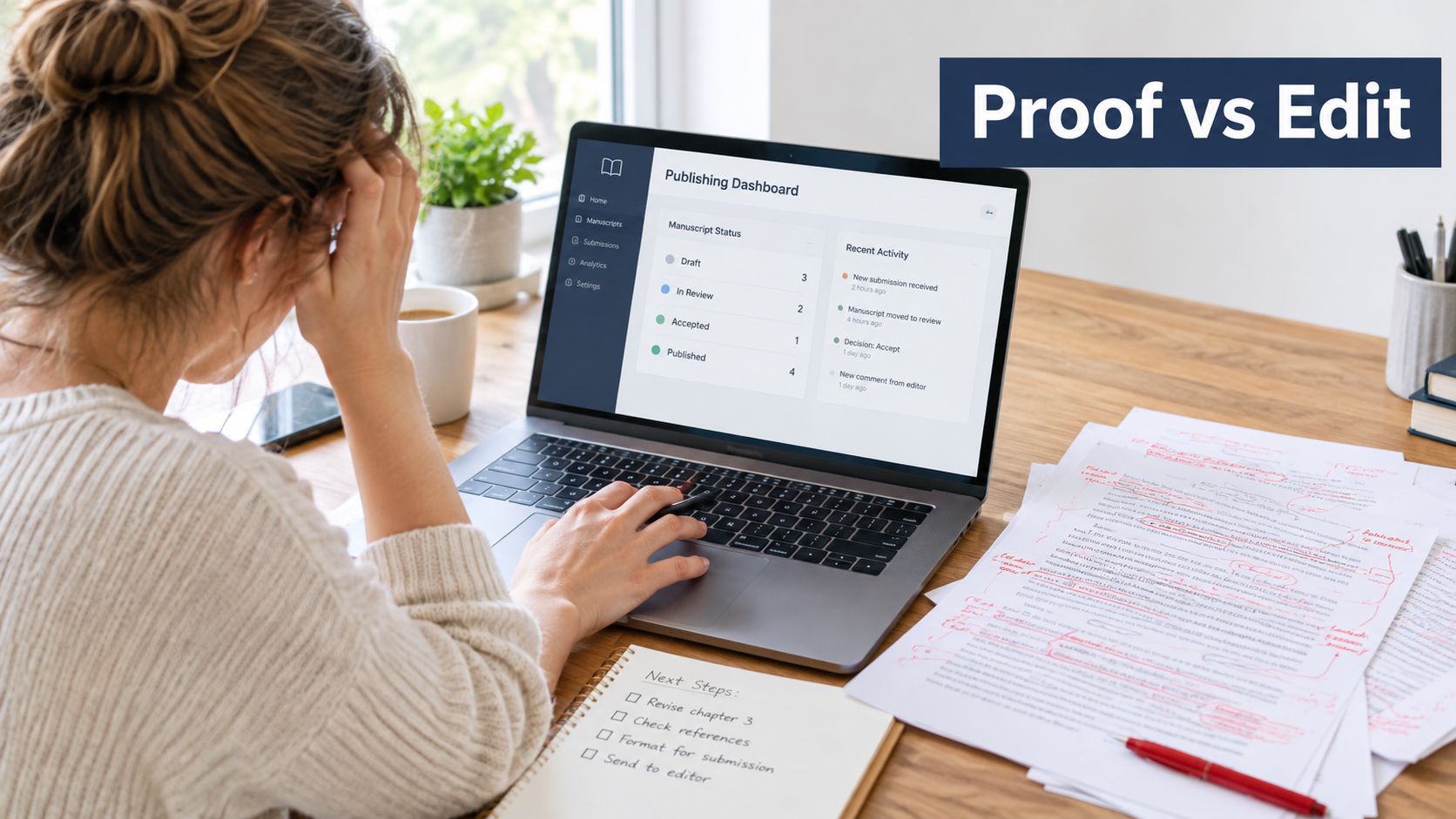
Editing works on the manuscript. Proofreading works on the final file. An editor can question chapter order, remove repetition, identify a weak transition, repair an unclear sentence, standardize terminology, and flag a factual inconsistency. A proofreader normally receives typeset pages or a final digital-book file and checks what remains, including typos, punctuation slips, spacing, page elements, captions, headings, and layout problems.
That distinction matters because the cost of an error depends on when you find it. Discovering that a chapter needs restructuring before copyediting may delay the schedule. Discovering it after design, formatting, marketing, and publication can force several rounds of paid rework. Proofreading a structurally unfinished manuscript is like inspecting the paint on a car whose engine still needs rebuilding.
A research-based distinction
The difference isn't just industry jargon. A historical study examined 189 articles across 23 academic journals and compared author manuscripts with the versions published by the journals. The analysis found that incorrect or missing references represented 42.7% of recorded changes, while typographical, grammatical, and stylistic corrections represented 34.5%. Missing data and changes that altered meaning made up additional categories of editorial work, as reported in the Scholarly Kitchen analysis of copyediting and repository manuscripts.
Those findings explain why a spell-checker isn't an editorial plan. Copyediting verifies information, consistency, clarity, references, and meaning, not only visible mistakes. Proofreading remains essential, but it belongs near the end, after the text and design have stabilized.
If you're unsure which service matches your manuscript, compare your needs with this practical guide to proofreading versus editing. The question isn't whether your book needs “editing” in the abstract. The question is which layer can fix the errors you have.
The Four Layers of Professional Book Editing
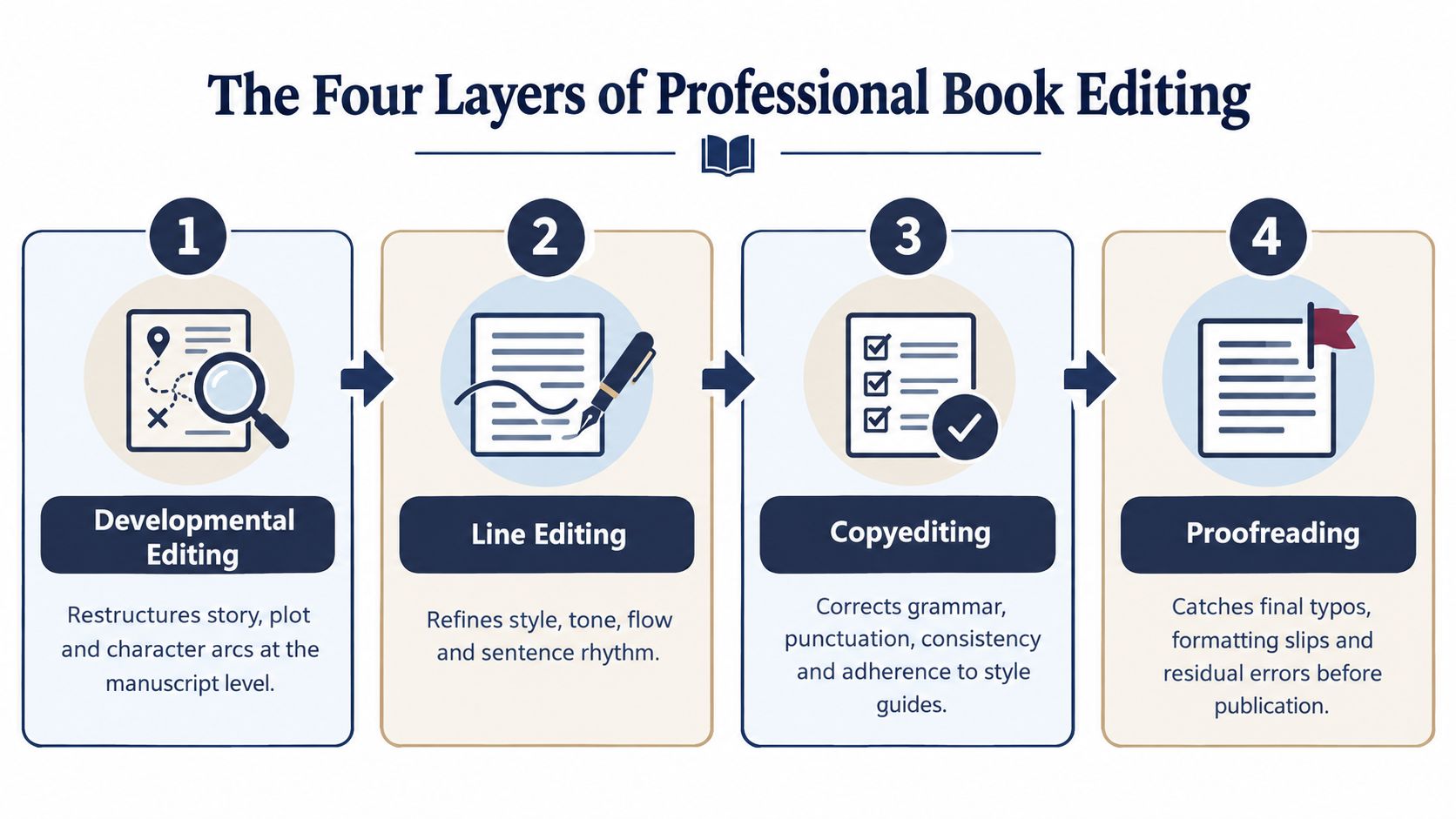
Professional book preparation works best as a sequence, not as one undifferentiated service. Each layer solves a different class of problem, and the order protects your budget. You don't want a copyeditor perfecting paragraphs that a developmental editor will later cut, or a proofreader correcting pages that still need to be redesigned.
Developmental editing
This is the manuscript-level diagnosis. For fiction, it may examine plot logic, character motivation, pacing, scene order, and the relationship between setup and payoff. For nonfiction, it may test the argument, chapter sequence, evidence, audience fit, and whether each section earns its place.
A developmental editor might tell you that the strongest material appears too late, that a key concept needs earlier explanation, or that several chapters repeat the same promise. Those aren't proofreading corrections. They affect the architecture of the book.
Line editing
Line editing focuses on how the manuscript sounds and moves. It examines voice, rhythm, transitions, tone, word choice, repetition, and sentence-level emphasis. A line editor can make a passage less mechanical without sanding away the author's personality.
This layer is especially useful when the ideas are sound but the reading experience feels flat, abrupt, inflated, or inconsistent. It isn't a license to impose one editor's preferred style. The work should make the author's intended voice easier to hear.
Copyediting
Copyediting handles correctness and consistency in the stabilized manuscript. It may address grammar, punctuation, usage, capitalization, spelling, terminology, internal references, citations, dates, numbers, and the chosen style guide. A copyeditor also creates or maintains a stylesheet so intentional choices don't look like accidental inconsistencies.
The historical research cited above is useful here because it shows how much editorial work concerns references and missing information rather than typography alone.
Proofreading
Proofreading comes after typesetting or ebook production. The proofreader checks the actual reading surface, not only the editable manuscript. That includes residual typos, repeated words, broken headings, inconsistent page numbering, awkward line breaks, missing captions, and navigation or formatting problems.
Research on scholarly editing reinforces the need for staged review. One study reported that an initial editorial stage rejected nearly 15% of papers that had already passed an earlier editorial check, while 47.2% of papers reaching the head copyeditor were returned to contributors for revision. The editing process required an average of nearly nine rereads, according to the International Scholarly and Educational Consortium study.
Practical rule: If the structure may change, start with developmental work. If the structure is stable but the prose is uneven, consider line editing. If the text is clear and stable, copyediting may be appropriate. Use proofreading only when the final pages are ready.
Authors who want a closer look at the first layer can review what developmental editing involves. The right service prevents both forms of waste: paying for detailed corrections that won't survive revision, and paying for a final check that can't solve deeper problems.
Why Human Eye Catches What Software Misses
Grammar software is useful, but it doesn't read like an editor. It compares patterns, identifies probable violations, and highlights language that resembles known errors. A human reviewer asks a different question: Does this sentence mean what the author intends in this particular book?
That difference becomes clear with context-dependent mistakes. A correctly spelled word can still be the wrong word. A grammatically valid sentence can break a character's voice, contradict the timeline, misuse a technical term, or turn an intentional ambiguity into an accidental one. Software may flag a repeated phrase without knowing that the repetition is a deliberate motif.
An experiment involving 80 participants found that typographical errors were detected more accurately than grammatical errors, with lexical or spelling errors between those categories. The study measured detected errors, false detections, and detection time, showing that proofreading depends on error type and cognitive load, as documented in the experimental research on proofreading performance.
A safer working sequence
Use technology to reduce mechanical workload, then give humans the decisions that require judgment.
- Stabilize the manuscript. Finish major research, chapter order, plot revisions, and author changes before commissioning detailed sentence work.
- Run a mechanical pass. Use tools such as Microsoft Editor, LanguageTool, or ProWritingAid to identify spelling, repeated words, punctuation patterns, and possible consistency issues.
- Review meaning manually. Check names, chronology, references, technical language, cultural context, characterization, and claims against the manuscript's purpose.
- Copyedit the approved text. Apply the agreed style, terminology, grammar, citation conventions, and internal consistency rules.
- Typeset or convert the book. The production file can introduce new errors that weren't present in the manuscript.
- Proofread the final pages. Inspect print-ready pages or the ebook file, not merely the original word-processing document.
Software is strongest when the rule is visible and repeatable. It can search for inconsistent capitalization or identify a likely typo across a long manuscript. It is weakest when the answer depends on intention, audience, tone, or evidence.
A tool can tell you that two sentences differ. It can't reliably tell you whether the difference is a continuity error or a deliberate change in perspective.
Skipping human review because an application reports a clean document creates a false sense of completion. The software has checked what it knows how to check. It hasn't accepted responsibility for the reader's understanding.
The Role of AI in Modern Manuscript Preparation
AI can help authors prepare a manuscript, but its safest role is acceleration rather than authorship. Recent survey data presents a divided picture. About 45% of 1,229 authors reported using generative AI, while 48% said they didn't use it and didn't plan to, according to the author survey published by Gotham Ghostwriters. A separate survey of 1,481 working writers found that 61% used AI, reported an average productivity increase of 31%, and that only 7% published AI-generated text, from the same source.
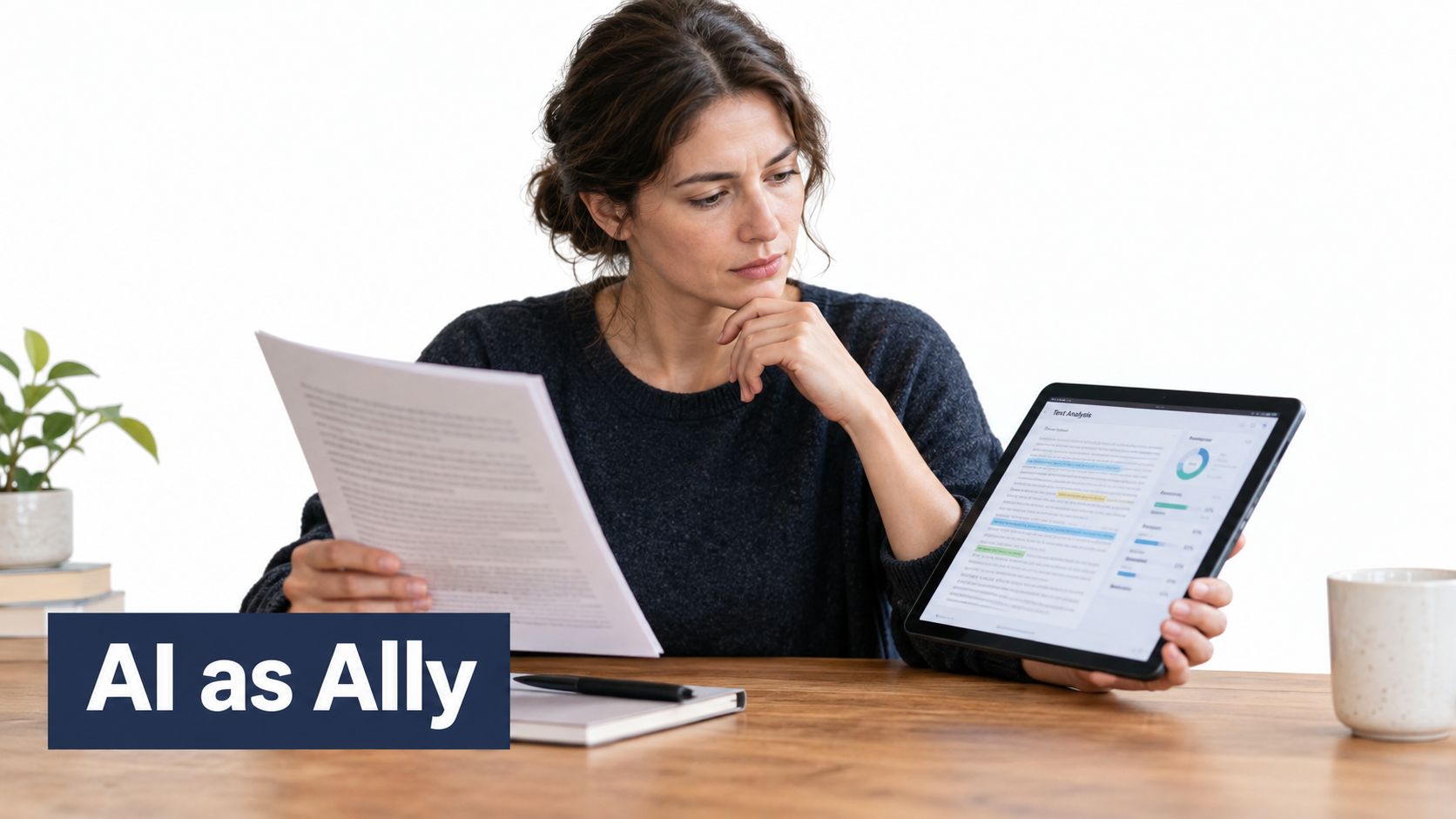
The useful conclusion isn't that every author should adopt AI or reject it. The evidence suggests that many writers use these tools to move faster while retaining human control over the final work. That distinction protects voice and reduces the risk of publishing fluent but inaccurate material.
Assign AI the repeatable work
AI and conventional software can assist with tasks such as:
- Repetition checks: Find recurring phrases, duplicate explanations, and overused transitions.
- Consistency audits: Compare character names, terminology, capitalization, spelling preferences, and section labels.
- Developmental diagnostics: Ask for possible gaps in a chapter's logic, unanswered questions, or unclear audience assumptions.
- Variant review: Generate alternative phrasings for a sentence you already understand, then decide whether any preserve your intent.
Authors working with research-heavy manuscripts may also find value in resources that help them streamline research with AI, provided they verify every source and conclusion themselves.
AI shouldn't make the final call on cultural meaning, ethical implications, factual judgment, characterization, or market positioning. It may produce a confident explanation that cites a source incorrectly, smooth a distinctive voice into generic prose, or “fix” a sentence whose unusual construction carries narrative purpose.
For a practical test, accept a suggested change only if you can answer three questions: What problem does it solve? What evidence supports the change? Does it sound like the author of this book? If you can't answer them, leave the sentence for human review.
The following video offers another perspective on using AI during manuscript preparation. Treat its suggestions as workflow input, not as a substitute for an accountable editor.
A responsible workflow keeps an audit trail. Save the original passage, record substantial AI-assisted changes, verify claims independently, and tell your editor what tools touched the manuscript. Transparency helps the editor distinguish intentional phrasing from accidental machine revision.
Beyond Typos and Reader Impact
A book can be grammatically correct and still be difficult or impossible for some readers to use. Accessibility begins with editorial decisions about structure, wording, headings, image descriptions, links, tables, navigation, and ebook production. It isn't merely a design adjustment applied after the words are finished.
A heading that describes the topic clearly helps screen-reader users find information. A meaningful alternative text description gives context when an image isn't visible. A logical reading order prevents a digital edition from presenting a caption, sidebar, and body paragraph in a confusing sequence. Plain language can improve access where the subject and audience allow it, although simplification shouldn't erase necessary technical meaning or literary texture.
Accessibility needs its own review
A 2025 systematic review screened 1,618 studies and analyzed 74 on ebook accessibility. Its recommendations included accessibility by design, EPUB 3 and WCAG standards, and workflows that combine automated checks with expert review, as summarized in the publishing fairness analysis from PEN America. The same analysis reports that only 2.4% of PDFs demonstrate full accessibility compliance.
Those figures show why “no typos” is too narrow a definition of quality. A proofreader may catch a missing period while overlooking an ebook's broken heading hierarchy or an image description that communicates nothing useful. The production format changes what readers can access.
A focused accessibility review can examine:
- Structure: Semantic headings, logical order, lists, tables, and consistent navigation.
- Language: Unnecessary ambiguity, unexplained abbreviations, and dense instructions where clarity matters.
- Images: Whether alternative text conveys the image's purpose rather than merely naming its subject.
- Digital files: EPUB validation, link behavior, reflow, keyboard access, and screen-reader presentation.
- Print choices: Legibility, spacing, contrast, and layout decisions that affect readers with visual or reading difficulties.
“Error-free” describes the text. It doesn't automatically describe the reading experience.
Accessibility also has a business dimension. A reader who cannot move through an ebook, interpret a diagram, or follow its structure may abandon it regardless of the prose quality. Authors publishing internationally should ask providers whether accessibility is included in the editorial and production brief, rather than assuming a standard proofread covers it.
The best approach combines automated validation with human inspection. Software can detect technical conditions. A reviewer can judge whether the content remains understandable, whether headings reflect the actual hierarchy, and whether an image description serves the reader.
How to Choose the Right Editing Provider
Choose an editor by manuscript risk, not by the most attractive label or the lowest quote. A finished novel with stable structure may need copyediting and proofreading. A nonfiction proposal with a weak argument needs developmental attention first. A translated or bilingual manuscript may need language editing that preserves meaning and cultural voice before anyone begins a final proof.
Ask prospective providers to identify the layer they recommend and explain what it will not cover. A responsible quote should distinguish developmental editing, line editing, copyediting, proofreading, formatting, fact-checking, and accessibility review. If one low-cost service promises to solve every problem in a single pass, ask how it can examine structure, sentence style, references, and final layout with equal care.
Questions that expose the fit
- What will you deliver? Look for a marked-up file, clean file, editorial letter, stylesheet, query list, or proof report where relevant.
- What stage is your manuscript in? An editor should ask about revisions, design status, genre, target audience, and publication format.
- How do you protect voice? Request a sample edit that shows changes and comments, not merely a polished paragraph.
- Who handles final pages? Proofreading should happen on the typeset or digital-book file when layout matters.
- What happens when the manuscript needs deeper work? The provider should be willing to recommend a different layer rather than force a proofreading brief onto a structurally weak book.
- How are facts and references handled? Clarify whether the service verifies them, flags them, or leaves them to the author.
A sample edit is more informative than a page count alone. Look at whether the editor explains decisions, notices continuity, respects deliberate style, and identifies risks that automated software wouldn't understand. You aren't buying a number of corrections. You're buying a better reader outcome.
An independent study of 584 U.S. adults compared edited and unedited workplace and public-facing materials, measuring readability, comprehension, attention, accuracy, credibility, and willingness to read more from the same source. The study found that combining developmental, stylistic, and copyediting improved reader perceptions for work-related content, while that deeper approach was the only tested approach producing a significant improvement in overall reader perception for material read mainly for interest or enjoyment, according to the ACES research summary.
Budget constraints don't mean you must skip all professional work. They mean you should sequence it. Spend first on the layer that could prevent the largest downstream loss, then use software for mechanical preparation, and reserve a final proof for the production file. Tools for coordinating assignments, versions, comments, and approvals can also support an organized process, especially when several people are involved, such as these editorial workflow tools.
BarkerBooks is one provider that offers manuscript editing services across editorial layers, alongside publishing support. Evaluate its scope, deliverables, sample work, schedule, and fit against the same criteria you'd apply to any editor.
BarkerBooks can help authors match a manuscript with the appropriate editorial layer, from developmental and copyediting support to final proofreading and publishing preparation. Review the available services at BarkerBooks, describe your manuscript's current stage, and request guidance before investing in the wrong type of review.