
A copyright page is the publication-information page usually placed on the reverse side of a book's title page, often called the verso. It records ownership, publication, edition, and rights information, but it isn't what creates copyright, which generally arises automatically when an original work is fixed in a tangible form.
The most popular advice about this page is also the most misleading. Many guides present it as a block of legal boilerplate that protects your manuscript once you print the copyright symbol. That makes the page sound more powerful than it is and leaves first-time authors confused about what the notice accomplishes.
A better way to understand it is as a public-facing rights and metadata record. It tells readers, booksellers, libraries, distributors, and potential licensees who is connected to the work, which edition they're holding, and where to direct questions about reproduction or permissions. The page doesn't replace registration, contracts, licenses, or evidence of creation. It helps people identify and act on the information surrounding your book.
What a Copyright Page Actually Is and What It Is Not
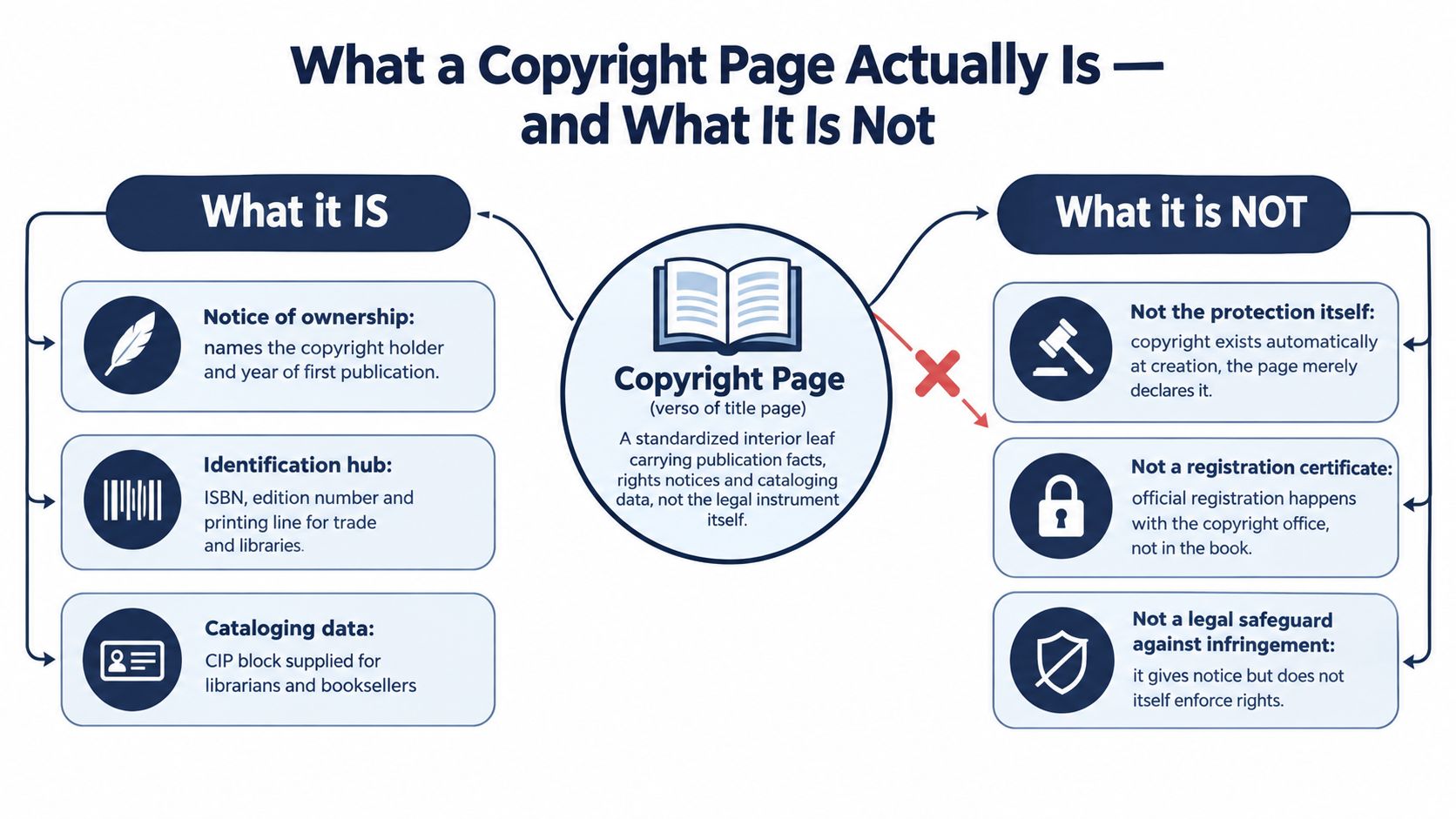
A copyright page is a standardized interior leaf, normally placed on the title verso, the reverse side of the title page. It commonly carries the copyright notice, copyright holder, first-publication year, publisher or imprint, edition details, ISBNs, printing information, permissions, and cataloging data.
The page's appearance can vary. A traditionally published novel may contain a dense block of cataloging and production information, while a self-published ebook may use a much shorter version. Both can serve the same basic purpose, which is to make the book's ownership and publication identity clear.
The misconception that causes the most trouble
Printing © 2025 Jane Doe inside your book doesn't switch copyright protection on. Under modern U.S. copyright principles, protection generally begins when an original work is fixed in a tangible form. A copyright page and registration are separate from that underlying protection, as the historical development described by the U.S. Copyright Office's explanation of the 1909 Copyright Act helps clarify.
Registration can still matter because it creates an official record and may provide important enforcement advantages. The page itself isn't a registration certificate, and an ISBN doesn't prove ownership. An ISBN identifies a particular book format or edition, while a Library of Congress control or cataloging record concerns bibliographic identity.
Practical rule: Treat the copyright page as a declaration and control document, not as a protective shield.
What the page does accomplish
The notice names the person or organization claiming rights. The edition line distinguishes one publication state from another. The ISBN helps commerce and library systems identify the specific format. Permissions and credits show how third-party material relates to the book.
That information gives real-world users a reliable starting point. A library can match a catalog record to an edition. A distributor can distinguish a paperback from an ebook. A rights professional can see whom to contact before licensing an excerpt.
Authors who work with product, branding, or marketplace issues may also benefit from broader guidance on copyright, design, and patent issues for Amazon sellers. The key lesson remains the same: a notice communicates a claim, but communication isn't the same as registration or enforcement.
The Essential Elements That Appear on the Page
Build the page from the information that identifies your edition, then add only the rights and credits that genuinely apply. You don't need to copy every dense line from a major publisher's book.
Start with the central notice:
© 2025 Jane Doe
That line contains the copyright symbol, the year of first publication, and the name of the copyright owner. You can identify an individual author, a pen name, or an organization, but make sure the name reflects the actual rights arrangement. If a publishing company owns the rights, don't casually substitute the author's name without checking the contract.
Add a rights statement beneath it:
All rights reserved.
You can expand this with a plain-language restriction covering reproduction, storage, scanning, recording, transmission, or distribution outside permitted uses. Avoid suggesting that the sentence creates protection. It communicates that you aren't granting those permissions automatically.
An edition line might read:
First Edition
For a revised version, use wording such as:
Second Edition, revised and expanded
A printing statement is different from an edition statement. A new printing can reproduce the same edition, while a new edition generally signals a meaningful change to the publication. If you use a printing line, make sure it reflects the production record rather than guessing from a template.
Information that identifies the product
List the ISBN for the format being published:
ISBN 978-1-23456-789-0, paperback
The number in this example is illustrative, not a number to assign to a real book. In practice, each distinct format or edition generally needs its own ISBN. The International ISBN Agency's guidance on ISBN scope and assignment explains why format-specific identification matters.
You may also include publisher information:
Published by North Harbor PressLondon, United Kingdomnorthharborpress.example
Only include contact information you're prepared to maintain. A permissions email or publisher address can help a rights holder reach the correct person, but it shouldn't expose private information unnecessarily.
Conditional blocks and credits
A Library of Congress CIP block belongs on the page when it has been supplied for the publication. Don't invent one or recreate it from memory. Permissions notices, image credits, translator acknowledgments, cover credits, interior design credits, and disclaimers belong there when the book's circumstances require them.
| Element | Required or Optional | Sample phrasing |
|---|---|---|
| Copyright notice | Core publication information | © 2025 Jane Doe |
| Rights statement | Commonly included | All rights reserved. |
| Edition statement | Conditional | First Edition |
| Format-specific ISBN | Conditional, based on distribution and format | ISBN [assigned number], paperback |
| Publisher or imprint | Commonly included | Published by North Harbor Press |
| CIP data | Conditional | CIP data supplied by the Library of Congress |
| Permissions | Conditional | Quoted material reprinted by permission. |
| Contributor credits | Conditional but often expected | Cover design by Alex Rivera |
| Disclaimer | Genre and subject dependent | This book is for educational purposes and is not legal advice. |
| AI-assistance disclosure | Conditional | The author used artificial intelligence tools during drafting and retained final editorial decisions. |
| Printing information | Optional or production dependent | Printed in [country]. |
The best page is not the longest one. It's the one that accurately records the rights, people, identifiers, and edition details that apply to your book.
How Copyright Law Shapes the Page Over Time
The modern copyright page makes more sense when you separate historical legal requirements from current publishing practice.
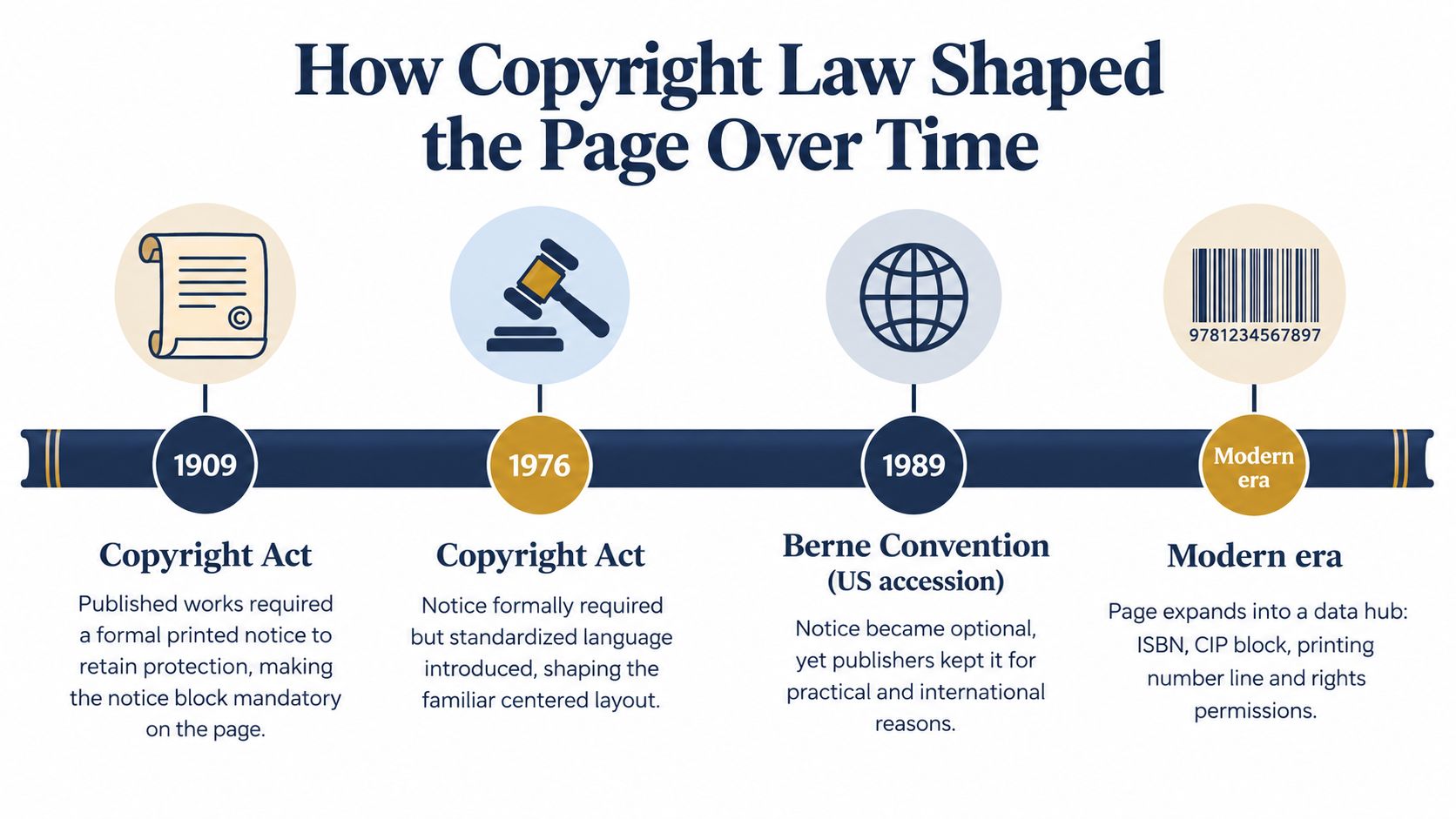
Under the U.S. Copyright Act of 1909, a copyright notice for a book had to appear on the title page or the page immediately following it. That rule helped establish the familiar location of the notice and gave the page a stronger gatekeeping function. An author could reasonably worry that a missing or defective notice might affect protection.
The Copyright Act of 1976 changed the environment. It generally took effect in 1978, and notice requirements became less restrictive. Copyright protection increasingly centered on the act of fixing an original work in a tangible form, rather than on whether an author had placed a particular phrase in a particular location.
From gatekeeper to record-keeper
In 1989, following U.S. implementation of the Berne Convention, copyright protection no longer depended on placing a notice on the work. The notice remained useful, but its role changed. It could communicate ownership and reduce ambiguity without serving as the condition that created protection.
That history explains why authors still see a familiar copyright block in books today. Publishers retained the format because it is useful, recognizable, and compatible with cataloging and rights administration. The page continued to evolve as ISBNs, cataloging records, edition statements, and permissions information became more important to the book supply chain.
The notice is still worth printing. It simply shouldn't be confused with the legal event that creates copyright.
If you want a plain-language explanation of the broader distinction between ownership, protection, and registration, BarkerBooks provides an overview of what copyright protection means for a book.
The result is a page that looks legal because it has legal history behind it, but now functions just as strongly as a bibliographic and rights record.
Placement, Layout, and a Sample Page Order
The conventional location is immediately after the title page, on its reverse side. In a print book, this is usually the title verso. That placement is customary and practical, not a universal modern requirement that determines whether copyright exists.
The title page introduces the work. The verso identifies the publication behind it. Keeping those pages together lets a reader, cataloger, bookseller, or rights professional find the title, author, publisher, ownership, and edition information without searching through the book.
A clean layout gives each block enough space to remain readable. Use a smaller but legible type size if necessary, keep related details together, and avoid squeezing every optional credit into the page. A copyright page may sit low on the page or use a compact centered arrangement, but clarity matters more than imitating a large publisher's visual style.
| Block | Trade Paperback, 6 x 9 | Mass-Market Paperback | EPUB / Digital |
|---|---|---|---|
| Ownership notice | Near the opening of the information block | Compact notice near the front matter | Included in the front matter file |
| Rights statement | Beneath the notice | Often compressed to save space | Reflowable text |
| Edition and format | Edition, printing, and format details | Short edition statement where relevant | Format and edition metadata |
| ISBN | Paperback identifier | Paperback identifier when assigned | Identifier for the specific digital edition when assigned |
| Publisher and credits | Imprint, contact, permissions, and contributors | Shortened publisher and credit information | Credits and permissions in readable front matter |
| CIP or cataloging data | Included when supplied | Included when supplied | Included only when relevant to the digital edition |
| Printing details | Country or production details when useful | Often minimized | Usually omitted or simplified |
A practical 6 x 9 example
For a 6 x 9 trade paperback, a four-block page could look like this:
- Copyright notice and rights statement.
- Publisher, imprint, and edition information.
- Paperback ISBN and printing details.
- Credits, permissions, disclaimer, and contact information.
The copyright page normally doesn't carry a visible folio, or page number, in the same way as the main text. Front matter pagination can vary by design, and a printer may insert blank pages to make the book's page count work correctly. Don't add a visible number just because a template includes one.
Digital books require a separate judgment. Reflowable EPUB text changes shape according to the reader's device and settings, so spacing and alignment behave differently from print. The page still needs to be findable and legible, but it doesn't need to imitate a fixed paper sheet. For the relationship between this page and the other opening pages, see the guide to book front matter.
How the Page Connects to ISBNs, CIP, and Retailer Metadata
The copyright page is the human-readable mirror of information that also travels through publishing systems. A retailer may display the title and format from metadata feeds. A distributor may use the ISBN to distinguish products. A library may rely on cataloging data to create or update its record.
The ISBN printed in the book should match the identifier assigned to that specific product everywhere else. Check it against the number encoded in the print barcode, the metadata submitted to retailers, and the information provided to libraries or distributors. If those records diverge, a retailer may associate the wrong format with the title, create a duplicate listing, or make it difficult for a buyer to understand which edition is being ordered.
What CIP contributes
Cataloging in Publication data is a prepublication bibliographic record for eligible books. When supplied, the publisher prints it on the verso, commonly on the copyright page. It can include the author, title, subjects, classification information, and publication details.
The Library of Congress explanation of the CIP Program distinguishes bibliographic cataloging from copyright registration. CIP helps libraries and other book professionals identify and process a publication. It doesn't establish ownership of the creative work.
That distinction prevents a common error. An author may see a formal-looking block of cataloging data and assume it functions like a legal registration. It doesn't. It describes the book as a publication, while copyright records concern ownership of creative or intellectual material.
Metadata consistency in practice
A useful internal record should connect:
- The book file: title, subtitle, author, contributors, and edition.
- The identifier record: the ISBN assigned to the exact format.
- The retail record: product metadata supplied to each sales channel.
- The library record: CIP or other cataloging information when applicable.
- The physical package: barcode, cover, title page, and copyright page.
Suppose a self-published author assigns one ISBN to a paperback but places a different identifier in the interior file. A retailer may treat the mismatch as a separate product rather than as a correction to the same edition. The author then has to reconcile the listings and update the affected metadata. The lesson isn't that every self-published book needs a complex cataloging block. It's that every identifier must describe the edition readers are buying.
Modern Rights Questions Every Author Should Consider
A boilerplate page can't answer questions about who contributed to a book, what material was licensed, or how a translated edition relates to the original. Those decisions belong to the author's actual publication history.
AI assistance is one current example. If an AI tool materially contributed to drafting, translation, images, or cover development, the author should consider the disclosure expectations of the publisher, platform, and market involved. A statement such as “AI tools assisted with drafting, and the author made the final editorial decisions” describes a process, but it doesn't automatically resolve authorship, ownership, permission, or platform-policy questions.
Translated and multilingual editions deserve separate attention. A translation may involve a translator's rights, a new edition record, a different ISBN, and territory-specific agreements. Don't paste the English-language page into a translated edition and change only the title. Recheck the rights holder, contributors, language, publisher, format, and permissions for that edition.
Permissions need evidence behind them
A short line saying Reprinted by permission is not a substitute for the permission itself. Keep the correspondence, license, contract, or other written record that supports the use of quoted material, song lyrics, epigraphs, photographs, illustrations, maps, stock images, or commissioned artwork.
Credits and permissions aren't identical. A cover designer may deserve a credit because they created the cover. A quoted poem may require permission because another rights holder controls the material. Both may appear on the copyright page, but they answer different questions.
A credit tells readers who contributed. A permission record shows why you were allowed to use someone else's material.
The page can also document adapted excerpts, third-party content, translator contributions, and relevant disclaimers. If the list becomes too long, place the full credits or permissions schedule elsewhere in the front or back matter and point readers to it from the copyright page.
Before finalizing a page, use this guide to copyrighting a book as a starting point, then verify the details against your contracts and the requirements of the markets where you'll publish. Templates are reusable only when the underlying edition facts remain the same.
A Pre-Publication Checklist for Authors
Review the page in passes. Each pass answers a different question, so you're less likely to focus on typography while missing an ownership error.
Four verification passes
Content verification: Confirm the copyright holder's exact name, first-publication year, edition statement, publisher or imprint, language, and translated or adapted credits. Check spelling against the contracts and title-page files.
Identifier verification: Match the ISBN for the exact format across the interior PDF, cover barcode, retailer records, distributor metadata, and library submissions. If you use an LCCN or CIP record, confirm that the title and author details match the supplied record.
Rights and permissions verification: Confirm that image credits, font licenses, quote permissions, cover-art agreements, translator terms, and relevant AI-assistance disclosures are documented or properly referenced. Don't rely on “all rights reserved” to solve a permission problem.
Layout verification: Review line breaks, spacing, font fallback, alignment, trim-size compatibility, and the visibility of every identifier. Make sure the page remains readable in print and in the selected digital format.
| Verification pass | What to confirm | Common mistake to catch |
|---|---|---|
| Content | Holder, year, edition, publisher, contributors | Copying an old author name or year |
| Identifiers | Format-specific ISBN and cataloging numbers | Using the paperback ISBN in an ebook |
| Rights and permissions | Licenses, credits, disclosures, permissions | Crediting material without retaining permission |
| Layout | Text flow, spacing, fonts, trim size | Clipped text near the gutter or page edge |
| Production proof | Exported file in the intended platform | Assuming the source document matches the final PDF |
Finish with a production spot check. Open the actual PDF prepared for KDP, IngramSpark, Lulu, or your chosen printer, and inspect the rendered page at normal reading size. A template can be reused when the format, rights holder, contributors, permissions, and identifiers are unchanged. Assemble a fresh page when you change language, format, edition, publisher, ownership, licensed material, or disclosure requirements.
BarkerBooks helps authors coordinate copyright and ISBN registration, prepare interior files, and format the copyright page alongside the rest of the book. If you want support checking your edition-level details before publication, visit BarkerBooks and discuss your manuscript and publishing route with its team.