
You've polished your manuscript, checked the spelling of the publisher's name, and sent the files to five carefully chosen companies. Then the inbox goes quiet. A week becomes a month, the submission portal still says “received,” and you start wondering whether the manuscript disappeared before anyone read the first page.
That silence is frustrating, but it usually reflects the structure of traditional publishing rather than the quality of your work. After guiding thousands of authors through the process, I've found that the most avoidable problems happen before an editor evaluates the writing. A wrong submission route, missing attachment, incorrect file type, or failure to follow a small house instruction can end the process at the desk.
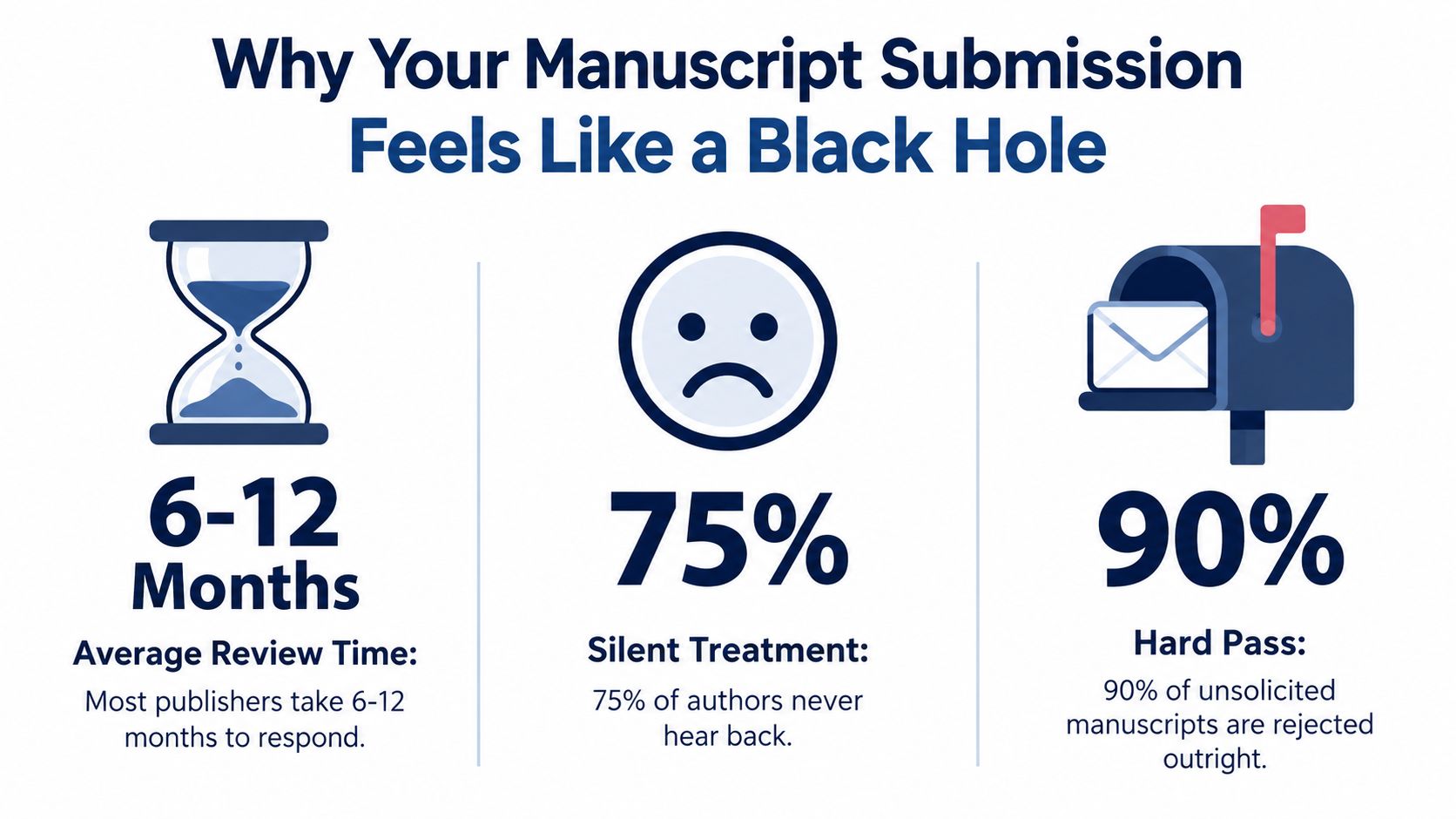
Why Your Manuscript Submission Feels Like a Black Hole
Publishing companies receive more material than their editorial teams can assess quickly. One major publisher says it receives up to 1,000 submissions per year and warns that a decision can take up to 14 weeks, as explained in its manuscript submission guidance. That means five unanswered submissions don't necessarily indicate that your work has been rejected, misplaced, or personally dismissed.
The first mistake authors make is treating submission as an email event rather than a pipeline. You send a manuscript, wait for a verdict, and interpret every quiet week as a signal. Publishers, however, may be checking whether the project fits their list, whether the editor is acquiring in that category, whether the material arrived through an accepted route, and whether the team has capacity to read it.
What happens after you click send
A compliant submission normally passes through several filters:
- Receipt and routing: The publisher records the submission or directs it to the appropriate editor.
- Eligibility check: Staff confirm that the house accepts the genre, format, and submission type.
- Desk assessment: An editor reviews the pitch, sample material, market position, and apparent fit.
- Further reading: The editor may request more material or send the project for internal discussion.
- Decision: The publisher accepts, declines, requests changes, or doesn't respond under its stated policy.
The exact sequence differs by company. Some publishers acknowledge receipt but don't provide detailed feedback. Others say they'll contact only authors whose work interests them. A lack of response can therefore mean that the manuscript is still waiting, that it failed an early filter, or that the publisher's policy doesn't include individual replies.
Practical rule: Treat every submission as unresolved until the publisher's stated response window has passed. Don't treat silence after a few days as meaningful evidence.
Historical context also matters. Authors once commonly mailed a complete manuscript directly to a publishing house, often as a single physical copy, and publishers frequently returned form-letter rejections. The industry gradually moved toward agent-mediated submissions, where an agent first reviews a query or partial manuscript and requests the full work only when there is meaningful interest. This transition is documented in the history of manuscript submission practices.
Why silence changes your strategy
The process is designed to filter a high volume of work while editors manage limited reading time, production schedules, and commercial priorities. You can't control the queue, but you can control whether your submission gives the reader a clear reason to continue.
Use the waiting period productively:
- Record the date sent: Note the exact submission date, route, editor, requested materials, and expected response window.
- Keep submitting selectively: Don't pause your entire publishing plan while one editor considers your work.
- Watch for requests: A request for a full manuscript, proposal, or additional chapters is a stronger signal than a generic acknowledgment.
- Review your package: If several targeted submissions produce no requests, inspect the query, synopsis, positioning, and compliance details before sending another batch.
The goal isn't to send indiscriminately. It's to build a process that separates normal waiting from a package that needs improvement.
Agented Versus Direct Submission Paths
The first decision is not “Which publisher should I email?” It's “Who is allowed to send this material to that publisher?” Many authors lose months because they answer the second question before answering the first.
An agented route means you query literary agents, secure representation, and allow the agent to submit the project to suitable publishers. A direct route means the publisher explicitly accepts submissions from authors without an agent. Neither route is automatically superior. The right choice depends on the publisher's policy, the book's category, and the materials requested.
The agented route
Choose this route when a publisher states that it accepts only agented submissions, discards unsolicited manuscripts, or works through an acquiring editor approached by representatives. An agent can also help shape the pitch, identify suitable editors, negotiate terms, and manage communication after a publisher expresses interest.
The trade-off is that you face an additional gate before a publisher sees the manuscript. Your first package is a query to agents, not a full submission to a publishing house. The agent may request a partial manuscript, a proposal, or the complete manuscript depending on the category and their own process.
When an agent requests the full manuscript, send exactly the version requested. Don't attach a revised file later unless the agent asks for it, and don't use the request as permission to add unrelated material. For practical guidance on identifying suitable representatives, use this resource on how to find an agent for a book.
The direct route
Direct submission makes sense only when the publisher's current guidelines clearly permit it. Some houses accept a query and sample chapters. Others ask for a proposal, a complete manuscript, or an online form. A few accept work only from authors connected to a workshop, conference, or specific editorial program.
| Question | If the answer is yes | Your next action |
|---|---|---|
| Does the publisher accept unsolicited work? | Direct submission may be possible | Follow the listed route exactly |
| Does it accept only agented work? | A direct manuscript is ineligible | Query agents instead |
| Does it request a proposal? | A full manuscript may be premature | Prepare the proposal and samples |
| Does it name an editor or portal? | General inboxes may be unsuitable | Use the named contact or system |
| Does it prohibit attachments or PDFs? | Your usual package may fail compliance | Rebuild the files before sending |
Do not assume that a publisher's general contact email accepts manuscripts. The current author page is the controlling document. A publisher may require Word files, attached chapters, one combined manuscript document, or no PDF at all, as shown in Routledge's author submission FAQs.
The practical rule is simple: the submission route is part of the submission itself. Sending a strong manuscript through a prohibited channel doesn't give the editor a chance to consider it. It gives the organization a reason to close the file.
Building a Compliant Submission Package
A strong manuscript can reach an editor and still be rejected before anyone assesses its writing. The failure may be a missing declaration, an incorrect file type, an incomplete proposal, or a submission sent through a prohibited channel. In some publishing venues, guideline noncompliance accounts for a substantial share of files rejected before review. A discussion thread on Absolute Write collects figures from Springer journal pages reporting about 10% rejected without review for failing to comply with submission guidelines and up to 60% rejected without review for that reason. These figures come from journal submission systems, not a universal book-publishing rate, but they show why technical compliance deserves the same attention as the manuscript.
Treat the package as a set of required documents, not a creative bundle. Each file should answer a stated requirement on the publisher's current submission page.
Start with the instructions
Save the guidelines as a PDF or web archive, then convert the current version into a working checklist. Record the exact requirements for:
- Submission route: Confirm whether the house accepts direct, agented, invited, or portal submissions.
- File type: Use the requested format, such as a Word document, rather than the format you prefer.
- Material scope: Send only the query, proposal, synopsis, sample chapters, or full manuscript requested.
- Metadata: Include the title, author name, genre, word count where requested, contact details, and rights information.
- Anonymization: Remove your name and identifying details if blind review is required.
- Ethical declarations: Complete permissions, disclosure, consent, or conflict-of-interest fields when applicable.
Check the page again immediately before sending. Submission requirements can change, and an older saved checklist cannot override the publisher's current instructions.
A request for a Word file is a functional requirement, not a minor preference. Editors may need comments, tracked changes, and established internal formatting workflows. If the guidelines request one combined document, assemble the files before upload. If the publisher accepts PDFs and requests a single combined file, merge your PDF materials before upload. A guide on merge multiple PDFs into one can help with that step, but the publisher's file rule determines whether the result is acceptable.
Build each component for its job
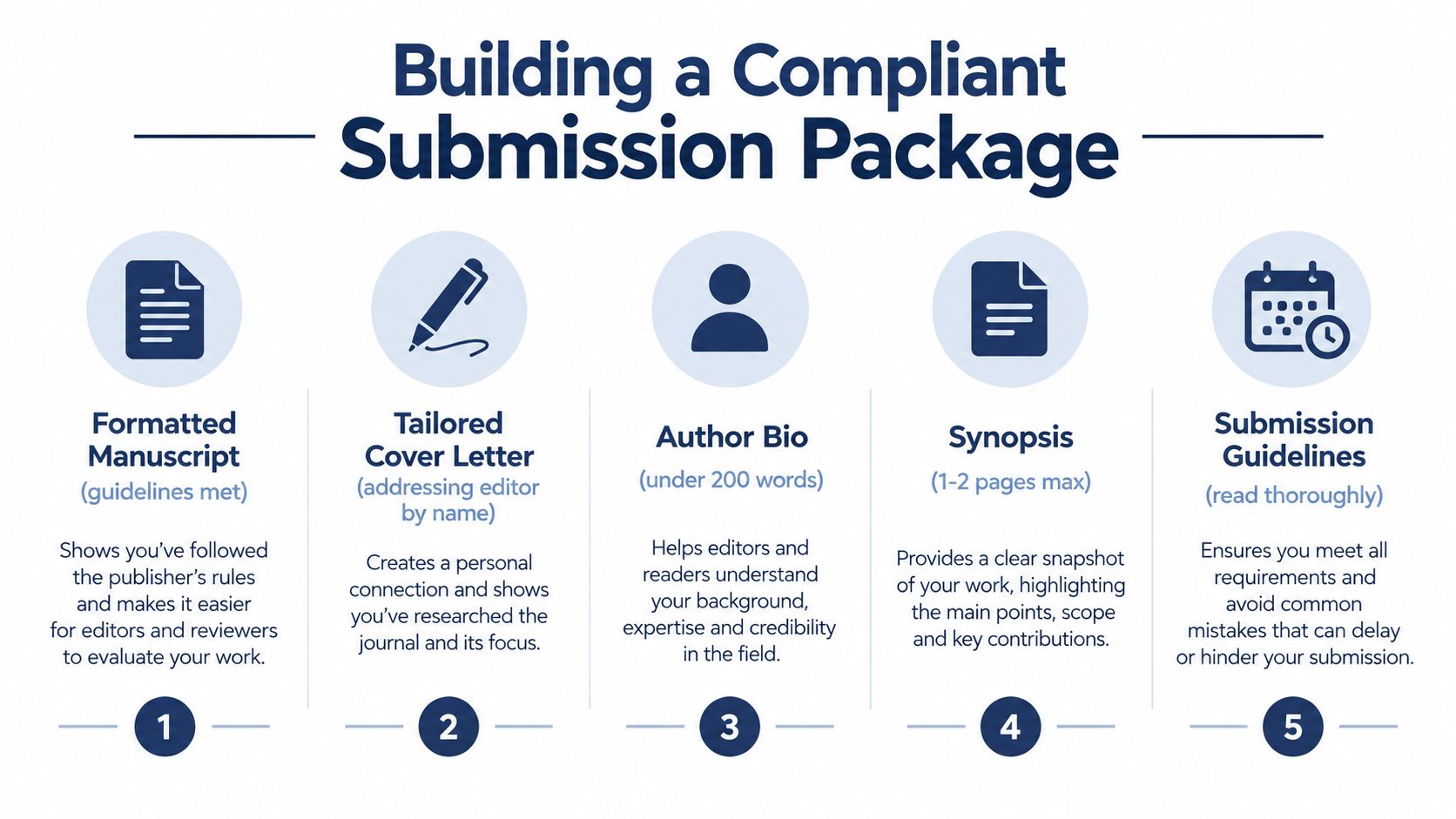
The query letter earns the next look. Identify the book, category, central premise, intended readership, comparison titles if requested, and relevant author credentials. Use the editor's or agent's name when the guidelines provide one, and explain why the project fits that person's list. Changing only the greeting does not make a generic letter targeted.
The synopsis proves that you understand the complete work. For fiction and memoir, state the central conflict and ending instead of withholding the conclusion like marketing copy. For nonfiction, explain the argument, audience, structure, and practical value. Follow the requested length precisely. A brief synopsis requires a brief synopsis, not a chapter-by-chapter essay.
The sample chapters or pages should represent the finished manuscript. Choose an opening that establishes voice, stakes, and direction. If the guidelines request specific chapters, send those chapters rather than the pages you personally prefer.
The author bio should support this project. Include relevant expertise, publications, professional experience, audience access, or credentials. The editor needs to see why you are suited to write this particular book, not read a general autobiography.
A clean package creates no friction. The reader should never have to guess which file is the synopsis, whether the manuscript is complete, or what the project is about.
For technical preparation, compare your files with this guide on how to format a manuscript. Open every attachment on another device, confirm that page numbers and headers display correctly, and remove tracked changes and comments unless the guidelines request them. Before uploading, check filenames, page order, and file contents against the checklist one final time.
Understanding Response Times and Rejection Statistics
A manuscript can sit in a queue for weeks without anyone having made a substantive decision. Separate initial response, full evaluation, and publication decision when you plan your submissions. A receipt confirmation only shows that the file arrived. It does not show that an editor has agreed to read it.
Trade publishers set their own schedules and submission rules. Review the relevant publisher submission guidance before calculating a follow-up date. Scholarly publishing provides a useful comparison: a cross-journal analysis found median times to acceptance ranging from 64 to 269 days and median times to publication ranging from 79 to 323 days. Another study reported an average first response time of 13 weeks across scientific fields. Those figures do not predict a trade-book decision, but they show why an editorial process can extend well beyond the first acknowledgement.
A tracked dataset of 9,569 electronic queries recorded an average rejection rate of about 87%, an average response time of three weeks, full-manuscript requests on 1% to 5% of unsolicited submissions, and an outreach result of 50 queries, 41 non-responses, 6 explicit rejections, 5 material requests, and 3 publication offers, per the Great Querying Project statistics. The same reporting indicates that two to three months is common, so build a range into your plans rather than relying on one expected date.
Read the signals correctly
Each response gives different evidence:
- No response: The recipient may have a no-response policy, an unresolved queue, or an early decline. Check the stated guidelines before following up.
- Form rejection: The project was not selected, but the message rarely identifies the reason.
- Personalized decline: Someone read enough to offer a specific observation. Test whether that feedback appears elsewhere in the manuscript or pitch.
- Partial or full request: The project passed an initial filter. It is a stronger signal, not a promise of representation or publication.
- Revision request: Confirm whether the editor wants a revised package, a revised manuscript, or only a suggestion for future work.
Treat patterns as diagnostic evidence. Repeated requests from well-targeted agents or publishers suggest that the premise and pitch are attracting attention, while the manuscript or proposal may need work. If nearly every submission ends without a request, inspect the package before increasing volume.
Do not revise after every individual rejection. One form response reveals little. A consistent pattern across carefully targeted submissions, sent with materially similar packages to recipients in the same category, supports a more reliable change. Keep a submission log with the recipient, route, materials sent, date, response, and any specific feedback. That record turns waiting time into evidence and helps distinguish a weak package from a slow queue.
Researching and Targeting the Right Publishers
A publisher isn't a target merely because it has published books. It becomes a viable target when its list, submission route, editorial appetite, and commercial expectations align with your project.
Start by identifying the manuscript's actual category. “General nonfiction” is rarely precise enough. A practical label might be narrative nonfiction, business leadership, practical psychology, historical biography, young adult fantasy, or a particular subcategory of crime fiction. The category determines which editors understand the project and which comparison titles make sense.
Use a decision tree before making a list
Ask these questions in order:
- Does the publisher publish this category? If not, remove it, even if the company's reputation is attractive.
- Does its recent list resemble the project? Look for books with a comparable audience, tone, structure, or subject.
- Is the publisher accepting submissions now? A previously open page may be outdated or temporarily closed.
- Which route does it permit? Choose agented, direct, invited, workshop-based, proposal-led, or full-manuscript submission according to the stated policy.
- What does it request first? Prepare only the requested materials.
- Does the project fit the market position? A strong manuscript still needs a clear readership and a credible reason for that publisher to acquire it.
This process prevents a common error: sending a completed novel to a publisher that wants a nonfiction proposal, or sending a proposal to a house that requests a complete manuscript. The problem isn't the quality of the writing. The problem is that the file doesn't answer the editorial question the publisher asked.
Research beyond the submission page
Read the publisher's current catalog and identify books that closely resemble yours. Note the apparent audience, format, tone, and positioning. Check acknowledgments, trade coverage, author interviews, and professional events for acquiring editors and agents connected to the category.
Keep the research in a spreadsheet. Useful columns include:
- Publisher and relevant imprint
- Category and comparable titles
- Submission route
- Required materials
- File and formatting requirements
- Named editor or portal
- Date guidelines checked
- Reason the project fits
- Response window and status
For further guidance on evaluating prospective houses, use this resource on how to find a publishing company.
Respect exclusions
If a publisher says it doesn't accept unsolicited manuscripts, don't send one “just in case.” If it accepts proposals only from agents, don't reclassify your full manuscript as a proposal. If it asks for sample chapters and a synopsis, don't attach the entire book unless invited.
Research also protects your positioning. A memoir presented as a business book, or a practical guide presented as literary nonfiction, can confuse the reader before the manuscript has a chance to work. Market fit begins with accurate language.
Creating a Strategic Submission Pipeline
A controlled submission pipeline protects both your time and your manuscript. Instead of sending every contact at once, create a ranked list, prepare the package, submit to a small targeted batch, and use the response pattern to decide what to change.
Build the workflow
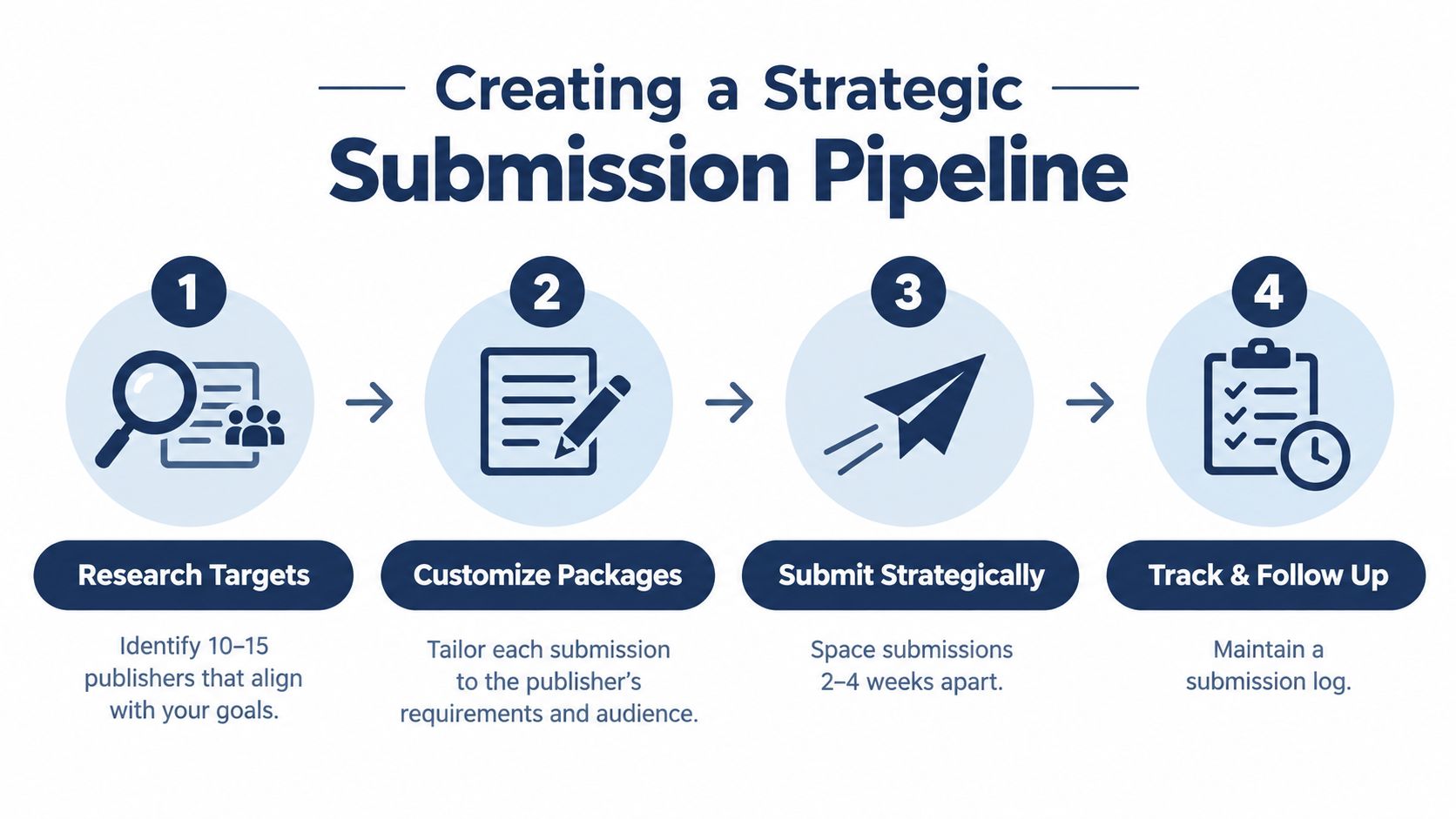
Research targets first. Separate strong-fit publishers from aspirational options. Verify each guideline immediately before submitting because policies change.
Customize the package. Adapt the query, synopsis emphasis, sample selection, and subject line to the recipient's stated interests. Personalization should demonstrate editorial fit, not merely insert a name.
Submit in waves. A batch lets you test whether the package is attracting requests without exhausting every realistic target. Keep your strongest opportunities in the plan, but don't wait indefinitely for one response.
Track every event. Record the date sent, materials supplied, expected response period, follow-up rule, reply, request type, and next action. A spreadsheet is enough. The value comes from consistent entries, not from a complicated system.
Measure the process, not your self-worth. A rejection is an outcome for one package at one organization. A pattern is information you can use.
After a meaningful batch, review the evidence. Repeated requests suggest that the query may be effective and the manuscript needs further development. Repeated non-responses suggest that you should first check eligibility, compliance, targeting, and the clarity of the pitch. Don't make broad changes based on one form rejection.
Follow up only when the publisher's policy permits it and the stated response window has passed. Keep the message short, identify the project and original submission date, and ask whether the material remains under consideration. Never resend the complete package unless requested.
Publishers also assess whether a project has a defined audience, a workable format, and a realistic path to discoverability. That doesn't mean you should force your manuscript into a trend. It means your submission should explain who will read it, why the book belongs in that category, and whether the concept can work across the formats relevant to its audience.
The technical work can be done independently, or authors can use professional support for proofreading, editorial editing, ghostwriting, cover design, interior layout, distribution, and submission preparation. BarkerBooks offers those publishing services and can help authors prepare manuscripts and submission materials for a broader publication plan.
When you submit, send the version you can defend. Check the route, confirm every requirement, open every file, and record the transaction. Then move to the next qualified opportunity instead of allowing one silent inbox to determine the future of the book.
If your manuscript needs professional preparation before submission, BarkerBooks can support proofreading, editorial editing, formatting, cover and interior design, and distribution planning. Visit BarkerBooks to discuss the specific stage of your manuscript and choose the practical help you need.