
An author pseudonym gives you a public-facing brand, but you still need your real identity for contracts, tax reporting, and ISBN registrations. It can protect your public privacy, but it isn't a legal shield and may affect how long copyright protection lasts.
That tension has existed for centuries. By the late 18th century, almost 70% of books published in Britain were pseudonymous works, and another historical overview reports that around 80% of novels appeared under a pen name or anonymously by 1830 (York University's scholarly overview). A pen name isn't a modern gimmick for authors who want a mysterious byline. It has long served as a practical response to social pressure, commercial positioning, genre separation, and personal safety.
The mistake is treating pseudonymity as one decision. It's two decisions: what readers see, and what publishers, platforms, tax authorities, banks, and copyright offices know. Manage only the public side and the private administrative side can expose you, delay payments, or weaken your preferred copyright position.
What Is an Author Pseudonym
An author pseudonym is a publishing identity, not a replacement legal identity. A writer adopts a fictitious name for the byline, cover, author page, and public marketing, while the underlying person or business remains responsible for contracts, rights, payments, and taxes.
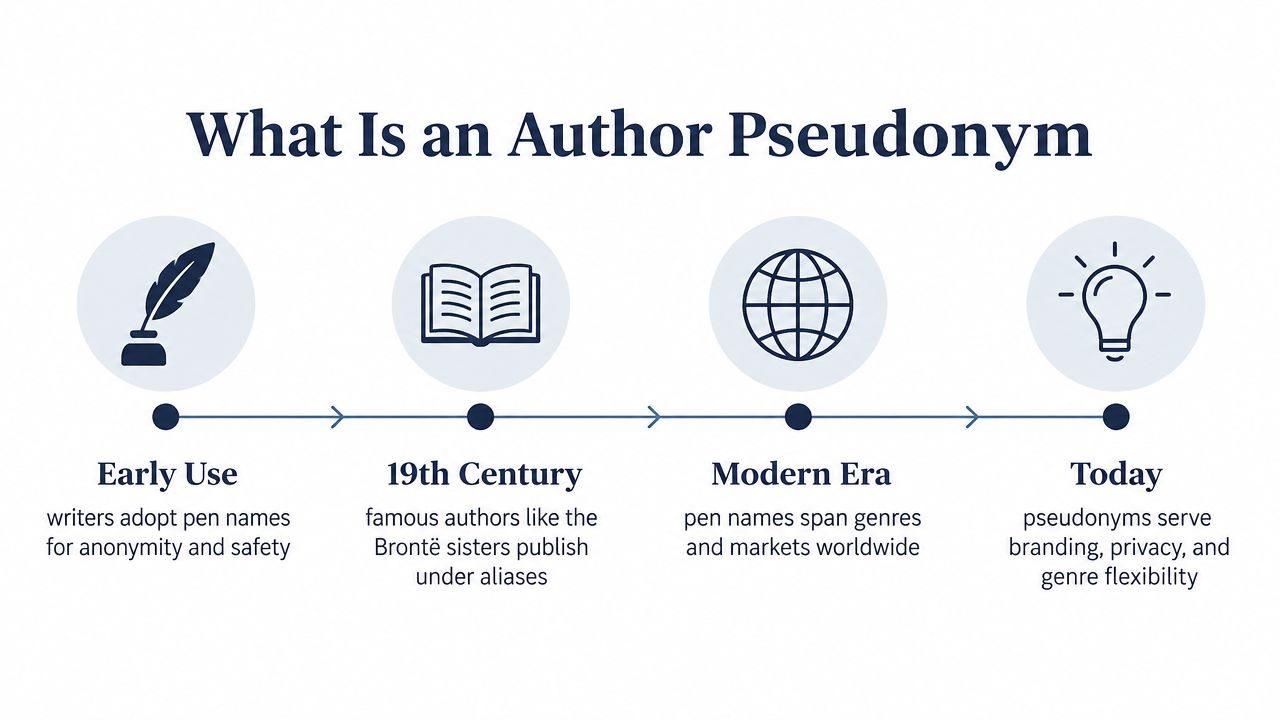
That distinction would have been familiar to writers in earlier publishing markets. Between 1660 and 1750, approximately 50% of published prose fiction did not list an author on the title page, while another 20% appeared under a pseudonym or tagline. Anonymous novels later rose to over 80% between 1750 and 1790, according to the British Library material summarized in the historical research on pseudonymous publishing.
Why writers adopted different names
Pseudonyms often solved problems that had little to do with creativity. A writer might need distance from political commentary, family expectations, professional duties, or assumptions about gender. In 1846, the Brontë sisters published poetry as Currer, Acton, and Ellis Bell, using names that helped them deal with the publishing culture of their period. The historical account of pen names and authorship also describes the 16th and 17th centuries as a “Golden Age of pseudonyms”, when almost every writer and many artists used a pseudonym at some point.
The strategy remains useful today, especially when an author's work crosses incompatible reader expectations. A romance writer may want a separate identity for horror. A professional may want to keep a memoir apart from a public career. A writer may also prefer a pen name because their legal name is difficult to spell, already associated with another author, or unsuitable for the genre they're entering.
The identity has two layers
Think of the arrangement as a publishing interface:
- Public layer: The pseudonym appears on the cover, title page, retailer listing, website, social profiles, and publicity materials.
- Private layer: The legal author or business appears in agreements, payment records, tax documentation, rights administration, and other compliance files.
Publishers and platforms can display the pen name while verifying the person behind it. That separation gives you branding flexibility, but it doesn't erase accountability. If you use a pseudonym to defame someone, evade a contract, or misrepresent ownership, the name won't protect you from legal consequences.
Legal and Copyright Implications
A pen name creates privacy, but copyright registration creates a difficult choice. If you register only under the pseudonym, you may preserve more public privacy while accepting a different copyright term. If you disclose your legal name in the registration, you may support a stronger long-term term while placing that name in a public record.
U.S. guidance summarized by LegalClarity's explanation of pen-name copyright issues says a pseudonymous registration can use only the pen name, but protection then runs for 95 years from publication or 120 years from creation, unless the author later reveals their identity. If the legal name is included in the filing, it becomes visible in the public catalog and isn't removed.
That isn't a minor administrative detail. Authors often choose a pseudonym precisely because they want separation from their public work. Copyright paperwork can undermine that separation if the legal name is entered without understanding the disclosure consequences.
The privacy choice versus the duration choice
The decision is best understood as a trade-off rather than a universal rule.
| Registration approach | Public privacy | Copyright term |
|---|---|---|
| Pseudonym only | Stronger privacy in the registration record | 95 years from publication or 120 years from creation, under the guidance cited above |
| Legal name included | Legal identity appears in the public catalog | May support the usual life-based term |
| Legal name disclosed later | Privacy can change after registration | Identity disclosure may affect the applicable term |
Authors Alliance explains that pseudonymous works can receive a different term from named works, with protection measured as 95 years from creation rather than the author's life plus 70 years in some cases (Authors Alliance copyright guidance). Treat that information as a decision point, not a form-filling footnote.
Practical rule: Decide whether privacy or the strongest long-term rights position matters more before you submit a copyright registration.
What to document before filing
Keep a private record connecting your legal identity to the pseudonym. Store contracts, drafts, dated publication evidence, registration details, and rights assignments securely. If you later sell, license, or enforce the work, that documentation helps establish the relationship between the person who owns the rights and the name readers recognize.
For a plain-language foundation on ownership and protection, review this guide to copyright protection for authors. It won't replace advice from a qualified copyright attorney, particularly when your work has multiple contributors, international publication, or a corporate rights holder.
ISBN Registration and Royalty Management
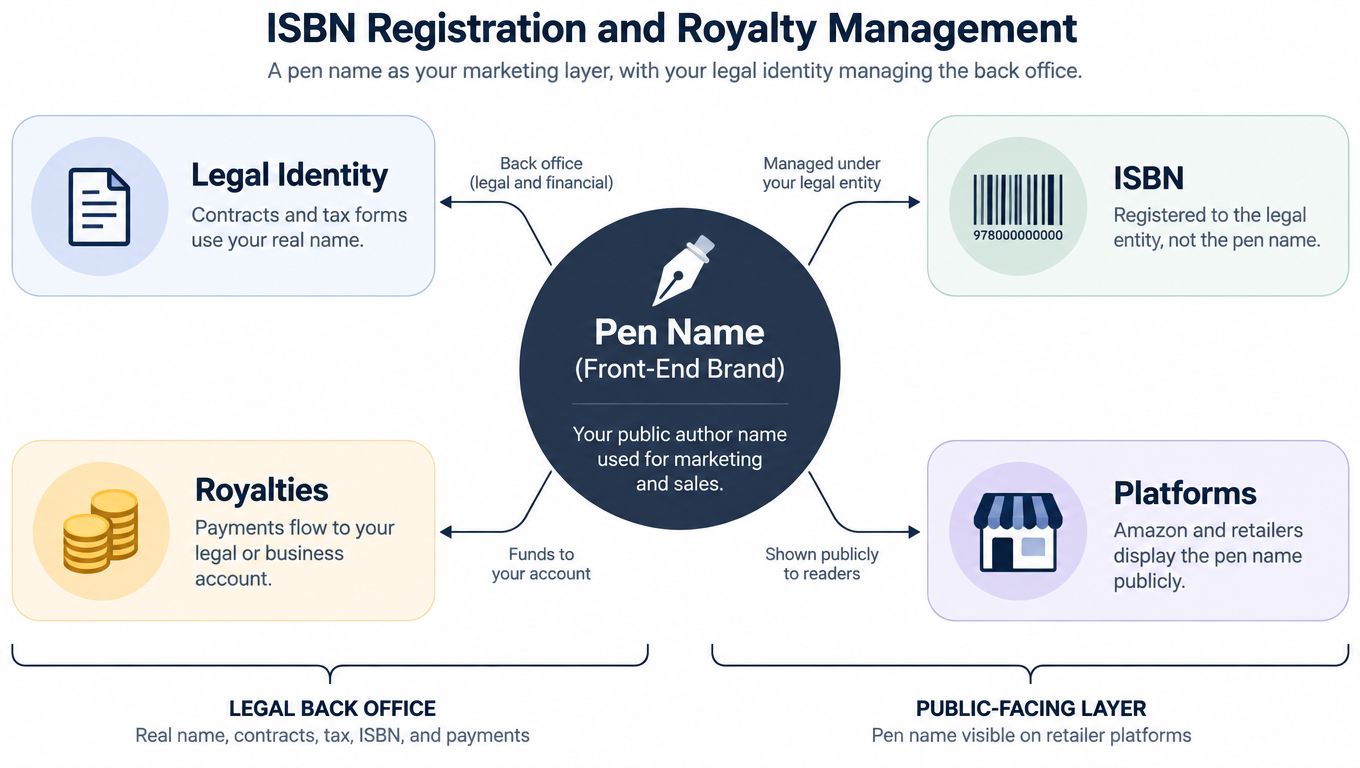
The operational rule is simple: the pen name belongs in the storefront, while the verified person or entity belongs in the financial system. Publishers, agents, distributors, and retailers need to know who owns the work and who receives money. A pseudonym doesn't satisfy those verification duties.
The ISBN process illustrates the separation. In a traditional publishing arrangement, the publisher or its legal entity handles the ISBN and presents your chosen name publicly. In a self-publishing arrangement, the responsible publisher or legal entity must keep accurate ownership and registration records, even if the book displays only the pseudonym. Read the practical guidance on getting an ISBN number before assigning identifiers to a multi-name publishing program.
Build a clean back office
Use a written identity map before you upload the manuscript:
- Record the legal owner. Identify the person or business that owns copyright and receives publishing income.
- Record the public byline. Specify the exact spelling, punctuation, initials, and capitalization of the pseudonym.
- Assign platform roles. Enter the pseudonym in the public author field, while completing identity verification and payment details with accurate legal information.
- Separate records. Keep contracts, invoices, royalty statements, tax forms, and rights licenses connected to the legal owner.
- Track the ISBN. Record which entity obtained or assigned each ISBN and which edition it identifies.
The purpose isn't bureaucracy for its own sake. It prevents a common failure: an author remembers the pen name but can't later prove which legal person owns a particular edition, account, or license.
Taxes don't follow the byline
Writing income remains taxable income regardless of the name printed on the book. If a platform pays your legal person or company, report the income through the appropriate tax process for that person or entity. Local rules differ, so obtain advice from a tax professional in every jurisdiction where you live, operate, or receive business income.
Some authors create a business entity or register a fictitious business name to make checks, invoices, and banking more consistent with the public brand. That can improve administration and privacy, but it doesn't eliminate identity verification. A bank, payment processor, publisher, or tax authority can still require your legal details.
A pen name can conceal your identity from readers. It can't conceal your identity from the institutions responsible for paying you and recording your obligations.
Choosing and Protecting Your Pen Name
A good pseudonym must pass two tests at once. Readers should remember it, and your business should be able to use it without creating confusion or conflict. A name that sounds perfect on a cover can fail because another author already owns the audience, a company uses the mark, or readers can't spell it.

Start with the market position. A serious thriller, a children's picture book, and a practical business guide usually need different signals from an author name. That doesn't mean the name must be theatrical. It means the name should support the promise made by the cover, description, and category.
Compare the real options
| Choice | Main advantage | Main cost |
|---|---|---|
| Real name | Builds one consolidated identity | Connects every genre and subject publicly |
| One pseudonym | Creates privacy and a focused brand | Requires consistent separation and maintenance |
| Multiple pseudonyms | Separates sharply different audiences | Multiplies websites, profiles, metadata, and administration |
Use one pseudonym when privacy or a clear genre boundary matters. Use multiple names only when you can maintain each identity properly. A neglected author page, inconsistent cover branding, or abandoned social account can make the name look temporary and damage discoverability.
Run checks before you commit
Search retailer catalogs, library catalogs, social platforms, trademark databases, and domain registries. Look for close variations, not only an exact match. A name can be technically available yet still create reader confusion because it resembles an established author.
Check how the name looks in the following places:
- Book cover: Does it remain legible at thumbnail size?
- Retailer search: Can readers type it accurately?
- Spoken introduction: Can you say it naturally at an event or interview?
- Email address: Can you obtain a professional address without extra characters?
- Rights paperwork: Can your team distinguish it from your legal identity?
The public name also needs active protection. Monitor retailer listings, social profiles, domain use, and new books in your category. If the pseudonym becomes commercially important, ask an intellectual-property professional whether trademark protection fits your use.
Privacy is a maintenance practice, not a feature you switch on once.
A pseudonym won't guarantee anonymity. Interviews, metadata mistakes, payment records, copyright filings, and careless social posts can connect the two identities. Decide in advance which people may know your legal name, what you'll say in public, and how your publisher will handle confidentiality.
If you're weighing a separate identity for a new genre, this discussion of writing under a pen name across multiple genres offers useful strategic context.
Publishing and Marketing Strategies
Treat the pseudonym as a standalone brand asset from the first day. A public identity needs its own author page, contact address, reader-facing biography, social profiles, and consistent visual language. If you mix personal and pen-name activity, readers may discover connections you intended to keep private, and marketing data becomes difficult to interpret.
Create the brand around reader expectations rather than a fabricated personal life. You can write a concise biography that describes your interests, genre, and books without inventing locations, credentials, or personal history. Authenticity doesn't require disclosure. It requires consistency.
Build one discoverable identity
Use the same name, spelling, profile image approach, bio, and links across retailers. Your title pages, cover files, metadata, website, newsletter, and publicity materials should all agree. Search engines and book platforms can then associate the books with one public author entity instead of scattering signals across variations.
A practical setup includes:
- Dedicated email: Use an address that belongs to the pseudonym and is separate from personal correspondence.
- Author website: Publish book information, reader signup details, contact options, and privacy-conscious biography copy.
- Retailer profiles: Claim and complete the author pages available through the platforms where your books appear.
- Content channels: Choose only the social networks where you can maintain a reliable presence.
- Editorial calendar: Plan launches, excerpts, newsletter messages, and appearances under the correct identity.
Keep marketing separate from administration
Your marketing team may work entirely under the pen name. Your contracts and payment records should not. Maintain a private spreadsheet or rights-management system that maps each public name to its legal owner, ISBN, edition, platform account, contract, and royalty destination.
That system matters when you release translations, audiobooks, box sets, or revised editions. Each format can involve separate metadata and rights decisions. Without a reliable mapping, a public brand that looks polished can conceal a back office full of contradictions.
Protect reader trust
Don't use a pen name to mislead readers about qualifications, endorsements, or lived experience. Avoid false claims in biographies and promotional copy. A private author identity can still have a clear ethical standard, and readers will judge the published work and public communications on their own terms.
The strongest pseudonymous brands feel coherent, not secretive. Give readers a dependable promise about subject, tone, and publishing quality, then keep your legal identity confined to the people and systems that need it.
How BarkerBooks Supports Pseudonymous Authors
Pseudonymous publishing becomes difficult when creative decisions, legal records, distribution metadata, and financial administration sit in different places. An author may know exactly which name should appear on the cover but still face uncertainty about copyright applications, ISBN records, platform accounts, or the connection between a pen name and the rights owner.
A full-service publisher can centralize those tasks. BarkerBooks describes support covering ISBN registration, copyright protection, cover design, interior layout, editing, and worldwide distribution, including availability through platforms such as Amazon Kindle and Apple Books. Its published company information also states that it has worked with over 7,500 authors and operates across more than 91 countries. Those figures come from the publisher's supplied company overview, so confirm current service details directly before signing an agreement.

What professional handling changes
The value isn't that a publisher makes the legal identity disappear. It's that the publisher can maintain the separation correctly. Your pseudonym can drive the public presentation while your legal identity remains attached to the contract, payment instructions, rights records, and required verification.
A careful publishing workflow should establish:
- Author records: The legal author or entity is documented privately and connected to the chosen public name.
- Copyright handling: Registration information is prepared with the privacy and term consequences understood before filing.
- ISBN coordination: Edition identifiers are assigned and recorded under the responsible publishing entity.
- Retail metadata: The pseudonym appears consistently in the author fields, cover credits, title-page information, and retailer listings.
- Financial administration: Royalty statements and payments flow through the verified person or business, with appropriate tax documentation.
- Brand production: Covers, author pages, descriptions, and promotional assets make the pen name look intentional and consistent.
BarkerBooks positions its publishing services as an end-to-end option for authors who want assistance with editorial work, design, distribution, and publishing administration. That model can suit an author who wants to focus on manuscript development and audience positioning rather than coordinating separate specialists for every production stage.
What authors should still control
Delegating administration doesn't remove your responsibility to ask precise questions. Before agreeing to a publishing package, confirm who owns the copyright, who controls the ISBN, which legal name appears in contracts, how the pseudonym appears in retailer metadata, and who receives platform payments. Ask how confidential information is stored and who can access it.
Also request a written explanation of the copyright registration approach. If privacy is your priority, you need to understand whether the filing will identify you publicly. If long-term rights duration matters more, you need to understand what disclosure the registration requires.
The right publisher doesn't promise impossible anonymity. It builds a documented, compliant bridge between the name readers see and the person who owns the work.
A pseudonym works best when the creative brand is distinctive and the legal foundation is boringly accurate. BarkerBooks can handle publishing production and distribution for authors who want that structure, but you should still review the agreement with appropriate legal and tax advisers where necessary.
BarkerBooks can help coordinate pseudonymous publishing, including editorial production, cover design, ISBN registration, copyright handling, and distribution while keeping the public byline separate from the legal records that require verification. Visit BarkerBooks to discuss your manuscript, pen-name strategy, and the administrative setup your book needs.