
More than 3.5 million self-published ISBN-bearing titles were issued in the United States in 2025, and self-published books represented about 84.6% of total U.S. book output that year, according to Bowker-based reporting summarized by the Des Moines Register. That single fact changes how authors should think about self publish ebooks.
The hard part isn't getting an ebook onto a retailer anymore. The hard part is helping the right readers notice it, trust it, and buy it. Uploading is a task. Discoverability is a system.
That system starts long before release day. A clean manuscript, genre-aware cover, strong metadata, sensible pricing, and a coordinated launch do more for an ebook than any last-minute scramble after publication. Authors who treat ebook publishing as an operational process tend to make better decisions, spend less money on rework, and give each release a real chance to find readers worldwide.
Why Self Publishing Ebooks Is More Competitive Than Ever
More than 3.5 million self-published ISBN-bearing titles entered the U.S. market in 2025, as noted earlier. That volume changes the job. Self publish ebooks now compete less on access and more on discoverability.
Authors still spend too much time on the upload itself. File conversion, retailer dashboards, and account setup matter, but they rarely determine whether a book gets seen. In a crowded ebook market, visibility comes from packaging, positioning, and clean execution before release day.
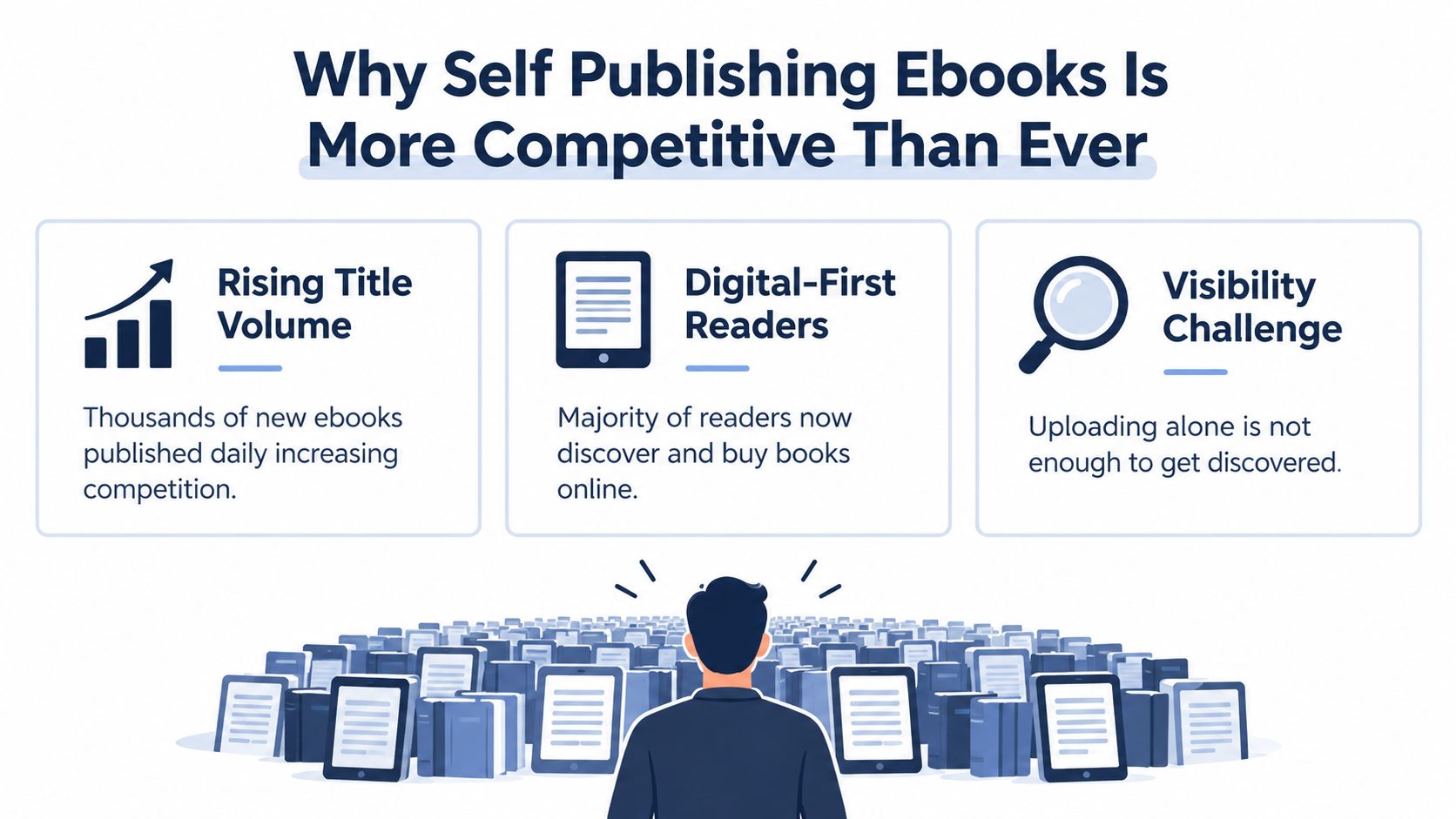
Access is easy. Reader attention is limited
The old barrier was permission to publish. The current barrier is reader confidence.
A browser gives a book only a few seconds. The cover has to signal genre fast. The subtitle or hook has to clarify what the book offers. Categories and keywords have to place it in the right shelf on the retailer. The sample has to confirm that the promise on the product page matches the reading experience.
Those are discoverability decisions, not technical ones.
Here is what affects performance early:
- Cover credibility that looks native to the genre, not homemade in the wrong way
- Metadata precision that helps the book appear in relevant searches and categories
- Description copy that gives a clear promise instead of a vague summary
- Sample strength in the opening pages, where many ebook shoppers decide whether to keep reading
- Price positioning that fits the category, author platform, and launch goal
- Launch timing that concentrates traffic and early sales instead of scattering attention
A practical test works well here. If a reader needs extra explanation to understand what the book is, who it is for, or why it is worth the price, the product page is underperforming.
Commercial opportunity is real, but weak positioning gets buried
Ebook self-publishing became commercially meaningful a long time ago. Authors can reach global storefronts, update files quickly, and keep a larger share of revenue than many traditional deals offer. That part is attractive.
The harder truth is that competent books disappear every week because their market signals are weak. I see it constantly. A solid manuscript goes live with a generic cover, broad categories, a flat blurb, and a price chosen by guesswork. The author concludes the book “didn't work,” when the problem was that the listing never gave the right readers a reason to click.
This is why upload mechanics are only the floor. The ceiling comes from how well the book is positioned in a market crowded with alternatives.
What authors should do differently
Treat ebook publishing as an operating system with checklists, not as a one-time file drop. The same process discipline used by content production system owners applies here. Repeated releases perform better when each title goes through the same quality checks before publication.
Use a simple pre-launch standard:
- Finalize title, subtitle, categories, keywords, and description before upload
- Confirm the cover matches the expectations of the target genre
- Review the first 10 percent for pacing, clarity, and formatting errors
- Set a price based on comparable books, not personal attachment to the manuscript
- Plan launch traffic in advance so the release does not arrive to silence
What works now is disciplined preparation tied to discoverability. What wastes time is polishing dashboard settings while the book's metadata, positioning, and sales page still leave readers uncertain.
Preparing Your Manuscript for Professional Publication
A manuscript is ready for ebook production only when the text itself is stable. Not “mostly done.” Not “good enough unless someone notices a few typos.” Stable.
The cleanest launches happen when authors separate editorial work from formatting work. If you keep changing scenes, chapter titles, headings, or back matter after conversion begins, you'll pay for the same work twice, whether you do it yourself or hire help.

Finish the big edits before the fine edits
Most books need more than one level of review. The order matters.
Development first
Fix structure, pacing, clarity, argument flow, missing scenes, repetition, and weak chapter openings before anyone spends time correcting commas. A proofread can't repair a confusing middle section or a nonfiction chapter that drifts off topic.Line or copy editing next
Once the content is settled, polish sentence flow, grammar, consistency, and usage. A book starts to read like a finished product rather than a promising draft.Proofreading last
Proofreading belongs at the end, after revisions are complete. Otherwise authors often reintroduce errors while making “small” changes.
If you need outside help, a service such as manuscript editing services can handle that stage before production begins. The important point isn't where you hire support. It's making sure the editorial sequence is logical.
Use beta readers carefully
Beta readers can be useful, but only if you ask focused questions. “What did you think?” won't give you much. Better prompts produce better feedback.
Ask things like:
- Where did you lose interest
- Which character or argument felt thin
- What confused you
- What did you expect to happen next
- Which sections felt slow or repetitive
Don't send beta readers a draft full of obvious mistakes. They should spend attention on the reading experience, not on fixing issues you should've caught already.
A messy draft gets messy feedback. A clean draft gets usable feedback.
Clean the file before formatting starts
Even strong manuscripts often carry hidden production problems. I regularly see these create avoidable conversion headaches:
- Tracked changes left unresolved that produce random insertions or formatting conflicts
- Manual tabs and extra spaces used to force alignment
- Inconsistent heading styles across chapters
- Multiple file versions with unclear naming
- Pasted text from email or web sources that imports stray formatting
Before formatting, create one master manuscript and lock it down. Name it clearly. Remove comments. Accept or reject all tracked changes. Standardize chapter titles and scene breaks. Put front matter and back matter in one place.
Know when to stop tinkering
Many authors delay publication because they keep revising after the manuscript is already good. That usually doesn't improve the book. It just moves effort away from packaging, metadata, and launch prep.
A manuscript is ready when the structure is settled, the language is clean, and outside readers aren't flagging major issues. At that point, stop rewriting and move into production.
Formatting and Cover Design That Converts Browsers to Buyers
A finished manuscript still isn't a market-ready ebook. Retailers sell tiny thumbnails, searchable listings, and instant samples. That means formatting and cover design are not decorative tasks. They are conversion tools.
The interior must read smoothly on phones, tablets, e-readers, and apps. The cover must communicate genre and professionalism at thumbnail size. If either one fails, readers leave before your writing gets a fair shot.
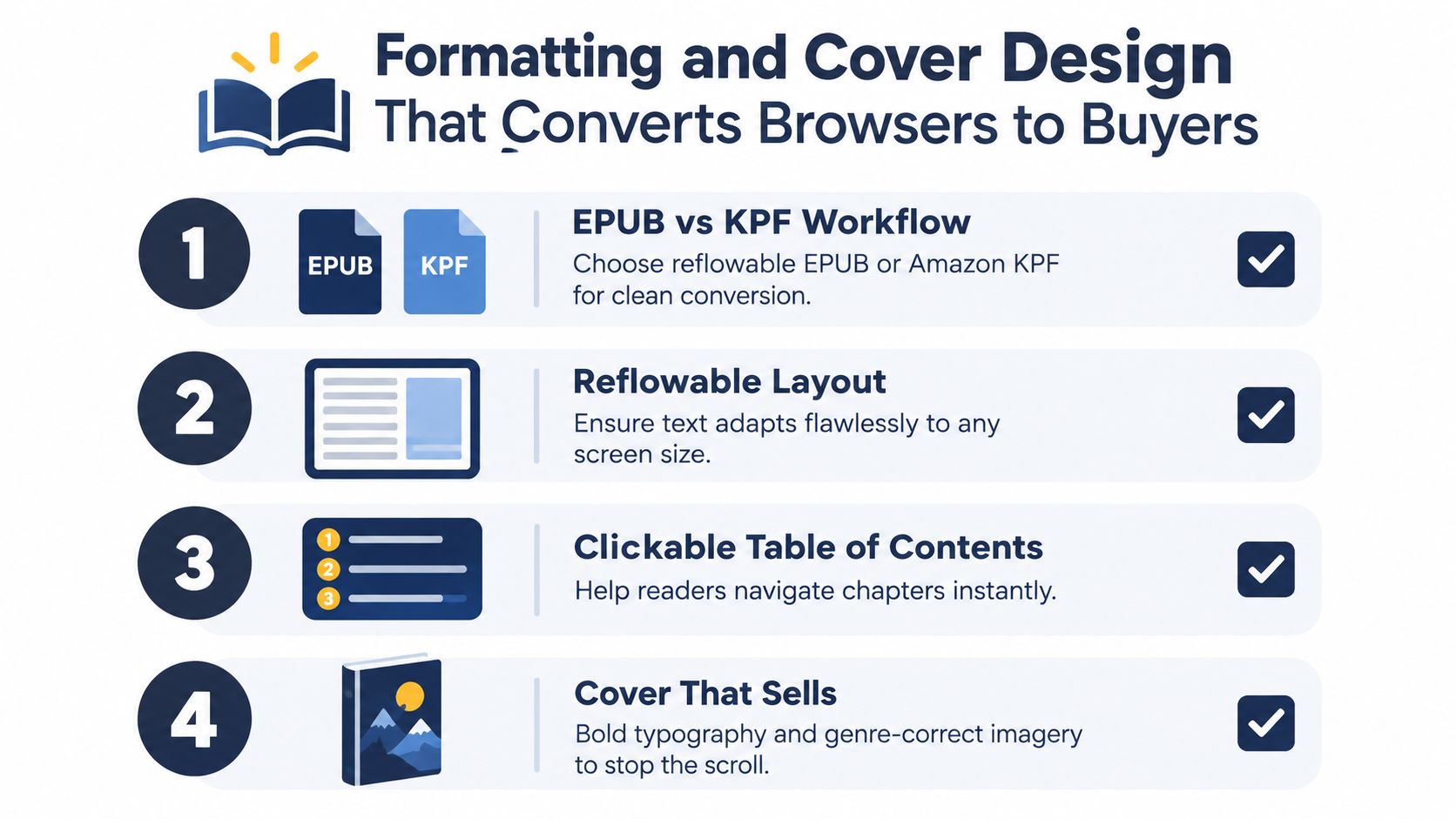
Choose a clean ebook workflow
For most self publish ebooks projects, the right goal is a reflowable ebook. Reflowable files let text adapt to different screen sizes and reader settings. That's what readers expect from fiction, memoir, narrative nonfiction, and most standard trade books.
Use a workflow built for ebook distribution:
- EPUB for broad retailer compatibility
- KPF if you're building specifically for Amazon through Kindle Create
- MOBI is no longer the format to build around for modern production
A good ebook file should include:
- Linked table of contents so readers can jump between chapters
- Consistent paragraph styling instead of manual spacing
- Embedded images only when necessary and tested for device behavior
- Simple front matter that gets readers into the book quickly
- Functional back matter with live links where retailers permit them
Here's a useful walkthrough before you move into production:
Common formatting mistakes that hurt reader experience
Formatting errors usually show up in samples and reviews. They make the book feel homemade even when the writing is solid.
Watch for these problems:
- Fancy fonts in body text that don't survive device rendering well
- Forced line breaks that create awkward spacing on smaller screens
- Images used as chapter headers that scale poorly
- Missing scene break consistency that confuses readers
- Broken hyperlinks in the contents page or back matter
The best-formatted ebook is the one readers don't notice because nothing interrupts the reading.
For heavily illustrated books, cookbooks, manuals, or children's books, fixed-layout solutions may be more appropriate. But most authors overcomplicate standard ebook interiors. Simplicity tends to travel better across platforms.
Covers sell the click
An ebook cover has one job first: stop the scroll. It does not need to explain every plot point. It needs to signal what kind of reading experience the buyer will get.
Good covers usually share three traits:
| Element | What works | What fails |
|---|---|---|
| Typography | Clear title hierarchy, readable at thumbnail size | Thin scripts, crowded text, weak contrast |
| Imagery | Genre-appropriate visual cues | Mixed signals, unrelated stock art |
| Composition | One focal point and strong balance | Too many objects competing for attention |
Look closely at top books in your genre before briefing a designer. A thriller, business ebook, cozy mystery, and romantasy title should not look interchangeable. Genre conformity isn't creative surrender. It's reader communication.
Briefing a designer or service provider
If you hire a designer or formatter, give them better inputs. Send:
- A final manuscript, not a changing draft
- Comparable covers from your genre
- Back cover copy or retailer description
- Series information, if the book belongs to one
- Platform targets, such as Amazon-only or wide distribution
You can use freelancers, specialized ebook formatters, or a full-service option such as BarkerBooks if you want one team to handle editing, cover, formatting, and upload support. The key is to judge the output by retail readiness, not by how impressive the file looks on your own laptop.
ISBN Copyright and Essential Setup Before You Distribute
Administrative setup feels less exciting than design, but many ebook launches get messy. Authors duplicate identifiers, use inconsistent metadata, or upload to the wrong places in the wrong order.
Good setup is simple. Decide what identifier strategy you need, secure your rights documentation, and prepare retailer metadata before you open any dashboard.
ISBN decisions and copyright protection
Not every ebook distribution path requires you to supply your own ISBN. Some platforms can list an ebook without one, while certain distribution workflows and cataloging preferences make an ISBN useful.
The practical question isn't “Do all ebooks need an ISBN?” It's “Will this distribution plan benefit from one?” A focused guide on whether you need an ISBN for an ebook can help you decide based on format and distribution goals.
Copyright is different. You already own the copyright to your original work when you create it, but formal registration can matter if you ever need to enforce your rights or document authorship. Many authors skip this until there's a problem. That's backwards. Handle it while your files and publication details are organized.
Metadata is setup, not an afterthought
Retailers use metadata to understand where your book belongs. Readers use it to decide if your book is for them.
Prepare these before uploading anywhere:
- Title and subtitle that match your cover exactly
- Author name and series name in consistent form
- Book description with a strong opening and clean formatting
- BISAC categories that fit the book
- Keywords based on reader search behavior, not writer jargon
- Publication date and edition details kept consistent across platforms
Weak metadata usually looks like this: broad category selection, keyword stuffing, and vague descriptions full of theme words but no market signal. Strong metadata is precise, readable, and aligned with reader intent.
If your categories are wrong, the retailer can't help the right reader find you.
Direct, wide, and hybrid setup choices
Authors usually choose between three paths:
| Setup path | How it works | Best fit |
|---|---|---|
| Direct to one retailer | Upload yourself to a single platform first | Authors testing Amazon-first strategy |
| Wide direct | Upload separately to multiple retailers | Authors who want more control platform by platform |
| Aggregator plus direct | Use direct for a primary retailer and a distributor for others | Authors who want reach without managing every dashboard |
A clean setup sequence saves headaches later. Finalize metadata first. Then choose identifiers. Then complete copyright registration if you're doing it. Then upload.
Choosing Where to Distribute and How to Price Your Ebook
More than 3.5 million books enter the market each year. In that kind of crowd, distribution is not just a filing decision. It shapes where your ebook appears, how often retailers surface it, and whether your price helps discovery or suppresses it.
Many first-time authors focus on upload mechanics. The stronger approach is to treat store choice, exclusivity, and pricing as one operating system. A well-positioned ebook is easier to find, easier to compare, and easier to buy.
Ebook distribution platforms compared
| Platform | Reach and Strength | Royalty Model | Best For |
|---|---|---|---|
| Amazon KDP | Largest practical ecosystem for many indie authors, plus Kindle Unlimited option | Varies by pricing band and program choices | Authors prioritizing scale, Kindle visibility, and Amazon ads |
| Apple Books | Strong global digital storefront with direct customer base | Retailer royalty model varies by terms | Authors writing for Apple-centric audiences and international readers |
| Barnes & Noble Press | Recognizable retail brand with direct upload option | Retailer royalty model varies by terms | Authors wanting another major store presence beyond Amazon |
| Google Play Books | Broad device ecosystem and search adjacency | Retailer royalty model varies by terms | Authors seeking additional global reach and platform diversification |
The right choice depends less on ideology and more on sales behavior in your genre.
Amazon-first can work well for commercial fiction, especially if the book fits binge-reading categories and you plan to use Kindle promotions or Amazon ads. Wide distribution usually makes more sense for authors with direct audience access, nonfiction with platform-driven sales, or books that may sell internationally outside the Kindle ecosystem.
Exclusivity has a real upside. It can simplify launch logistics and concentrate your reviews, ads, and retailer activity in one place. It also creates dependency. If one retailer changes merchandising rules or ad costs rise, your whole ebook business feels it.
Wide distribution spreads that risk. It also creates more admin work, more retailer pages to monitor, and more variables when sales are slow.
A practical decision filter:
- Choose Amazon-first if your category performs strongly in Kindle, you want the simplest launch path, and you can support visibility with ads, promos, or a series read-through plan.
- Choose wide if you already reach readers through email, speaking, content, or communities that buy across platforms.
- Choose a staged hybrid approach if you want to test market response in one store first, then expand after the cover, description, and pricing prove themselves.
Pricing affects conversion and discoverability
Retailers reward books that convert. Readers notice price before they read a sample. That makes pricing a discovery tool, not just a revenue setting.
I usually advise authors to set price based on category norms, author maturity, and the job of the book. A first-in-series novel can justify a lower entry price because it is doing customer acquisition work. A specialized nonfiction title with clear utility can often hold a higher price if the packaging and sales copy support it.
Use this checklist before you set your launch price:
- Compare the top 20 books in your subcategory, not the entire genre
- Check whether the leading books are in KU, wide, or both
- Decide whether this title is meant to maximize read-through, lead generation, or margin
- Leave room for temporary discounts rather than pricing at the floor on day one
- Track one variable at a time if you test changes
Common pricing mistakes are predictable. Debut authors price high because the book took years to write. Others go permanently cheap without a traffic plan, which can reduce perceived fit without creating enough volume to matter. The worst setup is changing price, cover, blurb, and categories at the same time. Once that happens, you cannot tell what improved results.
Price is a positioning decision before it is a royalty decision.
Match your distribution model to your pricing plan
Distribution changes what pricing can do.
An exclusive Kindle launch gives you access to Amazon-specific promotional options, but your price strategy has to work inside that ecosystem. A wide launch gives you broader retail presence, but discounting and merchandising are less centralized, so consistency matters more. Neither path is automatically better. One is concentrated. The other is diversified.
Use this operational checklist before you publish:
- Confirm your list price fits the platform's royalty band
- Check whether your chosen price matches your ad budget reality
- Make sure every retailer page uses the same subtitle, series info, and description version
- Verify that preorder, launch, and promo pricing dates are correct
- Review each store page on desktop and mobile before sending traffic
Authors who sell steadily tend to be disciplined here. They do not treat distribution as a one-time setup task. They review store pages, adjust prices with a purpose, and watch for signs that the book is being shown to the wrong readers.
If you're building your own author site or launch page to support pricing tests and retailer links, a practical walkthrough on how to publish with the block editor can help if you're using WordPress and want cleaner release pages.
Launch Marketing and Your Final Pre-Publish Checklist
A quiet launch usually stays quiet. The strongest ebook releases don't rely on one tactic. They line up assets so the book has a clear page to land on, a reason for readers to care now, and a clean buying path once interest appears.
That doesn't mean you need a sprawling campaign. It means the pieces should connect.
Build momentum before the book goes live
An author landing page gives you one place to send readers. Your email list gives you a direct line that doesn't depend on retailer algorithms. ARC readers help seed early reviews and catch last-minute issues in the live file or description.
A useful starting point is a focused guide to how to market your self-published book, especially if you need a practical list rather than broad motivation.
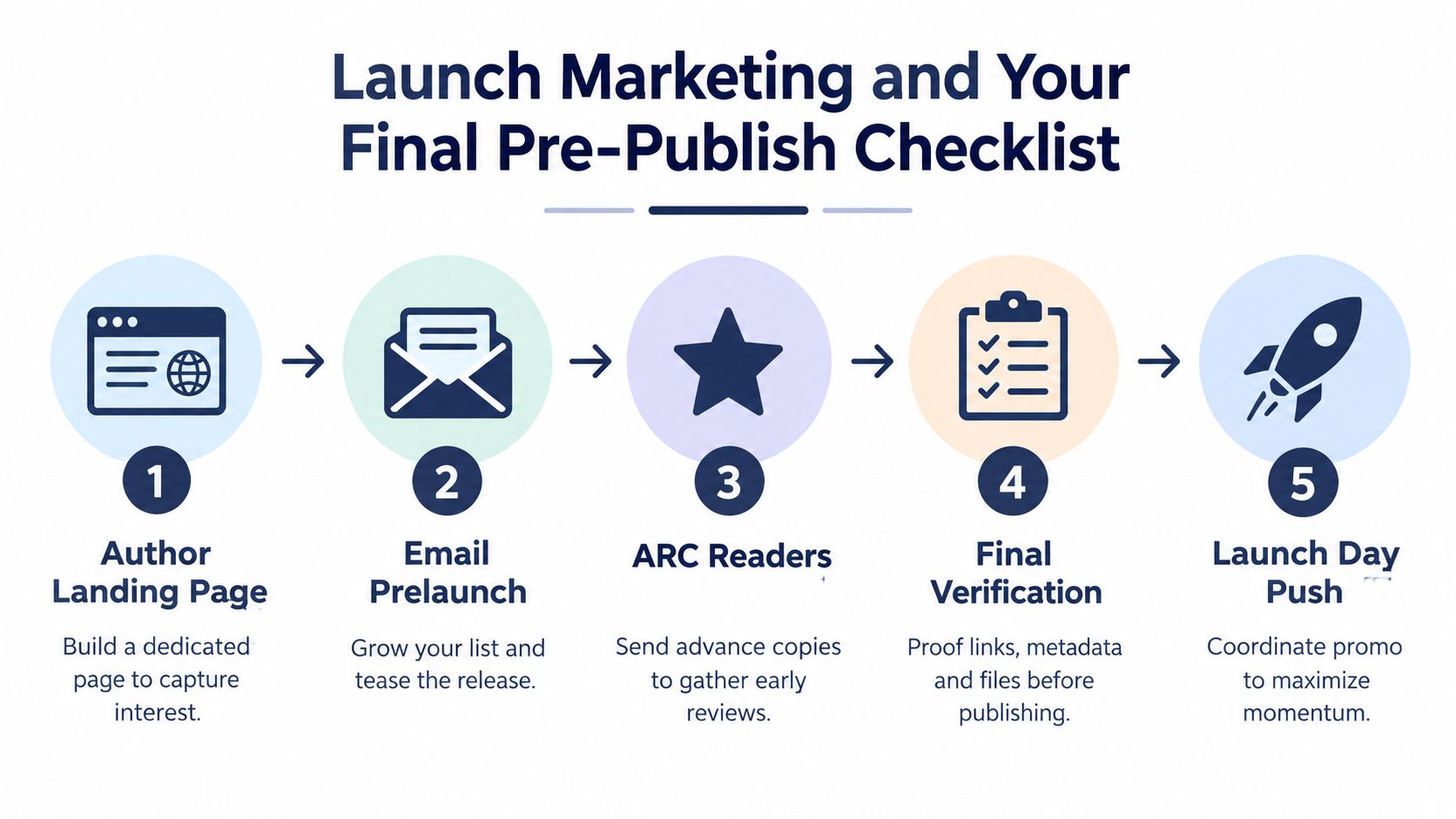
Use the prelaunch period to do work that compounds:
- Create a dedicated book page with description, cover, series context, and retailer links
- Recruit ARC readers early so they have time to finish the book
- Prepare email sequences for cover reveal, preorder or launch notice, and release reminder
- Collect final assets such as author bio, graphics, and short promotional copy
- Check retailer descriptions for formatting consistency across stores
What to verify before you hit publish
The final pass should be mechanical. Don't rely on memory. Use a checklist.
File check
Open the ebook on more than one device or app. Test chapter links, scene breaks, front matter, and back matter.Metadata check
Confirm title, subtitle, author name, series name, categories, and keywords match your planned positioning.Retail page check
Review the description for broken paragraphs, odd symbols, or pasted formatting artifacts.Price check
Make sure the launch price matches your promotion plan across every active retailer.Link check
Test website links, newsletter signup, and any back matter calls to action.Rights and territory check
Confirm you selected the correct territories and that no accidental exclusivity conflicts exist.
Publish the version you verified, not the version you think you uploaded.
The simplest launch sequence that still works
A workable release plan for many authors looks like this:
| Timing | Action | Purpose |
|---|---|---|
| Before release | Landing page, ARC distribution, metadata finalization | Build readiness and reduce launch friction |
| Release week | Email push, retailer link updates, audience outreach | Concentrate attention while the book is new |
| After launch | Review follow-up, ad testing, description and keyword refinement | Improve conversion based on real reader response |
The authors who do best with self publish ebooks usually aren't doing exotic marketing. They're doing the basics in order, with consistency. They launch a professional product, send readers to a clean page, ask for reviews politely, and keep improving the package after the book is live.
That's the job now. Not just publishing the ebook. Publishing it so readers can find it.
If you want help turning a finished manuscript into a retail-ready ebook, BarkerBooks handles the parts that usually slow authors down, including editing, cover design, formatting, ISBN and copyright support, distribution setup, and launch preparation. Visit BarkerBooks if you want a guided path from draft to published ebook without piecing the whole process together on your own.