
To write an historical novel well, start with exact dates and places, verify the lived details of that world, and keep only about 10% of your deep research on the page. Readers will forgive compression more easily than they'll forgive false notes, and one reader survey found 44% of complaints were about inaccuracies while 15% complained about excessive detail.
Most writers come to this genre with the same problem. They either love story and treat history like wallpaper, or they love history and bury the story under notebooks, archive tabs, and scenes that exist mainly to prove they did the homework.
The work is learning balance.
If you want to learn how to write an historical novel, the core skill isn't merely research. It's deciding what the reader needs now, what belongs in your private background file, and what must be invented because the record goes silent. That judgment is what separates an immersive novel from a clever costume piece.
Understanding the Research-Story Balance
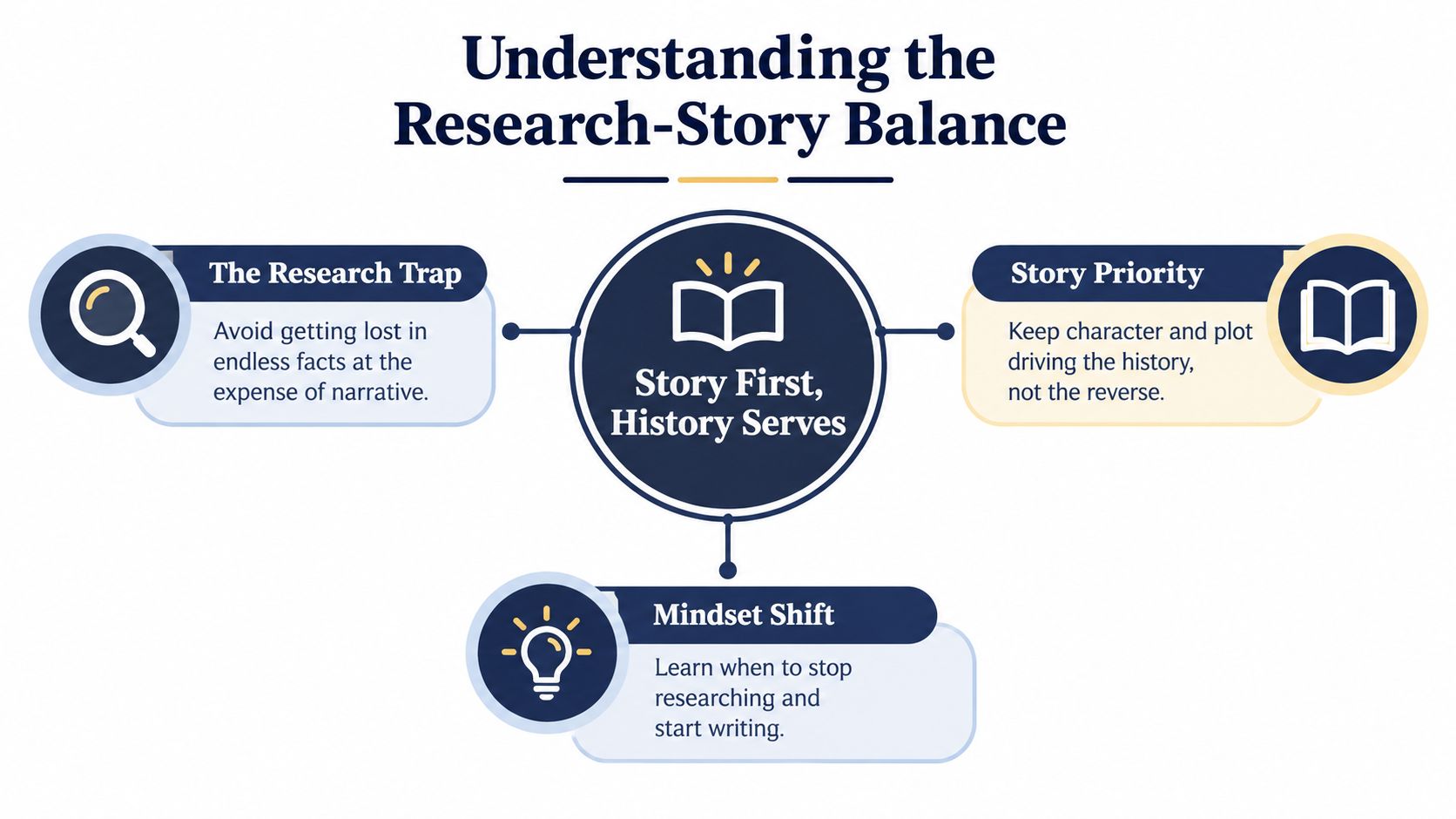
A new historical novelist usually falls into one of two traps. The first is thin research. The second is overresearch. The first gives you brittle scenes full of generic “olden times” gestures. The second gives you pages of carriage hardware, military ranks, tableware, and municipal politics that never become drama.
The old rule still holds: research deep, show little. A practical guide on historical-fiction research recommends identifying exact dates and places first, then verifying details such as food, clothing, travel, beliefs, and street life, while keeping only about 10% of the deeper research on the page as selected texture rather than exposition, as discussed in Novlr's guide to authentic history in fiction.
What selective detail looks like
A weak scene says, “It was 1872, and the town had many shops and horse-drawn vehicles.”
A stronger scene chooses one or two details that imply the rest. Mud drying on a hem. Lamp smoke caught in a boardinghouse curtain. A shopgirl counting coins with hands reddened by lye soap. The reader infers a world from specifics.
Practical rule: Put research on the page only when it sharpens conflict, deepens character, or orients the reader in a way the scene cannot do without.
That's the part beginners resist. If you spent two days learning how river traffic worked in your chosen city, you'll want to use all of it. Don't. The novel isn't a storage unit for research. It's an emotional experience.
What works and what doesn't
| Approach | What it does in a novel |
|---|---|
| Selective concrete detail | Builds trust and momentum |
| Research dumped in dialogue | Makes characters sound like lecturers |
| Era used as pressure on character | Creates genuine historical tension |
| History used as display knowledge | Slows pacing and flattens drama |
The balance becomes easier once you ask one hard question in every scene: what is this moment about? If the answer is grief, ambition, jealousy, fear, seduction, or betrayal, then the history should intensify that feeling. It should not compete with it.
When to stop researching and draft
Many writers delay the first chapter because they think one more source will make the book possible. Usually, one more source postpones the risk of writing badly. Drafting exposes what you don't yet know. That's useful. It turns abstract research into scene-level questions.
The cleanest process is often messy in practice. Draft until you hit a real knowledge gap, research that gap, then return to the manuscript.
That rhythm keeps history serving the novel instead of replacing it.
Building Authentic Settings and Dialogue
Your reader meets the past in a room before they trust it in a plot. A woman steps off a coach into a market square. If the mud, noise, prices, and forms of address feel generic, the whole novel starts to wobble, even if your dates are correct.
Authentic setting begins with limits. Pin down the year, month, district, weather, and social rank in the scene, then ask what those conditions permit. Who can enter the room without scandal. What can be bought that day. How far sound carries. Which smells would be ordinary enough to go unremarked. Specificity does more than decorate a chapter. It prevents accidental modern convenience.
A strong setting also gives you a framework for the gaps history leaves behind. Records rarely tell you everything about a boarding house kitchen in 1819 or a dockside tavern in 1893. They give fragments. Inventing inside those fragments is part of the job. The rule is simple. Fill gaps where the era gives you boundaries. Stop where invention would contradict known class habits, technology, law, religion, or geography.
Build the setting as pressure, not wallpaper
Writers often gather period objects before they understand period constraints. Start the other way around.
- Place characters precisely. Street, district, building type, distance from money, industry, docks, fields, or government power all shape behavior.
- Track daily logistics. Heat, light, sewage, laundry, food storage, wages, and travel time affect plot more than decorative antiques do.
- Use material detail to show status. One pair of good gloves, watered ale, lamp oil, imported sugar, or patched boots can do more than a paragraph of explanation.
- Write the era's assumptions into the room. What people fear, excuse, hide, or accept as normal usually matters more than what they own.
If you need help making setting carry story weight at scene level, BarkerBooks has a useful breakdown of the elements of a setting.
Use primary sources for voice, then translate for the reader
Library research guides for historical fiction regularly point writers toward letters, diaries, newspapers, memoirs, court records, etiquette manuals, and advertisements because those sources preserve the texture secondary histories often smooth out. The University of Cincinnati historical fiction library guide is a good starting point for finding that kind of material.
Primary sources help most with dialogue. They show what people avoided saying directly, how they softened insults, how they addressed strangers, and what counted as polite, vulgar, intimate, or absurd. They also reveal silence. That matters. In some periods, a character cannot speak openly about money, desire, race, grief, politics, or pregnancy without social cost.
Do not transplant source language line for line unless you want readers to struggle through it. Novel dialogue needs compression. My rule is to borrow period rhythm and pressure, then cut what a modern reader would need footnotes to decode.
A decision framework for dialogue gaps
You will hit moments the archive cannot answer cleanly. No source will hand you the exact words your blacksmith, governess, clerk, or smuggler would use in your scene. Use a filter.
- Check the social relationship first. Rank, kinship, region, and setting determine speech more reliably than decorative old-fashioned wording.
- Preserve the period taboo. If a modern phrase names a feeling too neatly, replace it with something indirect, concrete, or socially acceptable for the time.
- Keep only a light period signal. A few era-true address forms, sentence shapes, and idioms go a long way.
- Cut accidental exposition. Characters from the same world do not explain their own customs to each other for the reader's sake.
- Choose readability when the evidence is split. Readers forgive restraint faster than they forgive dialogue that sounds staged.
This is also where market awareness helps. Readers looking for historical romance, book club historical, mystery, or literary crossover often want different densities of period language. A Napoleonic officer can sound more formal than a heroine in a wide-market Gilded Age novel, but both still need clarity. The current market has room well beyond the usual WWII shelf, yet the books that travel best across subgenres share one trait. They feel researched without sounding trapped inside research.
A useful discussion of voice and period texture can also come from watching how experienced writers think through research choices in practice:
If readers notice your dialogue, let it be for control. The voices should sound like people of their time under pressure, making choices they believe are sensible. That is what convinces.
Developing a Dual Timeline Workflow
You draft a strong chapter around a funeral, a missed letter, and a hasty engagement. Then you check the dates and discover the river was frozen, the post would not have arrived for days, and the church your family uses had not opened yet. That kind of error is common in historical fiction, and it is expensive to fix once the manuscript is built.
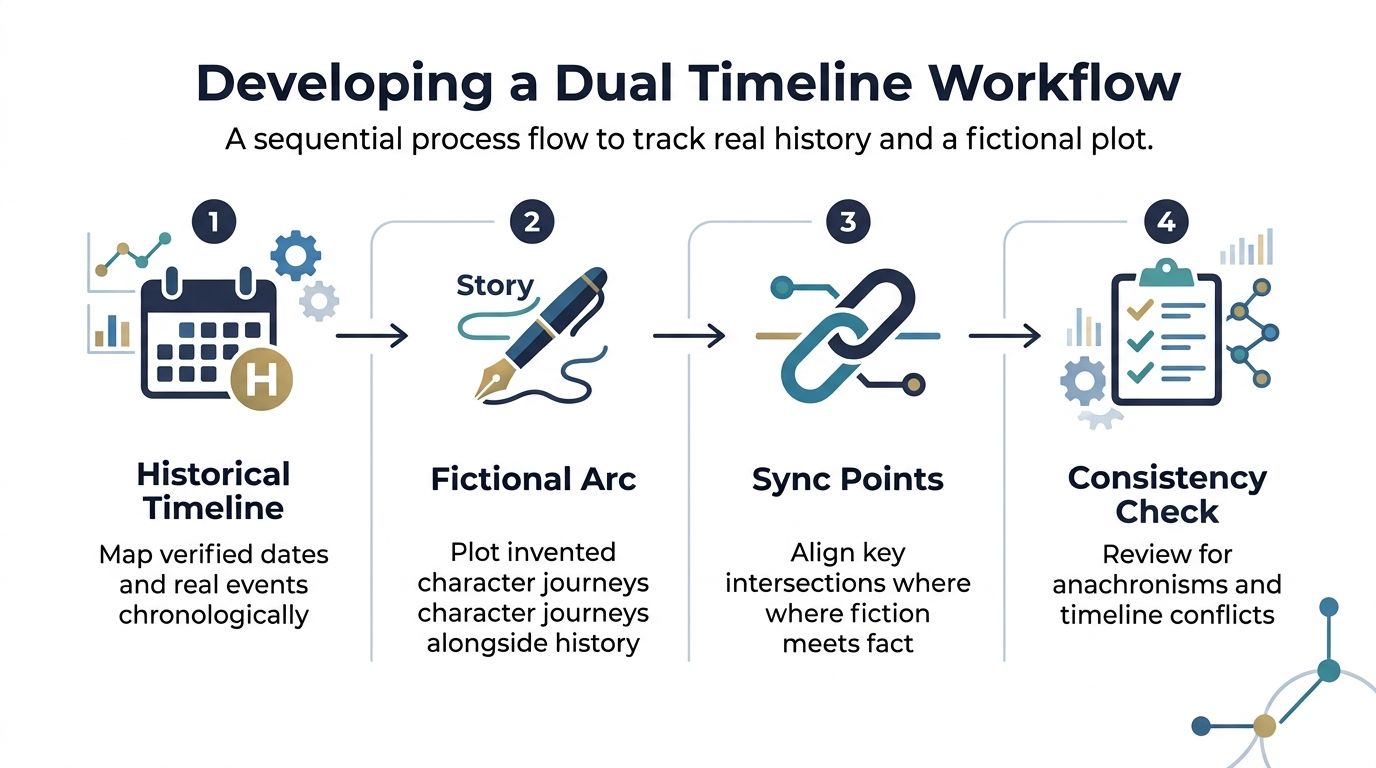
A dual timeline prevents that damage early. Keep one track for the verified historical record and one for your invented plot, and force them to stay in conversation from the first outline onward.
Keep two tracks visible at once
One line holds the public world. Elections, strikes, court rulings, troop movements, ship schedules, epidemics, weather events, harvest failures, scandals.
The other line holds the private story. Births, inheritances, debts, betrayals, courtships, relocations, illnesses, disappearances, deaths.
The useful part is not the format. It is the friction.
When those lines meet, you can test the novel scene by scene. Could your character reach that city in time? Would that business still be open on that date? Would a widow in that district still be in seclusion? These are story questions, not just research questions, because each answer changes pacing, motive, and consequence.
A simple working model
| Timeline | What belongs on it |
|---|---|
| Historical | Verified dates, public events, real people, legal changes, transport and technology limits |
| Fictional | Character beats, scene dates, travel time, reversals, secrets, off-page actions |
| Sync points | Moments when your plot depends on the verified historical record |
I also recommend one extra column: decision pressure. Mark any point where history constrains the story, where the story can move freely, and where the archive is silent. That distinction matters because not every gap deserves the same treatment. Some scenes need strict adherence to the record. Others can absorb invention without straining belief.
This is also where market awareness starts shaping craft. If you are writing outside the crowded WWII shelf, and many writers should, timeline discipline becomes a selling strength. Readers of Gilded Age family drama, Jazz Age crime, postwar migration stories, Regency mystery, medieval survival fiction, or 1970s political novels often come in with different expectations about public history. Some want major events tightly braided into the plot. Others want the period to press on the characters more indirectly. A dual timeline lets you choose that balance on purpose instead of discovering it halfway through revisions.
Choose a workflow you will actually maintain
Use a spreadsheet, index cards, Aeon Timeline, or a paper wall chart. The tool matters less than whether you can scan cause and effect in seconds.
Writers who love discovery drafting often resist this step because it feels like pre-emptive bureaucracy. I understand that. The trade-off is simple. A loose system gives you spontaneity now and larger repairs later. A visible timeline slows the opening phase a little, but it protects the middle of the book, where historical novels often start to sag under accumulated date errors and logistical strain.
If your manuscript has multiple viewpoint characters or a braided structure, pair the timeline with a clear scene map. BarkerBooks' guide on how to structure a novel is useful here because the timeline and the story architecture need to support each other.
Why this method saves revisions
Historical mistakes rarely stay isolated. One wrong date can distort travel time, inheritance law, military service, pregnancy timing, newspaper reaction, and who knew what when.
Keep a column labeled “proof status.” Mark each item as verified, probable, disputed, or invented.
That single habit sharpens later decisions. It also prepares you for the harder work in historical fiction: deciding which gaps require restraint, which allow invention, and which should force a plot change before you get attached to the wrong scene.
Filling the Gaps with Informed Imagination
This is the hardest part of writing historical fiction, and the advice writers often get is too vague. “Fill the gaps” sounds liberating until you sit down with a real person, a fragmentary archive, and a scene you badly want to invent.
The better question is not “what can I make up?” It is what can I invent that remains plausible under scrutiny?
A useful gap in much historical-fiction advice is the lack of a concrete decision framework for judging invention when the record is silent. Guidance has begun to call this out directly, especially around plausibility, point-of-view bias, and documenting deviations in a historical note, as argued in Writers & Artists' discussion of bridging unknown history with imagination.
A five-part test for invented material
When the archive gives you silence, run the scene through these questions:
Is the invention compatible with what is known?
If dates, class position, geography, religion, or custom would make the scene unlikely, don't force it.Would someone of this period plausibly think this way?
The danger isn't only factual error. It's importing modern sensibility where the era would have offered different assumptions.What is the source bias?
If your surviving record comes from officials, husbands, colonizers, newspapers, or courtroom witnesses, it may distort the missing person's experience. Invention can correct for silence, but it mustn't become fantasy dressed as justice.Does the scene solve a narrative need or merely satisfy curiosity?
Invent only where the story requires emotional or causal continuity.Can you defend it in an author's note?
If you'd feel evasive explaining your choice, the invention may be too loose.
Distinguish interpretation from fabrication
Not all invention is equal. These are different moves:
- Interpretation: Choosing among plausible motives suggested by the record.
- Compression: Combining events or minor figures for narrative clarity.
- Fabrication: Creating scenes, relationships, or decisions unsupported by evidence.
Interpretation is often necessary. Compression can be responsible. Fabrication is where trust gets tested.
A reader will usually follow you into invention if the invention feels earned by context, pressure, and period logic.
When real people are involved
Writers become bolder than they should when a person left few records. Sparse evidence is not permission to project anything convenient.
Use this short comparison:
| If the record shows | Safer move | Riskier move |
|---|---|---|
| Conflicting accounts | Choose one and explain the choice in a note | Pretend certainty |
| No record of motive | Build motive from circumstance | Insert modern values without support |
| Missing years | Create plausible continuity tied to place and class | Invent sensational turns for drama alone |
A good historical note isn't academic decoration. It tells the reader where you adhered closely, where you compressed, and where you invented. That honesty builds trust, especially if you're adapting family history or writing about people who cannot answer back.
Identifying Market Trends and Subgenres
A manuscript can be beautifully researched and still struggle if it enters the market as a familiar version of a familiar thing. That doesn't mean chasing trends blindly. It means understanding where sameness is crowded and where freshness is easier to notice.
One underserved angle in historical-fiction advice is market positioning beyond generic authenticity tips. Recent coverage points to attention moving beyond the usual World War II template toward the 1920s, 1930s, East Asia, and genre hybrids such as historical romance, fantasy, and magical realism, as discussed in Author Money's look at newer historical-fiction directions.
What that means for your book choice
If you're still choosing among several possible projects, don't ask only which era fascinates you. Ask which era gives you both passion and distinction.
A crowded setting isn't impossible. It just demands a sharper angle. If you write World War II, for example, you may need a less familiar geography, a different social lens, or a structure that feels unlike the standard wartime novel. If you write in the interwar decades or an East Asian setting, novelty may come more naturally, but the research burden often rises because you can't lean on stock assumptions.
A practical positioning grid
Consider your idea through four lenses:
Era freshness
Is the setting overused in your target market, or does it feel less expected?Geographic angle
Are you writing a place readers see often, or one they rarely encounter in mainstream historical fiction?Subgenre engine
Does the book also operate as romance, mystery, fantasy, family saga, or magical realism?Reader promise
What emotional experience are you offering beyond “a story set in the past”?
That last question matters most. Readers don't buy “research.” They buy immersion, tension, heartbreak, sweep, danger, wit, or obsession.
Hybrid forms that often feel alive
Hybridization works when the historical frame and the genre engine strengthen each other. A romance can expose class rules and marriage markets. A fantasy element can literalize folk belief or colonial fear. Magical realism can carry memory, myth, or inherited trauma without flattening the history into realism alone.
What doesn't work is adding a subgenre label after the fact because it sounds commercial. If the supernatural element could be removed without changing the novel, it probably belongs elsewhere.
Market awareness should guide selection and framing, not replace conviction. Readers can tell when a writer chose a period because it looked strategic rather than necessary.
The strongest historical novels tend to feel specific in both directions. Specific about the past. Specific about the kind of reading experience they're delivering now.
Drafting, Editing, and Preparing for Publication
Once the research base is sturdy, you need pages. Many historical novels die in planning because the writer mistakes preparation for progress. Draft the first act before the entire archive is perfect. The early chapters will tell you what you need to know.
Draft with placeholders, not panic
When you hit a small uncertainty, don't stop for half a day unless the answer changes the scene's logic. Use placeholders. Mark the missing carriage route, title, menu item, newspaper name, or military term and keep moving.
That approach protects momentum. It also reveals which research questions are structural and which are decorative.
A selective-depth method helps here. Historical-fiction advice often recommends starting with broad histories, then narrowing only to facts needed for specific scenes and applying a “necessity test” to avoid rabbit holes. The same reader survey cited in Historia Magazine's advice on researching a historical novel found 15% of readers flagged pacing, plot, and character issues, a reminder that accuracy alone won't carry a novel.
Edit for historical fiction, not just prose
Your second draft needs a different eye from your first. You aren't only improving sentences. You're checking for pressure points unique to the genre.
Use a revision pass like this:
Chronology pass
Verify seasons, dates, ages, travel times, and public events against your timeline.Language pass
Remove modern idiom, flattening clichés, and dialogue that sounds researched rather than spoken.Social logic pass
Check whether characters face the actual constraints of their class, sex, religion, profession, and location.Exposition pass
Cut any paragraph that exists mainly to display knowledge.
If you want outside help at this stage, a developmental editor can identify where research has overwhelmed story or where the plot leans on assumptions the manuscript hasn't earned. BarkerBooks offers that kind of support among many editorial paths, and if you're weighing what this level of editing does, their overview of what developmental editing is gives a clear baseline.
Revision in historical fiction is often an exercise in subtraction. The book usually gets stronger when you remove the facts the reader doesn't need.
Think past the manuscript
Publication asks a different set of decisions. Are you querying agents, going directly to independent publishing, crowdfunding a special edition, or releasing in multiple formats?
If you plan a reader-supported release, study a practical step-by-step book Kickstarter launch before you design rewards or set a campaign schedule. Historical fiction can lend itself well to editions with maps, notes, appendices, or archival extras, but those elements need planning.
Before submission or launch, make sure you've handled the less romantic essentials:
- Proofreading: Final cleanup after line edits.
- Cover direction: The design must signal era and subgenre clearly.
- Interior layout: Especially important if you include maps, notes, or a cast list.
- Author note: Explain major deviations, compressions, and invented material.
A publishable historical novel feels confident in two ways. The story moves. The history holds.
If your manuscript needs help getting from research-heavy draft to publishable novel, BarkerBooks offers editorial, design, formatting, and publishing support that fits this exact stage of the process. If you've got a draft, an outline, or even a historically grounded idea that needs structure, it's worth visiting them to see how they can help turn it into a finished book.