
You've got the interviews, the notes, and perhaps a stubbornly unfinished manuscript sitting in a folder. Your calendar is full, the launch date keeps moving, and every adviser repeats the same promise: a book can become the most credible business card you own. The difficult question isn't whether you need help. It's which kind of book ghostwriter you should hire, what that person should deliver, and how to prevent a costly mismatch.
The market gives buyers plenty of choice, but choice without scope discipline creates trouble. A polished website can conceal weak research habits, vague revision terms, or a writer who has never handled your genre. Treat the engagement as an investment tied to an outcome, not as a vanity purchase. Your goal might be a publishable memoir, a thought-leadership asset, a stronger speaking platform, or a book that supports a larger publishing and media plan.
Why You Might Need a Book Ghostwriter in 2026
A founder can have a powerful idea and still fail to turn it into a coherent manuscript. The familiar pattern is a half-finished draft, an increasingly unrealistic deadline, and too little uninterrupted time to solve structural problems. Established professionals often know what they want to say, but they don't have the hours required to research, outline, draft, revise, and fact-check a book.
A ghostwriter solves that capacity problem by taking ownership of the writing process while keeping the author at the center of the ideas, experience, and decisions. The arrangement works when the author supplies access, judgment, and timely feedback, while the writer supplies structure, prose, and project momentum.
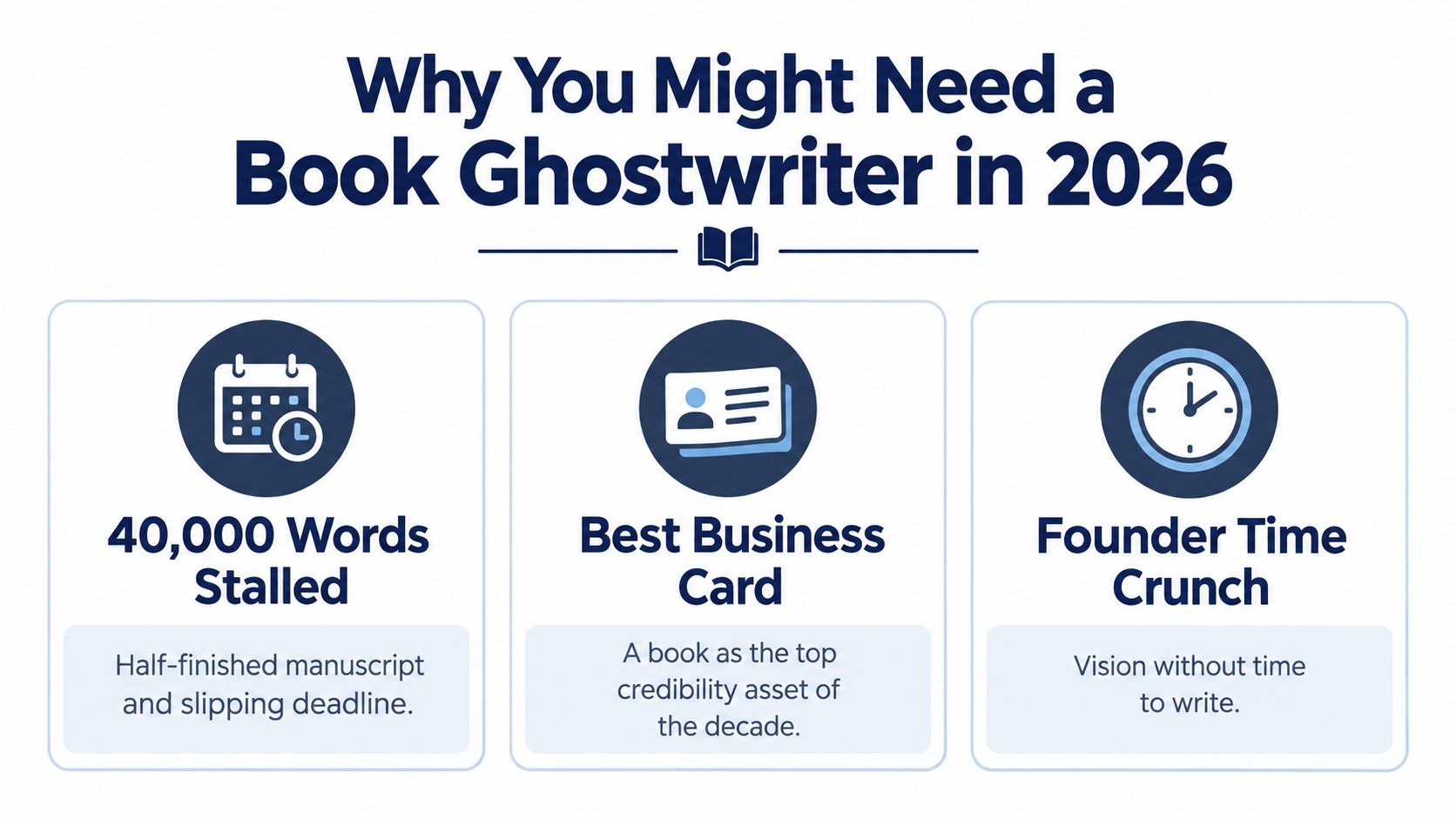
Three pressures behind the decision
Time poverty is the first pressure. A chief executive, physician, investor, or consultant may have enough material for a book but no reliable writing rhythm. Delegating the drafting doesn't remove the author's responsibility. It concentrates that responsibility into interviews, source review, decisions, and feedback.
Credibility is the second. A podcast appearance or a strong professional biography can establish familiarity, but a finished book gives readers a durable expression of your method and point of view. That's also why a ghostwriter must understand communication, not merely grammar. Resources such as Intonetic on communication confidence can help professionals clarify how their spoken authority should translate onto the page.
Technology is the third. AI-assisted transcription, research organization, and editorial workflows can speed up parts of the process. They haven't replaced the human work of choosing the right story, challenging a weak argument, recognizing a meaningful contradiction, or making a reader care about the outcome.
Start with the result you want. Then decide how much of the process you need to delegate, which genre skills matter, and how closely the writer must work with you. That sequence is more reliable than searching for a generic “best” ghostwriter.
What Book Ghostwriters Actually Deliver
A book ghostwriter is usually hired to turn raw material into a coherent manuscript. That work has three separate components: developmental structure, voice-led drafting, and revision. Confusing those components is one of the fastest ways to overpay or end up with a book that technically exists but doesn't represent the author.
Developmental work creates the book's architecture. The writer tests the central promise, arranges chapters, identifies missing evidence, and decides where personal stories, examples, or research belong. Drafting then turns that architecture into prose that sounds like the author rather than the ghostwriter. Revision is where the collaboration becomes precise, because the author can challenge emphasis, tone, facts, and interpretation.
The category itself is commercially mature. One market analysis estimates modern ghostwriting services at USD 817.8 million in 2025, with book ghostwriting representing USD 425.55 million, or about 52.0% of global revenue; it projects the overall market to reach USD 1.52 billion by 2032 at a 9.3% CAGR. The market analysis shows why buyers encounter such different offers. Book projects dominate the category, but the people selling them range from independent writers to full-service agencies.
Separate the manuscript from the extras
A writer may research and draft your book without handling publishing, publicity, or launch execution. Don't assume those services are included because the sales page uses broad language such as “full support.” For brand-building beyond the manuscript, separate guidance such as these PR writing tips for brand authority belongs in a communications plan, not inside a ghostwriting brief.
| Deliverable | Usually Included | Usually Extra |
|---|---|---|
| Book structure | Outline, chapter sequence, and central argument | Publishing proposal or agent submission |
| Drafting | Manuscript written in the agreed voice | Additional books, articles, or social content |
| Research | Agreed interviews and supplied source material | Extensive travel, specialist research, or new reporting |
| Revisions | The rounds specified in the contract | Unlimited rewrites or changes to the approved structure |
| Editorial finish | Structural refinement and manuscript polishing | Independent copyediting, proofreading, or legal review |
| Rights | Transfer terms stated in the agreement | Royalties, licensing administration, or foreign-rights work |
A reputable ghostwriter won't guarantee bestseller status. They aren't selling a byline either. They're selling judgment, writing skill, discretion, and a defined production process. Those deliverables change sharply across the budget tiers, so compare the scope before comparing the quote.
Budget Freelancer, Specialist, or Premium Partner
The right tier depends on the book's commercial purpose, your tolerance for managing the process, and the amount of editorial risk you can absorb. A low quote isn't automatically poor value, but it usually requires more work from the author. A premium fee isn't automatically justified either. The writer still needs to prove that their experience matches your subject and audience.
| Tier | Typical Price Range | Best For | What You Get |
|---|---|---|---|
| Budget freelancer | Lower-cost project or word-based quote | A short business book, personal project, or author with a strong editor | Drafting support, basic interviews, and limited revisions |
| Mid-tier specialist | Mid-market project fee | Most nonfiction thought-leadership books | Genre experience, structured interviews, outlining, drafting, and defined revision rounds |
| Premium partner | High-value flat project fee | A debut author seeking close management and publishing guidance | Developmental strategy, project management, senior writing, and selected publishing support |
The budget freelancer
Choose this tier when your manuscript already has a strong outline and your source material is organized. You should also have someone capable of reviewing structure, accuracy, and voice. This model can work for a memoir side project or a concise business book, but it becomes expensive in management time when the writer needs constant direction.
The mid-tier specialist
This is the sensible choice for most executives and professionals. A specialist who has handled comparable titles can challenge your thesis, recognize familiar business-book clichés, and shape your experience into a useful reader journey. A 2024 survey of working ghostwriters found that 25% charged at least USD 100,000 for their last nonfiction manuscript, 8% charged more than USD 150,000, and one-third reported annual ghostwriting income above USD 100,000. The same survey found that 50% charged USD 10,000 to USD 20,000 for a nonfiction proposal, according to Publishers Weekly's coverage of the survey. Those figures don't define your quote, but they demonstrate how specialized the service can be.
The premium partner
Pay for this tier when the book is central to a larger authority or publishing strategy and you need someone to manage complexity. Premium partners may coordinate interviews, developmental decisions, editorial handoffs, and publishing conversations. Ask what is included. “Premium” should describe a measurable increase in responsibility and judgment, not just a more impressive presentation.
For a practical discussion of pricing variables, review how much a ghostwriter costs before requesting proposals. Then ask each candidate to quote the same scope. Without that control, you're comparing different products under the same label.
Vetting Portfolios, Samples, and References
Start with evidence, not personality. A charming discovery call can tell you whether communication feels easy, but it can't prove that a writer can sustain your voice across a full manuscript. Read the portfolio with an editor's eye.
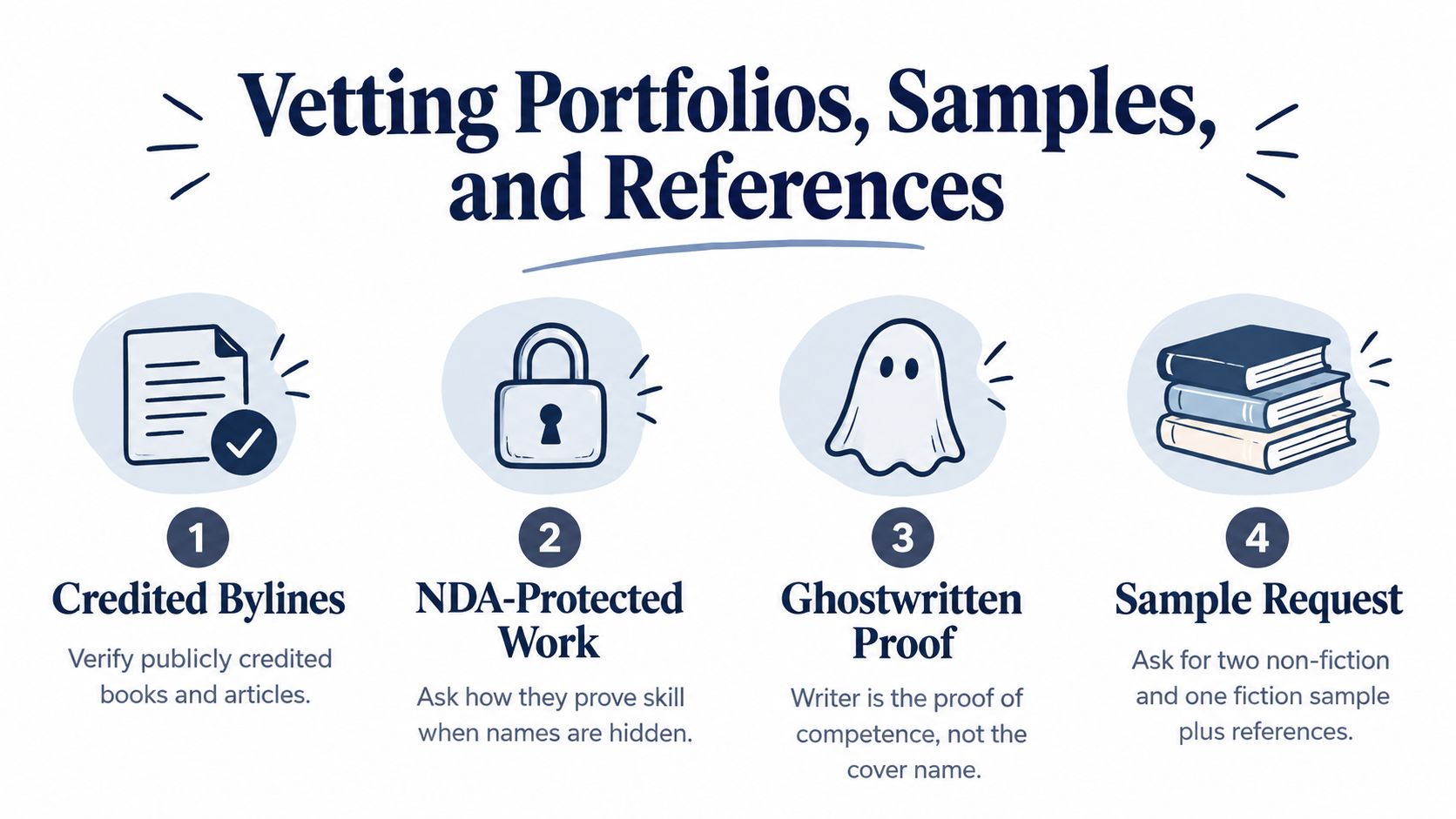
Separate three kinds of proof:
- Credited bylines: Verify books, articles, or essays the writer can publicly claim.
- NDA-protected work: Ask how the writer demonstrates skill when client names and titles must remain private.
- Ghostwritten titles: Look for acknowledgments, publisher information, or references that confirm the writer's role without exposing confidential material.
Test the work in sequence
Request samples that resemble your project. For a writer working across genres, ask for two nonfiction samples and one fiction sample when relevant to your search. You're looking for range, but you're also checking whether the writer's own voice overwhelms every assignment.
Then run a paid trial chapter. Don't ask for a speculative full manuscript. Give the writer enough source material to show how they handle interviews, transcripts, notes, and your existing prose. The trial should reveal whether they can absorb information and create an original argument rather than paraphrasing what you supplied.
The most useful sample is the one produced under your brief, with your material, and followed by one revision pass.
Assess four signals:
- Voice match: Does the revised chapter sound like you, or like a generic professional writer?
- Research handling: Does the writer distinguish your experience from supporting evidence and identify gaps?
- Responsiveness: Do they answer precise questions and flag risks before they become delays?
- Commercial awareness: Can they explain the reader, promise, positioning, and practical use of the book?
Score each candidate from 1 to 5 on those four dimensions. The scale isn't scientific. It forces you to compare candidates on the same criteria instead of choosing whoever had the strongest sales call.
Check LinkedIn, published-book acknowledgments, and references from authors who have already completed publication. Ask references what they would change about the working relationship. That question produces more useful information than “Were you happy?”
For a broader search process, use this guide on how to find a ghostwriter, but keep the paid trial as your decisive filter.
Locking Down Scope, Contracts, and Rights
The contract should make the project boringly clear. If the agreement says “a book” without specifying what that means, both parties are free to imagine a different deliverable. Put the scope in chapter counts, word ranges, research responsibilities, deadlines, and revision limits before drafting begins.
Industry guidance specifically warns buyers about vague deliverables, weak revision policies, and large upfront payments. It recommends defining genre, target word count, tone, deadline, revision limits, copyright transfer, and cancellation terms, while using a payment schedule that avoids paying more than about one-third of the total fee upfront. See this ghostwriting scope and pricing guidance for the reasoning behind those safeguards.
Clauses that prevent predictable disputes
| Clause | What to Specify |
|---|---|
| Deliverables | Chapter count, target word range, format, research tasks, and final files |
| Milestones | Outline approval, draft stages, revision dates, and final delivery |
| Revisions | Number of rounds, what counts as a revision, and fees for structural changes |
| Payment | Deposit, milestone payments, final balance, invoices, and late-payment terms |
| Rights | Copyright transfer, work-for-hire language where applicable, and transfer timing |
| Confidentiality | Manuscript, interviews, business information, identity, and source materials |
| Credit | Acknowledgment language, public disclosure, or no-credit terms |
| Termination | Notice period, kill fee, unfinished drafts, and transfer of source files |
| Materials | Return or destruction of recordings, notes, transcripts, and research after publication |
Rights deserve special attention. State that ownership transfers on final payment, define whether work-for-hire language applies in your jurisdiction, and include a moral-rights waiver where enforceable. Don't rely on an informal promise that “the book is yours.” Copyright, credit, confidentiality, and the treatment of unfinished work need separate language.
Tie payment to completed milestones rather than calendar dates alone. If the outline is not approved, the drafting stage shouldn't begin. If the writer stops work, the agreement should explain what happens to paid-for chapters, source files, notes, and future obligations.
Use a readable agreement, but don't confuse plain English with incomplete protection. A ghostwriting contract template can help you identify the clauses that need discussion. For sensitive memoir material, proprietary business information, or potentially defamatory claims, obtain qualified legal advice before signing.
Managing the Collaboration From Brief to Manuscript
A productive collaboration has a rhythm. Consider a representative nonfiction business book with an author who has a clear idea, a collection of interviews, and limited time for drafting. The writer's job is to turn that material into a manuscript. The author's job is to remain available enough to make decisions quickly.
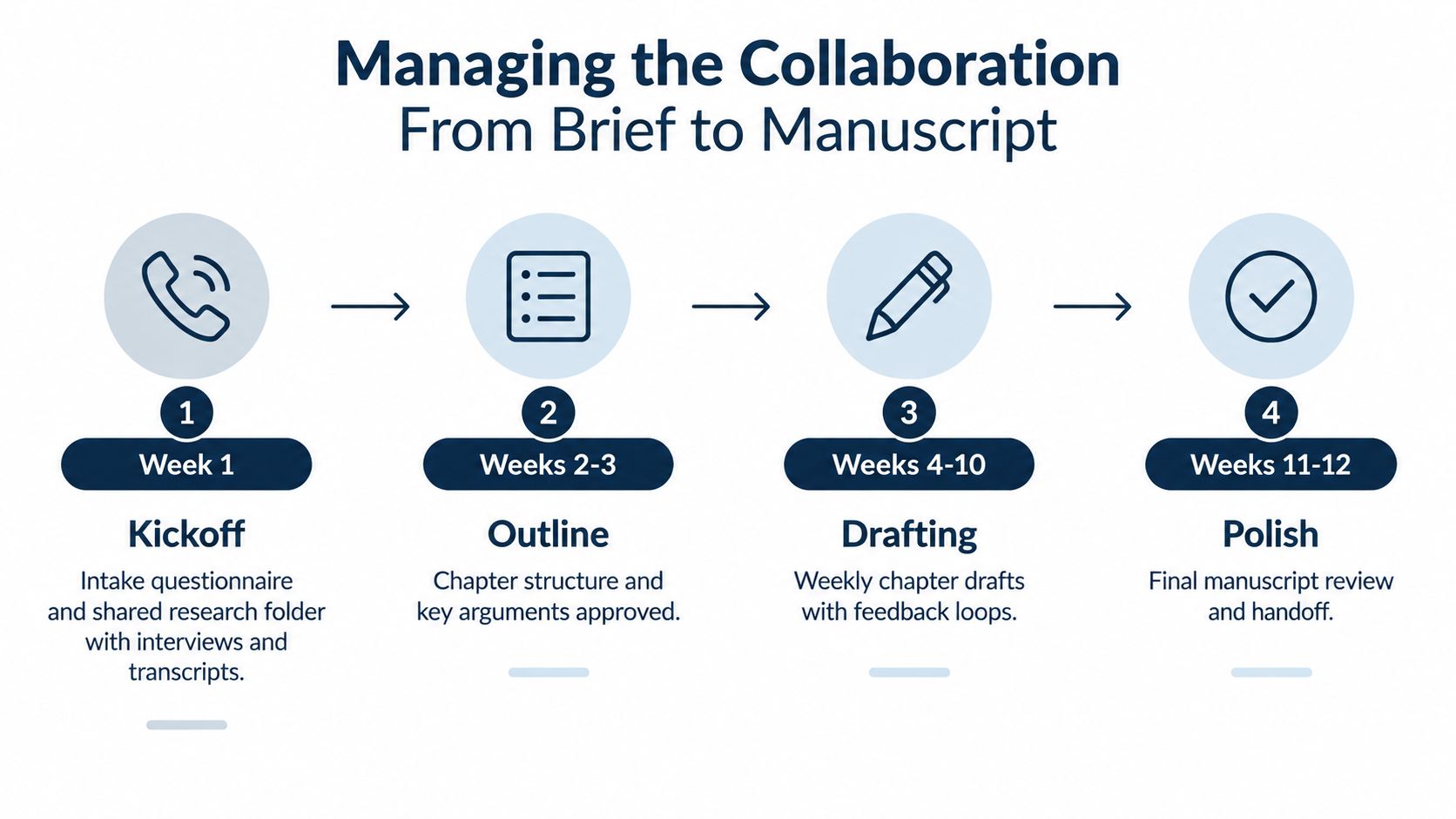
A working production calendar
Week 1 begins with intake. The author completes a detailed questionnaire, joins a kickoff call, and opens a shared research folder. Interviews, transcripts, previous articles, presentations, customer stories, and relevant source material should have clear labels. A writer shouldn't have to search through an unstructured inbox to discover the book's central evidence.
Weeks 2 and 3 focus on the outline. The writer produces the chapter sequence, the book's thesis, and the key argument for each chapter. The author marks up the outline in one concentrated pass. Scattered comments arriving across several weeks create contradictory instructions and slow structural decisions.
Weeks 4 through 9 are for rolling drafts. Deliver two chapters at a time, then return structured feedback quickly enough for the writer to stay inside the author's voice. Comments should identify the problem and the desired effect. “This doesn't sound like me” is a starting signal, not an editorial instruction.
Week 10 is the full-manuscript read. The author reviews continuity, factual accuracy, repeated ideas, and missing transitions. The revision pass should focus on approved changes, not a late redesign of the entire book.
Week 11 covers delivery and handoff. The writer supplies the final manuscript and source files, and both parties review remaining questions about positioning or media materials if those items are included in the agreement.
The strongest clients don't disappear after the kickoff. They answer questions, approve decisions, and tell the writer when a passage feels false. The strongest writers don't accept every request. They explain the editorial consequence of a change and protect the manuscript's coherence.
A process video can make the handoffs easier to visualize:
Your Pre-Hire Checklist Before You Sign
Before you send a deposit, force the project through four yes-or-no decisions. If any answer is no, pause the hiring process. The problem is probably not the writer. The brief isn't ready.
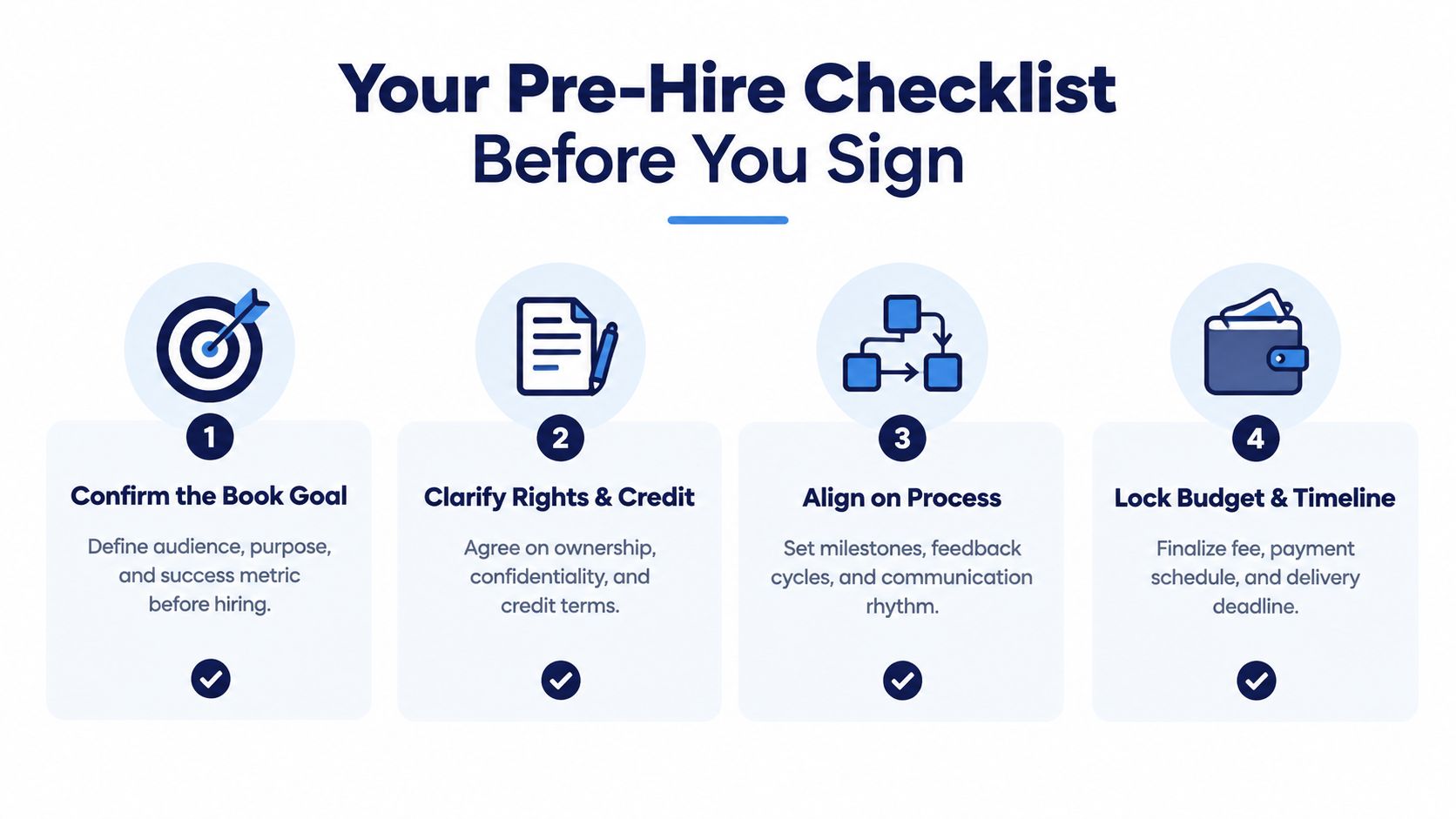
Confirm the outcome
Can you state the book's audience, purpose, and success metric in plain language? “I want to become more visible” isn't enough. Decide whether the book should support speaking leads, authority in a niche, client conversations, a publishing proposal, or a personal legacy. The outcome determines the writer tier and the supporting services you need.
Confirm the match
Has the candidate completed a comparable title, or can they prove they understand your genre through relevant samples and a paid trial? A successful novelist isn't automatically the right writer for a business book. A strong business writer may not have the narrative sensitivity required for memoir.
Confirm the scope
Does the agreement specify the chapter structure, word range, interview responsibilities, milestones, revision count, final files, and extra-work rates? If the quote describes an undefined “full manuscript,” send it back for clarification. Scope should be settled before enthusiasm turns into drafting.
Confirm rights and confidentiality
Do you own the manuscript under clearly stated terms after final payment? Does the agreement protect your identity, source material, interviews, and proprietary information? Does it explain credit, termination, unfinished work, and the treatment of research notes?
A serious ghostwriter will ask questions about your availability, audience, and decision-making process before accepting the project.
You also need to confirm your own readiness. Do you have a workable outline, a defined audience, access to the people and documents the writer must interview, and a real deadline? If you can't supply those basics, the writer will spend paid time discovering the project instead of producing it.
The right hiring decision isn't the cheapest quote or the most prestigious résumé. It's the candidate whose scope, process, genre experience, and level of involvement match the outcome you need. BarkerBooks offers ghostwriting alongside editorial and publishing services, so authors who need a more integrated path can evaluate whether that model fits their manuscript and launch requirements.
If your manuscript needs a disciplined scope, voice-led drafting, or a complete path from idea to published book, visit BarkerBooks to review its ghostwriting and author-service options. Bring your audience, target outcome, available source material, and deadline so the conversation starts with a workable brief rather than a vague promise.