
You've finished the manuscript. The chapters are arranged, the ending works, and you're ready to upload the file. Then the practical questions arrive: Is the book edited well enough? Who should design the cover? Which formats need separate files? How will readers find the title among millions of competing books?
Those questions reveal the purpose of self publishing services for authors. These services aren't a way to outsource tasks. They're a way to remove specific obstacles between a manuscript and a discoverable, professional product. The right decision depends on your genre, skills, budget, publishing goals, and the point where your project is most likely to lose readers.
Why Self Publishing Services Matter More Than Ever
Self-publishing has made book production more accessible, but accessibility has also created intense competition. Bowker-reported ISBN data shows that U.S. self-published titles reached 2.6 million in 2023, rising 7.2% year over year and more than doubling over the previous decade. In that year, self-published books outpaced traditionally published books by more than two million titles in the United States, according to Publishers Weekly's coverage of Bowker data.
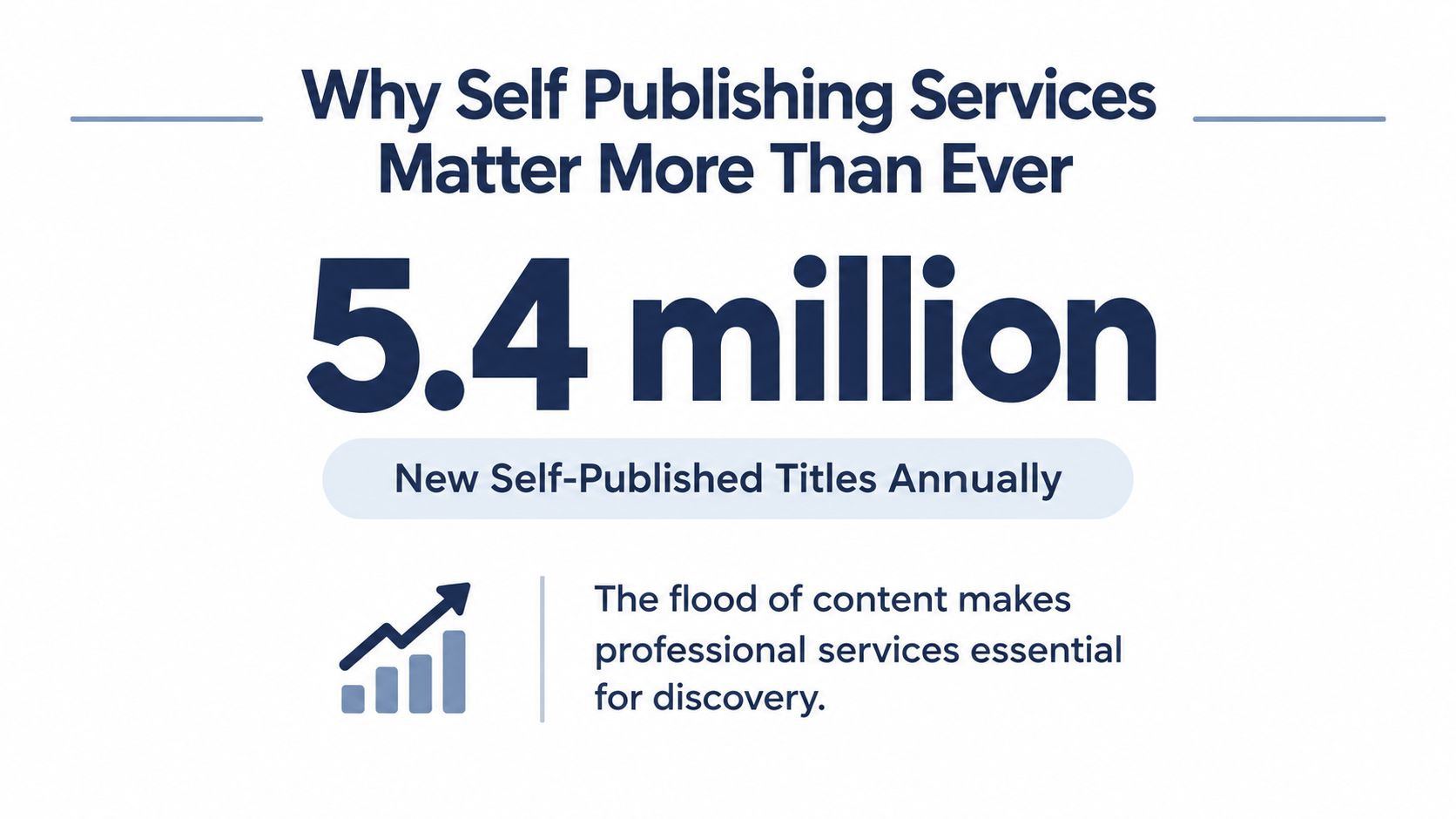
The infographic's rounded market message captures the pressure authors feel, though the verified Bowker figures should guide precise comparisons. You can publish a book without professional help, but publishing it is only the first checkpoint. Discoverability is the bottleneck.
The production problem has become a positioning problem
Digital platforms can accept a manuscript, cover, description, and pricing information with relatively little friction. That convenience doesn't guarantee that the book looks credible, reads smoothly, appears in appropriate categories, or reaches the retailers and readers you want.
A professional service provider sits between your raw manuscript and the finished publishing product. An editor strengthens the reader experience. A designer communicates genre expectations in a single image. A formatter makes the book comfortable to read across print and digital editions. A metadata specialist helps retailers understand where the book belongs.
Publishing coach's rule: Don't ask whether a service sounds impressive. Ask which reader-facing problem it solves.
Three pressures make that question especially important in 2026:
- Reader expectations: Readers notice awkward typography, inconsistent punctuation, weak covers, and careless proofreading quickly.
- Platform classification: Retailers and catalog systems depend on descriptions, categories, keywords, subject codes, and edition information to place books in front of relevant audiences.
- More formats and channels: Print, ebooks, audiobooks, retailer storefronts, email lists, and direct sales each create separate production and marketing decisions.
The industry context is changing quickly, and BarkerBooks' publishing industry trends guide can provide additional background. Use that context to plan, not to panic. Your task isn't to buy every available service. It's to identify the weakest link in your book's path to the right reader and spend there first.
The Core Service Categories Every Author Should Know
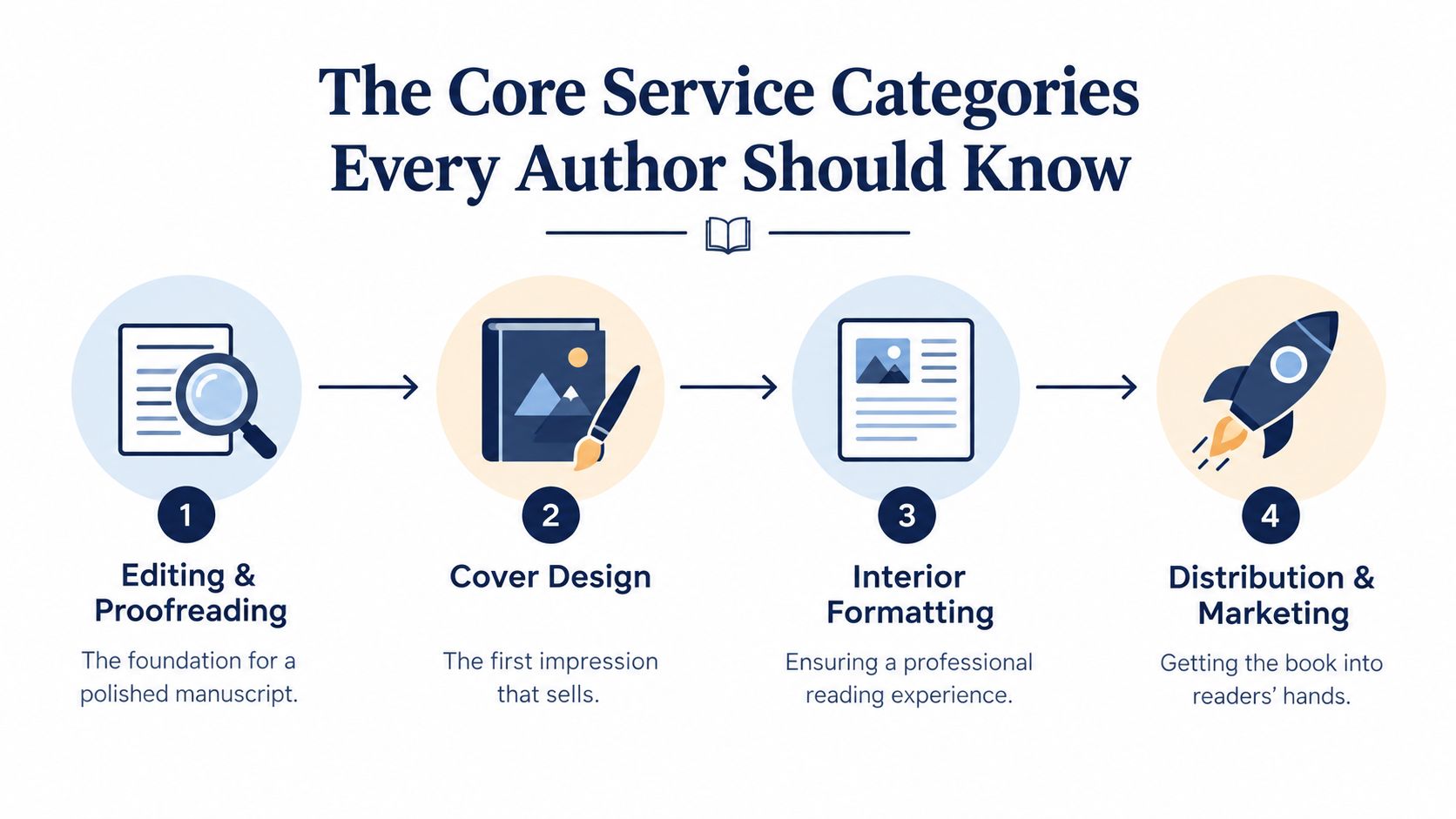
A manuscript becomes a marketable book through a chain of connected decisions. Think of each service as part of a house: editing checks the structure, design creates the exterior, formatting makes the rooms usable, and distribution provides the address.
Editing protects the reader's experience
Developmental editing examines the book at the level of structure, pacing, argument, character development, and audience fit. A fiction editor might identify a slow middle or an unclear motivation. A nonfiction editor might reorganize chapters so the promised transformation becomes easier to follow.
Copyediting works at sentence level. It addresses grammar, consistency, clarity, terminology, transitions, and style. Proofreading is the final inspection after layout, when the editor checks the actual pages for typographical mistakes, missing words, odd breaks, and formatting errors.
Skipping these stages is like putting fresh paint on a house with a damaged foundation. A polished cover can attract a click, but weak writing can prevent the review, recommendation, or repeat purchase that builds momentum.
Design and formatting turn files into a book
The cover is your book's storefront window. A genre reader should be able to identify the broad promise and tone before reading the description. A romance, business guide, thriller, and family memoir each communicate differently through typography, imagery, color, and composition.
Interior formatting controls the reading journey. Print books need appropriate margins, chapter openings, page numbers, running elements, and balanced spacing. Ebooks need flexible styling that works across different screen sizes and reading settings. A print layout cannot be converted into a reliable ebook by pressing an export button.
Metadata gives retailers usable information
Metadata is the book's catalog record. It includes the title, subtitle, author name, description, keywords, categories, audience information, publication details, and subject classifications such as BISAC.
An ISBN identifies a particular edition and format. A paperback and an ebook should be treated as separate publishing products, not as interchangeable files. Copyright registration and ownership terms also deserve attention, especially when a provider uploads or manages the book on your behalf.
Distribution and marketing create different kinds of access
Distribution connects a title with retailers, libraries, wholesalers, and direct sales channels. Marketing then helps potential readers notice and evaluate it through categories, retailer pages, advertising, launch communication, review outreach, newsletters, and social content.
Marketing also extends beyond launch week. A useful content strategy that drives repeat sales can help authors keep explaining the book's value after the initial release. These services interlock: accurate metadata supports distribution, a strong cover supports advertising, and a well-edited manuscript supports reader satisfaction.
How Service Packages and Pricing Actually Compare
A first-time author may receive three quotes for the same manuscript and find that each describes the work differently. The difference usually comes from how services are purchased, what outcome each package promises, and how much project management remains with you.
A la carte services let you hire an editor, designer, or formatter separately. This suits authors who already have reliable skills or completed files in some areas. You control each decision, but you also coordinate schedules, handoffs, file versions, and quality checks. A low editing quote has limited value if the manuscript still needs structural work.
Bundled packages place several services with one provider. The arrangement can reduce coordination, yet the label matters less than the deliverables. “Editing” might mean proofreading rather than developmental editing. “Marketing support” might cover only a retailer description upload. Ask what changes, files, meetings, and follow-up are included before comparing totals.
A third model is a full-service publisher that may charge upfront, retain production control, or take a royalty share. A substantial payment combined with a royalty claim deserves careful contract review. Hybrid and vanity publishing arrangements should be assessed separately from independent freelancers and service providers with clear ownership terms.
The table below is a qualitative planning guide, not a verified market price list. Fees vary according to manuscript length, genre, condition, format count, complexity, and provider experience.
| Service | Entry-Level Range | Mid-Tier Range | Premium Range | What Typically Drives the Price |
|---|---|---|---|---|
| Developmental editing | Lower commitment | More detailed manuscript assessment | Intensive editorial partnership | Word count, structural complexity, and editor expertise |
| Copyediting | Basic language cleanup | Full consistency and style review | Extensive line-level refinement | Manuscript condition, terminology, and depth of review |
| Custom cover design | Template adaptation | Original genre-focused design | Multiple concepts and strategic direction | Illustration, typography, revisions, and usage rights |
| Interior formatting | One standard format | Print and ebook preparation | Complex layouts and multiple editions | Tables, images, chapter architecture, and file requirements |
| ISBN registration | Author-managed purchase | Provider-assisted setup | Multiple formats and imprint management | Ownership, edition count, and administrative support |
| Audiobook narration | Author-managed production | Directed narration | Professional casting, direction, and mastering | Manuscript length, narrator, editing, and audio standards |
| Launch marketing | Basic setup | Coordinated launch assets | Ongoing campaigns and strategic management | Audience access, advertising, creative assets, and duration |
Read every quote line by line. Confirm editing passes, revision limits, file formats, cover ownership, retailer accounts, metadata responsibilities, audiobook deliverables, and launch dates. Also ask about revised-file fees, proof copies, advertising budgets, royalty splits, account access, and distribution exclusivity.
For a detailed budgeting discussion, review self-publishing book costs. The cheapest quote can cost more when each correction creates a new charge or when you cannot take your files elsewhere. In a crowded market, the useful comparison is the outcome: which option leaves you with a finished, discoverable book and control over the assets that support it?
How to Evaluate Self Publishing Providers
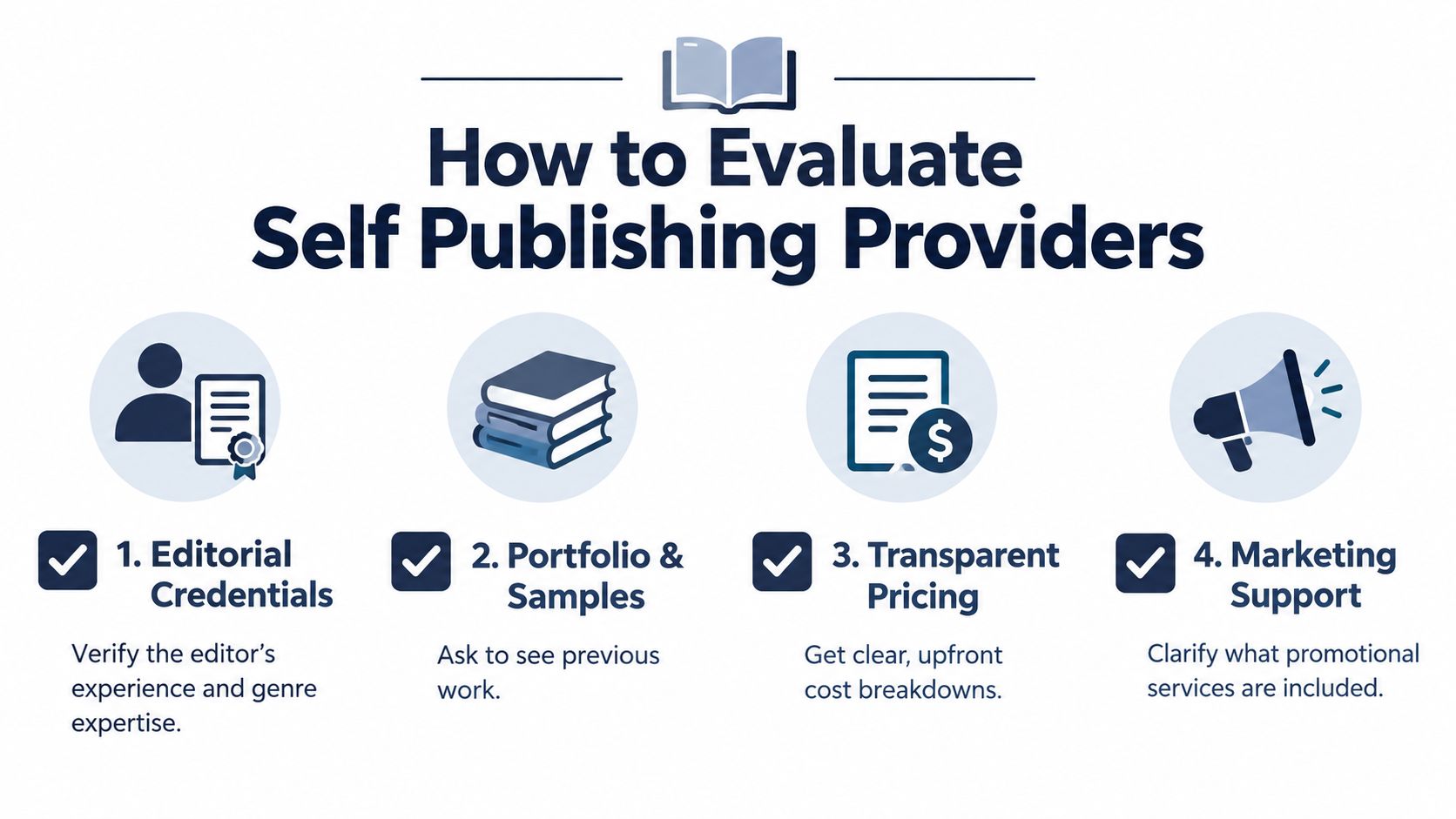
A provider's sales language tells you less than its working process. Start with the person responsible for the work. Ask who will edit the manuscript, whether that editor has experience in your genre, who owns the design files, and whether the provider uses named specialists or anonymous subcontractors.
Check evidence before promises
A portfolio should show work similar to your project, not only attractive examples from unrelated genres. A children's picture book, a technical manual, and a commercial novel require different editorial and design decisions.
Request a paid sample edit when possible. A short sample shows whether the editor notices the issues that matter in your manuscript and whether the feedback is respectful and understandable. For design, ask to see the complete cover wrap or comparable interior pages, not just a promotional mockup.
Green flags include:
- Named professionals: You know who performs the editorial and design work.
- Written scope: The contract defines deliverables, revisions, deadlines, and approval points.
- Clear ownership: You retain access to your manuscript, cover, interior files, metadata, and retailer accounts.
- Genre awareness: The provider can explain how your book's audience affects its presentation.
- Verifiable distribution: The company identifies actual channels rather than saying only “worldwide.”
Red flags include guaranteed bestseller status, vague promises of “massive exposure,” unclear timelines, pressure to sign immediately, and contracts that hide royalty deductions. A provider shouldn't promise a sales result it can't control.
Verify the publishing mechanics
Check whether the ISBN belongs to you, your imprint, or the provider. Confirm who controls the retailer account and who receives payments. Ask what happens if you end the relationship. You should know whether you can download final files, move the title to another distributor, and update the edition independently.
Use three diagnostic questions before signing:
- What exact deliverables will I receive, and how many revision rounds are included?
- Which accounts, ISBN records, files, and rights remain under my control?
- What costs or obligations continue after the book goes live?
Contract check: If a service can't explain ownership and exit terms in plain language, pause before paying.
A Realistic Author Bundle and What It Produces
Consider a representative debut novelist with a completed commercial fiction manuscript. The author has enough budget for targeted professional help but doesn't want a full-service package that includes every possible add-on.
The first purchase is an editorial assessment. Instead of asking an editor to polish every sentence immediately, the author first wants to know whether the opening delivers the right promise, whether the middle loses momentum, and whether the ending satisfies the genre. The editor returns a prioritized revision plan, and the author rewrites before commissioning copyediting.
Next comes the cover. The author supplies comparable titles and explains the intended audience, tone, and subgenre. The designer develops a cover that communicates the book's position clearly, rather than creating an image that merely looks attractive in isolation.
Each service should produce a usable result
The author then hires a formatter for a print interior and an ebook file. The deliverables include files that can be uploaded to the chosen platforms, plus a proofing stage for checking page breaks, chapter openings, scene breaks, and front matter.
Metadata receives its own review. The author prepares a precise description, selects appropriate categories and keywords, confirms edition details, and checks that the paperback and ebook records are consistent. Distribution decisions follow the author's goals. One retailer may provide a simple route to readers, while a broader distributor may support bookstore and library ordering. The author compares those trade-offs instead of assuming that one channel suits every purpose.
Marketing begins with assets the author can reuse: a retailer description, launch graphics, an email announcement, review-copy information, and a short content schedule. The author contacts early readers, prepares the retailer page, and tests the message against the book's actual audience.
What does this bundle produce? It produces a manuscript revised against a clear editorial plan, a cover that signals genre, reliable reading files, accurate catalog information, and a launch system the author can continue operating. It doesn't guarantee sales. Income is uneven across the independent author community. ALLi reported median self-published author income of $12,749 in 2022, while mean income exceeded $82,600, illustrating how a smaller group of higher earners can pull the average upward relative to the typical author. Those figures appear in the Alliance of Independent Authors data summary.
Useful expectation: A service bundle can improve the book's readiness and discoverability. It can't replace reader demand, consistent publishing activity, or a suitable channel strategy.
Where to Spend and Where to Skip
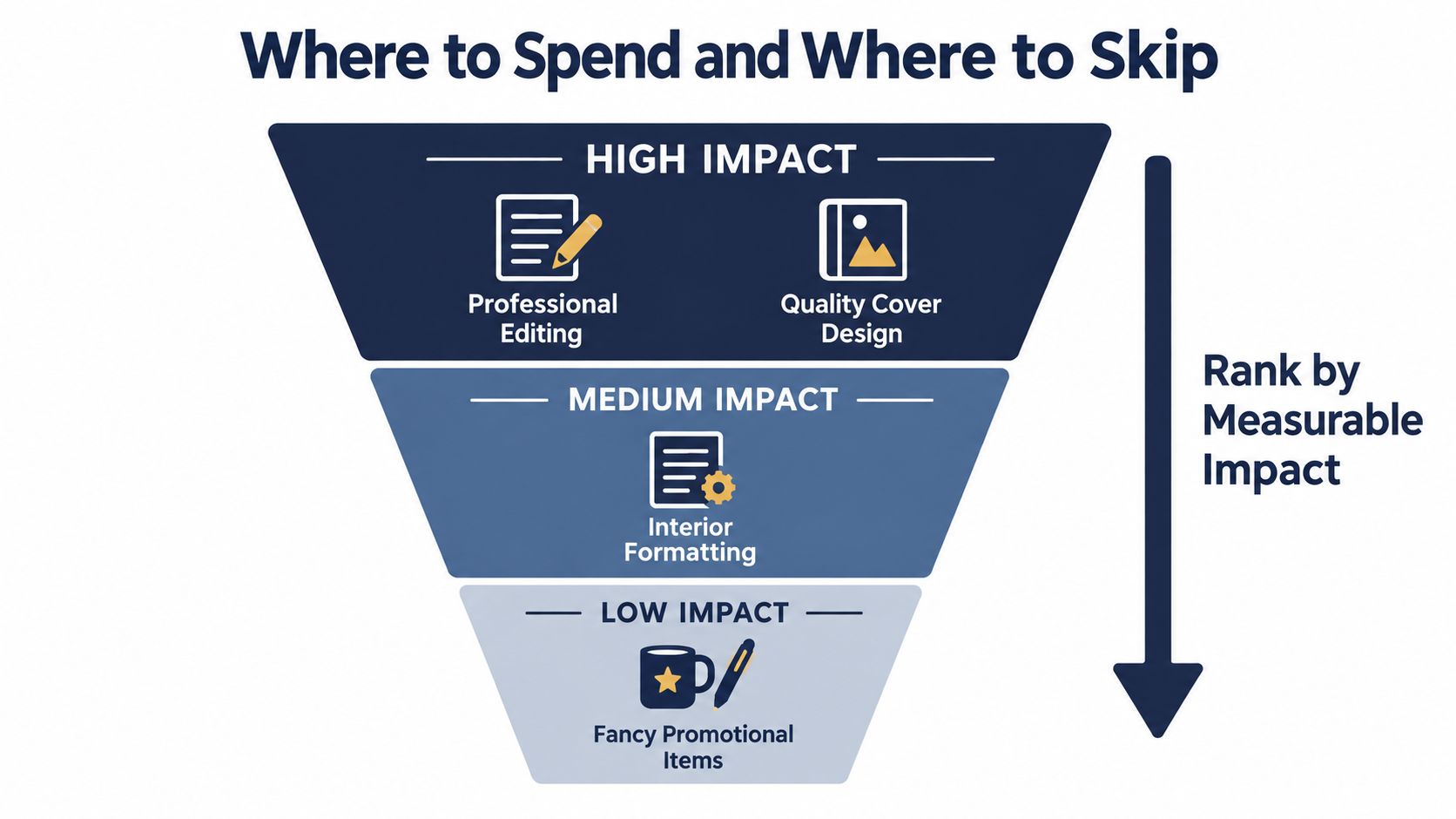
Buying every service can create an impressive invoice without solving the problem limiting sales. Start with a simple triage question: What would most likely stop a qualified reader from clicking, continuing, or finding the book?
For many projects, the first priorities are professional editing, a genre-appropriate cover, and accurate metadata. Those elements affect the reader's first impression and the retailer's understanding of the book. Interior formatting matters too, but it usually becomes urgent after the manuscript and cover are ready.
Use the bottleneck as your budget guide
If readers abandon the sample because the prose is rough, advertising won't fix the underlying issue. If the book is polished but the cover looks unrelated to its genre, a high-priced launch video may be a poor use of funds. If the retailer page is clear but the author has no way to reach interested readers again, an email list or useful ongoing content may matter more than another design add-on.
Lower-cost alternatives can help with preparation, though they don't replace professional judgment in every project:
- Beta readers: Use readers familiar with your genre to identify confusing sections and pacing problems.
- Canva mockups: Create simple social graphics without commissioning a custom video trailer.
- Newsletter swaps: Partner with compatible authors for relevant audience exposure.
- Author-managed metadata: Research comparable titles and prepare a draft for professional review.
- Staged audio production: Wait until the book's format and audience justify narrator casting and mastering.
For authors who need intensive manuscript support, professional book editing services may be a more sensible investment than decorative extras. The practical rule is to rank spending by impact, not prestige. Buy the service that removes the largest obstacle, then reassess before adding another.
Choosing Your Next Step with Confidence
You don't need to solve the entire publishing process today. Use a focused seven-day plan:
- Days 1 and 2: Set a firm budget ceiling and define the goal. Is this a personal edition, a commercial release, a lead-generation book, or the first title in a long-term author business?
- Day 3: Audit the manuscript, cover, interior, metadata, distribution, and marketing materials.
- Day 4: Shortlist two or three providers for the category that represents your biggest weakness.
- Day 5: Request samples, contracts, references, and clear deliverables.
- Day 6: Negotiate scope, revision limits, ownership, deadlines, and payment stages.
- Day 7: Choose the provider, or decide which task you'll manage yourself.
AI-assisted editing and cover-generation tools are changing how authors approach early drafts and production experiments. They can help you compare options, but they don't remove the need for editorial judgment, genre awareness, rights checks, or final quality control.
Direct-to-reader sales also give authors more ways to communicate with buyers through storefronts and email lists, while audiobook projects require early decisions about narration, casting, recording, editing, and mastering. Treat these channels as additions to your plan, not reasons to abandon the core priorities.
The U.S. market is crowded, and Bowker data shows self-published titles already exceed traditionally published output by a wide margin. Strategic service choices give your book a stronger chance to be understood, trusted, found, and read than an oversized package chosen without a clear objective.
BarkerBooks offers independent authors support with editing, cover design, interior layout, ISBN and copyright assistance, distribution, and launch preparation. If you want help matching those services to your manuscript and publishing goals, visit BarkerBooks and review the available publishing options.