
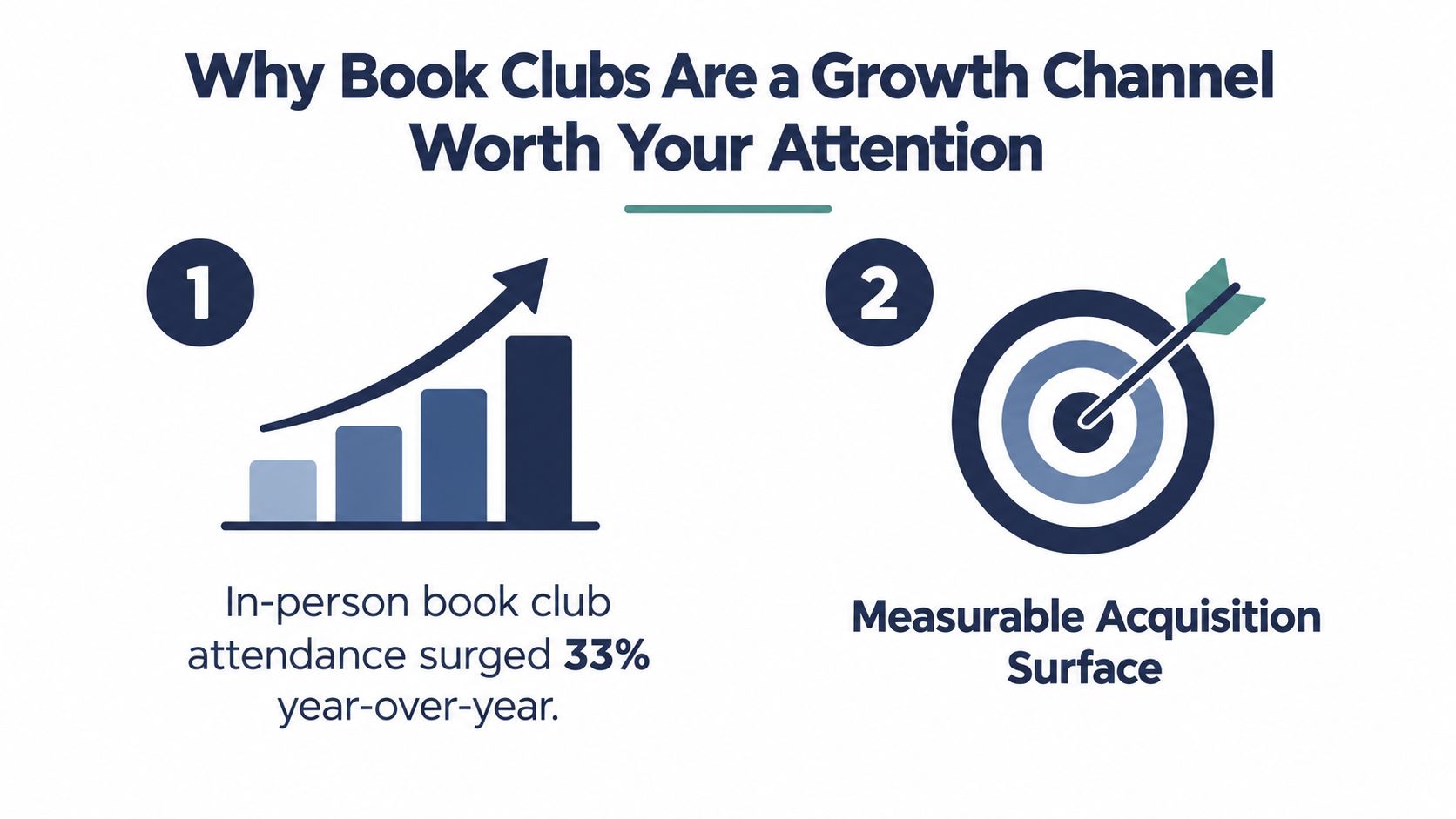
In-person book club events on Eventbrite jumped 33% in the first half of 2026 compared with the same period a year earlier, according to Axios coverage of the trend. That changes the question authors should be asking. Book clubs aren't a quaint publicity extra. They're becoming hyper-niche acquisition surfaces, where a well-matched selection can create discussion, recommendations, event attendance, and repeat buying.
The channel still punishes lazy targeting. A generic message sent to every club leader wastes time, while a useful discussion kit delivered to the right community can keep a book active beyond its launch window. Effective book club marketing connects four things: a title's identity, a club's selection logic, an event format, and a measurement system that separates lasting readership from temporary buzz.
Why Book Clubs Are a Growth Channel Worth Your Attention
A book club selection can create a reader network that a paid impression rarely produces. An advertisement asks one person to pause. A club selection gives several people a reason to read the same title, discuss it, and recommend it through relationships they already trust. Those networks include local clubs, library groups, bookstore communities, online reading circles, and smaller identity-based meetups.
The growth is especially relevant because readers are gathering around precise interests, not only broad literary categories. The Axios report on niche book club events describes momentum around hyper-niche meetups, while broader book-culture analysis highlights micro-communities, in-person gatherings, and live sessions as discovery environments. For a debut author, a closely matched club can build word of mouth without claiming universal appeal. For a mid-list author, it can extend attention after the initial publicity window.
Why selection matters more than exposure
Book clubs have a long history as trusted discovery systems. The Book-of-the-Month Club launched in the United States in 1926 with 4,750 members and grew to more than 550,000 subscribers within twenty years, according to historical book-club data. The same source estimates that book-club dollar volume rose from about $65.4 million in 1947 to $93.161 million in 1956, while copies sold increased from 54.4 million to 65.978 million.
Modern clubs won't reproduce that exact commercial structure, but a trusted selector can turn a title into a shared decision. That decision can outlast an isolated mention, especially when the author provides discussion questions, event options, retailer links, and follow-up communication.
Practical rule: Treat a club selection as a campaign with a beginning, middle, and follow-up, not as a single public-relations hit.
Measure the work beyond attendance or social reactions. Track which clubs select the book, whether members buy or borrow it, whether discussion leads to further recommendations, and whether those readers engage with the author's next release. A niche community earns continued outreach when it creates repeat readership, not just temporary buzz.
The operational work is clear: identify likely buyers, understand selection criteria, build a contactable list, pitch without overpromising, equip the leader, and record what happens after the discussion. Clubs reward consistency, but a strong kit cannot compensate for a poor audience match.
What Book Club Buyers Actually Do Differently
Book-club readers don't buy the same books as everyone else through another route. Canadian research found that 57% of book-club readers said they wouldn't otherwise have read some books selected by their group, and 8% of readers discovered their most recent book purchase through a book club, according to BookNet Canada's reading research. Selection therefore creates discovery that ordinary retail browsing may never produce.
The same research found that 7% of adult Canadians who bought a book in the last month belonged to a book club, and those buyers purchased 2.4 books per month on average, compared with 2.1 for non-members. The difference is strategically important. A club reader isn't only a potential buyer for the selected title. They're also a reader with an established purchasing habit and a social reason to keep reading.
The behavior behind the purchase
Structured discussion changes the cost of abandoning a book. A member has a meeting date, questions to consider, and peers who expect participation. That social accountability can help a selected title reach completion, while a curated choice reduces the fatigue that comes from comparing endless options.
Three audience patterns matter when you build a target list:
- Genre-locked hobbyists want recognizable pleasures, conventions, tropes, and discussion points within a defined category.
- Aspirational literary readers may respond to thematic depth, cultural context, author craft, and questions that support a serious conversation.
- Identity-driven affinity groups often choose books through a shared experience, community concern, language, or representation lens.
Those groups can overlap, but they shouldn't be treated as interchangeable. A romantasy club may care about relationship dynamics and world-building, while a local-language group may care more about cultural specificity and accessibility. The pitch should reflect the club's reason for existing.
| Metric | General Reader | Book Club Buyer |
|---|---|---|
| Monthly book purchases | 2.1 books on average | 2.4 books on average |
| Discovery through a book club | Not specified | 8% discovered their most recent purchase this way |
| Books selected outside prior interest | Not specified | 57% said they wouldn't otherwise have read some selections |
The commercial implication is clear: a selection behaves more like a coordinated group purchase with built-in recommendation potential than a single review. That doesn't guarantee bulk orders, and authors shouldn't assume every member will buy a personal copy. It does mean the selection can place a title in front of readers who weren't already searching for it.
Choosing the Right Book Clubs for Your Title
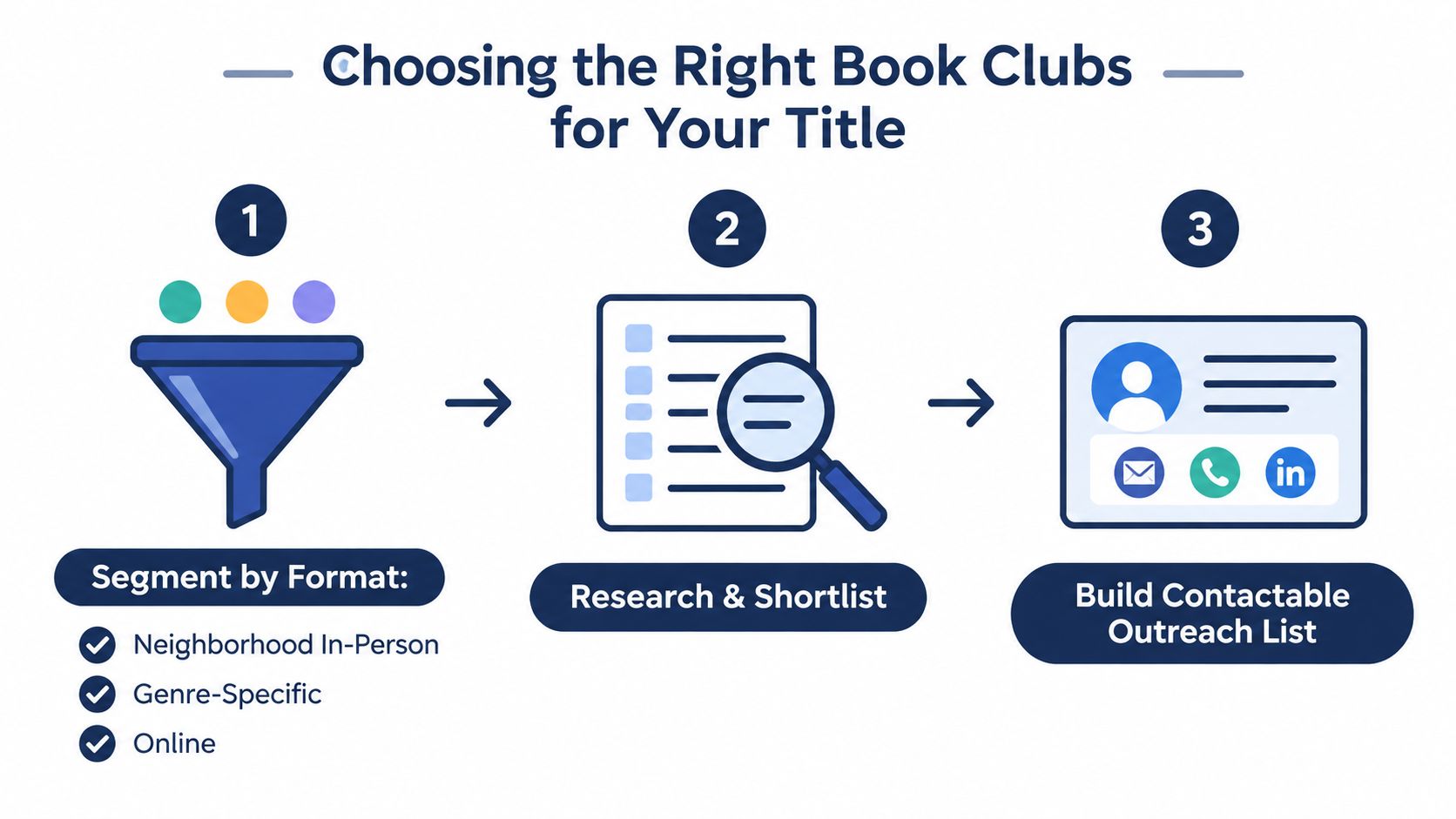
Start with format fit, not the largest follower count. Separate neighborhood groups, genre-specific virtual clubs, librarian-led programs, bookstore clubs, workplace communities, paid subscription groups, and creator-led communities on platforms such as Goodreads or Substack. Each format has different decision makers, event expectations, and ways to attribute sales.
A practical shortlist uses five filters:
- Audience fit. Does the club already read books with your genre, theme, tone, or audience identity?
- Selection transparency. Can you find how titles are proposed and chosen?
- Author participation. Has the leader hosted authors, virtual visits, or written Q&As before?
- Responsiveness. Is there a public contact route that appears current?
- Reach quality. Are members active participants, or are you looking at a dormant subscriber number?
Estimate realistic reach from active participation and past selection behavior, not vanity metrics. A club with a smaller but engaged membership may produce more useful discussion and better follow-up than a large account whose audience rarely attends events.
Build a list you can actually work
For a debut literary fiction author, the process might begin with a broad research pool and narrow to a smaller group of strong matches within the available outreach window. Don't claim that every candidate will convert. The point is to remove clubs with weak genre alignment, no visible activity, unclear contact details, or no history of considering outside titles.
Use publisher and bookseller directories, BookBrowse, Book Club Hub, public library pages, and searches across Instagram or Reddit. The BarkerBooks resource on online book clubs can also help authors think through the differences between digital groups and physical communities.
Your spreadsheet should include:
- Club name and format
- Genre or identity focus
- Leader name and contact route
- Selection month or decision process
- Author participation options
- Sample or galley status
- Date contacted
- Reply, selection, and event status
- Sales or code attribution
Don't send the same pitch to every row. A librarian-led club may need accessibility information and ordering details. A creator-led group may want a concise author introduction and a virtual Q&A option. A bookstore club may need dates, stock availability, and a clear event plan.
Outreach Templates and the Long-Tail Pitch
Club leaders don't need a press release. They need to know why the book suits their members, how easily they can run the discussion, and what support you'll provide. Keep the first email short enough to scan, then offer the assets that reduce their workload.
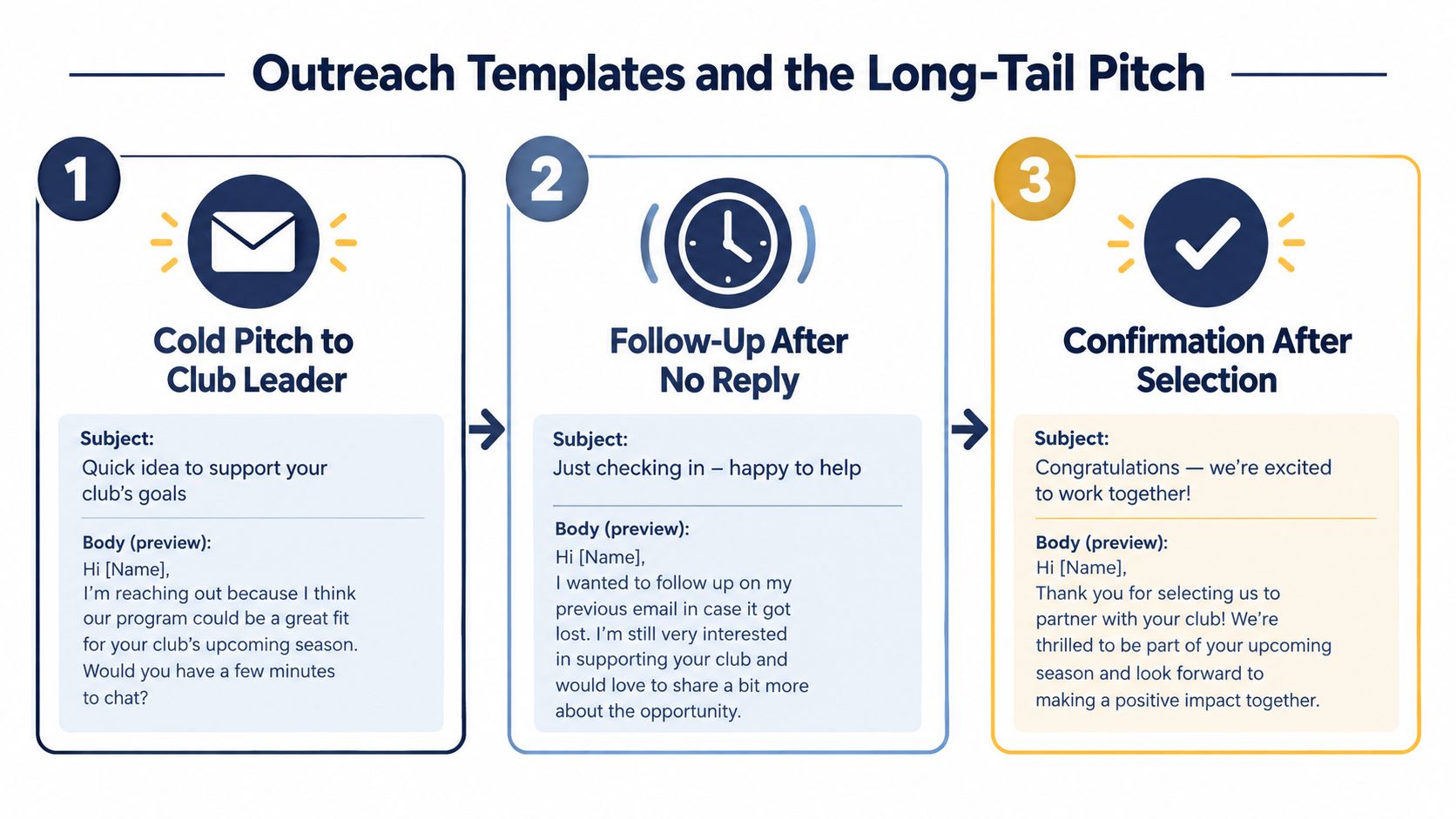
Cold pitch to a club leader
Subject: A discussion-ready title for [Club Name]
Hello [Name],
I'm reaching out because [specific reason the book fits the club, such as its setting, theme, genre, or community focus]. [Book Title] follows [one-sentence description] and would give your group room to discuss [two concrete discussion themes].
I can provide a reading copy, a discussion guide, and options for a virtual or live author conversation. Your group can consider it for [relevant selection month or season]. Would you be open to reviewing the title or receiving a short sample?
P.S. I noticed your group recently discussed [specific title or theme]. That conversation is one reason I thought this book might fit.
Follow-up after no reply
Subject: Following up on [Book Title] for [Club Name]
Hello [Name],
I wanted to follow up on my note about [Book Title]. The strongest fit for your members is [specific feature], and I can make the discussion easy to run with [guide, Q&A, event option, or ordering information].
If the timing isn't right, I'm happy to contact you for a later selection cycle. Should I send the sample and discussion materials?
P.S. If another person handles title suggestions, I'd appreciate being pointed in the right direction.
Confirmation after selection
Subject: Materials for [Book Title] discussion
Hello [Name],
Thank you for selecting [Book Title] for [month or event date]. Attached are the discussion guide, author Q&A, event details, and the club-specific purchase link or code.
Please let me know the expected format, attendee access needs, and whether members would prefer live answers, written responses, or a recorded message. I'll follow up before the discussion with any final materials.
P.S. I can also provide a short introduction for the leader to read at the start of the meeting.
The follow-up sequence matters because demand from a club endorsement can persist beyond the announcement. A U.S. study covering 2001 to 2011 found that Oprah Winfrey Book Club selections showed measurable demand spikes lasting at least 12 weeks, with reported coefficients of 3.885 after one week, 3.957 after four weeks, 3.739 after eight weeks, and 3.569 after twelve weeks, against a pre-sales mean of 1,865 units, as summarized in NetGalley's case-study material.
That doesn't mean every local club will produce a comparable effect. It does show why authors shouldn't vanish after selection. Use a simple cadence: Day 0, send the pitch; Day 7, follow up; Day 21, offer a useful asset or later timing; Day 45, check in for the next selection cycle. For list hygiene and outreach planning, a practical prospecting guide for email teams can help structure contact research without turning the process into indiscriminate mass emailing.
Building a Discussion Kit That Turns Selection Into Sales
A discussion kit should save the club leader time. If it only repeats the back-cover copy, it hasn't done its job. Build the materials around the actual meeting, the questions members will ask, and the next action you want readers to take.
Start with a one-page summary that includes the premise, themes, content notes where relevant, format details, and a short author biography. Add eight to ten discussion questions that move from accessible reactions to deeper analysis. Questions should invite disagreement and interpretation, not lead members toward a preferred answer.
The kit should also include an author Q&A brief, with three short stories or insights a leader can read aloud if the author can't attend. A themed snack suggestion and playlist pairing can make a virtual meeting or informal gathering feel more distinctive, but these elements should support the book's atmosphere rather than distract from it.
Match materials to the event
| Kit Element | In-Person Bookstore | Library Event | Virtual Zoom |
|---|---|---|---|
| One-page summary | Printed handout | Accessible print or digital file | Downloadable PDF |
| Discussion questions | Table or chair handout | Facilitator packet | Chat-ready prompts |
| Author Q&A | Live conversation | Read-aloud backup | Live or prerecorded answers |
| Snack and playlist pairing | Event atmosphere | Optional community activity | Shared pre-meeting prompt |
| Bookmark and discount code | Take-home conversion tool | Circulation or event handout | Clickable purchase link |
For a bookstore event, include a store-specific ordering path and confirm who handles inventory. For a library program, make the guide easy to print and provide a version that works for readers who borrow rather than purchase. For a virtual session, format questions for chat, allow asynchronous responses, and plan for participants who can't stay for the full conversation.
You can reuse one strong kit across a BookBrowse-style virtual visit, a library read-alive evening, or a local independent bookstore partnership. BarkerBooks offers book club discussion guides with themes, questions, author notes, and group prompts, which can serve as one model for organizing these materials.
Your seven-asset checklist is straightforward:
- Summary sheet: The book's premise, themes, and practical details.
- Discussion guide: Questions arranged from introductory to analytical.
- Author Q&A: Short answers and stories a leader can use.
- Event introduction: A script that takes pressure off the facilitator.
- Format notes: Instructions for bookstore, library, and virtual use.
- Bookmark or handout: A physical reminder of the title.
- Attributed purchase path: A club-specific URL or code.
Keep the discount code behind a club-specific URL when possible. That small piece of setup lets you connect the event to orders instead of relying on memory or general sales movement.
Tracking ROI Beyond Vanity Engagement
A publisher recap should answer more than “How many people saw the post?” Track the path from outreach email sent to reply, selection, discussion held, attributed sale, and repeat action. Every stage reveals a different problem. Low replies suggest weak targeting or an ineffective subject line. Replies without selections may indicate poor timing, pricing, format mismatch, or insufficient information.
NetGalley examples show why early intent can be measured. Its campaign material includes a 28% click rate and 11% of members claiming a free eBook, demonstrating that club-related outreach can be treated as a funnel rather than only a brand exercise, as shown in NetGalley's book-club campaign examples.
Use a defensible cost measure
A useful operating metric is cost per engaged reader:
Total outreach cost, shipped reading copies, and discussion-kit production divided by confirmed discussion attendees.
The formula won't tell you whether a title is culturally successful, but it will help compare formats. A library partnership may produce fewer immediately attributed purchases but strong local relationships. A creator-led group may create a fast sales response but require closer scrutiny of repeat purchasing and audience quality.
Record the following in one dashboard:
- Outreach volume: Emails sent by club segment.
- Response rate: Replies divided by delivered messages.
- Selection rate: Selections divided by qualified replies.
- Attendance: Confirmed attendees and actual participants.
- Attributed sales: Orders through club URLs, codes, or retailer reporting.
- Engagement cost: Total spend divided by confirmed attendees.
- Reader action: Newsletter sign-ups, reviews, or permission-based follow-up.
- Repeat signal: Later selections, reorders, or continued participation.
Use a QR code on physical bookmarks and event sheets, and track QR code scans separately from direct-link clicks. Don't treat scans as sales. They're evidence of intent that becomes more useful when matched against orders, email sign-ups, or later survey responses.
A short post-event survey can ask how readers found the book, whether they finished it, whether they'd recommend it, and whether they'd choose another title by the author. Ask the leader for a simple satisfaction rating and a note about what worked. For broader sales attribution, authors can also review book sales tracking support as part of their reporting workflow.
Your 90-Day Book Club Marketing Plan
A 90-day plan works because it gives every selection a preparation period and a follow-up period. The exact dates should reflect the club's schedule, the book's availability, and the seasonal reading patterns of the audience. Mother's Day, beach-season reading, and September or January group cycles can affect when leaders are willing to consider new titles, so build the calendar around the communities you want rather than forcing every club into launch week.
Weeks 1 and 2
Lock the title's positioning, sample chapters, price information, format availability, and discussion-kit outline. Segment the research list by niche and format, then remove clubs with no clear contact route or weak relevance. Create the spreadsheet before sending anything.
Weeks 3 through 5
Send personalized outreach in waves. Confirm whether leaders need print copies, digital access, ordering information, author availability, or content notes. Log every response, including a polite decline, because timing may be the only barrier.
Weeks 6 through 8
Ship or deliver selected reading materials and finalize discussion dates. Schedule bookstore and library events, open the virtual room, and send the leader the final kit. Give the facilitator a concise introduction and a clear purchase path.
Weeks 9 and 10
Add paid promotion only after organic pickup is measurable. Promote confirmed events, discussion questions, or a club-specific offer rather than advertising the book to an undefined audience. Paid activity should amplify evidence of fit, not compensate for an unqualified list.
Weeks 11 and 12
Reconcile attributed sales, QR scans, clicks, claims, attendance, reviews, sign-ups, and reorder signals. Ask which clubs would consider another title and record the next decision window. That information is more valuable than a large impression count because it informs the next outreach cycle.
Use this execution checklist:
- Week 1: Define audience identity, genre fit, and event options.
- Week 2: Finish the shortlist, sample materials, pricing details, and tracking links.
- Week 3: Send the first outreach wave.
- Week 4: Follow up and answer selection questions.
- Week 5: Confirm commitments and participation requirements.
- Week 6: Deliver copies and discussion materials.
- Week 7: Confirm event logistics and purchase attribution.
- Week 8: Run or support the first discussions.
- Week 9: Review organic response before adding paid promotion.
- Week 10: Promote confirmed events and strongest audience matches.
- Week 11: Collect sales, attendance, survey, and engagement data.
- Week 12: Calculate cost per engaged reader and plan the next cycle.
Book club marketing works when the author treats the group as a community partner, not a distribution list. Build for a narrow identity, make the leader's job easier, follow up after selection, and measure whether readers take a next action.
BarkerBooks supports authors with publishing, book club discussion guides, and outreach options for reading groups, libraries, bookstores, and community leaders. If you want help turning your manuscript into a professionally prepared title with materials that support book club marketing, visit BarkerBooks to explore the available publishing services.