
It’s easy to get proofreading and copyediting mixed up. Many writers use the terms interchangeably, but in the publishing world, they are two completely different—and equally vital—stages of the editing process. Getting this wrong can mean hiring the wrong pro at the wrong time, which is a costly mistake.
The simplest way to think about it is this: Copyediting is the deep-level polish that gets your manuscript in shape, focusing on clarity, consistency, and style. Proofreading, on the other hand, is the final quality check right before your book goes to print, catching any last-minute mistakes.
A copyeditor is like an engine mechanic, meticulously tuning every part of your manuscript so it runs smoothly. The proofreader is the detailer who gives the car a final polish before it hits the showroom floor.
Understanding the Core Differences

While both are essential for a professional book, they solve different problems at very specific times. Understanding when to use each service is one of the biggest distinctions that can save authors thousands of dollars and prevent embarrassing errors when their book hits global markets like Amazon and Apple Books.
Copyediting comes before the book is designed or typeset. It happens after you’ve finalized the story and structure, and the editor digs deep into the text to fix issues with flow, consistency, and style. Proofreading is the absolute last step, performed on the final typeset version (the “proof”) just before it goes to the printer.
For authors who are always looking to get better, understanding these professional editing stages is a great way to improve writing skills and learn what to look for in your own work.
At a Glance Comparison
To quickly see the main differences, here’s a high-level look at where each service directs its focus. This table breaks down their primary functions and impact, showing why both are critical for a professionally published book.
Quick Comparison Proofreading vs Copyediting
| Attribute | Copyediting | Proofreading |
|---|---|---|
| Primary Goal | To improve clarity, flow, and consistency. | To catch final surface errors before printing. |
| When It Happens | After the final draft is written, but before design/layout. | After the book has been designed and typeset into a “proof.” |
| Scope of Work | Checks grammar, syntax, style, tone, and factual accuracy. | Checks for typos, punctuation, and formatting mistakes. |
| Author Impact | Strengthens the manuscript’s core message and readability. | Ensures a flawless presentation and professional finish. |
The copyeditor polishes the author’s work—using industry knowledge a writer can’t be expected to have—and gets it ready to be turned into a book. Proofreading should be the very final safety net, there to catch the last typos and act as a different set of eyes.
This side-by-side view gives you a starting point. Now, let’s dig deeper into what each service actually involves, what you should expect to receive from an editor, and how to know which one your manuscript needs right now.
Diving Into the Copyediting Process
Think of a copyeditor as your manuscript’s personal trainer. You’ve done the heavy lifting of building the story’s skeleton and muscle—the plot, the characters, the world. Now, the copyeditor steps in to refine its form, boost its strength, and make sure it’s in peak condition before it meets its audience. This is a deep, substantive workout for your text that goes miles beyond just catching typos.
The copyeditor’s main job is to polish the writing for readability and consistency. They are the guardians of your manuscript’s internal logic, making sure a character’s eyes don’t suddenly change from blue in chapter one to brown in chapter ten. They also smooth out awkward sentences, rephrase clunky paragraphs, and ensure the tone you’ve worked so hard to establish stays consistent from the first page to the last.
What a Copyeditor Really Does
A professional copyeditor works through a manuscript methodically, focusing on what we in the industry often call the “4 Cs”: clarity, coherency, consistency, and correctness. It’s a detailed, multi-layered process.
Here’s a look at their checklist:
- Grammar and Syntax: This is the nitty-gritty. They fix subject-verb agreement, correct pronoun usage, untangle dangling modifiers, and restructure confusing sentences.
- Punctuation and Spelling: They ensure every comma, semicolon, and apostrophe is in its proper place and that spelling is flawless.
- Consistency: This is a big one. They track everything from character names and timelines to capitalization, hyphenation, and how numbers are formatted throughout the entire book.
- Style Guide Adherence: A copyeditor applies a specific style manual, like The Chicago Manual of Style for novels or AP style for journalism. This makes sure your manuscript meets professional publishing standards.
While we’re talking about manuscripts, these principles apply everywhere. If you’re also working on your author platform, you might find this guide on crafting engaging web copy helpful.
A great copyeditor doesn’t try to rewrite your work. Their goal is to amplify your voice by removing the distractions—the ambiguities and clunky sentences—that get in the way of your story.
This focus on improving flow and readability is what truly sets copyediting apart from proofreading. Copyeditors handle all the mid-level fixes, tackling grammar, syntax, and tone to catch around 95% of substantive issues. This is especially crucial for nonfiction, where we’ve seen that 40% of reader complaints stem from confusing or unclear phrasing.
A True Partnership With the Author
A common fear among authors is that an editor will come in and butcher their work, stripping it of its unique voice. In reality, good copyediting is a deeply collaborative process. A seasoned copyeditor never just imposes changes. They act as your first critical reader, flagging spots that might trip up your audience.
For instance, if a sentence could be read in two different ways or a character’s motivation feels a bit thin, the copyeditor will leave a query in the margin for you. This back-and-forth is vital. It keeps you, the author, in the driver’s seat, allowing you to clarify your original intent while benefiting from a professional’s trained, objective eye.
This partnership helps close the gap between the story in your head and the one readers experience on the page. We cover this dynamic in more detail in our guide that asks, “What is copy editing?“.
Let’s look at a quick example of a copyeditor’s work in action.
Before Copyediting:
- “The man, he was a very tall man, walked his dog, which was a poodle, down the street, which was a busy street.”
The sentence gets the point across, but it’s repetitive and clunky. It feels clunky and doesn’t pull the reader in.
After Copyediting:
- “The tall man walked his poodle down the busy street.”
See the difference? The edited version is sharp, concise, and flows much better. The copyeditor eliminated the unnecessary words and tightened the structure without losing any of the essential information. That’s the magic of copyediting—it makes the writing itself almost invisible so your story can truly shine.
Mastering the Final Polish: What is Proofreading?
If copyediting is the deep clean, think of proofreading as the final, white-glove inspection before you open your doors to the public. This is your last line of defense against embarrassing mistakes. It’s a meticulous quality check done on the final, typeset version of your book—often called the “proof”—not on your manuscript in a Word document.
This is the most important distinction to understand. The difference between proofreading and copyediting is that proofreading is not about improving the writing itself. The time for rewrites, restructuring, and clarifying your message has long passed. A proofreader’s job is to hunt down objective, surface-level errors with a fresh, eagle eye, ensuring the product readers hold in their hands is absolutely pristine.
What a Proofreader Looks For
The proofreader’s checklist is highly specific and technical. They’re trained to spot the tiny inconsistencies that an author—and even a copyeditor—will inevitably miss after reading the text dozens of times.
Their focus is squarely on issues that crop up once the text is formatted for printing. Their primary targets include:
- Typographical Errors: Any lingering misspellings or typos that somehow survived previous editing rounds.
- Punctuation Mistakes: A misplaced comma, a backward quotation mark, or an incorrectly used em dash.
- Formatting Glitches: This is where proofreaders really earn their keep. They hunt for widows (a single word stranded at the top of a page) and orphans (a single line from a paragraph left alone at the bottom).
- Layout Consistency: Checking that page numbers, running headers, and chapter titles are all correct and consistent throughout the entire book.
- Word and Line Breaks: Ensuring words are hyphenated correctly at the end of lines and that there aren’t awkward gaps between words.
Proofreading doesn’t mean the copyeditor failed—it means the publishing process is working exactly as it should. It’s the essential safety net. Even bestselling books have had hundreds of errors caught during this final stage.
This step is all about presentation. A proofreader pores over the final PDF, spotting production errors that only appear after typesetting. These can include bad hyphens (found in up to 12% of lines), widow/orphan glitches impacting 8-10% of pages, or incorrect page numbers. A thorough final check can slash these errors by 99%, which is vital for building credibility. For more on this, check out the insights on final checks at Reedsy.
Before and After Proofreading Examples
To really get a feel for what a proofreader does, let’s look at some subtle but critical fixes. These are the kinds of errors that almost always appear only in the final designed file.
Example 1: A Formatting Error
- Before Proofreading (in the final layout): The chapter ends, but the very last line of the final paragraph sits all by itself at the top of the next page. This is a classic “widow” that breaks the reader’s flow.
- After Proofreading: The proofreader flags the issue for the designer. The designer then adjusts the spacing on the previous page just enough to pull that lonely line back, making sure the paragraph ends as a single, cohesive block.
Example 2: A Punctuation Error
- Before Proofreading:
He yelled, "Look out"!This is a common mistake where the exclamation point is placed outside the quotation marks. - After Proofreading:
He yelled, "Look out!"The proofreader corrects the punctuation to follow standard publishing conventions, giving the text a professional look.
These changes might seem small, but they add up fast. A book riddled with minor formatting and punctuation errors comes across as unprofessional and can easily pull a reader out of the world you’ve worked so hard to create. Proofreading is the final polish that ensures your book looks as good as it reads.
Comparing Scope, Deliverables, and Cost
So, you’re trying to figure out where your money is best spent: on a copyedit or a proofread? It’s a common question, and getting it right is crucial for your publishing plan. Think of them less as expenses and more as critical investments in your book’s final quality. While they both polish your manuscript, they operate on completely different levels of intensity, collaboration, and, naturally, cost.
A copyeditor gets deep into the weeds with your writing. Their job is to tackle what we call the “4 Cs”: clarity, coherency, consistency, and correctness. You’ll get back a document bristling with tracked changes and comments in the margins, questioning awkward phrasing or pointing out that your character’s eye color changed between chapters. It’s an intensive, collaborative process.
Proofreading, on the other hand, is the final quality check before you go to print. The deliverable here is much cleaner—usually a marked-up PDF of your already designed pages. A proofreader is hunting for objective mistakes: typos, missed punctuation, and weird formatting issues like “widows” and “orphans” (those lonely words at the top or bottom of a page). There’s almost zero back-and-forth with you at this stage.
Breaking Down the Investment
The price difference between the two services comes down to the sheer amount of labor involved. Copyediting is a forensic analysis of your manuscript. It takes a lot of time and a skilled eye to untangle sentences, apply a consistent style, and make sure your unique voice shines through. A proofread is more of a meticulous, but much faster, hunt for surface-level errors in a finished product.
You’ll see this reflected in standard industry pricing. A thorough copyedit can run anywhere from $1 to $2 per page. Proofreading, with its much narrower focus, is significantly less, often around $0.20 to $0.25 per page. That means a final proofread might only cost about 20-25% of what you paid for the copyedit.
Here’s an analogy I love: Building a house. Copyediting is the inspector checking the wiring, plumbing, and structural frame before the drywall goes up. Proofreading is the final walkthrough to spot paint smudges on the trim before the keys are handed over. You can’t skip the structural inspection and hope the final walkthrough catches a faulty foundation.
To make this crystal clear, let’s put the two services side-by-side. This table breaks down exactly what you’re getting with each one, helping you decide what your manuscript needs right now.
Detailed Breakdown Copyediting vs Proofreading
| Criteria | Copyediting | Proofreading |
|---|---|---|
| Primary Deliverable | A heavily marked-up document (e.g., Word file with tracked changes) and a style sheet. | A lightly marked-up PDF or typeset proof highlighting objective errors. |
| Typical Turnaround | 2-4 weeks for a standard 80,000-word manuscript due to its detailed nature. | 1-2 weeks for the same manuscript, as the focus is narrower. |
| Author Interaction | High. Expect to answer queries and collaborate with the editor to clarify your intent. | Low to none. Changes are objective and do not require author input. |
| Pricing Model | Usually priced per word, per page, or per hour, reflecting the intensive work required. | Often priced per page or per hour, with lower rates due to the focused scope. |
| Return on Investment | Elevates readability, strengthens author voice, and ensures professional-level prose. | Guarantees a polished final product, free of embarrassing errors that damage credibility. |
In the end, it’s not about which service is “better.” It’s about which one is right for where your manuscript is in the production process. Each plays a distinct, non-negotiable role in creating a book that readers will love. For a deeper look into budgeting, check out our complete guide on how much book editing costs. Investing in the right service at the right time is the secret to a successful launch.
When to Use Each Service in Your Publishing Timeline
Knowing the difference between copyediting and proofreading is one thing, but knowing when to use each service is what really sets a professional book apart. Timing is everything. Bring in an editor too early or for the wrong kind of work, and you’ll end up wasting time, money, and creative energy.
Think of the publishing process like an assembly line. You write, you revise, you get the story and structure just right. Only after you’ve taken the manuscript as far as you can on your own is it ready for the next big step. This is when you call in a copyeditor—after the draft is final, but before it’s been designed and formatted for print.
A copyeditor digs into your raw manuscript, usually a Word document. Their job is to refine the language itself, making sure every sentence is strong, your details are consistent, and the overall readability is top-notch.
Choosing the Right Service for Your Stage
The best way to know what you need is to look at where your manuscript is right now. It’s a pretty simple diagnostic.
Let’s look at two common scenarios authors find themselves in:
You need a copyeditor if: The story is finished, but you know the writing itself could be better. Maybe you’re second-guessing some awkward phrasing, worrying about inconsistent character details, or wondering if your tone is consistent from chapter to chapter. The manuscript is complete, but it needs a professional polish to truly shine.
You need a proofreader if: Your book has already been copyedited and designed. It’s laid out exactly as it will appear in print or as an ebook (often as a PDF proof), with the cover, page numbers, and all formatting in place. You just need one final, meticulous check for any stray typos or formatting glitches before you hit “publish.”
One of the most common—and costly—mistakes I see is authors hiring a proofreader to do a copyeditor’s job. A proofreader isn’t going to rework clunky sentences or flag a plot hole. Their focus is purely on catching surface-level errors in a finished product, not performing a deep edit on the text.
If you skip the copyediting step and go straight to a proofread, all those deeper issues with clarity, flow, and style will still be there. That’s the kind of thing that leads to bad reviews and can really hurt your reputation as an author.
This timeline shows how the two services fit into the bigger picture and why their costs are so different.
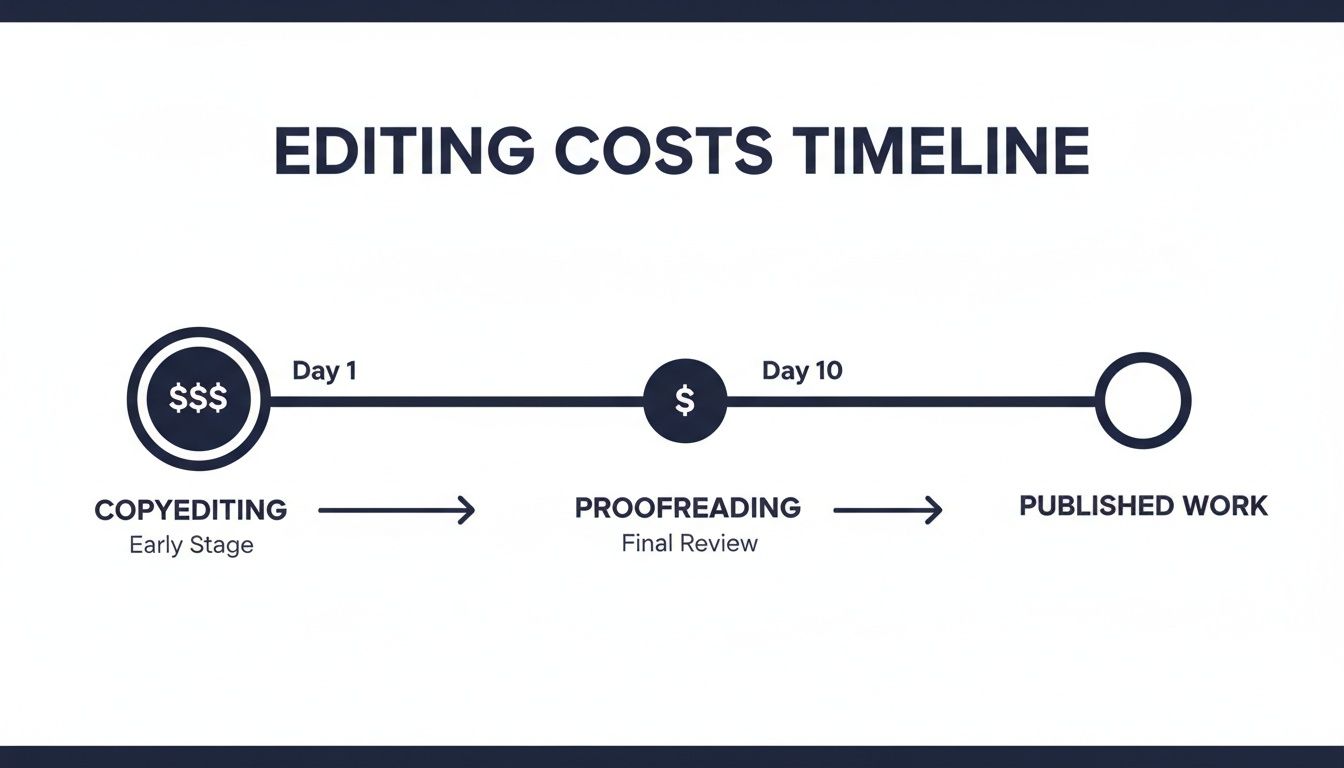
As you can see, copyediting is the heavier lift—a more significant investment made early on. Proofreading is the final, lower-cost quality check right before the finish line.
Mapping Out the Full Publishing Workflow
To see how this all works together, it helps to look at the standard professional workflow. Each stage builds on the one before it, and trying to skip a step almost always backfires. To get a really deep dive, you can explore the complete stages of publishing a book in our full guide.
A typical project flows like this:
- Developmental Editing: This is the big-picture edit. It’s all about plot, structure, character arcs, and pacing.
- Copyediting: Now we zoom in to the sentence level to tighten prose, fix grammar, and ensure consistency.
- Typesetting and Design: The edited manuscript is professionally formatted into a book layout.
- Proofreading: The final pass on the formatted proof to catch any lingering errors before printing.
Following this order is just plain smart. It prevents you from paying a proofreader to spot typos in a layout that’s going to change anyway after a copyeditor suggests rewriting a few paragraphs. It’s the efficient, industry-standard path to creating the best book possible.
How We Guide Your Manuscript to Publication
Knowing the difference between copyediting and proofreading is one thing. Finding the right partner to handle them is another. At BarkerBooks, we’ve built our entire process around the same workflows used by major publishing houses, so your manuscript gets the rigorous, professional attention it deserves.
Our job isn’t just to sell you a service. It’s to make sure you get the right service at the right time. After helping over 7,500 authors in 91 countries navigate this journey (and earning a 4.9-star average Google rating along the way), we’ve gotten pretty good at it. We’ve seen too many authors waste money on a proofread when what their manuscript really needed was a solid copyedit first. We’ll help you avoid that.
Finding the Right BarkerBooks Package for You
We keep things straightforward. Our publishing packages are designed to match where you are in the writing process. You just need to figure out how close your manuscript is to being truly finished.
Here’s a simple breakdown to help you decide:
- Essential Package: This is for authors who are confident in their manuscript and have likely already had it professionally copyedited. We’ll handle the final proofread to catch any last-minute mistakes before formatting your book for printing and distribution.
- Premier Package: Our most popular option. This is the go-to for most authors who need a thorough, professional edit. It bundles a complete copyedit to tighten up your writing, followed by a final proofread after the book is designed.
- Elite Package: This is our all-in, white-glove service. It’s for authors who want comprehensive support from start to finish, including deep developmental feedback, an intensive copyedit, and several rounds of proofreading to ensure absolute perfection.
A core belief at BarkerBooks is our “two-professional” rule. The editor who copyedits your manuscript will never be the same person who proofreads it. You absolutely need a fresh pair of eyes for that final pass—it’s the only way to guarantee a truly polished book.
Your Clear Path to a Published Book
When you work with BarkerBooks, you’re not just hiring an editor for a one-off job. You’re bringing a dedicated publishing team onto your side. We manage everything from your ISBN registration and copyright to the cover design and interior layout, making sure every piece fits together professionally.
Our integrated process prepares your book for both print and ebook marketplaces without you having to juggle multiple vendors. By building expert copyediting and proofreading right into our packages, we take the guesswork out of the equation. This lets you focus on your next story while we handle the million tiny details needed to get this one ready for readers.
A Few Common Questions
Even with a solid plan, it’s natural to have a few lingering questions about the editing process. Getting the details right is what separates a good book from a great one, so let’s clear up some of the most common points of confusion.
Can’t I Just Use Software for This?
I get this one a lot. Tools like Grammarly are fantastic for a first pass—they’re great at catching basic typos and grammar slip-ups. But they can’t replicate the nuanced judgment of a human editor.
AI often misses the big picture: contextual errors, awkward phrasing, inconsistencies in tone, or the subtle rhythm of a sentence that a professional copyeditor spends years learning to perfect. More importantly, software has no concept of a final typeset proof. It can’t spot formatting disasters like widows and orphans or ugly hyphenation breaks. For a book that looks and feels professionally published, human expertise is non-negotiable.
Do I Really Need Both Services?
For a professional-quality book, absolutely. They are two completely different jobs that happen at two different times. Skipping the copyedit means you’re leaving deeper issues with flow, clarity, and consistency on the table. A proofreader isn’t looking for that stuff.
Conversely, skipping the proofread is like running a marathon and tripping a foot from the finish line. All it takes is one embarrassing typo or formatting glitch introduced during the design phase to pull a reader out of the story. Investing in both ensures your manuscript is not only structurally sound but also flawlessly presented.
The most important thing is that the proofreader should be reading the proofs. They’re the person who checks the book professionally just before it goes to print, checking for all the potential problems that were created when your manuscript went from a Word document to a PDF.
Should the Same Person Do the Copyedit and the Proofread?
While one person could technically do both, it’s a huge mistake. The industry standard is to always use a different person, and for good reason. After a copyeditor spends weeks immersed in your manuscript, they develop what we call “editor’s blindness.” They become so familiar with the text that their brain starts to autocorrect errors on the page.
Bringing in a fresh set of eyes for the proofreading stage is the only way to guarantee a truly clean final product. It’s an essential quality control step and a non-negotiable part of our process here at BarkerBooks. It’s how we ensure your work gets the polish it truly deserves.
Ready to give your manuscript the professional attention it deserves? At BarkerBooks, our expert teams handle every stage of editing with precision and care, ensuring your book is ready for a global audience. Explore our publishing packages today.