
Plotting a novel is really about one thing: shaping your story’s events to hook a reader and never let them go. It’s the blueprint that makes sure your character’s journey, the conflicts they face, and how it all wraps up actually connect in a way that feels powerful and intentional. This is how you take a cool idea and turn it into a manuscript that works.
Why a Solid Plot Is Your Secret Weapon
I get it. A lot of writers think plotting will kill their creativity, forcing their story into a cookie-cutter mold. But here’s the thing I’ve learned from years of doing this: a strong plot isn’t a cage. It’s the engine.
Without a plot, you might have a string of interesting scenes, but they won’t add up to much. A solid structure gives your story purpose and momentum. It’s what keeps a brilliant concept from becoming a wandering draft that loses steam halfway through.
Think of it this way. A well-designed plot does a few critical jobs for your reader:
- It creates momentum. A good plot always answers the reader’s subconscious question: “Why should I turn the page?” Every scene should feel like a consequence of the one before it, pulling the reader deeper into the story.
- It builds an emotional connection. How do you make readers care? By strategically placing obstacles, setbacks, and moments of triumph. Plot is your tool for controlling the emotional ride, making them genuinely worry about your hero and cheer for their wins.
- It delivers a satisfying payoff. A great plot is all about making promises—introducing mysteries, setting up conflicts, defining a character’s deepest desires—and then delivering on them. That fulfillment is what makes a reader close the book with a sigh of satisfaction.
Turning Your Art into a Book People Want to Buy
Let’s talk business for a second. Plotting isn’t just a creative exercise; it’s a strategic one. In today’s crowded market, authors are competing for a reader’s most valuable asset: their attention.
Just look at the numbers. In the U.S. alone, adult fiction print sales reached 767 million units in 2023, a bright spot in an otherwise declining print market. With hundreds of thousands of new books hitting the shelves every year, a gripping plot is what makes yours stand out. For more on these trends, check out the data on Circana.com.
A plot is a series of events deliberately arranged so as to reveal their dramatic, thematic, and emotional significance. It’s the organization of meaning, turning simple story points into a powerful experience for the reader.
Ultimately, plotting is about respecting your reader. You’re asking for their time and focus. A clear, compelling structure is your way of guiding them through an experience they won’t forget. It’s one of the most foundational of all the literary elements.
If you’re looking to sharpen other parts of your craft, you can also find plenty of helpful general writing resources. Just remember, your plot is your promise to the reader that the journey you’re taking them on will be absolutely worth it.
Finding Your Story’s Skeleton
Every great story has a solid skeleton beneath the surface—a structure that holds everything together. When you sit down to plot your novel, picking this narrative blueprint is one of the first big decisions you’ll make. This isn’t about jamming your idea into a restrictive formula. It’s about finding a map that best fits the journey you want your readers to take.
Think of it like building a house. You wouldn’t just start nailing boards together and hope for the best. A narrative structure is your architectural plan. It ensures your story has a firm foundation, that the rising action builds in a way that makes sense, and that the ending feels both surprising and inevitable. It’s the framework that gives you the freedom to get creative without the whole thing collapsing.
This flowchart really lays out the core choice: you can plot your idea and create a clear roadmap, or you can try to write without one and risk getting lost in the weeds.
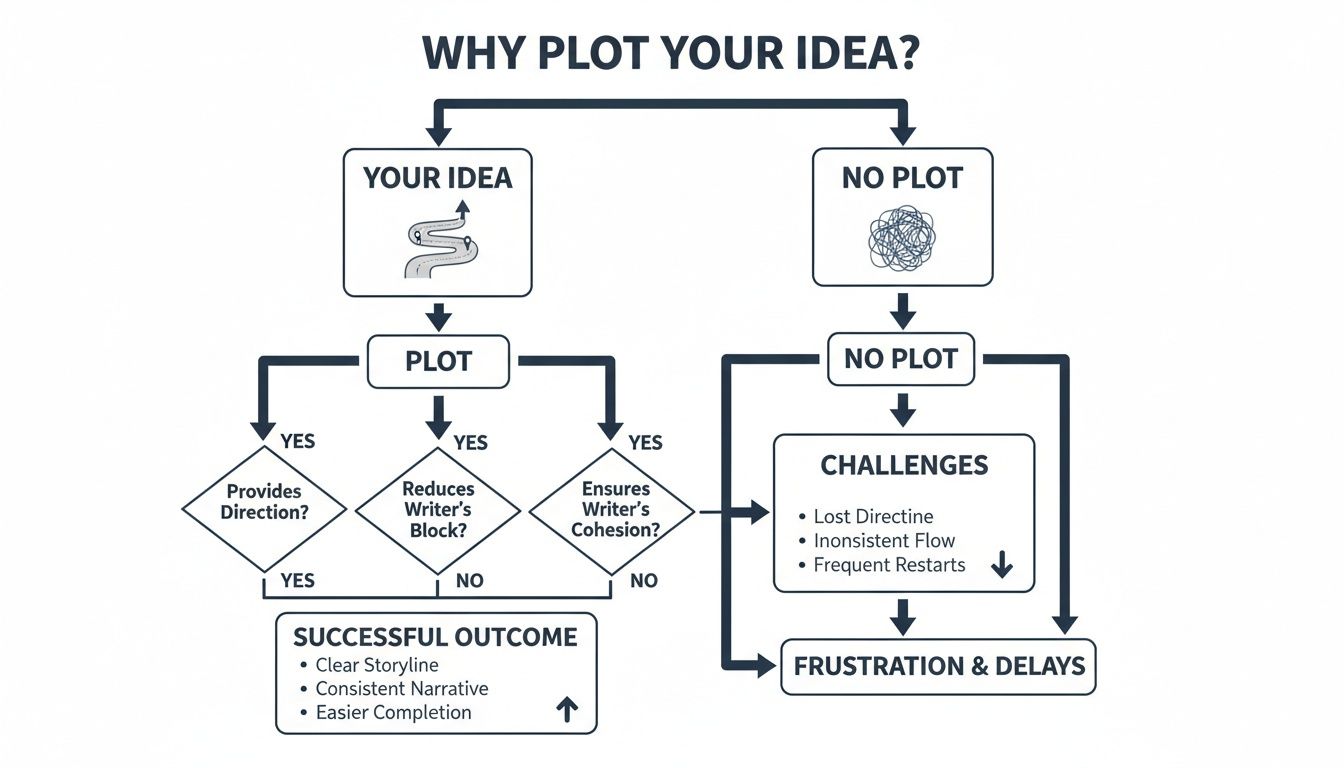
Ultimately, plotting gives you a clear path forward. It turns a massive, intimidating idea into a series of manageable steps with a clear direction.
The Big Four: Popular Plotting Frameworks
Writers have been telling stories for a long time, and a few tried-and-true structures have emerged. Each one has its own unique rhythm and strengths. Let’s break down four of the most common frameworks without getting bogged down in literary theory.
- The Three-Act Structure: This is the absolute classic of Western storytelling. You’ve got a beginning (Act I: The Setup), a middle (Act II: The Confrontation), and an end (Act III: The Resolution). It’s simple, powerful, and fantastic for building clear, driving momentum.
- The Four-Act Structure: This is a clever twist on the three-act model that solves a common problem: the dreaded “saggy middle.” By splitting the long second act in two, it creates a powerful Midpoint—a major turning point that often completely changes the hero’s goal or dramatically raises the stakes.
- The Hero’s Journey: Made famous by Joseph Campbell, this is the archetypal pattern you see in countless myths, epic fantasies, and sci-fi sagas. It follows a hero who leaves their ordinary world, faces a series of trials, wins a decisive victory, and returns home transformed.
- The Snowflake Method: For writers who cringe at rigid outlines, this is a more organic, “bottom-up” approach. You begin with a single sentence summarizing your story, then expand it into a paragraph, then into character summaries, and eventually, a full scene-by-scene outline. It’s perfect for discovering your story as you go. To see what a finished outline might look like, you can check out this detailed https://barkerbooks.com/book-outline-example/.
Comparing Popular Novel Plotting Structures
Choosing the right structure can feel overwhelming. This table breaks down the four methods we’ve discussed to help you see which one might be the best fit for your story and your writing style.
| Structure | Key Stages | Best For | Pros | Cons |
|---|---|---|---|---|
| Three-Act Structure | Setup, Confrontation, Resolution | Most genres, especially thrillers, mysteries, and screenplays. | Simple, intuitive, and creates strong forward momentum. | Can lead to a “saggy middle” if Act II isn’t well-paced. |
| Four-Act Structure | Setup, Rising Action, Climax, Resolution | Longer novels, character-driven stories, and epics. | The midpoint twist prevents the middle from dragging. | Can feel slightly more complex to manage than three acts. |
| The Hero’s Journey | The Call to Adventure, The Ordeal, The Resurrection, The Return | Fantasy, sci-fi, adventure, and stories with archetypal heroes. | Creates a deeply resonant and emotionally satisfying journey. | Can feel formulaic if the “beats” are too obvious. |
| The Snowflake Method | Sentence > Paragraph > Characters > Scenes | Planners who like to build organically; “pantsers” who need some structure. | Builds a detailed outline from a simple core idea, ensuring cohesion. | Can be time-consuming and feel less intuitive for some writers. |
Each of these blueprints offers a proven path to a finished story. Your job is to pick the one that feels most natural for the tale you want to tell.
Does Your Genre Dictate Your Structure?
While your personal preference matters, ignoring your genre is a missed opportunity. Readers have expectations. Aligning your story’s structure with genre conventions is a smart, market-savvy move. When you look at the global revenue data for fiction, you see romance at an estimated $1.44 billion, crime and mystery at $728.2 million, and sci-fi/fantasy at $590.2 million. Those numbers are built on reader satisfaction.
A romance novel, for instance, almost always follows a structure that hits specific beats: the “meet-cute,” the escalating romantic tension, the “dark moment” where it all falls apart, and the grand reunion. A thriller, on the other hand, needs a structure built for speed, with relentless pacing and twists that keep the reader off-balance.
Choosing a blueprint isn’t about limitation; it’s about communication. You’re using a shared storytelling language to connect with readers who are actively seeking the kind of emotional experience your genre promises.
So, Which Blueprint Is Right For You?
There’s no single “best” method. The right choice is a mix of what your story needs and what your personal style is.
A sprawling fantasy epic might be a perfect match for The Hero’s Journey. A tight, character-driven literary novel could shine with the clean momentum of a Three-Act Structure. If you’re a meticulous planner, the step-by-step process of the Snowflake Method might feel like coming home.
Don’t be afraid to mix and match or even create a hybrid model that works for you. And if you’re stuck, some modern AI story creator tools can be surprisingly helpful for brainstorming initial beats and structural ideas. The goal is to find a system that makes you feel empowered, not trapped. Your plot is your map—choose the one that gets you excited for the journey ahead.
Weaving Character Arcs into Your Plot

A plot is just a string of events until a character gives it a soul. The real magic happens when your character’s internal journey—their hopes, fears, and flaws—becomes the engine driving the external action. This is what gets readers invested, not just in what happens next, but in who it happens to.
The most powerful stories don’t just happen to their protagonists; they happen because of them. Their decisions, their mistakes, and their core beliefs should be the very things that push the story forward. Instead of building a plot and dropping a character into it, try thinking of the story as an extension of your character’s central struggle.
One of the biggest reasons a story falls flat is a passive protagonist. If your character feels like they’re just getting carried along for the ride, readers will check out. They need to be in the driver’s seat.
Connecting Internal Desire to External Goals
Every memorable character arc starts with a simple question: What does your character want? But just as crucial is the follow-up: What do they think they want? The chasm between these two is where your story truly comes to life.
For your protagonist, you need to define two things:
- The External Goal: This is the concrete, tangible thing they’re chasing. It could be winning a championship, finding a lost city, or exposing a corporate conspiracy. It’s clear, measurable, and drives the plot’s action.
- The Internal Need: This is the deeper, often subconscious lesson they have to learn to become a whole person. Maybe they need to learn to trust, forgive themselves, or accept that vulnerability isn’t a weakness.
The trick is to design your plot so they can’t get their external goal without confronting their internal need. A lone-wolf detective who wants to catch a killer (external goal) might have to learn to rely on a partner (internal need) to see the full picture. The plot points you design become the catalysts that force this internal change.
A propulsive plot is the result of your characters making choices. Your job as a writer is to hold the attention of your reader, and this is achieved when a character’s internal state—their desires, fears, and emotional makeup—fuels the choices they make.
Mapping Character Beats to Plot Points
Once you’ve got a handle on what your character wants versus what they need, you can start mapping their arc onto the major beats of your plot structure. Think of your plot as a custom-built obstacle course designed to challenge your character’s deepest flaw. They either change or break.
Let’s look at this through the lens of the classic Three-Act Structure:
- Act I (The Setup): We meet the character in their “before” state, where their core flaw is on full display. The Inciting Incident doesn’t just start the plot; it directly attacks this flawed worldview and yanks them out of their comfort zone.
- Act II (The Confrontation): This is the trial by fire. As the plot’s stakes escalate, the character keeps trying to solve problems using their old, broken methods. And they keep failing. This forces them to look inward. The Midpoint is often a point of no return where they finally realize their old approach is useless, prompting a radical shift in their strategy and mindset.
- Act III (The Resolution): The Climax is the final exam. Here, the protagonist must use their newfound strength or belief to face the ultimate obstacle. Their success (or failure) is a direct consequence of whether they’ve truly changed. The ending shows them living in a new normal, forever altered by the journey.
From Static Character to Dynamic Journey
Plotting isn’t just about scheduling events; it’s about orchestrating meaning. A character arc is what gives those events their emotional weight. Without it, even a story packed with explosions and car chases can feel empty.
Think about a shy librarian who gets swept up in a quest for a mythical artifact. The plot points—deciphering ancient texts, outsmarting a rival explorer—are fun. But the story becomes powerful when those external challenges force her to find her own voice and stand up for herself. Her journey from timid to tenacious is the story readers will remember.
To put this into practice, try making a simple chart as you outline:
| Plot Point | External Action | Internal Reaction & Choice | Change in Belief |
|---|---|---|---|
| Inciting Incident | Receives a cryptic map. | Fear vs. curiosity. Chooses to follow it. | “Maybe my quiet life isn’t enough.” |
| Midpoint | Is betrayed by a guide. | Learns not to trust blindly. Must rely on self. | “I can only depend on myself.” |
| Climax | Faces the final guardian. | Uses learned skills and courage. | “I am strong enough on my own.” |
When you weave your character’s internal transformation into the very fabric of your plot, you build a story that’s not just exciting, but deeply resonant. Every scene matters because it contributes to the most compelling journey of all: the evolution of your character.
Building Your Story Scene by Scene

So you’ve got your narrative blueprint and a killer character arc. Now it’s time to get your hands dirty and start laying the bricks. The scene is the fundamental building block of any novel, and this is where a high-level plan transforms into a tangible, chapter-by-chapter roadmap.
Every single scene has to earn its place in the book. If it doesn’t move the plot forward, reveal something new about a character, or crank up the tension, it’s probably just dead weight. A propulsive plot is nothing more than a series of scenes chained together by cause and effect, creating a current that pulls the reader right through to the end.
This might sound like a lot of pressure, but I find it liberating. Forget about writing a whole novel for a minute. Your only job is to write one great scene. Then the next one.
The Anatomy of a Powerful Scene
A simple, time-tested way to build a scene is to treat it like a miniature story with its own beginning, middle, and end. To make sure something meaningful always happens, every scene needs a goal, an obstacle, and an outcome.
- Goal: What does your character desperately want when the scene opens? Keep it clear and immediate. For example, a detective needs to get a key piece of information from a tight-lipped witness.
- Obstacle: What’s standing in their way? This is where the conflict lives. Maybe the witness lies, flat-out refuses to talk, or only offers cryptic clues that muddy the waters.
- Outcome: How does it all shake out? The character might succeed, fail spectacularly, or win the goal but at a terrible cost. The crucial part is that the outcome must represent a change.
Let’s say the detective fails to get the info. But in failing, they realize the witness isn’t being difficult—they’re terrified. This new reality forces the detective to make a new choice, which kicks off the goal for the very next scene. That’s causality in action. It’s the engine of your plot.
Tools for Scene-Level Plotting
You don’t need fancy software to map out your story. In my experience, simple, physical tools are often the best because they let you see the entire narrative at a glance and easily move things around. Two of my favorite methods are scene cards and spreadsheets.
Scene Cards (The Visual Method)
This is a classic for a reason. Grab a stack of index cards and jot down one scene on each. You can then lay them all out on a big table or pin them to a corkboard.
On each card, answer a few key questions: Who is in the scene? What is their goal? What’s the core conflict? What is the outcome? This bird’s-eye view makes it incredibly easy to spot pacing problems and experiment with your story’s flow just by swapping a few cards.
Spreadsheets (The Organizer’s Method)
If you crave a bit more structure, a simple spreadsheet is your best friend. You can create columns for the chapter, scene number, point-of-view character, setting, and a quick summary of the action.
Here’s a glimpse of what a scene-planning spreadsheet could look like:
| Chapter | Scene # | POV | Goal | Conflict | Outcome |
|---|---|---|---|---|---|
| 5 | 1 | Alex | Get the ledger from the safe. | A guard interrupts him. | Escapes with only one page. |
| 5 | 2 | Alex | Decipher the single page. | The page is in code. | Realizes he needs an expert. |
This method is fantastic for keeping track of subplots and making sure every character’s journey feels connected and logical. For those who want a ready-made framework, downloading a solid story structure template can be a great starting point for this kind of detailed planning.
No matter which method you choose, the goal is the same: create a detailed sequence of events that flows with both logical and emotional momentum. When you break your plot down into these manageable, purposeful scenes, the monumental task of writing a novel becomes a series of achievable steps. You’re building your story one essential brick at a time, ensuring the final structure is strong, coherent, and utterly unputdownable.
Mastering Pacing to Keep Readers Hooked
Have you ever been so deep into a book that you look up and realize hours have passed? Or maybe you’ve promised yourself “just one more chapter” only to find yourself still reading at 2 a.m. That’s not just a good story; that’s masterful pacing at work.
Pacing is the secret sauce. It’s how you control the story’s rhythm to keep your reader leaning in, desperate to know what happens next. It’s the invisible hand guiding their emotions—building suspense, delivering gut-punch reveals, and making them feel every moment of the character’s journey.
Think of your plot like a rollercoaster. You need those slow, rickety climbs to the top to build anticipation. Without them, the exhilarating, stomach-dropping falls wouldn’t have nearly the same impact. A story that’s all breakneck action quickly becomes exhausting, but one that’s all slow, quiet reflection can drag. The magic lies in the contrast.
Controlling the Story’s Rhythm
You have more control over your reader’s pulse than you might think, and it often comes down to the nuts and bolts of your sentences and scenes.
Short, choppy sentences? Bam. The pace quickens. They’re perfect for a frantic chase through city streets or a breathless argument where characters cut each other off. They create a feeling of immediacy and tension.
On the other hand, long, flowing sentences filled with description invite the reader to slow down. These are the moments for introspection, for a character to process a devastating loss, or for you to paint a picture of a breathtaking fantasy world. They give the reader room to breathe and feel.
Here are a few tricks of the trade I always come back to:
- To speed things up: Focus on action and dialogue. Keep descriptions tight and to the point. What are people doing? What are they saying right now? That’s what pulls the reader forward.
- To slow things down: Dive into a character’s internal world. Explore their memories, fears, and hopes. Use these moments to build atmosphere and emotional depth.
- The tactical cliffhanger: Ending a chapter just as a character opens a forbidden door or receives a shocking piece of news is one of the oldest—and most effective—tricks in the book. It practically forces the reader to turn the page.
Curing the Sagging Middle
Ah, the dreaded “sagging middle.” We’ve all been there. It’s that murky section of Act Two where the initial excitement has worn off, but the climax still feels a long way away. The plot starts to meander, and the tension just… deflates.
The best antidote for this is a truly game-changing midpoint. This isn’t just another complication; it should be a point of no return. It’s a moment that flips the story on its head, changes the hero’s goal, or reveals the real nature of the conflict. A strong midpoint injects a fresh dose of energy and purpose, giving the second half of your novel a powerful new trajectory.
Pacing isn’t just about how fast things happen. It’s about the strategic release of information. Holding back a key reveal, dropping hints about a dark secret, or letting the reader in on something the protagonist doesn’t know are all brilliant ways to create almost unbearable tension.
Every scene should be a cause that leads to an effect in the next, creating a chain reaction that builds momentum all the way to your climax. By plotting out not just the action but the moments of quiet reflection and the slow-burn reveals, you stop being a simple storyteller. You become the conductor of your reader’s emotional journey, controlling exactly how they experience every twist and turn.
Dodging Common Plotting Landmines
You can have the most detailed outline in the world, but it won’t save you from a few classic narrative traps. Think of this as the final pre-flight check for your plot—a chance to catch fatal flaws before you pour hundreds of hours into a first draft. Steering clear of these common missteps is often what separates a decent idea from a story that readers can’t put down.
One of the biggest culprits I see is predictable plotting. This is when your big twists feel telegraphed miles away, and the reader is always two steps ahead of your hero. If your “shocking” reveal is something your audience figured out by the end of Chapter Two, the climax will feel more like a whimper than a bang. I constantly ask myself, “What’s the least expected thing that could happen right now… that still makes perfect sense?”
The Dreaded Deus Ex Machina
Right up there with predictable plots is the infamous deus ex machina—Latin for “god from the machine.” This is the story-killer that appears when your protagonist is backed into an impossible corner, only to be saved by a completely random and unearned event. Think of the long-lost billionaire uncle suddenly showing up with a suitcase of cash just as the bank is about to foreclose.
It’s a cheap trick, and it cheats your reader. Why? Because it breaks the internal logic of your world and signals that your protagonist wasn’t clever or strong enough to solve their own problems. Any solution to a major conflict has to be earned through choices the character makes and elements you’ve already seeded into the story.
A plot problem is almost always a character problem in disguise. If a motivation feels flimsy or an ending feels unearned, look back at your character’s core desires and fears. The solution is usually buried there.
Is Your Plot Ready for the Market?
Avoiding these issues isn’t just about crafting a better story; it’s a cold, hard business decision. The average self-published book sells a sobering 250 copies, and about 90% of them sell fewer than 100. Often, those low numbers are a direct result of plotting weaknesses that kept the story from resonating with readers.
A well-structured, professional-level plot is your best strategy for bucking that trend. You can dig into more of these market realities in reports from places like Grand View Research.
Before you start writing, give your outline one last shakedown. Scrutinize these key areas:
- Motivation Check: Is your character’s “why” strong enough to carry the entire story? If their motivation is weak, their actions will feel forced and unbelievable, especially when the going gets tough.
- Logical Consistency: Do events unfold through a clear chain of cause and effect? A coincidence can be a great way to kick off a story, but a plot that relies on a string of them just feels lazy.
- Stake Escalation: Do the stakes actually get higher as the story progresses? If the consequences of failure in Act Three aren’t significantly more dire than in Act One, you’re going to lose momentum and, more importantly, your reader’s attention.
Common Questions About Plotting a Novel
Even with the best-laid plans, questions are bound to surface as you’re mapping out your novel. Let’s tackle some of the most common ones that writers grapple with, so you can move forward with a clear head and a solid foundation for your story.
What’s the Real Difference Between Plot and Story?
It’s easy to use these terms interchangeably, but for a writer, the distinction is crucial.
Think of story as the raw, chronological sequence of events—just the facts. “The king died, and then the queen died.” It’s a simple timeline of what happened, A to B to C.
Plot, on the other hand, is the connective tissue. It’s the why and how that links those events together, creating a chain of cause and effect that pulls the reader in. The legendary novelist E.M. Forster nailed it with his example: “The king died, and then the queen died of grief.” That last part, “of grief,” is everything. It’s what transforms a dull sequence into a compelling narrative with emotional weight.
Is It Okay to Change My Plot While I’m Writing?
Not only is it okay, it’s often a sign that you’re doing something right. An outline is a fantastic tool—it’s your map—but it’s not the territory itself.
Once you dive into the actual writing, your characters will start talking back. They’ll make choices you didn’t expect, and new, more exciting pathways will open up. That’s the magic of discovery in storytelling. Don’t ever feel chained to an outline you made weeks ago if a better, more organic idea emerges.
Many seasoned authors finish a messy first draft and then create a “reverse outline” to see what story they actually wrote. This helps them find the true heart of the narrative before they dive into revisions.
Your number one job as a storyteller is to keep the reader hooked. If changing the plot makes for a better, more compelling experience, then you absolutely should do it.
How Detailed Does My Plot Outline Really Need to Be?
This is the classic “plotter vs. pantser” debate, and honestly, the only right answer is the one that works for you. There’s no one-size-fits-all solution here.
Are you a Plotter? You might feel most comfortable with a super-detailed, scene-by-scene roadmap. Knowing every character motivation and emotional beat before you type a single word can give you the confidence to write freely and quickly.
Or are you a Pantser? For you, a detailed outline might feel like a creative straitjacket. A simple, one-page summary of the major turning points could be all you need to keep you pointed in the right direction without killing the joy of discovery.
Experiment a bit. Your outline should be exactly as detailed as you need it to be to start writing with confidence. Find the level of structure that frees your creativity, rather than restricting it.
Ready to turn your carefully plotted novel into a professionally published book? The expert team at BarkerBooks is here to guide you every step of the way, from editing and design to global distribution. Discover how we can help you achieve your publishing dreams at https://barkerbooks.com.