
Before you even think about posting your first “coming soon” announcement, we need to talk about your foundation. A successful book marketing social media strategy isn’t built on a frantic series of posts; it’s built on a solid author brand. This is the groundwork that turns random scrollers into lifelong fans and ensures your hard work actually translates into pre-orders and sales.
Building Your Author Brand Before You Post
Diving into social media without a clear brand is like shouting into the wind. You might make some noise, but you’re not going to connect with the right people. The first, most critical step is to define who you are as an author. This goes way beyond a nice headshot and a matching color palette. It’s the soul of your work.
Your brand is your promise to your readers. It’s what makes them pick up your thriller instead of the ten others on the shelf. It’s that unique mix of your personality, your writing style, and the core themes you can’t help but explore. A well-defined brand is the secret to learning how to build social media presence that feels authentic and effective.
Define Your Unique Authorial Voice
So, what makes you you? Are you the funny, sarcastic friend? The thoughtful, deep-diving academic? Maybe you’re warm, folksy, and inspirational. Whatever it is, your voice on social media needs to feel like a natural extension of your writing. If you write gritty, noir detective novels, a feed full of sunshine and rainbows will just confuse people.
Try to nail down three to five keywords that encapsulate your brand. For someone writing sweeping historical romance, they might be:
- Epic love stories
- Meticulously researched
- Emotionally charged
- Strong heroines
These words become your North Star, guiding every single piece of content you create. This identity should flow through everything, especially your author website. Your bio, for instance, is often the first real introduction a reader gets. Make it count. You can find some great advice for crafting a compelling about the author page that truly reflects your brand.
Identify Your Ideal Reader Persona
Listen, you can’t be for everyone, and trying to is a recipe for failure. Instead, get laser-focused on your ideal reader. I’m not just talking about age and location. What are they obsessed with? What other authors do they binge-read? What podcasts are in their queue?
A sci-fi author focused on military space operas might picture their ideal reader as a 35-year-old IT professional who follows NASA on Twitter, plays strategy video games, and spends weekends building intricate models.
Getting this specific is pure gold. It tells you exactly where to hang out online and what kind of conversations to start. When you know precisely who you’re talking to, your marketing stops feeling like a sales pitch and starts feeling like a genuine connection. This is the heart of smart book marketing.
Choosing the Right Platforms to Find Your Readers
When authors first dip their toes into social media marketing, the biggest mistake I see them make is trying to be everywhere at once. It’s a fast track to burnout and leaves you with watered-down results across the board.
The secret isn’t to conquer every single platform. It’s to get strategic. You need to pick one or two, maybe three, core channels where you know your ideal readers are already hanging out. It’s about quality over quantity, always. Focus your precious energy where it aligns with your genre, your author brand, and—just as importantly—the kind of content you actually enjoy creating.
A recent survey of over 850 authors backs this up. It showed that 78% use social media weekly to connect with readers, and the two undisputed heavyweights are Facebook (62%) and Instagram (51%). These aren’t just places to post; they’re goldmines for finding new readers and turning them into loyal fans. You can see more of the data in SpineBook Printing’s marketing insights.
So, how do you decide where to invest your time? Start by getting clear on your main goal.
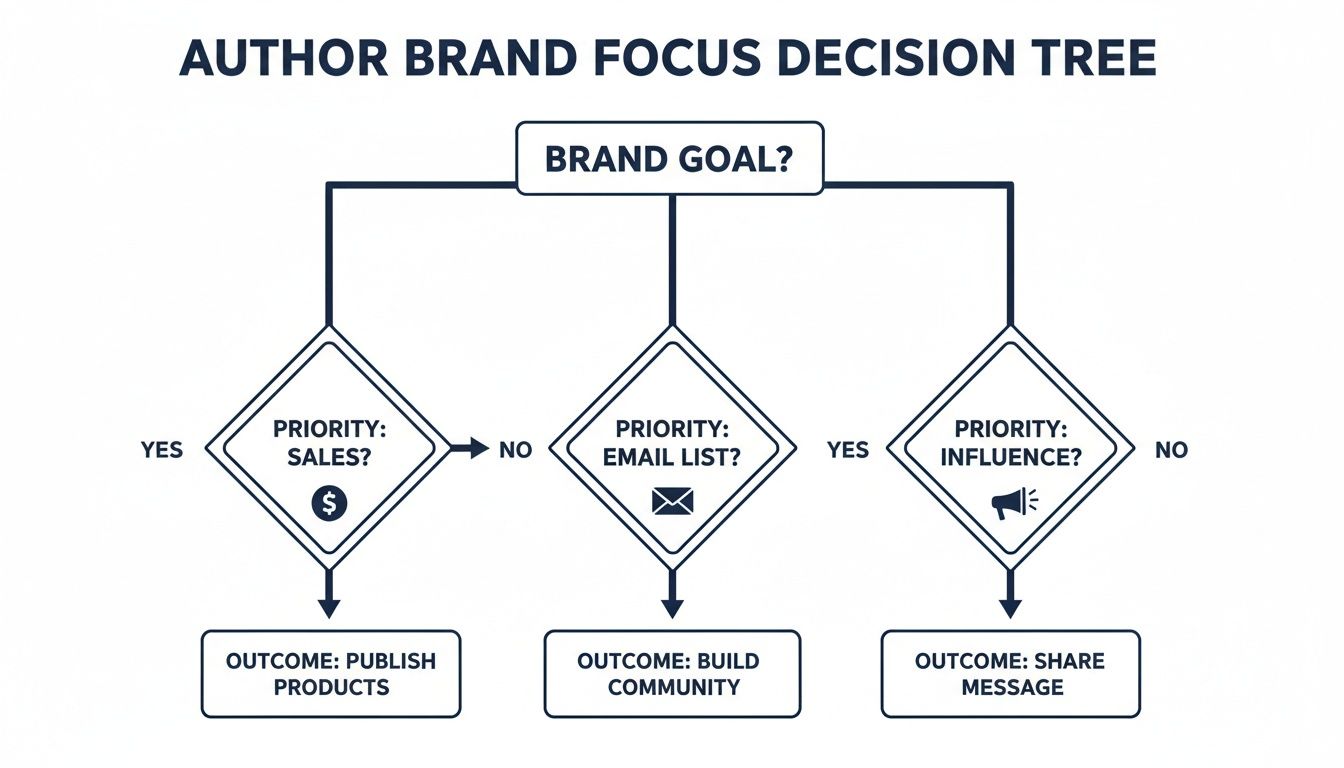
This simple decision tree helps you pinpoint what matters most right now. Are you laser-focused on direct sales, building your email list for the long haul, or establishing your influence as a go-to voice in your genre? Your answer will point you in the right direction.
Where Your Genre Thrives
Every genre has its natural habitat online. A thriller author dropping plot teasers on X (formerly Twitter) is speaking a different language than a cookbook author sharing beautiful process shots on Pinterest. Understanding these nuances is everything.
Facebook: Still a titan, especially for genres that appeal to readers over 30. It’s fantastic for building tight-knit communities in private groups, making it perfect for romance, cozy mystery, and historical fiction authors.
Instagram: A visual-first playground. If your book has a strong aesthetic, this is your place. Fantasy authors can share stunning world maps and character art, while cookbook and lifestyle authors can build a following with mouth-watering photography.
TikTok: This is where books go viral. The #BookTok community has become a publishing phenomenon, launching YA, romance, and fantasy novels onto bestseller lists through raw, emotional reader videos.
A Closer Look at the Top Platforms
To help you make the final call, here’s a quick-reference table breaking down what each platform does best for authors. Think of this as your cheat sheet for choosing a home base.
Social Media Platform Comparison for Authors
| Platform | Best For Genre | Primary Audience | Key Content Format | BarkerBooks Strategy Tip |
|---|---|---|---|---|
| Romance, Thriller, Historical Fiction, Memoirs | 30+; broad demographics | Text posts, images, video, reader groups | Create a private “Reader VIP” group for exclusive content and sneak peeks. It builds incredible loyalty. | |
| Fantasy, Sci-Fi, YA, Cookbooks, Lifestyle | 18-35; visually oriented | High-quality images, Reels, Stories | Use Reels to create mini book trailers or “a day in the life of a writer” clips. Authenticity wins. | |
| TikTok | YA, Romance, Fantasy, Contemporary Fiction | 16-24; trend-driven | Short-form video (15-60 seconds) | Don’t sell. Share the feeling of your book. Duet reader reviews and use trending audio to boost reach. |
| X (Twitter) | Sci-Fi, Thriller, Literary Fiction, Non-Fiction | 25-49; writers, agents, journalists | Short text updates, threads, memes | Perfect for networking. Engage in industry chats (#WritingCommunity) and share quick writing insights. |
| Cookbooks, Self-Help, Crafting, DIY, Travel | 30+, predominantly female | Vertical “Pins” (graphics & video) | Think like a search engine. Create beautiful pins with titles like “10 Recipes From My Italian Cookbook.” |
After reviewing the options, remember that the goal isn’t just to broadcast, it’s to connect.
“Find the digital room where your readers are already talking about books like yours, and then join the conversation. Don’t show up to sell; show up to share.”
If you’re still weighing your options, think about the platform’s core function. Facebook is your community hub—a digital living room for deep chats and running polls. Instagram is your book’s art gallery, the place for visual storytelling with cover reveals and aesthetic quote graphics. And TikTok is the wild card, a place where a single, heartfelt video can create an overnight sensation.
Don’t forget the more specialized platforms either. For non-fiction authors in categories like cooking or self-help, Pinterest is a powerful visual search engine. For authors who want to network with the literary world, X (Twitter) is the undisputed hub for connecting with agents, reviewers, and fellow writers.
Ultimately, the best platform is the one you’ll actually use consistently. My advice? Pick one primary and one secondary platform to start. Go deep, not wide. Once you’ve mastered them and built a real community, then you can think about expanding. A focused, authentic presence will always beat a scattered one.
Crafting Content That Captivates and Sells
Now that you’ve picked your platforms, the real fun begins. Your social media content is the engine that drives your entire book marketing strategy. It’s what turns a passive scroller into an engaged follower and, eventually, into a reader who can’t wait for your next book to drop. The key is to find a rhythm, creating posts that feel authentic, give real value, and gently nudge your audience toward buying your book.

This doesn’t mean every post should be a flashing “buy my book!” sign. Actually, it’s the opposite. To truly sell, you first need to learn how to create engaging social media content that people genuinely enjoy. A strong strategy is all about balance, making sure your feed is a place people want to hang out.
The Three Pillars of Author Content
I like to think of a good content plan as a sturdy three-legged stool. Each leg is crucial for balance and supports your bigger goals. If you neglect one, the whole thing gets pretty wobbly.
- Behind-the-Scenes Content: Readers are genuinely curious about the creative process. This is all about pulling back the curtain and showing the human behind the book. Honestly, it’s the best way I’ve seen to build a real, personal connection.
- Value-Driven Content: This is where you give without asking for anything back. You’re sharing your expertise and being generous, which makes followers feel like they’re getting an inside scoop.
- Community-Focused Content: Social media is a conversation, not a monologue. This pillar is dedicated to interacting with and celebrating your audience, turning them from passive followers into active members of your author community.
By cycling through these three pillars, your feed stays fresh and interesting, and it never feels like you’re just selling, selling, selling.
Your social media should feel less like a billboard and more like an invitation to a fascinating conversation. When you make your audience the hero of the story, they’ll become your most powerful marketers.
Post Ideas for Each Content Pillar
So, what does this actually look like day-to-day? Here are some concrete ideas you can steal for your own book marketing social media calendar so you’re never stuck wondering what to post.
Behind-the-Scenes Posts:
- Your Writing Cave: Snap a photo of your desk—messy or not!—and share a little bit about your writing routine.
- Research Rabbit Holes: Did you uncover a wild fact while researching your historical fiction? Share it! Found a cool location that inspired a scene? Post a picture.
- “Ask Me Anything” (AMA) Sessions: Use Instagram Stories or go live to answer questions about your writing, your characters, or the wild journey of publishing.
- Celebrating the Wins: Let people in on your excitement when you finish a draft, sign with an agent, or get your hands on the first printed copy of your book.
Value-Driven Posts:
- Genre Tropes You Love (or Loathe): Start a fun debate. “Okay, fellow romance readers, are we for or against the ‘enemies-to-lovers’ trope? Discuss!”
- Quick Writing Tips: Share a simple, actionable bit of advice that helped you get over a writing hurdle.
- Book Recommendations: Talk about a book you just finished and loved, especially if it’s by another indie author. This builds so much goodwill in the writing community.
- Character Playlists: Put together a Spotify playlist that perfectly captures your main character’s vibe and share the link.
Community-Focused Posts:
- Reader Spotlights: When a reader posts about your book, reshare it! User-generated content is pure marketing gold, and it makes that reader feel amazing.
- Engaging Questions: Ask simple, open-ended questions related to your book’s themes. If you write fantasy, try: “If you could have one magical power, what would it be?”
- Polls and Quizzes: Use the built-in features on your platform to run polls on character names, cover directions, or even fun “Which character are you?” quizzes.
Templates for Major Book Milestones
Some moments in your book’s life are bigger than others and need a bit more strategy. Think of these as your major promotional beats.
A well-planned cover reveal, for example, can create a massive amount of buzz. I’ve seen authors have great success by teasing little cropped snippets of the art for a few days before the big reveal. When you finally share the full image, pair it with the book blurb to give followers the whole picture. That blurb is critical; it’s an art form in itself. If you’re struggling, our guide on how to write book blurbs will get you hooking readers from the very first sentence.
When you share reader reviews, don’t just copy-paste the text. Turn a powerful quote into a beautiful graphic using a tool like Canva. Always tag the reviewer (if you can) and thank them sincerely. This not only encourages more reviews but also makes your readers feel truly seen. It’s this kind of consistent, thoughtful engagement that forms the foundation of great social media for authors.
How to Build an Engaged Community of Superfans
Let’s get one thing straight: great social media marketing for authors isn’t about the follower count. It’s about connection. Your real goal is to stop broadcasting and start building a community of superfans—those amazing, loyal readers who don’t just buy your books but become your biggest champions. This is where you shift from just promoting to actually having conversations, and that’s when things get exciting.

Think of your social media space less like a storefront and more like your personal book club. It’s a gathering place for shared passions and lively chats. You’re the host of the party.
Spark Conversations That Matter
Nothing kills engagement faster than only talking about yourself. Flip the script. Ask questions that pull your followers directly into the world you’ve created. This simple act turns them from a passive audience into active participants.
Don’t just throw out a generic, “What are you reading?” Go deeper by tying your questions to the themes and feel of your own genre.
- For a thriller author: “What’s a plot twist that left you completely speechless? (No spoilers!)”
- For a fantasy writer: “If you could pull one magical item from my book into the real world, what would it be and why?”
- For a romance novelist: “Friendly debate: What makes a ‘perfect’ first date scene in a romance novel?”
Questions like these get people talking to you and to each other. When you see a great comment, don’t just “like” it—reply with another question. Your comment section should feel alive and buzzing.
Harness the Power of User-Generated Content
One of the most valuable tools you have is user-generated content (UGC). This is gold. It’s when your readers create and share their own content about your book, and it’s far more authentic and persuasive than anything you could post yourself. Your job is to encourage it and celebrate it when it happens.
Create a unique, memorable hashtag for your book or series (like #TheAshenProphecy). Ask readers to use it when they post photos of your book “in the wild”—at the beach, with their cat, on their packed bookshelf.
When a reader takes the time to post about your book, they’re giving you a gift. Reshare their post to your stories, comment with genuine appreciation, and make them feel seen. This simple act of recognition turns a happy reader into a superfan for life.
This creates a fantastic flywheel effect. When others see you celebrating your readers, it inspires them to post too, hoping for their own shout-out. Before you know it, your community is helping you market your book.
The #BookTok Phenomenon
You simply can’t talk about building an author community today without mentioning the massive impact of #BookTok. It’s not just a trend; it has fundamentally changed how readers discover and talk about books. The raw, emotional reactions from everyday people have become an unbelievable sales engine.
The influence of the #BookTok community is staggering. In 2024, it was estimated to have driven 59 million print book sales in the U.S. alone. Short videos capturing a reader’s genuine tears over a plot twist have become the new word-of-mouth. You can discover more insights about these book marketing statistics to see just how potent this platform is.
You don’t need a fancy studio to get involved. Authors can jump in by:
- Sharing your own reactions to common tropes in your genre.
- Duetting or stitching reader review videos with a heartfelt “thank you.”
- Using trending audio to create quick, fun videos about your characters or writing struggles.
The key to platforms like TikTok is authenticity. Don’t sell; just share. Connect with the emotions your book evokes, and you’ll find a community that’s ready and waiting to champion your work.
Using Paid Ads to Accelerate Your Growth
While consistent, organic content is the bedrock for building a loyal community, paid advertising is your shortcut to reaching thousands of new, highly targeted readers. Think of it as putting rocket fuel in your marketing engine. It allows you to bypass the slow burn of organic reach and get your book directly in front of the people most likely to buy it.
This isn’t just an expense; it’s a strategic investment in growing your audience. With a small, controlled budget, you can test different ad designs and targeting options to see what genuinely connects with readers before you even consider spending more. It’s a cornerstone of any modern book marketing social media playbook.
Getting Your First Ad Campaign Off the Ground
Jumping into platforms like Facebook and Instagram Ads is much more straightforward than you might think. The trick is to start with a single, clear objective. Don’t try to boil the ocean on your first attempt.
A fantastic starting point for most authors is a Traffic campaign. The goal is dead simple: get people to click a link that takes them somewhere specific. This is perfect for driving potential readers straight to your book’s sales page on Amazon, Barnes & Noble, or your own author website.
Here’s what that initial setup usually looks like:
- Pick Your Objective: You’ll select “Traffic” to focus entirely on sending people to your chosen URL.
- Define Your Audience: This is where the magic really happens. You get to decide exactly who sees your ad.
- Set Your Budget: Start small. I mean it. $5 to $10 per day is plenty to start gathering data.
- Create Your Ad: Design a simple visual and write some punchy, compelling text.
This methodical approach takes the guesswork out of the process and helps you learn what works without a massive financial risk.
Mastering Audience Targeting
If there’s one skill to master in social media advertising, it’s targeting. You could have the most beautifully designed ad in the world, but if you show it to the wrong people, you won’t sell a single book. The goal is to find readers who are already primed to love what you’ve written.
Forget broad categories like “people who like books.” Get granular. For instance, if you’ve written a gritty psychological thriller, you could target users who have shown interest in:
- Specific Authors: Gillian Flynn, Tana French, or Stephen King.
- Similar Books or Films: Gone Girl or The Silent Patient.
- Genre-Specific Interests: “Thrillers,” “mystery novels,” or “crime fiction.”
By layering these interests, you can build a laser-focused audience. Imagine showing your ad to someone who has liked both Stephen King’s official page and the page for The Shining. That’s a reader who is almost certainly going to be interested in your new horror novel.
Making Sense of Your Budget and Key Metrics
So, how much should you spend? There’s no magic number, but starting small and scaling up is always the smartest strategy. A daily budget of $5 to $10 is more than enough to run a test for a few days and collect some incredibly valuable data.
As your ad runs, keep an eye on a few key numbers:
- Cost Per Click (CPC): This shows you exactly what you’re paying every time someone clicks your ad link. A lower CPC is generally better.
- Click-Through Rate (CTR): This is the percentage of people who saw your ad and actually clicked on it. A higher CTR means your ad is hitting the mark.
Global social media ad spend was projected to hit $276 billion in 2025, and for good reason—platforms like Facebook offer fantastic returns for authors who know how to use them. While a 1-2% CTR is a solid benchmark for book ads, the sheer scale of these platforms means you can reach thousands of potential readers with just one campaign. For authors looking to get the most from their ad spend, understanding how to advertise a book effectively is a game-changing skill.
Don’t be afraid to experiment. Run two versions of an ad with different images or headlines—a process known as A/B testing—to see which one performs better. This data-driven approach will systematically improve your results over time, turning paid ads into a reliable and powerful tool for selling more books.
Your Top Book Marketing Questions, Answered
Let’s be honest, navigating the world of social media marketing can feel overwhelming. You’ve put in the work—you’ve built your author brand, picked your platforms, and started posting—but the questions always seem to pile up.
This section is all about getting you straight, practical answers to the most common hurdles authors run into. Think of it as your go-to cheat sheet for clearing up confusion and moving forward with confidence.
How Much Time Do I Really Need to Spend on Social Media Every Day?
This is probably the question I get asked most often. The answer isn’t about clocking in for hours on end; it’s about consistency. You don’t need to live online to see results.
Aim for a dedicated 30-45 minutes each day. That’s it. It’s a completely manageable target that won’t lead to burnout.
Here’s how to break it down for the biggest impact:
- 10-15 minutes: Post or schedule your content for the day.
- 20-30 minutes: Dive into real engagement. This means replying to every single comment, interacting with posts from other authors in your genre, and jumping into relevant conversations.
A sustainable daily habit is infinitely more powerful than a massive, three-hour session once a week. Showing up consistently is what builds momentum and community.
A scheduling tool like Buffer or Later can be your best friend here. Batch-create a week’s worth of content in one go, which frees up your daily time for what truly moves the needle: genuine connection.
What Are the Biggest Social Media Mistakes Authors Make?
It’s surprisingly easy to get things wrong, but most missteps fall into just a few common traps. If you can sidestep these, you’ll already be way ahead of the game.
The absolute biggest mistake is treating your social media feed like a 24/7 billboard. A profile that just shouts “Buy my book!” over and over again is the fastest way to lose followers. People are on social media for connection and value, not to be sold to constantly. This is why having different content pillars is so important—you have to earn the right to promote.
A few other common pitfalls to watch out for:
- Spreading yourself too thin: Trying to master five different platforms is a surefire recipe for failure. It’s so much more effective to dominate one or two channels where you know your ideal readers hang out.
- Posting and ghosting: Don’t just drop a post and run. The magic happens in the comments section. Ignoring replies sends a clear message that you’re only there to broadcast, not to build a community.
- Forgetting the “social” part: It’s not all about you! Share and celebrate the work of other authors, give a shout-out to your readers, and participate in conversations that aren’t on your own feed.
How Do I Actually Know If My Social Media Is Working?
Success on social media is about so much more than your follower count. Chasing those “vanity metrics” is a trap that won’t actually help you sell books. Instead, you need to focus on the numbers that prove you’re building a real, engaged community.
The most important metric to track is your Engagement Rate. This is simply the total likes, comments, and shares on a post, divided by your total follower count. It’s the clearest indicator of whether your content is actually hitting the mark. An account with a smaller, highly engaged following is far more valuable than a massive account with a dormant audience.
Also, keep a close eye on your Link Clicks. Most platforms offer analytics that show you exactly how many people clicked the link in your bio or in a specific post. This tells you if you’re successfully moving people from your social feed to your author website or book sales page.
While it can be tricky to draw a direct line from a single post to a sale, look for patterns. Did you see a bump in Amazon sales the day after running a promotion on Instagram? That’s a powerful sign that your efforts are paying off.
Is It Realistic to Sell Books Directly From Social Media?
Yes, one hundred percent. Authors do it successfully every single day. While a huge piece of the puzzle is building your brand and fostering a community, social media can absolutely be a powerful sales engine when you use it the right way.
The best strategy is usually indirect. You use your content to build trust and get people excited about your work. Then, you gently guide your interested followers toward a clear call-to-action—typically the link in your bio that leads to your book’s Amazon page or your own website.
Platforms like Instagram and Facebook also offer shopping features that can make the process even more direct. But the core principle never changes: you have to earn the sale by building a relationship first. The transaction is the very last step of the journey, not the first thing you ask for.
At BarkerBooks, we guide authors through every stage of publishing, from top-tier editing and cover design to building marketing strategies that connect your book with the right readers. Ready to see your manuscript become a success story? Explore our comprehensive author services and let’s get started.