
Before you spend a single dollar on ads or a single minute on social media, you have to get your book’s Amazon page right. This is the bedrock of your entire marketing plan. Your cover, your description, and your backend keywords have to be dialed in perfectly to grab a reader’s attention and, just as importantly, to play nice with Amazon’s algorithm. This is the work that turns a casual browser into a buyer.
Building Your Book’s Foundation on Amazon
Think of your book’s page as your digital storefront. It doesn’t matter how many people you get to walk through the door; if the store is a mess, they’ll turn around and leave. Getting this foundation right is non-negotiable. Every single element needs to work together to convince someone that your book is the one they’ve been looking for.
This isn’t just about looking pretty. It’s about sending signals of quality and professionalism to both human readers and Amazon’s powerful A9 algorithm. The marketplace is incredibly crowded. Amazon commands about 50% of all print book sales in the U.S. and a staggering 68% of ebook sales. With over 1.4 million self-published books hitting Kindle Direct Publishing (KDP) every year, a polished, professional listing is what separates you from the noise.
Your Cover Is Your Most Important Ad
Long before anyone reads your brilliant description or sees your five-star reviews, they see your cover. It’s just a tiny thumbnail on a crowded search results page, but it’s your first—and often your only—shot to make an impression. A professionally designed cover that fits your genre isn’t just nice to have; it’s your most critical sales tool.
I see so many new authors trip up here. They get a cover they personally love, but it doesn’t scream “thriller” to a thriller reader. Your romance novel needs to look like a romance novel. If the cover looks amateur or out of place, potential buyers will scroll right on by, assuming the writing inside is just as unprofessional.
Your cover gets a reader to click. Your description gets them to buy. Neglecting either one is like building a car with only three wheels—it simply won’t get you where you want to go.
Crafting a Book Description That Sells
Okay, they clicked! Now your book description has to do the heavy lifting. This isn’t a book report summary. It’s sales copy. Its sole purpose is to hook the reader emotionally and make them absolutely need to know what happens next.
Make your description easy to scan. No one wants to read a giant wall of text. Use short paragraphs and simple HTML like bolding or bullet points to guide their eyes through the copy.
Here’s a simple framework that works:
- Start with a killer hook: Ask a question or make a bold statement that immediately grabs their attention.
- Introduce the core conflict: What’s the main problem or challenge your character is up against?
- Raise the stakes: What’s on the line? What happens if they fail? This creates real tension.
- End on a cliffhanger: Leave them with a burning question that can only be answered by buying your book.
To make sure your book is not only appealing but also easy to find, you’ll want to master the various Amazon listing optimization strategies that top authors use.
Choosing Keywords and Categories for Discoverability
While your cover and description are for people, your keywords and categories are mostly for Amazon’s algorithm. These backend settings are how you tell Amazon what your book is about and who should see it. This is absolutely fundamental.
When you set up your book, you get to pick two categories. Be as specific and relevant as you possibly can. It’s often much easier to hit the “Bestseller” list in a smaller, niche sub-category. That little orange banner is powerful social proof that sells more books.
For your seven keyword slots, you need to think like a reader. What would someone actually type into the search bar to find a book like yours?
- Use longer phrases, not just single words (e.g., “dystopian sci-fi with strong female lead”).
- Think about genre, setting, character types, plot devices, and even authors who write similar books.
- Don’t waste space by repeating words that are already in your title or subtitle.
This backend work is completely invisible to shoppers, but it’s the engine that drives your book’s organic visibility on the platform.
To pull this all together, here’s a quick checklist to make sure you’ve covered the essentials for a strong listing foundation.
Amazon Book Listing Optimization Checklist
| Element | Key Action | Impact on Marketing |
|---|---|---|
| Book Cover | Invest in a professional, genre-specific design. | The #1 factor for click-throughs from search and ads. |
| Title & Subtitle | Craft a compelling title with a keyword-rich subtitle. | Improves search ranking and clearly communicates the book’s promise. |
| Book Description | Write hook-driven sales copy using formatting (bold, bullets). | Converts page visitors into buyers by creating emotional investment. |
| Categories | Select two specific, relevant, and less competitive categories. | Increases chances of earning a “Bestseller” tag for social proof. |
| Keywords | Use all seven keyword slots with long-tail, reader-focused terms. | Drives organic discoverability by telling Amazon’s algorithm where to show your book. |
| A+ Content | (If eligible) Design visually rich content to enhance the description. | Boosts conversion rates by 3-10% and adds a professional polish. |
Treat this checklist as your pre-flight inspection before you launch any marketing campaigns. Getting these elements right from the start will make every other marketing effort you undertake more effective.
Running Profitable Amazon Ad Campaigns
Alright, your book’s foundation is solid. Now it’s time to get some eyeballs on it. Amazon Ads are, without a doubt, the most direct way to reach readers who are already on the platform, actively looking for their next read.
Think of it like setting up a billboard right at the entrance of the world’s biggest bookstore, pointing directly to your book. The system can feel a bit complex at first, but the core idea is simple: you bid to have your book appear in front of potential buyers. The trick is to start small, see what works, and build from there.
Understanding the Main Ad Types
Amazon gives you a few ad formats to play with, but for most authors, it really boils down to two main types. Each one has a specific job in your overall marketing plan.
Sponsored Products: These are the ads you see constantly—they pop up in search results and on the product pages of other books. These are your workhorses, perfect for targeting specific keywords and authors who write books similar to yours.
Sponsored Brands: You know those banner ads that sometimes appear at the very top of a search results page? Those are Sponsored Brands. They’re fantastic for authors with a few books out, letting you show off a whole series or a collection of your work with your logo.
If you’re just starting out, stick with Sponsored Products. They’re more affordable, a breeze to set up, and will give you a mountain of useful data on what terms readers are actually using to find books like yours.
Your First Campaign on a Small Budget
You really don’t need a huge war chest to get going. In fact, jumping in with a big budget is a great way to lose money fast.
Start with just $5 to $10 a day. Seriously, that’s plenty. The goal of your first few campaigns isn’t to make a profit; it’s to gather intelligence.
I always tell authors to begin with an Automatic Targeting campaign. This is where you let Amazon’s algorithm do the heavy lifting. It takes your book’s title, description, and keywords and starts showing your ad to shoppers it thinks are a good match.
Let it run for a week or two. Then, you can dive into the advertising reports and find a goldmine. You’re looking for the “Search Term Report.” This report tells you the exact phrases customers typed into Amazon right before they clicked your ad. These are your proven, high-converting keywords.
From Automatic to Manual Control
Once you’ve found a handful of solid search terms from that automatic campaign, it’s time to launch a Manual Targeting campaign. This is where you take the reins. You tell Amazon precisely which keywords to bid on, which means you can put more of your budget behind what you know works.
When you’re brainstorming keywords, put yourself in the reader’s shoes. What would they type into the search bar?
- Broad Genre Terms: “space opera,” “historical romance,” “cozy mystery with baking”
- Similar Authors: “books like stephen king,” “authors similar to lucy score”
- Specific Tropes: “enemies to lovers fantasy,” “found family sci-fi”
A great trick here is to do a little competitor recon. Go to the page of a bestseller in your genre and scroll down. Amazon’s “Customers who bought this item also bought” section is a fantastic place to find more authors and books to target in your ads. For a deeper dive, there are some great advanced Amazon advertising for books strategies that can really level up your campaign structure.
The single most important metric to track is your ACOS, or Advertising Cost of Sale. This percentage tells you exactly how much you’re spending on ads for every dollar you make in sales. A low ACOS means your ads are profitable. A high ACOS means you’re losing money.
Reading Your Reports and Optimizing
The biggest mistake I see authors make is setting up ads and then walking away. You have to check in on your campaigns at least once a week. The game plan is simple: scale what’s working and kill what’s not.
Is a keyword getting a ton of clicks but zero sales? It’s burning cash. Pause it. Found a keyword with a super low ACOS? Try inching up your bid to get it in front of more people. Exploring different geo tools for Amazon sellers can also offer a competitive edge by sharpening your targeting and optimization efforts.
This constant cycle of testing, analyzing, and tweaking is how you run profitable Amazon ad campaigns. It turns advertising from a shot in the dark into a data-driven machine that consistently sells more books.
Using KDP Select Promotions to Your Advantage
Enrolling your book in KDP Select means giving Amazon exclusive rights to sell your ebook for 90 days at a time. This is a big decision. You can’t list it on Apple Books, Kobo, or even your own website. For some authors, that’s a dealbreaker, but for many—especially those just starting out—the promotional firepower you get in return is a massive advantage.
Think of it as a strategic trade-off. You’re sacrificing a “wide” distribution for much deeper access to Amazon’s huge reader base and its powerful internal marketing engine.
Tapping into the Kindle Unlimited Ecosystem
The biggest perk of KDP Select is getting your book into Kindle Unlimited (KU). This is Amazon’s “Netflix for books” service where subscribers pay a monthly fee to read as many KU-enrolled books as they want. As an author, you get paid from a shared global fund for every single page they read.
This income can be surprisingly stable, particularly if you write a series. KU readers are often voracious, devouring multiple books a week. They’re the binge-readers who will tear through your entire backlist in a few days and, importantly, are highly likely to leave reviews. This creates a fantastic cycle of visibility. To give you an idea of the scale, the KU Global Fund paid out a staggering $575 million in 2023 alone.
Pro Tip: Don’t just see KU readers as a page-read payout. They are your potential superfans. If you hook them with a great story, they’ll become the engine that drives your career forward through reads, reviews, and word-of-mouth.
The Power of a Free Book Promotion
One of KDP Select’s most famous features is the Free Book Promotion. You get to run one for up to five days every 90-day enrollment period. Giving your book away for free might sound completely backward, but it’s one of the most effective visibility tactics out there.
A well-timed free run can lead to thousands of downloads, especially if you stack it with paid promotions from sites like Freebooksy or The Fussy Librarian. This strategy hits two critical goals:
- Build Your Audience: It gets your book into the hands of countless new readers who might never have taken a chance on an unknown author otherwise.
- Juice the Algorithm: A huge spike in “orders”—even at $0.00—tells Amazon’s algorithm that your book is hot. This can improve your visibility in the “Also Boughts” and give your paid rank a serious boost when the promo ends.
We often call this the “slingshot effect.” The momentum from the free downloads carries over, slingshotting your book up the paid charts for a nice, sustained period of visibility.
Creating Urgency with Kindle Countdown Deals
If your main markets are the US or UK, Kindle Countdown Deals are an incredible tool for creating real urgency. This feature lets you run a limited-time discount where the price gradually ticks back up to its original list price over a period of up to seven days.
A Countdown Deal works so well because it’s more than just a sale; it’s an event. Shoppers see a literal timer on your book’s page, counting down the hours until the price increases. That psychological trigger is a powerful nudge to buy now. Combine this with an email to your newsletter list or a social media push, and you can drive a significant spike in sales and climb the rankings.
Of course, mastering these promotions starts with getting the setup right. For a complete walkthrough of the technical side, you can explore our detailed guide on how to publish an ebook to Amazon, which covers the entire KDP process from start to finish. With over 2.6 million new self-published titles hitting KDP each year, using these tactical promotions is more important than ever to stand out.
Engineering a High-Impact Book Launch
A powerful book launch isn’t just about hitting “publish” and hoping for the best. It’s a calculated, short-term burst of energy designed to create what marketers call sales velocity. This rapid initial sales pace is a massive signal to Amazon’s algorithm that your book is popular, relevant, and worth showing to more readers.
The whole point is to orchestrate a spike in activity—sales, downloads, and reviews—within the first few days. This initial momentum can have a lasting impact on your book’s long-term visibility and success. Think of it as giving a boulder a huge shove down a hill; the initial effort is intense, but it builds momentum that keeps it rolling long after you’ve stopped pushing.
Assemble Your Launch Team
Your secret weapon for a knockout launch is a dedicated “street team.” This is a small, hand-picked group of your most engaged readers and supporters who get an Advance Reader Copy (ARC) of your book before it goes live.
Their mission is simple but absolutely critical: read the book and be ready to post an honest review on Amazon as soon as it’s published. Those first few reviews are incredibly powerful social proof. A book page with zero reviews feels like a ghost town, but a page with even five to ten positive reviews immediately feels more credible and inviting to new buyers.
So, where do you find these people?
- Your Email List: Start with your most loyal subscribers. They’re already fans.
- Social Media: Announce that you’re looking for ARC readers in your author groups or on your social media pages.
- Your Network: Don’t forget to reach out to friends, family, and fellow writers who are avid readers in your genre.
The key is to make your team feel like valued insiders. Create a private Facebook group just for them, share some behind-the-scenes content, and be crystal clear about launch day expectations.
A successful launch isn’t about getting thousands of sales on day one. It’s about creating a concentrated burst of activity that makes the Amazon algorithm sit up and take notice. Reviews, KU downloads, and sales all contribute to this critical initial velocity.
Stack Promotions for Maximum Impact
A common mistake I see authors make is spreading their marketing efforts too thin. For a launch, you want to stack your promotions to create that sales spike we just talked about. This means coordinating different activities to all happen within a very tight window, typically the first 3-7 days.
Imagine your promotions laid out on a timeline. This visual shows how you can layer different KDP Select promotions to keep the momentum going.
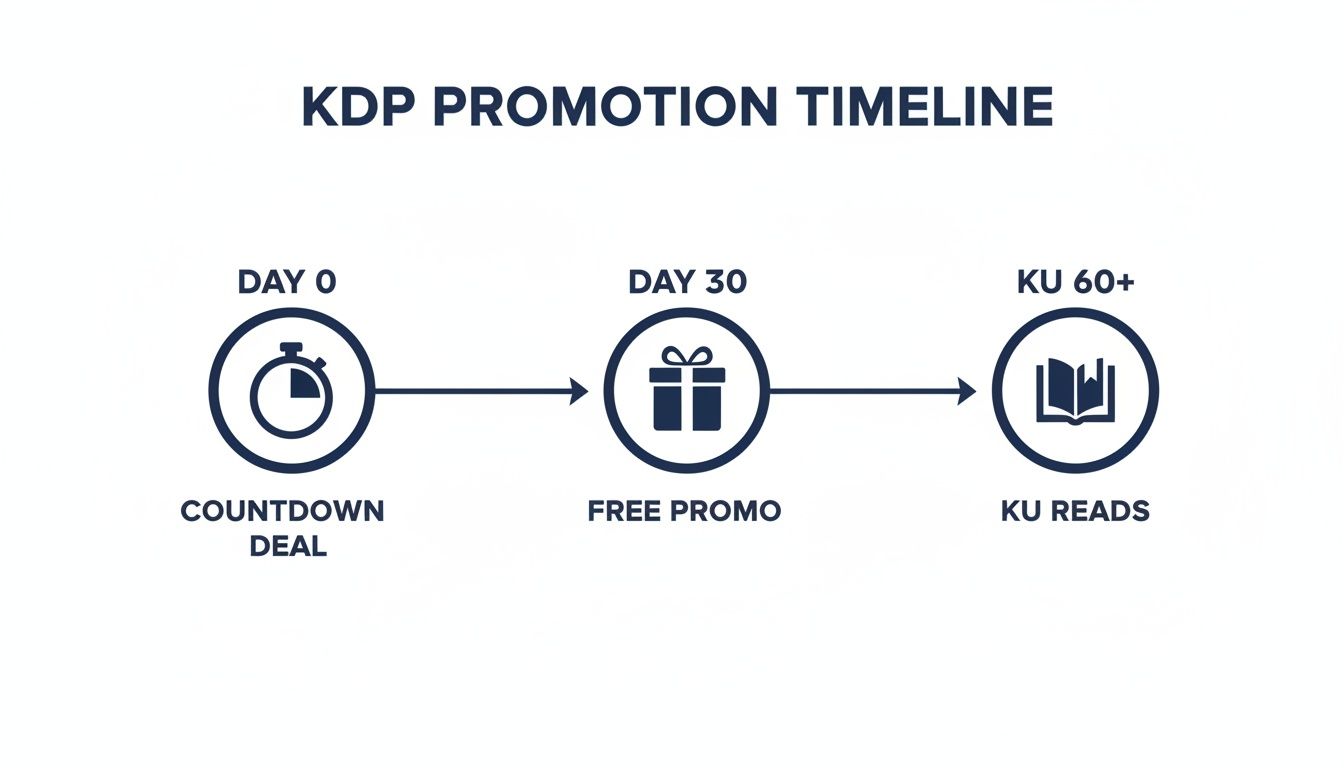
This strategic layering ensures your book stays visible to the algorithm, transitioning from one promotional boost to the next without losing steam.
Let’s look at a practical example of how this might work. Here’s a sample schedule you could adapt for your own launch week.
Launch Week Promotional Calendar
| Day | Primary Action | Supporting Channels |
|---|---|---|
| Day 1 (Launch Day) | Price at $0.99; Announce launch | Email list, social media, launch team |
| Day 2 | Submit to a paid newsletter service | Share newsletter feature on social media |
| Day 3 | Run a Facebook/BookBub Ad to the book page | Cross-promote with another author |
| Day 4 | Remind email list about the special launch price | Post a book excerpt on social media |
| Day 5 | Raise price to $2.99 (or full price) | Announce “last chance” for the deal |
| Days 6-7 | Monitor Amazon Ads, adjust bids | Continue organic social media engagement |
This kind of coordinated effort, where each element amplifies the others, is how you drive a concentrated wave of traffic and sales directly to your book page.
Elevate Your Book Page with A+ Content
Once you have an established author profile, Amazon unlocks a powerful tool called A+ Content. This feature lets you replace the standard, text-only “From the Publisher” section on your book page with visually rich modules. Think custom images, comparison charts, and beautifully formatted text.
This is your chance to create a stunning, magazine-style layout that tells a deeper story about your book. With 90% of self-published authors using Amazon KDP, standing out is essential. Using A+ Content to show off excerpts, character art, or an author bio can boost conversions by up to 5-10%—a significant edge in a crowded market. According to some eye-opening self-publishing statistics, these conversion tactics directly impact your Best Sellers Rank (BSR); books that consistently rank under 10,000 can often sell hundreds of copies each month.
Here are a few ways you can use A+ Content:
- Build a stunning “About the Author” section with a professional headshot.
- Display graphics featuring powerful quotes from the book.
- Create a visual guide to your series, showing new readers exactly where to start.
- Highlight key themes or elements of your world-building with custom art.
This professional polish signals quality to potential readers and gives you a much better shot at turning a curious browser into a buyer. And at the end of the day, that’s what a great launch is all about.
Driving External Traffic to Your Amazon Page

While optimizing your book’s page is a huge piece of the puzzle, banking only on Amazon’s internal traffic is a dangerous game. Algorithms shift, ad costs climb, and your visibility can drop overnight without warning. The most resilient authors I know have all learned a fundamental truth of modern publishing: you have to build your own audience.
Creating marketing channels that you own and control is the ultimate long-term play. These external traffic sources do more than just spread your risk around; they send powerful signals back to Amazon. When a consistent flow of buyers arrives on your book page from outside the platform, it tells the algorithm your book has broad appeal, which can do wonders for your organic rankings.
Your Email List Is Your Greatest Asset
If you focus on just one thing outside of Amazon, make it your email list. It’s the single most valuable marketing tool you can have. It’s a direct line to your readers—no algorithm standing in the way. You can reach them whenever you want, whether you’re launching a new book, running a price drop, or just sharing a behind-the-scenes story.
To get started, you need a compelling reason for people to sign up. This is your lead magnet, and it has to be something valuable and exclusive they can’t get anywhere else.
- A bonus chapter or epilogue: Give readers a satisfying glimpse of what happens after “The End.”
- A short story set in your book’s world: This is a fantastic way for fiction authors to deepen their universe and hook readers.
- A practical checklist or resource: For non-fiction, a downloadable PDF that solves a problem related to your book’s topic is incredibly effective.
Make sure to promote your lead magnet everywhere—in the back matter of your books, on your website, and across your social media profiles. The goal is to constantly turn one-time buyers into long-term fans who are primed and ready for your next release.
Using Social Media for Connection, Not Just Promotion
Let’s be honest, social media can feel like a content-creation hamster wheel. The secret is to stop shouting “Buy my book!” into the void and start building a real community. Instead of spamming links, focus on giving your target readers something of value and creating genuine connections.
First, figure out where your ideal readers are actually spending their time. If you write page-turning thrillers, a dedicated Facebook group for the genre might be your spot. If you’ve written a cookbook with stunning photos, Pinterest could be a goldmine. For a much deeper look at platform-specific tactics, our guide on social media for authors has a ton of practical advice for building an engaged following.
The best social media strategy isn’t about being on every platform; it’s about being authentic and consistent on the one or two platforms where your readers actually hang out. Share your writing process, ask fun questions, and talk about other books you love. Act like a member of the community, not just a marketer trying to sell something.
Tapping into Paid External Traffic
Once you have your own platforms up and running, you can hit the accelerator with paid ads. Unlike Amazon Ads, which target shoppers already on the site, these ads help you discover brand-new readers across the web and bring them straight to your Amazon page.
Here are a couple of popular and effective options to start with:
BookBub Ads: This platform is incredible because it lets you target the dedicated fans of specific, well-known authors in your genre. You can run ads to a super-relevant audience with a daily budget as low as a few dollars, which makes it a perfect place to test the waters without breaking the bank.
Facebook Ads: With its sophisticated targeting tools, you can build ad campaigns aimed at users based on their interests and behaviors. For instance, you could run an ad targeting people who “like” Stephen King’s page and have an interest in “Kindle ebooks.”
A crucial tip: when running external ads, always send that traffic directly to your Amazon book page. This creates a seamless path to purchase and concentrates all that valuable traffic right where it can positively influence your sales rank. This is how you create a powerful feedback loop where your off-Amazon efforts directly boost your on-Amazon success.
Your Top Amazon Book Marketing Questions, Answered
Jumping into Amazon marketing can feel overwhelming. I get it. Over the years, I’ve seen authors grapple with the same set of questions time and time again. Let’s clear the air and tackle some of the most common hurdles you’ll face.
How Much Should I Really Spend on Amazon Ads When I’m Just Starting Out?
This is the big one, isn’t it? My advice is always to start small and smart. A budget of $5 to $10 per day is the perfect training ground.
Your goal in the beginning isn’t to hit the bestseller list overnight. It’s to gather data. Think of it as market research. You’re paying Amazon to tell you exactly what search terms actual shoppers are using to find books like yours.
A great way to do this is with an automatic campaign. Just let it run for a week or two. Then, dive into your search term report. You’ll find a goldmine of keywords that are actually converting. Grab those winners and move them into a manual campaign where you can bid more deliberately and control your spend. You’re not just buying sales; you’re buying intelligence.
Is KDP Select and Going Exclusive with Amazon Worth the Hype?
For a new author, I almost always say yes. It might feel limiting to commit your ebook to Amazon exclusively for 90 days, but the trade-off is often well worth it.
Enrolling in KDP Select unlocks some of Amazon’s most powerful promotional tools. We’re talking about Kindle Countdown Deals and Free Book Promotions—both fantastic for making a splash during your launch. More importantly, it gets your book into Kindle Unlimited (KU). KU is a massive pool of readers who are constantly looking for their next favorite author and aren’t afraid to take a chance on someone new. Those page-read royalties can become a surprisingly steady source of income.
Remember, KDP Select is a 90-day commitment, not a life sentence. You can test it out. See how it works for you. If you decide a “wide” strategy is a better fit later on, you can simply opt out when the term is up. It’s a strategic tool, not a permanent trap.
What’s the Magic Number of Reviews I Need to Start Selling?
There’s no single magic number, but there is a tipping point. Aim to get at least 10-20 positive reviews as quickly as you can. This is all about social proof. It’s the digital equivalent of seeing a busy restaurant—it tells potential buyers that others have tried your book and liked it, making them feel much more comfortable clicking “Buy Now.”
The timing of these first reviews is almost more important than the total count. Getting a burst of reviews within the first 72 hours of your launch is a powerful signal to Amazon’s algorithm that your book is relevant and gaining traction. This can give your book a significant visibility boost right when it matters most.
So, how do you do it? Build a launch team. Reach out to your email list, your social media followers, or even friends and family, and offer them an advance reader copy (ARC) in exchange for an honest review on launch day.
Should I Market the Ebook or the Paperback?
Focus your firepower on the ebook. That said, having a professionally produced paperback is non-negotiable.
Here’s why the ebook comes first: ebook sales and KU page reads are the primary fuel for your Amazon Best Sellers Rank (BSR). A better BSR means more visibility, which creates a “halo effect” that lifts the sales of all your book’s formats, including the paperback. Plus, all the juicy promotional tools we talked about, like Kindle Countdown Deals, are for ebooks only.
But don’t neglect the paperback. It’s critical for other reasons:
- Credibility: A physical book just feels more “real.” It solidifies your status as a professional author.
- Reader Choice: Some people will simply always prefer the feel of a physical book. Don’t leave them out.
- Gifts: People love to give physical books as gifts. It’s much harder to wrap an ebook.
Think of your ebook as the engine of your marketing machine and your paperback as a crucial part of your author storefront. You absolutely need both.
Publishing a book is a monumental achievement, but marketing it effectively is what turns your dream into a career. If you’re ready to transform your manuscript into a professionally published book with a powerful marketing strategy, the expert team at BarkerBooks is here to guide you every step of the way. Learn how we can help you reach a global audience.