
So, you’ve poured your heart and soul into a manuscript. The final word is written, the last chapter closed. Now what? The question every writer eventually faces is a big one: how do you actually get your book published?
This guide is designed to be your roadmap, breaking down the entire journey from a finished draft to a book in readers’ hands.
Your Publishing Journey Starts Here

We’re going to cut through the industry jargon and give you a clear, realistic look at your options. Whether you’re dreaming of landing a deal with a traditional publisher, thinking about the independence of self-publishing, or considering a full-service partner, we’ve got you covered.
This is all about practical, real-world advice.
We’ll walk through everything you need to know, including:
- How to polish your manuscript until it shines.
- Which publishing path actually fits your goals and personality.
- The nitty-gritty details like ISBNs and copyright registration.
- Building a launch plan that helps your book find its audience.
The path to becoming a published author can feel like a climb, but your dream is more achievable today than ever before. If you want a candid look at the odds, you might want to start by exploring how hard it is to get a book published in our deep-dive article.
Either way, this guide will give you the clarity and confidence to take the next step.
Getting Your Manuscript Ready for Prime Time
So, you’ve finished your draft. Congratulations! That’s a huge milestone, but the journey from a finished manuscript to a published book is just beginning. This is where the real work of turning your story into a professional product starts, and it goes way beyond just running a spell-checker.
Think of it like this: your first draft is the raw clay. Now it’s time to sculpt it into something that will captivate readers.
The Different Layers of Editing
Editing isn’t a single, one-and-done task. It’s a multi-layered process, and each layer addresses something different. Skipping a step is like building a house on a shaky foundation.
Here’s a breakdown of what to expect:
- Developmental Editing: This is the big-picture stuff. A developmental editor looks at your plot, character development, pacing, and overall structure. Is the story sagging in the middle? Is your main character’s motivation believable? This is where you fix the core of the book.
- Line Editing: Once the structure is solid, line editing zooms in on the language itself. This stage is all about how your sentences flow. It polishes your prose, tightens up awkward phrasing, and makes sure your authorial voice is consistent and clear.
- Copy Editing: This is the nitty-gritty of grammar, spelling, punctuation, and consistency. A copy editor is your last line of defense against those pesky typos and grammatical errors that can pull a reader right out of the story.
A manuscript isn’t just a collection of words; it’s a carefully crafted product. Investing in professional editing is one of the single best decisions an author can make to ensure their book competes effectively in the marketplace.
When you’re ready to format the manuscript for submission or production, it’s crucial to follow industry standards. To get started on the right foot, check out our complete manuscript formatting guidelines.
And if you find yourself hitting a wall during this intensive phase, don’t worry—it happens to everyone. You might find these techniques to overcome writer’s block helpful to get you moving again.
Choosing Your Path to Publication
Alright, you’ve written the book. Now comes the single most important decision you’ll make as an author: how will you get it into the world? This choice will dictate everything from your timeline and creative control to your potential earnings.
You’re essentially standing at a crossroads with three main paths leading forward: traditional publishing, do-it-yourself self-publishing, and a hybrid option often called full-service publishing. Each one is a completely different journey.
Understanding Your Options
The traditional route is what most people picture when they think of publishing. It involves querying literary agents who, if they love your book, will pitch it to publishing houses. It’s prestigious, but the odds are steep. The “Big Five” publishers accept fewer than 1% of unsolicited manuscripts.
On the other end of the spectrum is self-publishing, where platforms like Amazon KDP empower you to upload your book directly. This path gives you complete creative control and a higher royalty percentage, but it also means you’re the one responsible for everything—editing, design, marketing, the works. It’s a huge undertaking, reflected in the millions of books self-published each year. You can dig into some fascinating publishing industry statistics here.
Full-service publishing, sometimes called hybrid publishing, offers a middle ground. It blends the freedom of self-publishing with the professional support you’d expect from a traditional house, though the author funds the production.
This flowchart can help you think through one of the first big hurdles—editing—and whether to go it alone or bring in a pro.
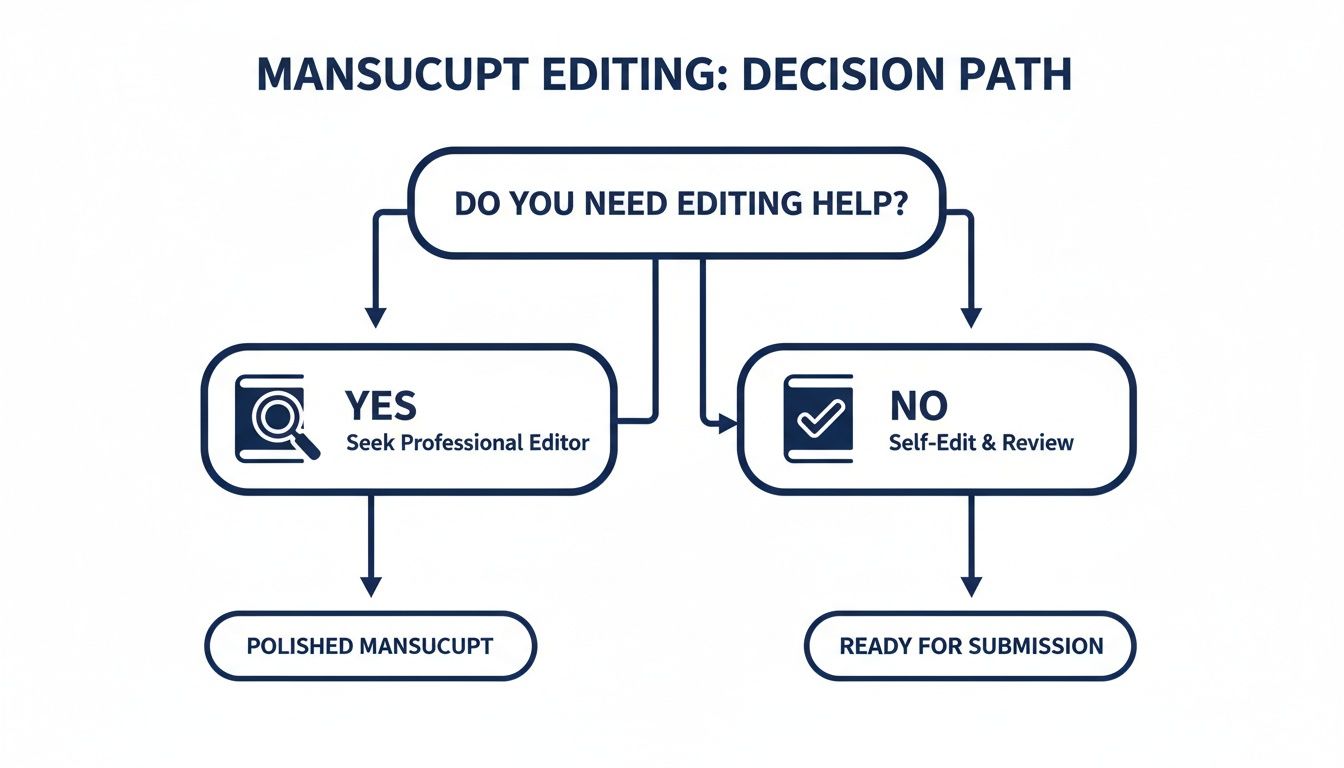
As the chart suggests, investing in professional help at the editing stage is almost always the right move for creating a book that’s truly ready for readers.
Publishing Routes Compared: Traditional vs. Self-Publishing vs. Full-Service
To make this decision easier, let’s break down what each path really looks like side-by-side. Think about your personal goals, budget, and how much hands-on control you want to have over your project.
| Feature | Traditional Publishing | Self-Publishing (DIY) | Full-Service Publishing (e.g., BarkerBooks) |
|---|---|---|---|
| Upfront Cost | None. Publisher pays you an advance. | You pay for everything (editing, design, etc.). Can range from $500 – $5,000+. | You pay a single fee for a package of services. Ranges from $2,000 – $15,000+. |
| Creative Control | Very little. Publisher has final say on title, cover, and editing. | 100% control over every aspect of your book. | High. You collaborate with professionals but retain final approval. |
| Time to Market | Slow. Typically 18-24 months after signing a contract. | Fast. You can publish as soon as your book is ready—days or weeks. | Moderate. Faster than traditional, usually 6-12 months. |
| Royalties | Low. 5-15% of net receipts. | High. 40-70% of the list price. | High. Similar to self-publishing, typically 50-70%. |
| Distribution | Extensive. Guaranteed placement in physical bookstores. | Primarily online (Amazon, Apple Books), with print-on-demand for physical copies. | Broad. Combines online reach with potential for bookstore placement. |
| Marketing | Publisher handles major marketing, but authors are still expected to do a lot. | 100% your responsibility. You build the platform and run the campaigns. | A collaborative effort. They provide a marketing foundation and strategy. |
Choosing a path isn’t about which one is “best”—it’s about which one is best for you. A DIY approach is perfect if you have a tight budget and the skills (or willingness to learn) to manage the whole process. If you want the prestige and distribution of a major house and are willing to trade control for it, traditional is the goal. And if you want professional quality without giving up ownership, a full-service partner might be the ideal fit.
Getting Down to the Nitty-Gritty
Okay, you’ve picked your publishing path. Now comes the part where you roll up your sleeves and tackle the technical stuff that transforms your Word doc into a real, honest-to-goodness book. These details might not be as fun as writing, but they are absolutely essential if you want to get your book published properly.
Design, Inside and Out
First impressions are everything, and your book cover is your single most important marketing tool. It’s the first thing a reader sees, and a professional design can make the difference between a scroll-past and a click.
But don’t stop at the cover. The interior layout—the typesetting, fonts, and chapter headings—is just as crucial. A clunky, hard-to-read interior will pull readers right out of your story.
The Paperwork: ISBNs and Copyright
Next up are the official identifiers. You’ll need a unique International Standard Book Number (ISBN) for every single format of your book. That means one for the ebook, one for the paperback, and another for the hardcover. Think of it as your book’s social security number; it’s how retailers track sales.
You also need to officially register your copyright. This step legally protects your work and solidifies your ownership of the intellectual property you’ve worked so hard to create.
Getting Your Book on the Shelves
Finally, it’s time for distribution. This means getting your book listed on major platforms like Amazon, Apple Books, and Barnes & Noble where readers can actually find and buy it. With the global book market projected to reach a staggering $229.5 billion by 2035, you want to be where the readers are. You can dig into more of these fascinating market trends from Spherical Insights.
Feeling overwhelmed by all the details? You’re not alone. Many authors find this side of publishing daunting. Partnering with a full-service publisher can take all these technical complexities off your plate, letting you get back to what you love—writing.
Marketing and Launching Your Book for Maximum Impact

Let’s be honest: writing the book was the easy part. Now comes the real work—making sure people actually read it. A powerful launch doesn’t happen by accident; it’s the result of a deliberate, well-timed strategy designed to build excitement and drive those crucial early sales.
Building Buzz Before Day One
Your marketing efforts should start months before your book is available. The goal here is to build an audience that’s ready and waiting to click “buy” the moment it goes live.
One of the most valuable assets you can build is an email list. This gives you a direct line to your most dedicated readers, allowing you to share updates, cover reveals, and exclusive content. To get this right, you’ll need to master email marketing strategies for your book launch.
A well-executed plan is what separates a bestseller from a book that vanishes without a trace.
The Financial Reality of a Good Marketing Plan
It’s tempting to skimp on marketing, but the numbers tell a clear story. While a staggering 90% of indie authors earn less than $1,000 a year, those who invest in professional marketing often see their sales double or even triple.
This investment allows you to tap into a booming digital publishing market projected to hit $26.04 billion. If you want to dive deeper, you can explore the latest digital publishing market trends on PublishDrive.
A strong launch week, fueled by a flurry of early reviews and strategic promotions, can make all the difference in your book’s long-term success. For a step-by-step guide to pulling this off, take a look at our blueprint for creating a comprehensive book marketing plan.
Your Top Questions About Book Publishing, Answered
Let’s be honest: the publishing world can feel like a maze. When you’re just starting out, it’s easy to get overwhelmed by questions about cost, timelines, and all the confusing industry jargon. I get it. Over the years, I’ve heard the same concerns from countless aspiring authors.
So, let’s cut through the noise and get you some straight answers to the most common questions people ask on their journey to get your book published.
How Much Does It Cost to Get a Book Published?
This is the big one, isn’t it? The answer is… it depends entirely on the path you take. Each route has a completely different financial model, so understanding them is the first step to making a smart decision.
If you go the traditional publishing route, you typically pay no upfront costs. The publisher foots the bill for editing, design, printing, and distribution. In exchange for that investment, you’ll receive an advance (if you’re lucky) and royalties, which are usually around 10-15% of the book’s net receipts. It sounds great, but remember, getting that deal is the hard part.
With DIY self-publishing, you’re the one in charge of the budget. You pay for everything yourself. Costs can swing wildly, from a few hundred dollars for the absolute basics to several thousand for a top-tier production. A realistic breakdown looks something like this:
- Professional Editing: $500 – $5,000+ (Don’t skip this!)
- Cover Design: $300 – $1,500+
- Interior Formatting: $100 – $500
Then there’s full-service publishing. Think of it as a bundled solution where you make a single investment—often between $2,000 and $10,000+—for a comprehensive package of professional services. This path gives you high-quality production and often includes marketing support, which can make a huge difference in your book’s success.
A crucial mindset shift: Don’t think of professional services as an expense. See it as an investment in your book’s future. A polished, professional book attracts readers and good reviews, which directly fuels sales and builds your reputation as an author.
How Long Does It Take to Publish a Book?
Time is another huge variable, and your patience will definitely be tested on some of these paths.
Traditional publishing is a marathon. Seriously. From the day you sign that coveted contract, it can easily take 18 months to three years before your book is actually in readers’ hands. That long runway is for extensive edits, cover design debates, marketing ramp-up, and fitting into the publisher’s crowded seasonal release calendar.
Self-publishing is the sprinter’s lane. Technically, you could have your book live on a platform like Amazon KDP in under 72 hours. But—and this is a big but—rushing is a terrible idea. A professional self-publishing timeline, which includes proper editing, design, and a pre-launch marketing strategy, is much more realistic at four to six months.
A full-service publisher finds the sweet spot in the middle. They’re built for both quality and speed, typically taking your manuscript from start to finish in about six to nine months. You get the professional polish of the traditional world without the agonizingly long wait.
Do I Need a Literary Agent to Get Published?
This question really only applies to one specific path. If your dream is to land a deal with one of the big traditional publishing houses (like Penguin Random House or Simon & Schuster), then yes, you absolutely need a literary agent. Almost none of them will even look at a manuscript that doesn’t come from a trusted agent.
Think of an agent as your career champion. They have the industry connections to get your manuscript in front of the right editors, the experience to negotiate the best contract for you, and the know-how to guide your career.
On the other hand, if you decide to self-publish or work with a full-service publisher, you do not need an agent. You’re either the publisher yourself or you’re partnering directly with a publishing services company. This gives you way more control and a much, much faster path to market.
What Are the Most Common Mistakes First-Time Authors Make?
I see the same preventable mistakes trip up new authors time and time again. They’re heartbreaking because they can completely tank a book’s potential. Knowing what they are is half the battle.
Here are the biggest and most damaging pitfalls:
- Skipping Professional Editing: Nothing screams “amateur” louder than a book riddled with typos, grammar goofs, or clunky sentences. It’s the fastest way to get hit with one-star reviews and kill your credibility.
- Designing a DIY Cover: Your cover is your #1 marketing tool. It has about three seconds to grab a potential reader. Unless you’re a professional book cover designer, a homemade cover will actively repel buyers.
- Forgetting to Market: Hitting “publish” isn’t the finish line; it’s the starting line. Too many authors think a good book will magically find its audience. It won’t. Without a real marketing plan, even the most brilliant book will likely fade into obscurity.
- Holding Unrealistic Expectations: Becoming a successful author is a long game, not a lottery ticket. Overnight success stories are incredibly rare. It’s about putting out quality work consistently, connecting with your readers, and building momentum over time.
By investing in a quality product and having a clear plan, you can sidestep these common traps and give your book the shot at success it truly deserves.
Ready to avoid the common pitfalls and publish your book with a team of experts? BarkerBooks has helped over 7,500 authors bring their stories to life with professional editing, stunning design, and global distribution. Schedule your free consultation today!