
Practical Roadmap To Structure A Novel
Getting a grip on your story’s skeleton means breaking it into clear acts and beats. By choosing a framework—whether the classic three-act, four-act, hero’s journey, or an episodic approach—you lay down a path for every scene.
Most writers aim for:
- Setup (25–30%): Introduce characters, stakes, and the world
- Confrontation (40–50%): Deepen conflicts and push arcs forward
- Resolution (20–30%): Tie up threads and deliver payoff
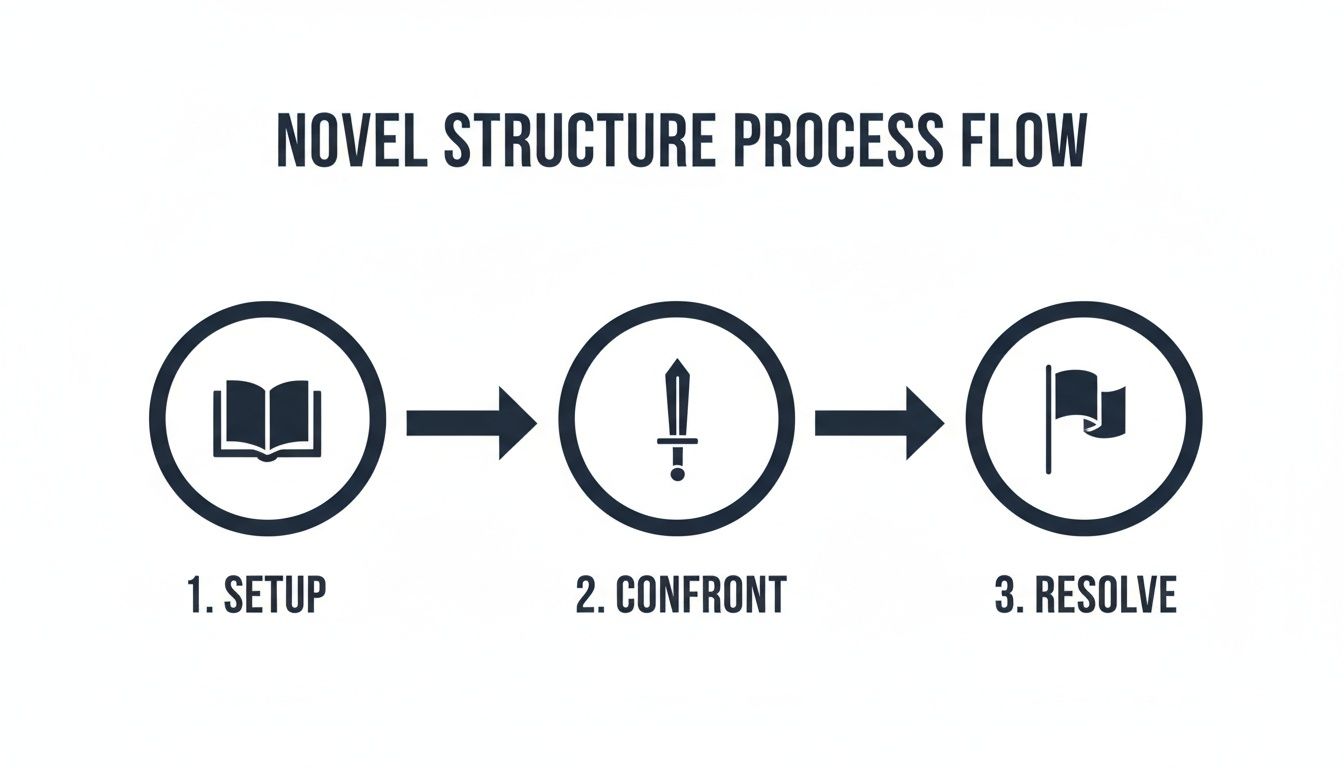
This visual highlights why pacing each segment keeps readers hooked from page one to the very last sentence.
Key Structure Percentages
A solid rule of thumb comes from decades of storytelling practice: roughly 30% for setup, 45% for the middle build, and 25% for the finale. These ratios help balance momentum and emotional beats.
Overview Of Common Novel Structures
Below is a quick comparison of popular narrative frameworks. Use it to pick the model that fits your story’s scope and style.
| Structure Model | Segment Distribution | Ideal Use Case |
|---|---|---|
| Three-Act | 25–30% / 40–50% / 20–30% | Most genres with a clear beginning, middle, and end |
| Hero’s Journey | 12 distinct stages | Epic quests and deep character growth |
| Episodic Arc | Self-contained episodes | Serialized fiction and short-story collections |
| Four-Act | 25% each | Complex plots with dual climaxes |
Each framework has its strengths. If you want a tighter progression, the three-act model often delivers. For sprawling sagas, the hero’s journey adds meaningful milestones.
You might also explore different narrative models in our guide on narrative structure.
Next Steps For Your Draft
With the big picture in place, sketch out individual scenes and chapters. Visual tools—like index cards or digital beat sheets—make it easy to shuffle events until pacing feels right.
- Anchor each scene on a specific conflict and clear payoff
- Weave subplots back into your main stakes at every turn
- End chapters on hooks that compel the reader forward
A tight act structure sets the stage for vibrant scenes and keeps readers turning pages.
Begin by arranging your Act One scenes on index cards, labeling each with its primary conflict. Next, challenge your outline by writing 100-word summaries of every scene. Tweak any pacing hiccups before you dive into full prose.
Happy plotting—and here’s to pages that fly by!
Selecting The Right Novel Framework
Every story carries its own momentum. Picking a structure that mirrors your narrative’s tone and scope shapes pacing, tension, and reader engagement.
Genre conventions and your personal writing rhythm often point in different directions. And in an era of digital reading habits, understanding where your chapters should split can boost immersion.

Evaluating Traditional And Modern Models
If you love clear checkpoints, the three‐act split (setup, confrontation, resolution) delivers predictable beats. Writers seeking deeper inflection points often lean on a four‐act breakdown with a midpoint peak and second twist.
Meanwhile, the Hero’s Journey maps internal growth through 12 stages, ideal for character‐driven sagas. Episodic structures, with flexible segments, thrive in serialized or online markets.
| Structure Model | Distribution | Best Use |
|---|---|---|
| Three-act | 25/45/30 | Most genres with clear pacing |
| Four-act | 25/25/25/25 | Complex plots with dual peaks |
| Hero’s Journey | 12 stages | Character-driven epics |
| Episodic | Variable | Serialized narratives |
Weighing Reader Retention Data
Serialized chapters excel at keeping readers hooked. Cliffhangers every 1,500–2,000 words echo the top web serials.
Web novels and online serial fiction reached USD 3.5–4.0 billion by 2024–2025, with growth projected at 14% CAGR through 2025–2035. Learn more about web novel market findings on WiseGuyReports
Consider these questions:
- Does your genre demand rapid‐fire reveals or slow‐burning tension?
- Would leaner chapters match your drafting speed?
- How often do you want to shift a character’s viewpoint?
Tips For Choosing Your Best Fit
Start with headlines. Jot down one‐ or two‐sentence summaries for each act or chapter to spot pacing gaps.
Feed early drafts to a small group and track where attention dips. Then:
- Assign clear stakes at every break point.
- Rotate character perspectives to keep scenes fresh.
- Tweak act lengths based on beta feedback.
You might be interested in our story structure template for hands-on exercises and blank outlines.
Mini Case Studies From Bestsellers
J.K. Rowling threads an episodic arc through a three‐act design, ending each chapter with a question that begs for the next click. Brandon Sanderson, on the other hand, follows a four‐act cadence in his Stormlight Archive, inserting interludes to reset tension.
- Harry Potter escalates stakes over 60–80 pages before offering a mini‐resolution.
- Sanderson drops interlude chapters every 100k words to recharge reader interest.
These examples show how flexible splits can support both serialized and traditional releases. Test different ratios early, then let feedback shape your final draft.
Balancing Pacing And Workflow
For tight schedules, shorter segments keep momentum alive. Labeling each quarter of a four‐act plan turns a massive outline into bite‐sized goals.
If you’re a rapid drafter, episodic arcs with built‐in cliffhangers can become daily writing targets. Try mapping instalments onto a calendar and shuffling scenes with index cards or writing apps.
- Block out short writing sprints aligned with chapter breaks.
- Use physical index cards or a digital tool for quick reshuffling.
Don’t let structure become a straitjacket. In American Gods, Neil Gaiman blends three acts with episodic interludes, giving his sprawling tale both momentum and room to breathe.
By testing frameworks early and monitoring reader reactions, you’ll find the rhythm that keeps your chapters feeling fresh and compelling.
Next, we’ll dive into crafting scenes and chapters that flow seamlessly within your chosen framework.
Crafting Scenes and Chapters That Flow
Scenes are the engine of your novel. They carry your story forward with a clear target, rising tension, and a satisfying payoff.

A well-placed hook can grab readers from page one. Imagine opening a detective thriller with a ransom call—the stakes skyrocket before the first coffee break.
- Every scene pushes toward a specific goal
- Conflict should escalate and challenge your characters
- Mini-arcs tie chapters back to the main plot
- A clear payoff rewards momentum and primes the next turn
Defining Scene Goals
I always start by asking, “What matters most in this scene?” That focus makes each beat resonate with the larger drama.
Align your micro-goals with Act Two or Three by:
- Clarifying how the scene supports the act structure
- Linking the goal to a character’s emotional journey
- Highlighting which subplot takes center stage
- Noting the moment when the stakes shift
Balancing Momentum And Description
Too much worldbuilding can stall your plot. Too little can leave readers stranded.
Strong scenes weave setting into action so readers stay immersed in both
Try these techniques in tense moments:
- Pin down 2–3 sensory details to ground the scene
- Use sharp analogies that evoke mood without slowing pace
- Break exposition up with dialogue or inner thought
| Approach | Strength | Risk of Overuse |
|---|---|---|
| Tight Pacing | Keeps pages turning fast | Can feel superficial |
| Rich Detail | Builds immersive worlds | Slows down key confrontations |
| Dialogue Focus | Reveals character through talk | Risks info dumps disguised as chat |
Using Chapter Breaks Strategically
A chapter break can be a soft landing or a cliffhanger that propels readers onward. Think of it as an emotional pivot point.
Consider wrapping up chapters with:
- A revealing fact or urgent question
- A shift in viewpoint for fresh tension
- A pause right after a big payoff
In one thriller draft I edited, Chapter 8 closes on a locked door that won’t budge. It’s a simple image, but it had beta readers sprinting to Chapter 9.
Best practices for powerful breaks:
- Tease the next scene’s goal in the final lines
- Don’t tie up every loose end before the break
- Use breaks to jolt subplots or deepen your world
- Keep chapter lengths consistent so pacing feels natural
Visualizing Your Chapter Flow
When I map scenes on index cards, cluttered spots and pacing gaps pop right out. It’s a low-tech way to see your novel’s rhythm.
Try this on your wall:
- Move cards around to shape tension arcs
- Annotate each card with setting or POV notes
- Color-code cards by subplot or character journey
A quick storyboard reveals where to insert breaths or speed up the chase. For a ready-made system, check out BarkerBooks Story Structure Templates at BarkerBooks Story Structure Templates.
With these methods, your scenes will connect seamlessly and each chapter will hum with purpose. Your readers won’t just follow the story—they’ll live it.
Mapping Character Arcs and Managing Pacing

Crafting a character’s emotional path and the story’s rhythm go hand in hand. When internal stakes rise with each plot twist, readers are far less likely to look away. Over the years, I’ve found that plotting emotional beats keeps growth and tension perfectly in sync.
Here’s how I break it down:
- Pinpoint each protagonist’s key emotional milestone
- Tie every beat to a concrete plot event
- Make sure each shift deepens your character’s driving motivation
Plotting Emotional Beats
Emotional beats are the moments your hero truly changes. I once had a shy lead humiliated on stage—her resolve snapped into place, and the rest of the story built straight from that crack.
Midpoint reversals serve as perfect character tests. For instance, in The Hunger Games, the tracker jacker episode forces Katniss to confront both terror and bravery.
Emotional beats are the backbone of reader empathy and narrative momentum
Weaving Subplots For Impact
Subplots should either echo your main journey or throw it into sharp relief. A friendship subplot, for example, can underscore trust issues in your hero’s love interest.
Mixing these sidelines into the main storyline keeps your pages fresh. I usually swap focus every 3–4 chapters to avoid any lull.
| Subplot Role | Benefit | Timing Tip |
|---|---|---|
| Thematic Echo | Reinforces central theme | Weave early and often |
| Character Mirror | Reveals side characters’ growth | Sync with main stakes |
| Comic Relief | Offers breathing space | Place after intense scenes |
Maintaining Tension And Flow
Pacing ties your emotional map to story speed. Quick sequences can ratchet up stress, while slower scenes give readers a moment to absorb character choices.
On average, readers start to check out after 3 low-tension scenes. I counter that by inserting a twist or deadline right before interest dips.
- 1. Open with a challenge that immediately tests your hero
- 2. Alternate high-stakes conflicts with quieter reflections
- 3. Introduce a ticking clock or deadline in Act Two
- 4. Layer obstacles so they stack toward your climax
In Sara J. Maas’s work, self-doubt collides with betrayal—creating dual pressure on the protagonist. And in The Night Circus, every magical duel is followed by a tender longing scene, which keeps romantic tension alive.
Combining inner growth with outward challenges makes motivations crystal clear
Case Studies From Novels
George R. R. Martin’s A Clash of Kings balances a dozen viewpoints while keeping momentum up. Each POV chapter wraps on a crisis, practically demanding you turn the page.
Emily St. John Mandel’s Station Eleven stitches together timelines, freezing mid-event in “The River Station” to send readers diving into another arc. Those parallel threads reconnect later in surprising ways.
- Map your major arcs on a timeline or index cards
- Label each card with its beat type and word count goal
- Use colored markers to spot pacing gaps at a glance
By blending clear emotional milestones with varied scene lengths, your manuscript will hum with forward motion. Each chapter then becomes a pulse—driving both plot and personal change.
With this roadmap in hand, you’re ready for outlining techniques that lock in these arcs and set your rhythm in stone.
Using Outlines And Revision Checkpoints
Once your story structure and character arcs are sketched out, it’s time to plot every beat and polish the flow. A detailed outline becomes the map that guides you from the opener’s hook all the way to that satisfying payoff. Writers often choose one of three methods based on how they think visually or linearly:
- Beat Sheets create a sequential table of key events, making structural gaps obvious before you dive into drafting.
- Index Cards let you pin colorful cards to a board and shuffle scenes on the fly—perfect for spotting pacing hiccups.
- Digital Logs turn each note into a searchable entry. Tag themes, timelines, or subplots and pull them up by keyword.
Pick the one that clicks with your process. Some writers love the tactile shuffle, while others thrive on filters and collapse tools in apps like Scrivener. Whichever you choose, consistency is the secret to clarity.
Building Your Customized Outline
I once worked with a thriller author who laid out 30 scenes on index cards, sorting them by rising tension. When six cards felt flat, we slipped them toward the climax and bumped up the twist earlier. That hands-on shuffle exposed a 15% pacing lag in Act Two. A quick subplot injection erased the lull and sparked interactions between the leads.
We’ve broken down the process in this book outline example so you can tailor beats to your plot.
With the skeleton locked in, schedule revision check-ins at key stages. These checkpoints catch scene confusion or pacing lulls before they calcify in the next draft.
Structure Revision Checkpoints
“Spotting structural gaps early can save up to 30% of rewriting time,” notes a development editor.
I recommend setting up 5 checkpoint reviews: right after your outline, once the first draft is done, at that critical midpoint cut, before your polish pass, and just ahead of external feedback. At each stop, scan for these essentials:
- Stakes Clarity
- Tone Consistency
- Emotional Progression
- Subplot Weave
- Pacing Rhythm
| Format | Best For | Revision Focus |
|---|---|---|
| Beat Sheets | High-Level Plotting | Structural Gaps |
| Index Cards | Scene Shuffling | Pacing Adjustments |
| Digital Logs | Searchable Tagging | Theme Consistency |
These quick glances highlight where each method shines in catching your story’s unique challenges. Next up, let’s drill into how to refine each scene with surgical precision.
Refining Your Draft Strategically
When you launch a revision pass, ask yourself: does every scene push the stakes forward? Are conflicts clear? Does the tone flow smoothly across chapters? I keep a separate doc for notes and color-code issues—red flags for missing stakes, blue for subplot drift—so each round feels focused rather than chaotic.
- Tone Consistency Ensures Your Voice Feels Steady
- Emotional Beats Tie Character Growth To Plot Milestones
- Subplot Integration Prevents Side Stories From Wandering
This approach turns your draft into a living document you can refine with confidence. Each sweep reveals fresh ways to heighten tension, unify voice, and sharpen pacing before you share with beta readers or an editor.
Recap And Common Mistakes To Avoid
When you’re ready to start drafting, these fundamentals will keep your story on track.
A strong narrative boils down to choosing the right structure, writing scenes that matter, aligning character arcs, and scheduling revision check-ins.
Pick a model—three-act, four-act, hero’s journey or episodic—that fits your genre and the promise you’ve made to readers. Build each scene around a clear goal, a tension curve and a payoff that sets up what follows. Map out your protagonist’s emotional highs and lows, then weave subplots that reinforce your theme and raise the stakes. Set up milestones for revisiting pacing, logic and tone before anyone else sees your work.
- Framework Selection: Match structure to story scope and reader expectations
- Scene Crafting: Center each segment on conflict and resolution
- Character Mapping: Align emotional beats with plot shifts
- Revision Checkpoints: Review at outline approval, midpoint and draft wrap-up
Solidify Your Framework
It’s easy to tangle in overplanning. I once watched a friend build a 50-page spreadsheet and never write a single chapter.
A flexible outline should spark momentum, not kill it. Try keeping it simple by:
- Sketching just 8–10 scenes per act
- Pinning index cards to a board for quick reshuffling
- Swapping long notes for a 150-word synopsis of your core idea
A functional outline fuels progress; don’t let it boss you around.
Balance Scenes And Chapters
Dumping all your worldbuilding at the chapter’s start can freeze the pace. Instead, slip setting details into a character’s reaction or a moment of conflict. You might:
- Open with a character action or compelling question
- Braid in atmosphere through dialogue and internal thought
- Close on a reveal or urgent dilemma
That way, each chapter drives the story forward instead of pausing it.
Mind Your Midpoint
Rushing to Act Three only to discover your midpoint is flat can cost reader engagement. Your central twist should redefine goals or deepen uncertainty.
| Midpoint Mistake | Effect on Story | How to Repair |
|---|---|---|
| Flat Turning Point | Momentum stalls | Introduce a surprise obstacle |
| Lack of Stakes | Reader detachment | Raise the personal cost |
| Unclear Shift | Confusion in plot direction | Clarify character’s new priority |
A strong midpoint propels you straight into Act Three with fresh tension.
Run Strategic Revision Checks
Skipping structural reviews leaves loose threads that haunt your rewrite. Even a bulletproof outline can buckle under new scenes. Divide your revision into focused passes:
- Confirm stakes and pacing feel balanced
- Tie every subplot back to the main arc
- Check for consistent tone and emotional progress
“Small structural tweaks cut down rewrite time by as much as 30%.”
These checkpoints sharpen your draft and reinforce key principles of novel structure.
Quick Tips To Avoid Common Traps
- Don’t chase perfection in initial outlines—aim for functional sketches
- Test chapter endings on a beta reader for maximum impact
- Signal your midpoint shift with a recurring metaphor or symbol
- Tag scenes in your digital draft to note conflict, goal or emotional beat
Revisit these essentials regularly. They’ll turn that raw manuscript into a polished narrative ready for publication.
This recap moves you from scattered notes to a clear drafting or revision path—no second-guessing required.
Frequently Asked Questions
Writers often run into the same bumps when shaping a novel’s structure. Here, you’ll find practical solutions for nontraditional story shapes, pacing hiccups, outline flexibility, and knowing when it’s time to dive into revisions.
Each answer includes real-world examples drawn from hands-on experience. Whether you meticulously plan every beat or follow inspiration as it strikes, these tips will help you streamline your narrative.
What If My Story Defies The Three Act Model
If your plot refuses to fit a classic three-act mold, mix and match frameworks until you find the right rhythm. I once worked on a mystery that abandoned a clear midpoint. Instead, tension rose through a chain of unexpected reveals—mapped out on index cards to test different beats.
Here’s how you can approach it:
- Sketch hybrid act proportions and assign approximate word counts
- Break subplots into mini-arcs with clear stakes and payoffs
- Shuffle scenes around to see which order builds the best momentum
Focus on linking every subplot twist back to your core theme. That way, even an unconventional structure stays cohesive.
How Detailed Should My Outline Be Before Drafting
A too-locked-in outline can stifle creative sparks. My sweet spot? Jot down 8–10 key beats per act, then leave plenty of breathing room.
I remember discovering a fresh subplot halfway through my first draft—because I didn’t micromanage every scene. A flexible beat sheet keeps you on track without boxing you in.
A loose outline fuels creativity without chaos
That balance is your antidote to both writer’s block and aimless drafting.
What’s The Best Way To Fix A Sagging Middle
A flat middle often means stakes aren’t high enough or conflicts feel stale. To reignite momentum, try injecting a subplot twist or cranking up tension at midpoint.
In a fantasy draft, I dropped a shocking betrayal in Chapter Twelve. By Chapter Fourteen, the hero’s objectives had completely shifted—and the story was humming again.
Here are a few tactics:
- Introduce a character dilemma that complicates main stakes
- Weave in a short subplot to offset any lull
- Rework your midpoint scene with fresh urgency
Don’t forget to gather reader feedback on early drafts—that external perspective often highlights exactly where the middle drags.
When Should I Revise For Structure
Give your first draft a cooling-off period. After a brief break, you’ll return with sharper eyes for pacing issues or muddy stakes.
Set up 5 Structural Checkpoints to tackle revisions in focused sweeps:
| Checkpoint | Focus |
|---|---|
| Outline Approval | Spot pacing gaps and missing stakes |
| Midpoint Assessment | Test reversal impact and tension |
| Draft Completion | Confirm subplot integration |
| Pre-Beta Review | Fix tone and character clarity |
| Final Sweep | Polish flow and resolve loose ends |
Your final pass should align each scene with your chosen framework—maximizing tension, emotional payoff, and overall clarity.
Ready to publish with confidence? Partner with BarkerBooks to take your structured novel from draft to bookshelf. We offer editorial editing, cover design, global distribution, ISBN registration, and targeted marketing campaigns to launch your work worldwide.