
So, you've written a book. Now what? The real question is, how do you turn that manuscript into a digital product people will actually buy? It really boils down to getting four key things right: preparing your files, picking the best sales channels, nailing your pricing strategy, and then marketing the heck out of it.
Your Blueprint for Selling Ebooks Successfully
The thought of selling an ebook can feel daunting, but it’s not some secret club reserved for big-name authors. It’s a very achievable (and profitable) path for any writer willing to learn the ropes. My aim here is to pull back the curtain and show you just how manageable this process is.
The digital book world is massive, and it's created an incredible opportunity for authors to connect directly with readers, no gatekeepers required.
Consider this: industry estimates show that indie authors sell around 300 million self-published ebooks every single year. That translates to a market worth an astounding $1.25 billion. Those numbers prove there's a huge audience out there, ready to discover new authors on platforms like Amazon KDP.
The Ebook Selling Journey
Before we get into the weeds, let's look at the big picture. Selling an ebook isn't just one action; it's a process. I find it helps to break the journey down into three distinct, manageable phases.
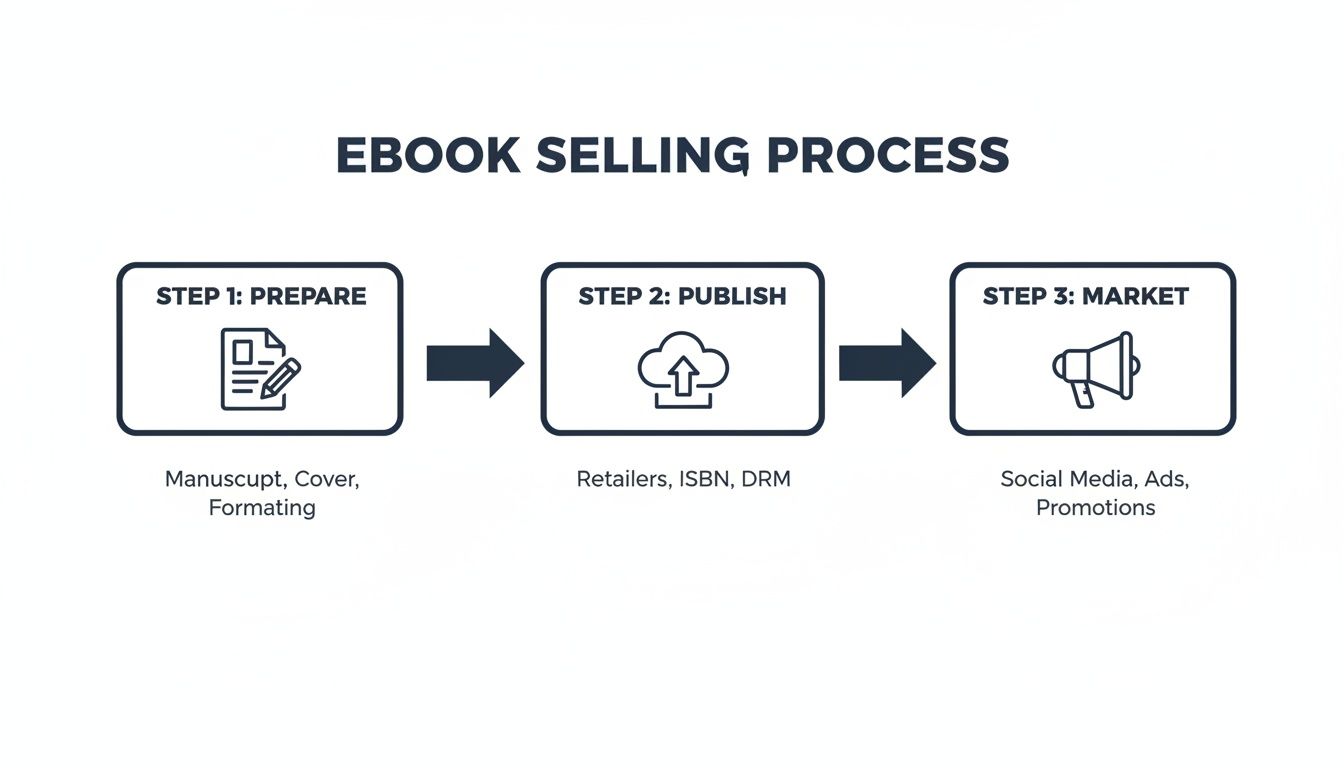
As the diagram shows, a successful launch follows a logical path from creation to promotion. Each step is a building block for the next, ensuring your ebook is not only polished but also gets in front of the right readers.
To make this crystal clear, here’s a quick breakdown of what those stages involve.
Ebook Selling Process at a Glance
| Stage | Key Action | Primary Goal |
|---|---|---|
| Prepare | Format manuscript, design cover, handle legal tasks | Create a professional, market-ready digital product |
| Publish | Choose platforms, upload files, set price | Make your ebook available for purchase by readers |
| Market | Launch promotions, run ads, build audience | Drive visibility and generate consistent sales |
This table neatly summarizes the entire workflow. Each stage depends on the one before it. A brilliant book on the wrong platform gets lost, and a perfectly published ebook with zero marketing will never find its audience.
This guide will walk you through each of these pillars, giving you the practical, no-fluff advice you need to get it done right. As you map out your plan, you might also find these comprehensive resources on ebooks useful for diving deeper into specific topics. Let's get started.
Getting Your Ebook Ready for a Winning Launch
Before you can even think about hitting that "publish" button, you have to get your manuscript in fighting shape. A finished draft is just the starting point. To stand out in a sea of new releases, your ebook needs to look and read like a professionally published book. Skimp on this prep work, and you're setting yourself up for bad reviews that can sink your book before it ever has a chance to swim.
Think of it this way: all the marketing in the world can't save a bad product. Getting these foundational pieces right is what gives your marketing efforts a solid product to stand on.
Professional Editing Is a Must-Have, Not a Nice-to-Have
I see it all the time: authors who think a quick once-over from a friend (or just themselves) is enough. This is easily the biggest mistake you can make. Even the best writers are blind to their own typos and awkward sentences. Readers, on the other hand, are ruthless. Nothing screams "amateur hour" faster than a book littered with grammatical errors and plot holes.
A truly professional book goes through several rounds of editing, each with a specific purpose:
- Developmental Editing: This is the big-picture view. A developmental editor looks at your plot, pacing, character arcs, and overall structure. They make sure the story actually works before you start polishing sentences.
- Copy Editing: Now we're getting granular. A copy editor dives into your prose, fixing grammar, refining word choice for clarity, and ensuring consistency from chapter to chapter.
- Proofreading: This is the final, crucial pass. A proofreader is your last line of defense, catching any sneaky typos, punctuation mistakes, or formatting glitches that made it through the other stages.
Let me be clear: paying for professional editing isn't an expense; it's an investment in your author career. It's the best insurance policy you can buy against those soul-crushing one-star reviews.
Nailing Your Ebook Formatting
With your text polished to perfection, it's time to format it for digital readers. This isn't as simple as saving your Word doc as a PDF. Your book needs to be in a specific file format that displays correctly on e-readers like the Kindle, Kobo, and Nook.
The two main formats you need to know are EPUB and MOBI. EPUB is the universal standard used by nearly everyone—Apple Books, Barnes & Noble, Kobo—while Amazon's Kindle devices use their own format (historically MOBI, now transitioning to KPF).
My Two Cents: You can try to format your book yourself, but be warned: it's a notoriously finicky and frustrating process. I've seen authors waste weeks trying to get it right.
Software designed for this job will save you a world of pain and produce a far better result. Tools like Vellum (Mac only, but the gold standard) or the free Reedsy Book Editor can generate beautifully formatted files for every major retailer with just a few clicks. For a more detailed breakdown, our guide on how to format a book for publishing covers the nitty-gritty.
A Cover That Stops the Scroll
On a digital shelf, your cover does all the heavy lifting. It's the first thing a potential reader sees, and it has about two seconds to convince them to click. A bad cover doesn't just look bad; it screams that the book inside is probably low-quality, too.
Unless you're a professional book cover designer, this is not a job for Canva. You need to hire a designer who lives and breathes your genre. A great thriller cover has a completely different vibe than a sweet romance cover, and an experienced designer knows exactly which fonts, imagery, and colors will trigger the right emotional response in your target readers.
Your Blurb: The Sales Pitch That Closes the Deal
If your cover gets the click, your book description (the blurb) has to seal the deal. This is your sales copy. It has one job: to hook the reader so deeply they can't imagine not buying the book to find out what happens.
For fiction, a proven formula looks something like this:
- The Protagonist: Introduce your main character and their normal world.
- The Inciting Incident: What event throws their life into chaos?
- The Stakes: What do they stand to lose? What must they overcome?
- The Hook: End with a cliffhanger or a tantalizing question that leaves them desperate for answers.
For a non-fiction book, shift your focus to the reader's problem. What's their pain point, and how does your book provide the solution? You're selling a transformation. Clearly explain what they will be able to do after reading your book.
Get these core pieces in place, and you've built a product that's truly ready to compete.
Choosing Where to Sell Your Ebook

Alright, your masterpiece is finished. Now you've hit one of the most critical forks in the road for any author: where do you actually sell this thing? This isn’t just about picking a storefront; it's a fundamental business decision that shapes your entire strategy.
You essentially have two paths. You can go exclusive with one massive retailer, or you can "go wide" and make your book available across a bunch of different online stores. Each route comes with some serious perks and definite trade-offs.
The Allure of Amazon KDP Select Exclusivity
Let's be honest, going exclusive almost always means one thing: enrolling in Amazon's Kindle Direct Publishing (KDP) Select program. You agree to sell your ebook only on Amazon for 90-day periods, and in return, they unlock a powerful set of promotional tools just for you.
The biggest draw here is getting your book into Kindle Unlimited (KU). Think of it as a Netflix for books. Subscribers pay a monthly fee and can read as many KU books as they want. You get paid for every page they read. For authors in genres with ravenous readers—like romance, fantasy, and sci-fi—this can be an absolute goldmine.
Enrolling in KDP Select also gives you access to a couple of other handy tools:
- Kindle Countdown Deals: These let you run timed discounts on your book, creating a real sense of urgency that can give your sales rank a nice kick.
- Kindle Free Book Promotions: You can make your book free for up to five days each enrollment period. It’s a classic, effective way to get a flood of new readers in the door.
My Takeaway: For a new author, especially if you have a series ready to go, KDP Select can be a fantastic launchpad. Tapping into the built-in KU audience—people who are actively hunting for their next read—is a huge leg up.
But it’s a double-edged sword. You're putting all your eggs in the Amazon basket, making you completely dependent on their ecosystem and its notoriously fickle algorithms.
The Freedom of Going Wide
The other path is "going wide," which simply means you sell your ebook everywhere you can. This includes Amazon (just not enrolled in KDP Select), Apple Books, Barnes & Noble Press (for the Nook), Kobo Writing Life, Google Play, and a host of smaller stores.
This strategy turns your author business into a diversified portfolio. If sales slump on one platform, another might be having a great month. You’re also reaching readers in other countries who might prefer Kobo or Apple to Amazon.
Now, managing all of those platforms one-by-one sounds like a full-time job. That's where aggregators save the day. Services like Draft2Digital or Smashwords are a massive help. You upload your book just once, and they handle distributing it to dozens of online stores for you. It’s a game-changer.
Going wide gives you some serious advantages:
- Audience Diversification: You build a fanbase across multiple platforms, making your career far more resilient.
- Total Pricing Control: You can run your own promotions or even make a book permanently free (perma-free) without needing anyone's permission.
- Broader Reach: Your book becomes available in stores and digital libraries that exclusive authors simply can't access.
The global market really highlights this opportunity. Forecasts show that ebook revenue is expected to hit $17.7 billion worldwide by 2025. Even in the U.S. alone, ebooks accounted for $1 billion in trade book revenue in 2022, so this is a major slice of the publishing pie.
Comparing Ebook Distribution Strategies: KDP Select vs. Going Wide
Deciding between exclusivity and wide distribution is a major strategic choice. This table breaks down what you gain and what you give up with each approach.
| Feature | KDP Select (Exclusive) | Going Wide (Multiple Retailers) |
|---|---|---|
| Primary Retailer | Amazon only | Amazon, Apple, Kobo, Barnes & Noble, Google Play, etc. |
| Key Advantage | Access to Kindle Unlimited (KU) page reads and exclusive promotional tools. | Diversified income streams and a broader, more resilient reader base. |
| Biggest Drawback | Complete dependence on Amazon's ecosystem and algorithm changes. | Slower initial growth; you miss out on the massive, consolidated KU audience. |
| Promotional Tools | Kindle Countdown Deals and Free Book Promotions. | You have full control to run promotions on any platform, anytime. |
| Audience Reach | Limited to Amazon's global customers and KU subscribers. | Truly global reach, including readers who prefer non-Amazon retailers and use library services. |
| Best For… | Authors with series in high-volume genres (e.g., romance, fantasy) seeking rapid growth. | Authors building a long-term, stable career or those with content appealing to a diverse audience. |
Ultimately, there's no single "best" answer, only the best answer for your books and your goals.
So, Which Path Is Right for You?
The most effective way to sell your ebook really boils down to your genre, your long-term goals, and your tolerance for risk. For a much deeper dive, our guide on where to sell your ebook breaks down this decision even further.
Think of it this way. Imagine a sci-fi author with a ten-book series. The potential page-read income from Kindle Unlimited could be life-changing, making exclusivity a no-brainer.
But what about a non-fiction author with the definitive guide to sustainable gardening? Their target audience is likely spread out and may prefer to buy from Apple Books or their local library's digital service. For them, going wide is the smartest play to reach every single potential customer.
How to Price Your Ebook for Maximum Profit
Figuring out what to charge for your ebook is one of the most critical decisions you'll make. Pricing isn't just about picking a number; it's a powerful signal to readers about your book's quality and value. Get it right, and you’ll hit that sweet spot of high sales and great take-home pay. Get it wrong, and you could leave a lot of money on the table or scare away readers before they even read your blurb.
Before you can nail down a price, you have to understand how you get paid. The royalty structures on major platforms, especially Amazon's Kindle Direct Publishing (KDP), are the foundation of any smart pricing strategy.
On Amazon, the rules are simple but have a huge impact. Price your ebook between $2.99 and $9.99, and you’re eligible for a 70% royalty. Go below $2.99 or above $9.99, and your royalty rate plummets to just 35%. This one detail is why the vast majority of indie ebooks you see are priced within that magic window.
The Math Behind Royalties
Let's look at how this plays out. Say you price your book at $2.50. After Amazon's cut, you'll earn about $0.87 per sale (35%).
Now, what if you bumped the price up just a little to $2.99? Suddenly, your earnings jump to roughly $2.09 per sale (70%). You’d have to sell more than two copies at the lower price just to make the same profit as one sale at $2.99.
The Bottom Line: That $2.99 to $9.99 range isn't just a popular trend; it's a strategic move to maximize your earnings on the world's biggest ebook store. Unless you have a very specific, well-thought-out reason to do otherwise, stick to that range.
Of course, there are good reasons to price outside this box. They just serve different goals.
Three Proven Ebook Pricing Strategies
Your price should be a tool to help you achieve a specific objective. Are you trying to get a flood of new readers, signal premium quality, or build a loyal fanbase for a series?
Here are three battle-tested playbooks you can use.
-
The $0.99 Launch Blitz
This one is all about building momentum. By launching at a rock-bottom price, you make it a no-brainer for readers to take a chance on you. The goal isn't profit—it's to rack up a high volume of sales and, crucially, reviews. That initial social proof and sales velocity can catch the attention of Amazon's algorithms, boosting your book's visibility long after you raise the price to its normal level. -
The Perma-Free Series Hook
If you've written a series, making the first book permanently free is one of the most effective marketing tactics out there. You’re giving readers a risk-free ticket into your world. Once they’re hooked on the story and invested in your characters, they’ll happily pay full price for the rest of the series. The first book becomes your best salesperson. -
The Premium Price Point ($4.99+)
For a deep-dive non-fiction book or a new release from an established author, a higher price signals authority and value. If your book solves a major problem, teaches a valuable skill, or offers a top-tier reading experience, pricing it at $7.99 or $9.99 positions it as a premium product. Just be sure the book delivers on that promise with a professional cover, a killer description, and clean editing.
Do a Little Market Research
You don't have to price your book in a vacuum. Go spend an hour on Amazon and look at the top 20 bestsellers in your specific sub-genre. What are they charging? Are they standalones or part of a series? Take notes.
Your book needs to look like it belongs on the same digital shelf. If every other paranormal romance is priced at $3.99, launching yours at $9.99 is going to be a tough sell unless you're a household name. Match the market's expectations, and you'll give your book the best possible shot at finding its audience.
Marketing Your Ebook Without Breaking the Bank
Finishing your manuscript is a huge accomplishment, but let's be honest—the real work is just beginning. Now you have to get people to actually buy it. Marketing is how you find your readers, but it absolutely does not require a Hollywood-sized budget. The secret is to put your energy into a few high-impact strategies that create a genuine connection with your audience.

Let's walk through the essential marketing toolkit that will help you move copies without draining your savings.
Build Your Core Marketing Assets First
Before you even think about spending money on ads, you need to build two foundational pieces of your author platform: your website and your email list. These are the only two assets you truly own and control. They aren't subject to the whims of a social media algorithm or a retailer's changing rules.
Think of your author website as your digital home base. It’s where new readers can learn about you, see all your books in one place, and—most importantly—sign up for your email list. It’s a mark of professionalism and gives you one central link to point everyone to.
Your email list is your direct line to your biggest fans. These people have literally given you permission to show up in their inbox. They are your launch-day buyers, your most likely reviewers, and your most reliable source of sales, period.
Getting Those Crucial Early Reviews
Nothing sells a book faster than social proof. When a potential reader sees a book with a solid number of positive reviews, it instantly builds trust and makes them far more likely to take a chance on it. But how do you get those first reviews when you have zero sales?
The answer is an Advanced Reader Copy (ARC) team. This is simply a group of volunteer readers who get a free, early copy of your ebook in exchange for leaving an honest review on launch day.
- Start with your email list: These are your warmest leads and most likely to say yes.
- Try dedicated services: Platforms like Booksprout or StoryOrigin exist specifically to connect authors with vetted reviewers in their genre.
- Reach out to book bloggers: Find influencers who review books like yours and politely offer them a free copy with no strings attached.
Just remember to always ask for an honest review. Never, ever pay for or demand a positive review. It violates the terms of service on every major retailer and will tank your credibility if discovered.
Pro Tip: Make it ridiculously easy for your ARC team to follow through. On launch day, send them a quick reminder email with a direct link to the review page on Amazon or wherever you’re selling. Reducing that friction makes a huge difference in how many people actually post their review.
Using Paid Ads Strategically
Once you have at least a handful of good reviews, you can start dipping your toes into paid advertising. For most authors, the best places to start are Amazon Ads and Facebook Ads. The key here is to start with a tiny budget, test everything, and only put more money behind the ads that are actually working.
With Amazon Ads, you're reaching people who are already on the site, actively looking for a book to buy. This makes your ad spend incredibly efficient. You can target specific keywords a reader might search for (like "cozy fantasy mystery") or even place your ad directly on the product pages of similar authors.
Facebook Ads are better for discovery. You can target people based on their interests, like readers who follow specific authors or are members of certain bookish Facebook groups. This is a powerful way to get your book in front of a whole new audience that hasn't heard of you yet.
Build Authority With Smart Content
Content marketing is a long-term play, but it's one of the best ways to build your brand and attract readers organically. It’s about positioning yourself as an expert and giving people a reason to follow you before they even consider buying your book. For a much deeper look at this, exploring different book promotion ideas can give you a ton of inspiration.
Here are a few content strategies that work wonders for authors:
- Author Blogging: Write posts about topics related to your book's themes. If you wrote a thriller about a hacker, you could blog about recent cybersecurity news. This pulls in readers who are already interested in your subject matter.
- Guest Posting: Find blogs that your target audience already reads and offer to write a post for them. This gets your name in front of a built-in community and lets you "borrow" their credibility.
- Engaging on Social Media: Don't just spam your feed with "buy my book!" posts. Share behind-the-scenes glimpses of your writing process, ask your followers questions, and actually talk to people. Provide value first, and sales will naturally follow.
By combining a strong foundation (website and email list) with early social proof (reviews) and strategic reach (ads and content), you can build a marketing machine that grows over time.
Navigating the Legal Side of Publishing
You've poured your heart and soul into writing your book, and now it’s time to switch gears. The business side of being an author—the legal stuff—can feel intimidating, but it’s more straightforward than you might think. Getting a few key pieces in order is what separates a hobbyist from a professional, protecting your work and making sure you get paid.
Think of it as setting up the foundation for your author business. Before you hit that publish button, it's smart to get familiar with the basics of intellectual property protection. This is all about safeguarding your rights as a creator.
Let’s start with the one everyone asks about: copyright.
Understanding Copyright for Your Ebook
Here’s some fantastic news: in the United States, your book is legally copyrighted the moment you create it. As soon as you type the words or save the file, that basic protection is yours. It’s automatic.
So, why bother doing anything else? Because officially registering your copyright with the U.S. Copyright Office gives you some serious legal muscle. Registration creates a public record that you are the owner, and more importantly, it's a prerequisite if you ever need to sue someone for infringement. It turns your claim from a simple fact into a legally-proven one.
You can handle the entire process directly through the U.S. Copyright Office website.
This is the official portal for getting it done. It’s a small administrative task that offers powerful, long-term security for your hard work. Think of it as an insurance policy for your book.
The Deal with ISBNs
Next up is the ISBN (International Standard Book Number), that unique 13-digit code you see on the back of books. Do you absolutely need one for your ebook? Well, it depends on your strategy.
- Selling only on Amazon? You don’t need an ISBN. Amazon KDP will assign its own identifier, called an ASIN (Amazon Standard Identification Number), for free.
- Going wide? If you want your ebook on Apple Books, Barnes & Noble, or Kobo, then yes, you’ll need an ISBN. Some distributors like Draft2Digital might offer a free one, but be aware it will be registered under their name, not yours.
My Advice: Buy your own ISBNs. Go to Bowker and purchase a block of them. When you own your ISBN, you are listed as the publisher of record. This is a small detail that makes a huge difference in how you are perceived and gives you total control over your book's metadata for the long haul.
One last thing: don't forget the money. When you set up your seller accounts on the various retail platforms, you’ll be asked for your tax information. This is a simple but critical step to ensure your royalties are reported correctly and you get paid without any hiccups.
Got Questions About Selling Ebooks? We’ve Got Answers.
Even with the best plan in hand, you're bound to have questions. Getting into digital publishing for the first time means running into a whole new world of acronyms and decisions that feel massive.
Let’s break down some of the most common questions I hear from authors. The goal here is to give you clear, no-nonsense answers so you can keep moving forward.
How Can I Stop People from Pirating My Ebook?
This is a big one, and I get it. The idea of someone stealing your hard work is infuriating. But here's the honest truth: you can't stop piracy completely. It's a game of whack-a-mole you'll never win.
The best defense is a good offense. Make it easier and more rewarding to buy your book than to steal it.
Services like Draft2Digital and Amazon KDP offer Digital Rights Management (DRM), which is designed to prevent unauthorized copying. It can stop some casual file-sharing, but it won't stop a determined pirate.
In fact, many top-selling authors skip DRM altogether. Why? Because it often punishes your actual, paying readers by making it a pain to move their legitimately purchased book between devices. Instead of fighting a losing battle, focus on building a real connection with your readers through an email list or social media. Someone who feels like they know you is far more likely to buy your book than to hunt for a pirated copy.
What’s the Right File Format for an Ebook?
You’ll hear a lot of talk about different file types, but it really boils down to just two main formats that run the show.
-
EPUB: This is the industry standard. Think of it as the MP3 of the ebook world. It works on Apple Books, Barnes & Noble's Nook, Kobo, and just about every other platform out there. The great thing about EPUB is that it's "reflowable," meaning the text automatically adjusts to fit whatever screen the reader is using—phone, tablet, you name it.
-
MOBI / KPF: For years, Amazon’s Kindle devices used the MOBI format. They've now moved on to KPF (Kindle Package Format), but you don't really need to worry about the specifics. When you upload your file to KDP, Amazon takes care of all the conversion work behind the scenes.
The bottom line? Focus on creating a clean, professionally formatted EPUB file. That single file will get you onto almost every major retailer. For Amazon, just upload your manuscript (often a Word doc or EPUB), and their system will handle the rest.
So, How Much Can I Actually Make from This?
Ah, the million-dollar question. The answer is… it depends. I know that's not what you want to hear, but it's the truth. Your income is a mix of your genre, how well you market, how many books you have for sale, and your price.
A brand-new author might only make a few hundred dollars in their first year. It’s a tough learning curve. On the flip side, I know authors with a ten-book series and a loyal email list who are pulling in six figures a year.
Success rarely happens overnight. Concentrate on writing a fantastic book that people want to read, work hard to get those first crucial reviews, and never stop marketing. Your income grows as your catalog of books (your "backlist") and your audience grow. Think of it as a marathon, not a sprint.