
Getting a book published really boils down to three big stages: polishing your manuscript until it shines, picking the right path to get it out there (traditional, hybrid, or self-publishing), and then, of course, executing a smart plan for submission and marketing. If you can get a handle on these three things, your dream of being published stops being a wish and starts becoming a project with a finish line.
Your Publishing Journey Starts Now
So, you've written a book. Let's just pause there for a second. That in itself is a massive accomplishment, one that puts you in a pretty exclusive club of people who actually see things through. But the path from that finished draft to a book in someone's hands can feel like staring at a huge, blank map.
The good news? It's a road plenty of people have walked before. There are signposts, you just need to know what to look for. Think of this guide as your compass. We're here to demystify the whole thing and give you a realistic, step-by-step look at what it really takes to get your book published in today's world.
Setting Realistic Expectations
Before we jump into query letters and ISBNs, let's get grounded. This industry is tough. It demands a thick skin and a whole lot of persistence. While a ton of people dream of being an author, the numbers paint a stark picture of the competition.
Consider this: of all the writers who start a novel, only about 3% ever finish it. And of that small group, an even tinier fraction—just 0.6%—actually get their book published through any route. That's a sobering thought, working out to roughly 6 out of every 1,000 writers who begin the journey. If you want to dig into those numbers, you can find a good breakdown of completion and publication rates over on leilaniestewart.com.
This isn't to scare you off. It's to arm you with reality. Success doesn't just happen; it belongs to the writers who are resilient, strategic, and professional on top of being talented.
The difference between a hopeful writer and a published author often comes down to one thing: a clear, actionable plan. It’s about treating your writing not just as art, but as a business.
What This Guide Will Cover
This roadmap is designed to give you the knowledge and tools to walk into the publishing world with your eyes wide open. We're going to cover everything from the ground up, making sure you have a solid foundation for the road ahead.
- Manuscript Preparation: How to take your draft from "done" to "dazzling" and ready for submission.
- Publishing Avenues: We'll break down the pros, cons, and costs of traditional, hybrid, and self-publishing.
- Submission & Contracts: Everything you need to know about crafting query letters, finding agents, and making sense of contracts.
- Production & Marketing: A look at the nuts and bolts of editing, design, distribution, and how to start building your author platform.
Turning Your Manuscript Into a Market-Ready Book
Finishing your manuscript is an incredible feeling, a huge accomplishment. But in the world of publishing, that's really just the starting line. Before your manuscript can land on an agent's or publisher's desk, it needs to be transformed from a personal draft into a professional product.
It’s about more than just a quick spell-check. Think about it from the agent's perspective. They might get 50 to 100 queries a week. They are overwhelmed and actively searching for quick reasons to say "no." A manuscript that's riddled with errors or formatted incorrectly is an easy rejection, and they might never even get to the brilliance of your story.
Your job is to make your work undeniable.
The Layers of Editing Most Authors Don't See
Editing isn't just one thing; it's a series of distinct stages, and each one is absolutely vital. I've seen countless promising manuscripts get passed over because the author tried to cut corners here.
-
Developmental Editing: This is the high-level, "big picture" edit. A good developmental editor looks at the very bones of your story—plot, pacing, character development, and overall structure. They're the ones who will tell you, "The middle of the book sags and loses momentum," or "The protagonist's motivation here feels a bit thin." It's where you solve the fundamental problems.
-
Line Editing: Once the structure is rock-solid, line editing zooms in on the sentence level. This is all about the craft of your writing. A line editor helps your prose sing by tightening up clunky sentences, sharpening your imagery, and making sure your authorial voice is strong and consistent.
-
Copyediting & Proofreading: These are the final, detail-oriented passes. A copyeditor is your grammar guru, catching everything from spelling and punctuation errors to inconsistencies (like a character's eyes changing color from blue on page 20 to green on page 150). Proofreading is that last final-final check for any typos that have slipped through before it goes to print.
Why Manuscript Formatting Is a Non-Negotiable
Formatting might feel like a boring, administrative task, but it’s the first signal of your professionalism. Sending in a manuscript that ignores industry standards is the writer's equivalent of wearing sweatpants to a job interview. It instantly tells the agent you haven't bothered to learn the rules of the game.
A properly formatted manuscript does more than just look professional—it shows respect for the agent's time. They read for a living and are used to a specific layout that lets them focus on the story, not on deciphering your font choice.
The good news is that the standard is pretty simple. It's all about creating a clean, readable, and distraction-free document. For a complete checklist, you can dive into our full guide on manuscript formatting guidelines.
Putting Together Your Submission Package
Your manuscript doesn't travel alone. It needs two crucial companions: a killer synopsis and a professional author bio. For many agents, these documents are their very first impression of you and your work, so they have to be just as polished as your manuscript.
The Art of the Synopsis
A synopsis is a brief, one-to-two-page summary of your entire plot, from the first page to the very last. Its job isn't to be a mysterious teaser; its job is to prove you've written a complete, cohesive story that works.
A strong synopsis always does these three things:
- It clearly introduces the main character and the inciting incident that kicks off the story.
- It hits the major plot points and turning points that drive the conflict.
- It reveals the climax and the resolution. Seriously, don't leave them guessing. You have to show how it all wraps up.
The biggest mistake I see authors make is getting bogged down in subplots or trying to explain their book's themes. Keep it laser-focused on the protagonist's main journey. Think of it as a functional roadmap of your plot, not as marketing copy.
Crafting Your Author Bio
Your author bio should be short, sweet, and relevant. It’s always written in the third person and is your chance to quickly establish your credibility.
If you have writing credentials—previous publications, writing awards, an MFA—definitely lead with that. If not, you can briefly mention any personal or professional experience that gives you a unique perspective on your book's subject. The key is to keep it professional and concise, usually between 50 and 100 words.
Choosing Your Path To Publication
Once your manuscript is polished, you've hit your first major fork in the road: deciding how to get your book into readers' hands. The publishing world isn't what it used to be; today, authors have three very different avenues to choose from. Each comes with its own set of rules, rewards, and realities.
Making this choice is a big deal. It dictates everything from your creative control and potential income to your marketing duties and how quickly you can launch. Let's walk through the main options so you can figure out which one feels right for you and your book.
The Traditional Publishing Route
This is the classic path everyone imagines—getting a literary agent who then pitches your book to one of the big publishing houses, like Penguin Random House or Simon & Schuster. When you land a traditional deal, the publisher foots the bill for everything: editing, cover design, printing, distribution, and even some marketing. They pay you an advance, which is a sum of money paid upfront against your future book sales.
The big wins here are the industry validation and the publisher’s established network. Your book gets into stores, and you don't have to pay for production. The trade-off, though, is pretty steep. You give up a lot of creative control, the timeline from signing to launch can take years, and the royalty rates are modest, typically 5-15% of the net price. It's a long, highly competitive game of persistence.
The Self-Publishing Revolution
On the complete other side of the spectrum is self-publishing. Here, you are the publisher. You call all the shots, retain full creative control, and keep a much larger slice of the pie—often 40-70% in royalties. You can also get your book to market in a matter of months, not years.
The catch? You’re also the one funding the entire project. Professional editing, compelling cover design, interior formatting, and all the marketing falls on your shoulders. While platforms like Amazon KDP have made the technical side of things much easier, the responsibility for creating a professional-quality book and finding an audience is all yours.
For a more detailed breakdown of these two paths, our guide on traditional vs. self-publishing really gets into the nitty-gritty.
Choosing a publishing path isn't about finding the "best" one; it's about finding the best fit for your book, your career goals, and your entrepreneurial spirit. Each route demands different skills and offers different rewards.
The Hybrid Publishing Middle Ground
Trying to bridge the gap between the two is hybrid publishing. A hybrid publisher functions a bit like a traditional one—they usually have quality standards, a submission process, and handle distribution—but the author shares the financial investment. You pay for their services, but in return, you get more professional support than going it alone and earn higher royalty rates than a traditional deal.
This can be a great option if you have the budget and want professional guidance without signing away all your rights. But be careful. This corner of the industry has its share of less-reputable players. A legitimate hybrid publisher will be selective about the books they take on and have a proven distribution network. Do your homework.
No matter which road you're leaning toward, getting your manuscript into professional shape is the absolute first step.
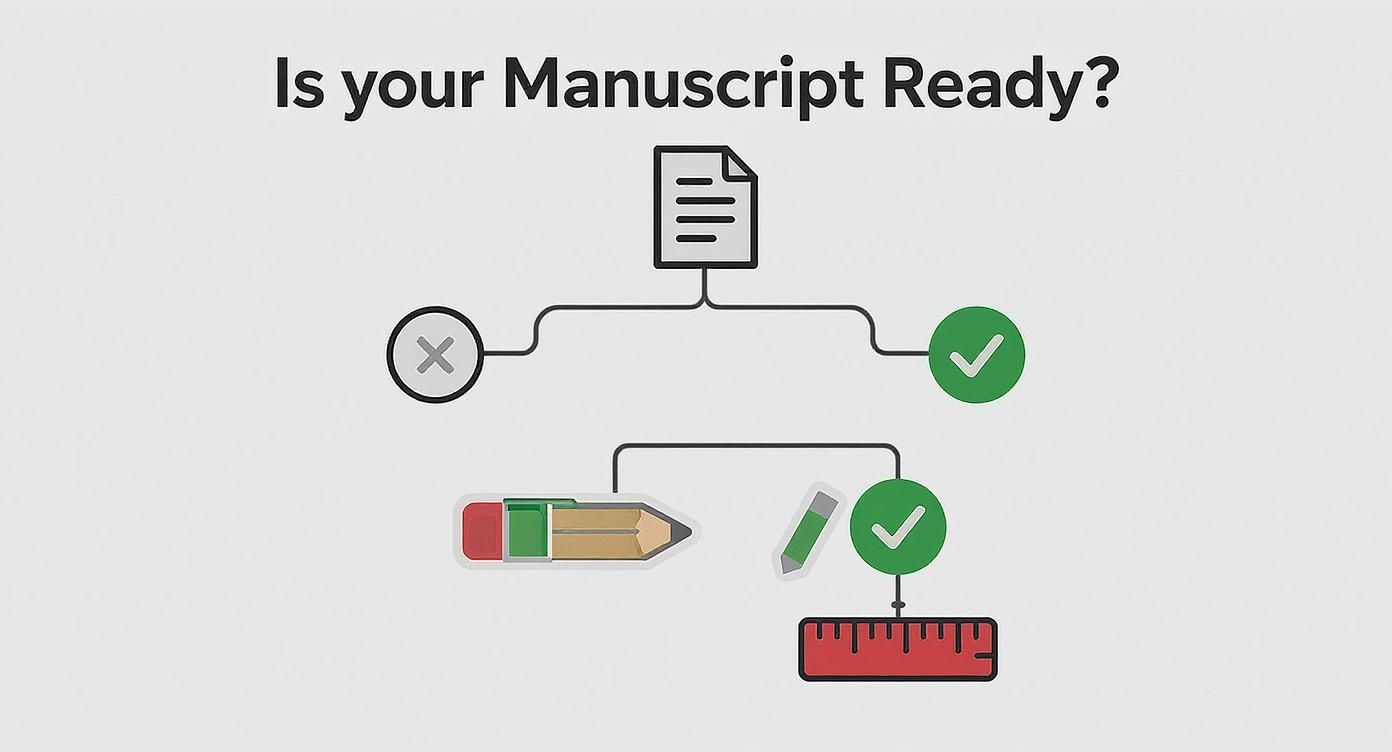
This decision is a huge one, and it helps to see the key differences laid out side-by-side.
Comparing Your Publishing Options
| Feature | Traditional Publishing | Hybrid Publishing | Self-Publishing |
|---|---|---|---|
| Upfront Cost | None. Publisher invests. | Author invests. Costs vary. | Author invests in all services. |
| Creative Control | Low. Publisher has final say. | Medium. Collaborative process. | High. Author has full control. |
| Royalty Rates | Low (5-15% of net) | Medium (20-50% of net) | High (40-70% of retail) |
| Speed to Market | Very slow (18-24+ months) | Moderate (6-12 months) | Fast (Author sets timeline) |
| Distribution | Strong retail and online | Varies; can be strong | Primarily online; retail is harder |
| Marketing | Publisher-led, but author input is key | Shared responsibility | 100% author's responsibility |
| Validation | High industry gatekeeping | Varies by publisher reputation | Comes from sales and reviews |
Ultimately, weighing the factors of control, cost, and support will point you toward the path that makes the most sense for you. The global book publishing industry is valued at roughly $126.9 billion, and the growth in digital formats shows that authors have more power than ever to connect directly with readers around the world. Your publishing journey is yours to define.
How to Navigate the Traditional Publishing Route

For a lot of writers, traditional publishing is the dream. It’s the path that comes with industry validation, the potential for wide distribution, and the muscle of a real publishing house behind your book. But it's also a path lined with gatekeepers, and the first—and most important—one you need to win over is a literary agent.
Think of an agent as your career champion. They're the ones with the industry relationships to get your manuscript past the slush pile and onto the desks of editors at major publishing houses—editors who, by and large, don't accept unsolicited work from authors. So, your first real mission is to get an agent to represent you.
This whole process is famously competitive. It's not unlike the rigorous world of academic publishing, where you have to follow strict protocols and survive peer review just to get a foot in the door. The takeaway? You need a polished manuscript and a smart strategy. For a deeper look at these kinds of highly selective environments, you can check out the overview on academic publishing processes.
Researching and Targeting the Right Agents
The first step isn't frantic emailing—it's focused research. Blasting your manuscript to every agent you can find is a surefire way to fill your inbox with rejections. Precision is everything.
You need to build a curated list of agents who are actively looking for manuscripts in your specific genre and category. An agent who builds their career on historical fiction isn't going to be the right fit for your sci-fi epic, no matter how amazing it is.
Here are a few of the best places to start your search:
- QueryTracker: This is an indispensable database for filtering agents by genre, checking their submission statuses, and tracking your queries all in one place.
- Publishers Marketplace: A subscription is required, but it's the industry standard for seeing who is making deals and selling books like yours.
- Manuscript Wish List (#MSWL): A fantastic resource, both as a website and a Twitter hashtag, where agents and editors post exactly what they hope to find in their inbox.
As you build your list, pay close attention to agents who have a solid track record of selling books by debut authors. That tells you they’re passionate about launching new careers. Aim for a well-researched list of 10-15 agents to kick off your first round of queries.
Crafting a Query Letter That Stands Out
Your query letter is a one-page sales pitch. It has one job: to hook an agent, introduce your book, and make them need to read more. Many agents decide whether they're interested in the first few sentences alone, so your letter has to be sharp, professional, and compelling right out of the gate.
A great query letter doesn't just describe your book; it sells the story. It needs to be as well-crafted and engaging as the manuscript itself, because for the agent, it's the first sample of your writing.
A solid query letter generally follows a three-part structure:
-
The Hook & Pitch (150-200 words): Open with a killer one-sentence hook that captures your story's core concept. Then, flow into a tight summary of the plot—introduce your main character, their goal, the central conflict, and what’s at stake. Think of it as the teaser copy you’d find on the back of a book.
-
The Metadata (~50 words): This is a quick, practical paragraph. State your book's title, genre (e.g., "upmarket psychological thriller"), word count, and a couple of "comp titles"—recent, successful books that are similar in tone or theme. Comps show you know where your book fits in the market.
-
The Bio (~50 words): A very brief, third-person introduction to you. Mention any relevant writing credentials or life experiences that give you a unique perspective on your story. Keep it short and to the point.
Handling Rejection and Offers of Representation
Let's get this out of the way: rejection is a normal, unavoidable part of trying to get published. You'll get form rejections, and you’ll probably get a lot of them. The trick is not to take it personally. An agent's "no" can come from a dozen reasons that have nothing to do with your writing quality—their client list might be full, or they just signed a book with a similar theme.
Once you’ve sent your queries, respect the agent's submission guidelines on follow-ups. If you haven't heard back within their stated timeframe (usually 8-12 weeks), a polite, brief nudge is perfectly acceptable.
When an offer of representation finally comes in, it's a huge moment. But don't say "yes" on the spot! It's professional courtesy—and a smart move—to notify any other agents considering your manuscript that you have an offer. This can often generate more interest and potentially lead to multiple offers, giving you the power to choose the agent who is the absolute best partner for you and your career.
Mastering the Business of Self-Publishing
https://www.youtube.com/embed/0mP4VscdkZI
When you decide to self-publish, you’re not just a writer anymore. You’re the CEO of your own one-person publishing company. This path gives you incredible freedom—you call the shots on your creative vision, your schedule, and most importantly, your profits. But with that freedom comes responsibility. It's time to put on your entrepreneur hat.
First things first: you need to turn your manuscript into a legitimate, sellable product. A few logistical steps are absolutely non-negotiable if you’re serious about this.
Setting Up Your Publishing House of One
Before you can put your book on any digital shelf, you have to establish its official identity. This boils down to two critical pieces of the puzzle: securing an International Standard Book Number (ISBN) and registering your copyright.
The ISBN is that unique 13-digit number you see on the back of every book. It’s how bookstores, libraries, and distributors track inventory. Sure, platforms like Amazon KDP offer a "free" one, but there's a catch—it lists them as the publisher. If you want to be the publisher of record (and you do), you need to buy your own ISBNs from your country's official agency, which is Bowker in the US.
Copyright registration is just as vital. By registering your work with the U.S. Copyright Office, you create a public, legal record that you are the owner. This is your shield. If anyone ever tries to steal your work, this registration is what gives you the power to fight back. It’s a small investment for some serious peace of mind.
Treating your book like a business means making smart, upfront investments in the assets that protect your work and signal professionalism to the market. Your ISBN and copyright are foundational.
Budgeting for a Professional Product
I’ve seen it a hundred times: a new author tries to do everything on the cheap to save a buck. This almost always ends badly. Today's readers have sky-high expectations, and a book with a homemade cover or riddled with typos will get buried under bad reviews before it ever has a chance.
Your budget needs to be focused on two things that will make or break your book:
- Professional Editing: This is not optional. It’s the single most important investment you will make. A great editor doesn't just fix commas; they elevate your entire story, making it tighter, clearer, and more powerful.
- Professional Cover Design: People do judge a book by its cover. Your cover is your #1 marketing tool, and it needs to scream "this book is amazing" to someone in your target genre who is scrolling through hundreds of options.
What's a realistic starting budget? You should plan on spending somewhere between $2,000 and $3,000 to get a book properly edited and designed. Cutting corners here isn't saving money—it's kneecapping your book's potential from the start.
Choosing Your Distribution Channels
Okay, your manuscript is polished and your cover looks incredible. Now, where are you going to sell it? The self-publishing world is dominated by two major players for print-on-demand and ebook distribution: Amazon KDP and IngramSpark.
- Amazon KDP (Kindle Direct Publishing): This is the easiest and most direct route to the world's biggest bookstore. If your main goal is to sell on Amazon, KDP is a no-brainer.
- IngramSpark: Think bigger. IngramSpark gets your book into the massive catalog that thousands of independent bookstores, big-box retailers, and libraries order from. If you want your book to have a life beyond Amazon, you need to be on IngramSpark.
Many savvy authors use a hybrid strategy: they publish their Kindle ebook exclusively through KDP but use IngramSpark for all print distribution. This approach helps you maximize your reach and your royalties. Managing all these moving parts can be a lot, which is why many authors are exploring content automation and AI publishing strategies to help streamline the process.
Pricing, Royalties, and Your Launch Plan
Finally, let's talk money and marketing. To price your book, go spy on your competition. See what other authors in your genre are charging for their ebooks and paperbacks, and price yours accordingly.
You also need to understand royalties—the cut you get from each sale. This percentage changes depending on the platform, format, and list price. KDP, for instance, offers a generous 70% royalty on ebooks priced between $2.99 and $9.99.
A successful launch doesn't just happen when you click "publish." It's a carefully orchestrated campaign. Here's what a rough timeline might look like:
- 3-4 Months Out: Lock in your final edits and cover design.
- 2 Months Out: Start assembling your street team or ARC (Advance Reader Copy) readers.
- 1 Month Out: Get your book uploaded to KDP and IngramSpark and set up a pre-order.
- Launch Week: It's go-time! Push for reviews, run ads or promotions, and be active on social media.
By getting a handle on these business fundamentals, you give your book the professional foundation it deserves—and the best possible shot at finding its audience.
Building Your Author Platform to Sell More Books

Here’s a hard truth of modern publishing: no matter which path you choose—traditional, hybrid, or self-publishing—you are your book's number one marketer. The romantic idea of the reclusive author who just hands off a manuscript and waits for royalty checks is, for the most part, a fantasy.
Building an author platform isn't just a marketing task; it's about creating a genuine connection with your readers. It’s your community, your home base, and it's something you should start building months, or even a year, before your book ever hits the shelves.
Your Platform's Core Components
Getting started can feel like a huge undertaking, but you don't need to be everywhere at once. A solid author platform is built on just a few key pillars. Focus on getting these right before you try to do anything else.
Here’s your essential toolkit:
- A Simple Author Website: Think of this as your professional home online. It needs a good bio, details about your book(s), and, most critically, a sign-up form for your email list.
- An Email List: This is, without a doubt, your most important marketing asset. You don't own your social media followers, but you own your email list. It's a direct line to your biggest fans, free from algorithms.
- A Focused Social Media Presence: Pick one or two platforms where your ideal readers hang out. Don't try to master them all. For more on this, our guide on https://barkerbooks.com/social-media-for-authors/ is a great place to start.
The goal of an author platform isn't to blast out "buy my book" messages. It's to build real relationships that turn a one-time buyer into a lifelong reader who can't wait for your next release.
Authentic Marketing Strategies That Work
The best book marketing doesn't feel like marketing at all—it feels like an interesting conversation. A huge piece of this puzzle involves building an email list so you can talk directly to your audience. This direct channel is perfect for sharing behind-the-scenes content, release updates, and exclusive goodies.
Once you have that foundation, you can start reaching out. Connect with book bloggers, podcasters, and "Bookstagrammers" in your genre. Offer them an advance reader copy (ARC) of your book. Their reviews create powerful social proof that can convince other readers to take a chance on you.
Don't be afraid to dip your toes into paid ads, either. Running targeted campaigns on Amazon or Facebook around your launch can give you a massive visibility boost, even with a small budget. The whole point is to create a sustainable plan that helps you find your readers and keeps them coming back for more.
Your Top Publishing Questions, Answered
If you're on the road to getting published, you've probably got a million questions swirling around. It's a confusing industry, and everyone seems to have a different opinion. Let's cut through the noise and tackle some of the most common questions I hear from writers.
How Long Does Traditional Publishing Really Take?
Patience is the name of the game here. Traditional publishing is a marathon, not a sprint. Once you finally sign with a literary agent (which is a huge achievement in itself), they'll start shopping your manuscript around to publishers. That process alone can take anywhere from 3 to 12 months.
Once a publisher acquires your book, their own internal clock starts ticking. The entire production cycle—which includes rounds of editing, cover design, typesetting, and printing—typically adds another 12 to 24 months to the timeline. So, from the day you sign with your agent to the day you hold your book, you're realistically looking at a 2- to 3-year journey.
Can I Actually Get Published Without an Agent?
The short answer is yes, but it depends on your goals. If you're dreaming of landing a deal with one of the big New York houses (think Penguin Random House, Simon & Schuster, etc.), then an agent is non-negotiable. They simply don't look at manuscripts that come in "over the transom," as they say.
However, the publishing world is bigger than just the "Big Five." Many fantastic smaller independent presses and digital-first imprints are wide open to direct submissions from authors. It's a completely legitimate path to getting published, but keep in mind that an agent's real value is in negotiating the best possible contract terms and advocating for you.
Your budget for self-publishing should prioritize professional editing and cover design. These two investments have the single greatest impact on your book's perceived quality and sales potential.
Speaking of alternative paths, a lot of writers ask about the price tag for going it alone. If you're thinking about how to get published independently, what's a realistic budget? To do it right and create a book that can compete with traditionally published titles, you should plan on spending somewhere in the neighborhood of $2,000 to $3,000.
Ready to turn your manuscript into a professionally published book? At BarkerBooks, we handle everything from editing and design to global distribution, helping you reach readers worldwide. Discover our publishing packages.