
Think of your book blurb as the ultimate sales pitch. In just 100-200 words, you have to introduce your hero, hint at their impossible conflict, and tease the world-ending stakes. Your one job? Hook them hard and leave them hanging, desperate to know what happens next.
Why Your Blurb Is Your Most Important Sales Tool
Let's get real for a second. Your book blurb is the hardest-working member of your marketing team. It’s your 24/7 salesperson, your silent pitch artist, and very often, the one thing that stands between a reader clicking "buy now" or just scrolling on by.
A fantastic cover might get you a first glance, but it's the blurb that seals the deal. This isn't just a plot summary; it’s a carefully engineered piece of copy designed to spark curiosity and an emotional connection. In a marketplace flooded with millions of books, your blurb has to be the clear, compelling signal that tells your ideal reader, "This is the one you've been looking for."
The Blurb’s Many Hats
It’s easy to think of the blurb as just that text on the back cover, but it’s so much more. It's a foundational piece of your book's identity, influencing gatekeepers and decision-makers at every stage.
- For Readers: This is their first taste of your story. It sets genre expectations and makes a promise of an experience worth their time and money.
- For Agents and Publishers: A sharp, well-written blurb shows you understand your story’s commercial hook and know how to sell it. It screams market awareness.
- For Retailers and Librarians: This is the at-a-glance info they use to decide if your book deserves a spot on their precious shelf space.
For new authors, this is doubly true. Publishing industry insiders consistently point to the blurb as a critical tool for landing those early retail orders and getting media attention. It's often the very first impression for industry pros sifting through countless new titles. A powerful blurb is a non-negotiable part of any serious author's book marketing strategy.
Your book cover makes a promise. Your blurb proves you can deliver. It’s the handshake that turns a casual browser into a committed buyer.
Bottom line: learning how to write a killer book blurb isn't just a writing exercise—it’s a core business skill for any author who wants to succeed. It’s your opportunity to frame the conversation and convince everyone that your story is one they absolutely cannot miss.
Decoding Blurb Expectations by Genre
Think of a blurb as a promise. For a thriller reader, it promises heart-pounding suspense and twists they'll never see coming. For a romance fan, it’s a promise of emotional tension and a hard-won "happily ever after." Writing a one-size-fits-all blurb is like trying to sell a steak to a vegetarian—it shows you fundamentally don't get your audience.
To really nail how to write book blurbs, you have to become fluent in the language of your specific genre. Every category has its own unwritten rules, beloved tropes, and certain words that act like a secret handshake, telling readers, "This is the book for you." Get this right, and a reader feels seen. Get it wrong, and they just feel confused and move on.
This has never been more important. The global book market, valued at around USD 144 billion in 2024, is an incredibly crowded space. With millions of new books hitting the shelves every year, a genre-savvy blurb is your best weapon for cutting through the noise. If you want to dive deeper, you can get an inside look at book market trends to see just how fierce the competition is.
Thriller and Suspense Blurbs
Thrillers are all about pace and peril. The blurb has to feel like a ticking clock, creating an immediate shot of urgency and danger right from the first line. A great way to do this is to start with a character in a perfectly ordinary situation, then slam them with a disruptive event that shatters their world.
Your word choice should be punchy and visceral. Think words like shattered, hunted, unravels, and desperate. The mission is to establish terrifyingly high stakes and leave the reader wrestling with a chilling "what if" question they can’t shake.
Key takeaway: A great thriller blurb doesn't just describe the plot; it simulates the feeling of reading the book. It should be breathless and make the reader's pulse quicken.
For instance, a political thriller's blurb might hint at a massive conspiracy reaching the highest levels of power. A psychological thriller, on the other hand, will zero in on the protagonist's fractured mind, raising questions about what's real and who, if anyone, can be trusted.
Romance and Relationship Blurbs
Romance blurbs live and die by emotion and conflict. Your blurb absolutely must establish two things: the central couple and the major obstacle standing between them. Readers need to know who they're supposed to be rooting for and exactly why their journey to love is going to be so deliciously difficult.
Focus on the "why now?" of their story and crank up the emotional stakes. What makes this relationship so compelling yet so impossible at the same time? Use evocative language that taps into feelings of yearning, passion, and potential heartbreak.
It also helps to lean into the tropes readers love. You can signal what kind of ride they're in for by highlighting things like:
- Enemies-to-lovers: Play up the biting animosity and the inconvenient sparks of attraction.
- Forced proximity: Spotlight the clever situation that traps the characters together against their will.
- Second chance: Dwell on the past heartbreak and the fragile new hope that could heal old wounds.
Fantasy and Sci-Fi Blurbs
When it comes to speculative fiction, world-building is everything—but the blurb has to ground it in character. Instead of dumping a ton of lore, introduce your unique world through the eyes of the protagonist. Reveal just enough about the magic system, futuristic tech, or complex political landscape to be intriguing, not overwhelming.
The blurb needs to present a central conflict that is both intensely personal to the hero and has world-altering consequences. It's this blend of the micro and the macro that hooks readers.
Whether it's a reluctant farm boy who discovers a hidden power or a starship captain facing an unknown alien threat, the reader connects with the person before they can invest in the world. The goal is to hint at a vast, imaginative setting while keeping the emotional core tight and relatable.
Building Your Blurb from Scratch
Theory is one thing, but sitting down to actually write the blurb? That’s where the real work begins. Staring at a blank page can feel paralyzing, but I’ve found that the best authors don’t just wait for a lightning bolt of inspiration. They rely on a simple, powerful framework.
One of the most effective models I’ve seen is the classic Hook, Conflict, Cliffhanger structure. It’s brilliant because it forces you to cut through the noise and focus on the three things that actually sell a book. You’re not trying to summarize your entire novel; you're building an emotional gut-punch that makes someone need to know what happens next.
If you're stuck before you even start, trying out different brainstorming techniques can be a lifesaver. It’s a great way to nail down the most compelling parts of your story before you even attempt to write that first sentence.
Pinpoint Your Unforgettable Hook
Your hook is your opening salvo. It has one job: to make someone stop scrolling. To do that, it needs to be specific, intriguing, and drop the reader right into the middle of a unique situation. Generic openings like "In a world where magic is forbidden…" are a red flag for readers. It’s been done to death and says nothing special about your story.
You need to zoom in on your character and their immediate, unusual problem.
- Weak Hook: Jane Smith was an ordinary librarian whose life was about to change.
- Strong Hook: For librarian Jane Smith, the only thing more dangerous than a book returned late was one that whispered back.
See the difference? The second one works. It instantly introduces a character, hints at a world that isn't quite normal, and sparks a sense of mystery and danger. It’s concrete, and it makes you lean in.
Introduce the Central Conflict
Okay, you’ve hooked them. Now it's time to reel them in with the core conflict. Who is your protagonist, what do they desperately want, and what’s the massive obstacle standing in their way? This is where you introduce the stakes—what your character stands to lose if they don't succeed.
The trick here is to keep it personal. Readers don't connect with abstract plot points; they connect with a character’s struggle. Don’t just tell us the world is in peril. Show us how that peril is about to wreck the life of the person we just met. Raise the tension by making the choice feel impossible and the consequences devastating.
The best blurbs don't just state the conflict; they make the reader feel the weight of the character's choice. The reader should think, "I have no idea how they're going to get out of this."
This visual breaks down the simple, three-step framework for building a blurb that grips the reader from start to finish.
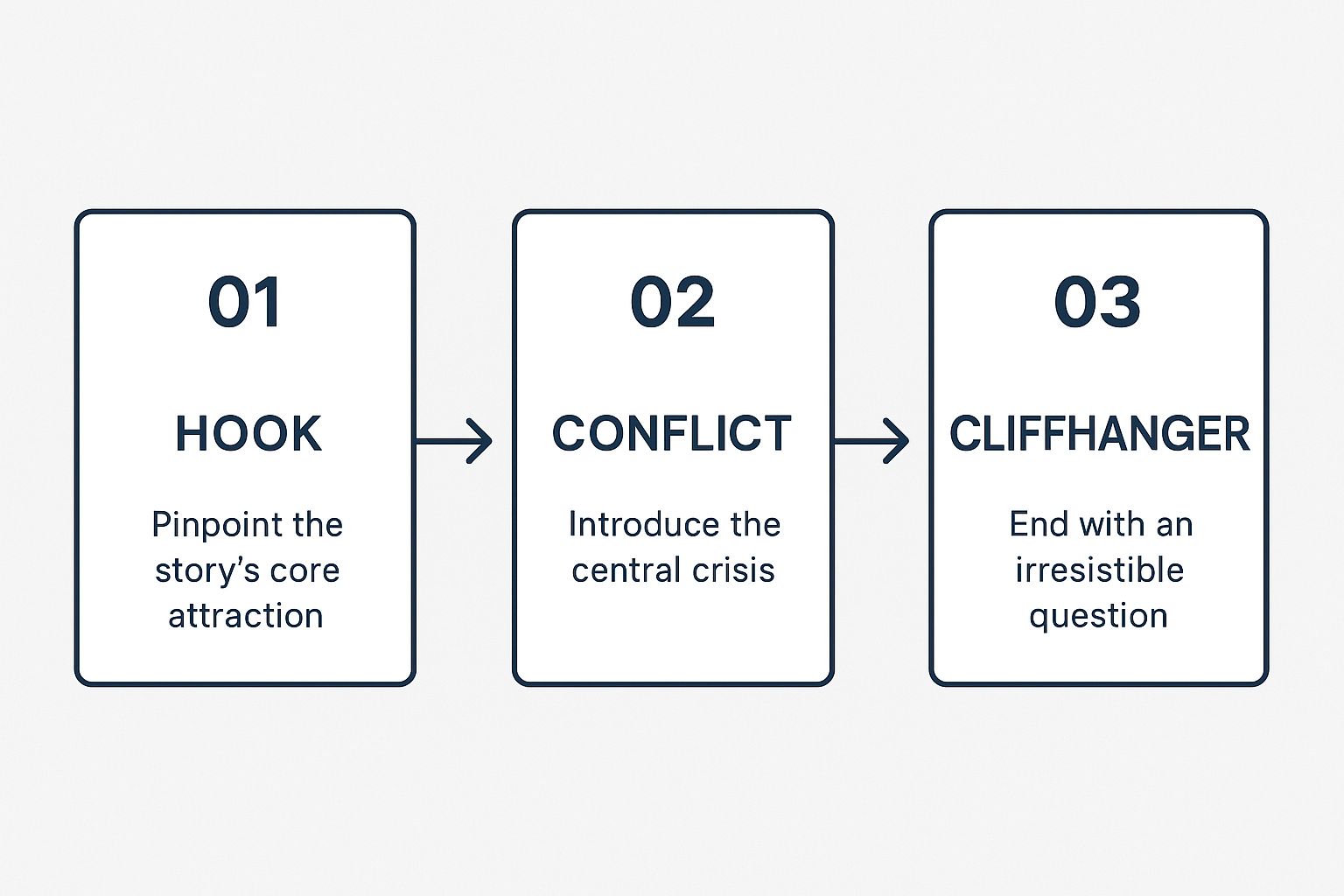
Following this sequence is your roadmap to starting strong, building gut-wrenching tension, and finishing with a powerful push that gets the reader to click "buy."
End with a Killer Cliffhanger
And now for the final punch. Your blurb should never solve the problem. It has to leave the reader hanging with a question so irresistible they can't walk away. This is what turns a casual browser into an actual buyer.
You can do this with a direct question or a powerful statement that hints at a terrible choice or an impossible situation. Your goal is to create a mental itch that only reading the book can scratch. Think of it as the final, tantalizing taste that makes them desperate for the whole meal.
Here are a few ways you can frame that final line:
- The Impossible Choice: "Now she must choose between saving her family and saving the world."
- The Dire Consequence: "But a deal with a demon always comes with a price, and the bill is about to come due."
- The Unsettling Question: "What if the monster she’s been hunting is the only one who can save her?"
Each of these examples slams the door on an easy answer, forcing the reader to open your book to find out what happens next.
Polishing Your Blurb Until It Shines
Getting that first draft down is a massive win, but it’s just the starting block. The real magic in writing a book blurb happens during revision. This is where you take that raw block of clay and sculpt it into something sharp, compelling, and impossible for a reader to ignore.
Think of this stage as a super-focused edit, almost like you’re doing line editing on just a few paragraphs. Every single word is prime real estate and has to fight for its spot. Your goal is to be ruthless—cut every ounce of fat until only the most powerful, high-impact language is left.
This isn’t just about catching typos. It’s about sales psychology. You're honing the hook, raising the stakes, and making that final cliffhanger an absolute gut-punch.
Read It Out Loud
If there's one editing trick I swear by, it's this. Your eyes are masters of deception; they’ll glide right over awkward phrasing and clunky sentences. Your ears, on the other hand, are brutally honest.
Reading your blurb aloud forces you to slow down and actually hear the rhythm and flow.
Listen for a few key things:
- Awkward Pauses: Where do you find yourself stumbling or tripping over the words? Those are your red flags for sentences that are too complex or just plain clumsy.
- Word Repetition: Are you leaning on the same adjective or verb? You might not see it, but you'll definitely hear it.
- The Final Punch: Does the last line land with a satisfying thump or a disappointing fizzle? Hearing it is the only way to know for sure.
Honestly, this simple step can instantly show you where your blurb feels weak. If it doesn’t sound exciting when you say it, it has zero chance of feeling exciting to a potential reader.
Hunt Down Weak Verbs and Useless Fluff
You have a tiny amount of space, so every word has to pull its weight. Weak verbs and passive voice are the sworn enemies of a powerful blurb. They kill momentum and eat up precious character counts.
It’s time to go on a search-and-destroy mission.
Swap out those bland, boring words for active verbs that paint a picture and create a sense of forward motion.
-
Instead of: "She was in danger."
-
Try: "Danger stalked her every move."
-
Instead of: "He had to make a choice."
-
Try: "He faced an impossible choice."
-
Instead of: "The city was going to be destroyed."
-
Try: "The city hurtled toward destruction."
Pro Tip: Do a specific search for adverbs (those pesky "-ly" words) and filler like "just," "really," "very," and "that." In 90% of cases, you can just delete them. The sentence will instantly become stronger, often by forcing you to pick a more powerful verb.
Get Feedback from the Right People
Let's face it: you’re way too close to your own story to be objective. Once you’ve polished the blurb as much as you can on your own, it’s time to bring in fresh eyes. But not just any eyes.
Choose a small group of trusted beta readers—people who actually read and love your genre. Give them two or three slightly different versions of your blurb.
The absolute worst question you can ask is, "Do you like it?" It's useless. Instead, get specific.
Ask targeted questions like these:
- "Which version makes you want to read the book most, and why?"
- "Tell me the exact sentence where you got hooked. Or where you got bored."
- "Based only on this, what do you think this book is about?"
- "What kind of reader do you think would be all over this book?"
Their answers are pure gold. They’ll tell you if your message is landing with your target audience or missing the mark entirely.
To help you through this self-editing phase, I've put together a quick checklist. Run your blurb through these points before you even think about showing it to anyone else.
Your Blurb Revision Checklist
| Revision Check | What to Look For | Actionable Tip |
|---|---|---|
| Hook Potency | Does the first sentence immediately grab attention and raise a question or create intrigue? | Rewrite the opener three different ways. Which one is the most dramatic? Go with that. |
| Active Voice | Are your sentences driven by strong, active verbs, or do they feel passive and weak? | Use a search function to find instances of "was," "is," "are," and "were." Can you replace them with a more dynamic verb? |
| Clarity | Is the core conflict and what's at stake for the protagonist crystal clear? | Ask a friend to read it and repeat back the plot in their own words. Does it match your intention? |
| Genre Tone | Does the language and tone match the expectations of your genre (e.g., fast-paced for a thriller, romantic for a romance)? | Read the blurbs of five bestsellers in your genre. Analyze their word choice and sentence structure. |
| Word Economy | Have you eliminated every single unnecessary word, adverb, and filler phrase? | Challenge yourself to cut the blurb's word count by 20% without losing the core message. |
| Cliffhanger | Does the final sentence leave the reader with a burning question they need to have answered? | Ensure the ending poses a dilemma or a choice, not just a statement. Make them desperate to know "what happens next?" |
This process of refining your blurb is closely related to the art of sentence-level writing. If you want to get even better at making every word count, understanding the principles of what is line editing can give you a huge advantage.
Taking the time to put your blurb through this rigorous process is the final step that turns a good description into a powerful sales tool. It's what makes a reader stop scrolling and click "Buy Now."
Optimizing Your Blurb for Amazon and Online Retailers
When you're selling books online, your blurb has two jobs. It needs to hook a human reader, of course, but it also has to speak the language of search algorithms. A blurb that never shows up in a reader's search is basically invisible. This is where the art of storytelling slams right into the science of digital marketing.
Think about how people find books on Amazon or Kobo. They don't just wander around aimlessly. They search. They type in things like "slow-burn fantasy romance" or "spy thriller set in Cold War Berlin." Those phrases are your keywords, and working them into your blurb is absolutely critical if you want your book to be found.
The digital marketplace has completely changed the blurb game. As ebook and audiobook sales exploded between 2010 and 2025, online attention spans got shorter and shorter. At the same time, the boom in self-publishing—which now makes up around 30-34% of all ebook sales—made things even more competitive. Suddenly, SEO became a survival skill for authors.
Master the “Read More” Click
On Amazon, only the first few lines of your blurb are visible before a potential reader has to click "read more." This makes your opening sentence, without a doubt, the most important part of your entire description. It's your whole pitch, squeezed into one irresistible hook.
Let's look at the difference.
- Weak Opening: This story follows the journey of a young woman named Elara.
- Strong Opening: Elara was the last dragon rider in a world that had forgotten dragons even existed.
The strong opening nails it. It immediately signals the genre, raises the stakes, and presents a unique character. It also gives both the reader and the algorithm juicy keywords like "dragon rider." Getting this first impression right is a huge part of learning how to promote your book on Amazon.
Formatting for Skimmability
Let's be honest: online readers skim, they don't read. A huge block of text is an immediate nope. You have to use formatting to make your blurb look inviting and easy to scan on a screen.
Think of your blurb as a series of signposts, not a novel. Each formatted element should guide the reader's eye to the most compelling information, making it effortless for them to grasp the core conflict and hook.
Here are a few simple but powerful tricks I always recommend:
- Short Paragraphs: Break your text into one or two-sentence paragraphs. The white space makes it feel less like a chore to read.
- Strategic Bolding: Use bold text for key phrases, genre keywords, or a really killer quote. It draws the eye right where you want it to go.
- Bullet Points: If you're writing non-fiction or describing a series, bullet points are your best friend. They're perfect for laying out key features in a clean, digestible way.
Once you’ve polished your blurb, figuring out the nuts and bolts of how to publish your book on Amazon is the logical next step. By tuning your blurb for both search algorithms and human psychology, you're giving your book the best possible shot at being discovered.
Answering Your Toughest Blurb Questions
Even after you’ve drafted and redrafted, some tricky questions always seem to surface. I've heard them all from authors over the years. Let's clear up some of the most common points of confusion so you can get your blurb polished and ready for readers.
What’s the Perfect Word Count for a Blurb?
There's no single, perfect number, but years of experience show the sweet spot is between 100 and 200 words. This gives you just enough space to set the scene, introduce the core conflict, and hint at the stakes without bogging the reader down.
Keep in mind how people shop online. On sites like Amazon, a reader only sees the first few lines before they have to click "read more." Those opening 20-30 words have to do some seriously heavy lifting. If your blurb spills over 200 words, you're asking for a lot of a potential reader's time and attention—a risk you don't want to take.
Should I Ever Spoil the Plot?
Never. Not even a little bit. Your blurb is the movie trailer, not the movie review. Its only job is to intrigue and create questions, not give away the answers.
You need to introduce the world, present the central problem, and make the reader need to know what happens next. Hint at the devastating consequences if the hero fails, and end on a note of suspense. The big reveals, the shocking twists—those belong inside the book, waiting to be discovered.
A blurb promises an experience. Spoilers break that promise by delivering the conclusion upfront, robbing the reader of the joy of discovery. Protect your plot twists at all costs.
Is It a Good Idea to Hire a Professional?
Honestly, it can be a game-changer. As the author, you're so immersed in your 80,000-word world that it’s incredibly difficult to step back and see it from a stranger's perspective. What you think is the most important plot point might not be the most compelling hook for a new reader.
A professional blurb writer brings that crucial outside perspective. They are experts at crafting persuasive, punchy copy that is designed to sell. If you’re pulling your hair out trying to shrink your epic story into 150 words, hiring someone with proven experience in your genre is often a fantastic investment.
Can I Put a Testimonial in My Blurb?
Absolutely! If you've got a great one, you should flaunt it. A short, powerful quote from a respected author, a major publication, or a popular book blogger is pure gold.
Try placing it right at the very top of your blurb. It acts as instant social proof and builds immediate trust with the reader. A killer testimonial can often be more persuasive than anything you could write yourself. If you don't have one yet, don't sweat it—just focus on making your hook completely irresistible on its own.
At BarkerBooks, we know that a killer blurb is just one step on the road to a successful launch. Our team is here to guide authors through the entire journey, from professional editing and cover design to global distribution and marketing. If you’re ready to see your manuscript become a professionally published book, we’re ready to help. Discover how we've helped over 7,500 authors connect with readers at https://barkerbooks.com.